Leveraging Data Insights For Smarter Business Decision Making with Jim Cook and Winnie Aoieong
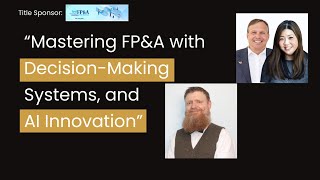
This is a YouTube video titled "Leveraging Data Insights For Smarter Business Decision Making with Jim Cook and Winnie Aoieong" published in May 2024. It features a podcast-style conversation hosted by Paul Barnhurst with guests Jim Cook and Winnie Liang, both experienced finance professionals with backgrounds at Mozilla and other tech companies. The discussion centers on financial planning and analysis (FP&A), focusing on scaling finance teams, building decision-making systems, leadership evolution, and the importance of trust and communication in business partnerships. The content is an in-depth interview exploring practical insights and lessons learned in FP&A and finance leadership within growing technology companies.
What does great FP&A look like?
Great FP&A is really the balance of technical skills and translate that into actionable plans through communications with the business.
It's not just about the data, it's about the insights and about partnering. And now it's about. I like to push the FP and A teams to create decision making systems.
Progress over perfection. There's never perfection in any business. Nothing is binary. There's not one person. You only do one thing. You've got to figure out what is the right balance for your company, for your business business to find that tagging so that you can use all these amazing systems and technologies to solve those problems.
Tagging the transaction at the customer level, at the more and following that transaction through the business in order to create the modern day general ledger is the new way of doing things. When you start tagging transactions, it's Easy to add 5 tags, 10 tags, 20 tags. You now have to be a finance person that says what do we not need to tag? Do we really need that tag? Why are we tagging it? What are we solving for before you actually tag it? Once you get a new product going or a new department or a new set of departments going, you need to.
The third generation FP&A tools showcase is this week's title sponsor of FPA Tomorrow. Join the showcase and see the latest technology in FPA planning software. Hello everyone. Welcome to FP&A tomorrow where we delve into the world of financial planning and analysis. I am your host, Paul Barnhurst and I will be guiding you through the evolving landscape of FP&A. Each week we are joined by thought leaders, industry experts and practitioners who share their insights and experiences, helping us navigate today's complexities and tomorrow's uncertainties. Whether you're a seasoned FPA professional or just starting your journey, this show has something for everyone. I'm thrilled to welcome our guests to the show this week. Jim, Winnie, welcome to the show.
Thanks Paul.
Thank you, Paul.
Really excited to have both of you. So let me just give a little bit of information of our guests. They're both coming to us from the Bay Area. Winnie is the VP of Business Finance at PowerSchool and she spent 10 years working with Jim at Mozilla. Jim is currently working as helping companies scale leadership and operations as a consultant, but previously he was CFO of Mozilla. Also worked at Netflix and Intuit, among other companies. So we're really excited to have both of them with us. So this is a question we like to start every show off with. And Winnie, we're going to ask this question to you. In your opinion, kind of in your view, what does great FP&A look like? What is great FP&A?
Great FP&A? Good question. So I always think that great FP and A is really the balance of technical skills and translate that into actionable plans through communications with the business. It really hasn't changed all that much what great FP&A looks like from when I where I started actually when Jim started pushing me. It's really about merging those skills where you need to do jobs. But how do you tell that story? How do you get the business to understand and make it actionable to achieve those goals? So that's where I think how great FPA looks like in the past and looks like today.
Great. Appreciate that Jim, anything you'd add to that?
Yeah, my answer has changed over time. I mean in the early days it was it's not just about the data, it's about the insights and about partnering. And now it's about I like to push the FPA teams that I either coach or advise to be to create decision making systems. So ultimately what they're trying to do is partner with their department business unit and create really excellent decision making systems because that's what our data is eventually doing.
I like that. Decision making systems. So is that where you see FP and A going in the future is much more of that decision making systems thinking in FP and A or what's your thoughts kind of for the future of FP&A? Jim?
Winnie, you want to take that or do you want me to take that multiple bullet?
Yeah, you go ahead.
Okay, so I do see it going there because you know we, we were at once upon a time that P and A was kind of this backroom department. Right. And we were only supposed to produce the numbers and then hand them off to somebody. And then along the way we were asked to be more strategic and then along and then we kind of learned how to do that but didn't learn. We're asked to be to communicate better. But I think on the in order to be strategic strategy is all about making decisions. So if our data is all about making decisions and we're asked to be more strategic, then we have to actually set up the systems to actually make create great decisions.
Makes sense. Winnie, your thoughts on that?
I do agree with Jim and I think about like the way that I partner with the business. Like you know what some people actually said, what's business finance like how is that different than FP and A? It is really that business partnership and in order to have a good business partnership, you are leveraging those decision making systems. Those decision systems come with a set of things that you need to do either through predictive modeling or like, you know, the things that are really hot, like the generative AI. How do you take these different approaches and package it in the system that makes sense for the business? Not everyone speaks the finance language, but in order to for them to make those decisions, really tackle them into those brass tags, translate into the system that they understand and they can mobilize and execute.
I love that you mentioned. Go ahead, Jim.
It's interesting, Paul, because I know you and I may have talked a year ago in the podcast, but about being a systems thinker, but Winnie and I have certainly talked in the past and this is probably going to be a thread about being a systems thinker, but I didn't really put two and two together until a few years ago that, you know, it ultimately results in these creating decisions from the systems you build.
I really like that. And I like that you mentioned systems. And one thing I really like that you said, Winnie, is that translation process, right? Because if finance doesn't translate what they're doing into business language, you just get this look of like, what are you talking about? Like if you're in a meeting and all you're discussing is accounting and accounting terminology, they're all just going to look at you like, you're wasting my time. Why am I here? So that translation is just so critical. And I've seen it when people don't have it can be a really painful meeting with the business. Why don't we go ahead and have each of you tell us a little bit about yourself and then we'll jump some more into the interview. I really want to dig deep to the experience you two had at Mozilla of growing that company, how you thought about scaling fpa, how you both went through that working together as CFO and you know, FP and A. But before we do that, why don't we give you an opportunity to just tell the audience a little bit more about yourself and we'll start with you, Winnie.
Great. So as you know, I am Winnie Liang. Currently I'm a VP of Business Finance at Powell. I have been with Household for the last three years and before that I had the opportunity to work with Jim for the last 10 years. My background really has always been either in accounting and FP&A.1 thing that I quickly knew in my career is that I love the analytical part, the forward future looking piece, the business partnership rather than the back corner crunching numbers, counting beans if you will. I have dabbled into different industries including entertainment, telecommunications, digital marketing, but where my heart and soul is in technology. Mozilla is an open source company that really focuses on technologies on a different end. But right now at house school is all about education, technology and I love this space because education is just meant to be disrupted in such an archaic past. One thing that you can stay positive out of COVID is the accelerated that put a light into that industry that needs to be accelerated to be disrupted. So I'm really excited to be where I am today and continue working for a mission driven company.
All right, Jim, why don't you give us an introduction about yourself, tell us a little bit about yourself and your background.
So I think the best way to describe my background looking back over since I've been in the Silicon Valley since early 90s, is I've been at the early stages of several companies just helping to build their finance and operations. Looking back, I never sought out to become a cfo, but everybody said you need to be the cfo. And so I've, I've elevated to be CFO eventually of many of these companies. But I don't think I think of myself more as a builder, an operator, a leader and I just happen to do finance. So that's how I think about myself. Been at companies like Intuit in the early 90s, Netflix, helped start Netflix in the late 90s, joined Mozilla in the mid 2000s, hired Winnie around 2010, 2011. Probably my best hire in my life and that's why I'm glad to be on this podcast with her.
So it's always good when you, when you hire the right person. It makes a world of difference when you get that one you never want to let go, let go of.
It's great, 100% good deal on that.
So what were you looking for when you made that first hire? You know, you hired Winnie as one of your first ones there at Mozilla, as you were trying to make that decision, bring in that first finance hire. What was that process like?
First and foremost? I wanted a partner. I was doing most of that, almost all of it. I was doing all of it by myself. Mozilla was still very young. I wanted a partner, I wanted a thought leader. I wanted someone who was hands on, who think, who thought in systems because we had a lot of things to build and I just needed an all around business athlete. And so after a dozen or so interviews, when I stumbled on Winnie, I was like, ding, ding, ding, you're the one. She didn't join me for three months though, so she almost said no. But anyway.
So I'm curious, Winnie, what made you interested in Mozilla to work for a startup environment in the Silicon Valley? What was it that made it so attractive to you, that made you choose to join the company?
You know, I think Jim actually caught a lot of things that I was just nodding my head along. I really wanted to join a company that is in that hockey stick growth space, has a lot of opportunity to build things, build systems, build process. So when Jim and I talked about, actually the first question he asked was like, what do you want to do? And items like, I want to grow with the company, I want to build systems that can grow. I wanted to have a seat at the table working with the leadership part and solving problems. It's like, sounds fantastic. Like, what, what are these things that you want to do? So we went on like a two hour conversation. He just, sounds great. When can you start? I was totally taken back by that. So I would say, you know, coming back is really the opportunity to build these systems and the processes that grow with the company. And that's what really attracted me at.
Brazila, that opportunity to build, grow, scale a company. So talking about scaling a company, we'll start with you, Jim. How did you think about scaling this company? I mean, I'm sure you saw the rapid growth that was going on and knew over time the plan was to hire a lot more people. And so today's processes weren't necessarily going to be tomorrow's right. You had to modify and change. So how are you thinking about that as you were in the CFO role?
Well, the good news is I was classically trained from my Intuit and my Netflix days to always think about the customer first. So I always thought about the business as the customer and what did the customer need at the specific time and why. Combined with what you just said, which is I just fundamentally believed in my core that you have to always be thinking at least 18 months ahead and then build to that future. And I could see anybody who was at Mozilla at the time could see the growth that Mozilla was experiencing and what the systems we had. When, when I walked in the door, there were 18 employees and a bunch of community members. When Winnie walked in the door, we were 150 employees maybe, but we know we, we knew we were going to 300, 400, 500, you know, probably a thousand. And the system there weren't, you know, we just had to build those systems. And we know it takes, you know, it takes three, six, nine months to get systems up and running. At least back then. It's faster now. And so if you went ahead of the curve, you were drowning.
Yeah, systems could take a long time. I was like three months. What systems were you implementing in three months? I'm impressed.
I can name a few.
I'm sure you can. I'm sure you could name a few that were a lot longer than three months.
Too true.
Most.
Most. Most.
Yeah, exactly. That's what I was getting at. There we go. All right. You, you had mentioned when we chatted about this, I know we've emailed back and forth. One thing you guys mentioned is how the leadership had to change at 600 and 1200. You had to make some, I'm sure, some hard decisions and make some real changes. So I'm going to go to you first, Winnie, and as you saw those changes coming, how did you manage that from your perspective, you know, the CFO and seeing leadership changes happen within the organization, how did you manage that and how did you manage that with your team?
Yeah, so I'll break it down into two parts. So, you know, when we talk about leadership, leadership does change over time. The leaders themselves are also maturing with the business at the time at Mozilla, they be all of them. They went from operators to hands on managers to become, you know, the senior leaderships and sometimes even the executive leaderships. So you really have to meet them where they were truncating the information, the insights into a bite size that along with the North Star or the initiatives that we're doing. So that's like one way that you're going to have to tailor the different delivery with the audience that you have. But the other part is if I'm a VP of engineering, my focus is focusing on delivering code on my product releases. All the things about operations is secondary to them. So you know, as an operator like Jim and myself, I had to think about how do we do this necessary legal reviews or purchasing review and just get these things moving so the business doesn't have to worry about that. So the second pillar was really about how do we put together operation procedures, processes, systems that enable us to do that. So you know, you talk about like those three, six, nine months of system implementation. Two of the very initiatives that Jim and I tacked on once I started at Mozilla was those Three way hacky open source ticket system that do all these reviews so that we know the business. Like, oh, do I need a privacy reviews? Do I need a data reviews? Do I need a legal contract review? Do we need a financial review? That all happens simultaneously so people know exactly where things are. The second thing is how do we scale financial systems? We went from a multi tab Excel spreadsheets into our first implementations of Adaptive Insights. So how do we do the system and be able to turn down our monthly reporting, our dashboard into the business so that they understand financially where things are? Those are how. Those are the things that we had to do to scale with the leadership changes, but also evolving over time with the business.
I like that and I definitely see, yes, you definitely have to evolve. Question for you around this, Jim. How did you think of the evolution process? First from people you mentioned you had to make some big changes to leadership as you scaled. Some people are great for a startup and they may not be, the role may not be the same for them at 600 or 1200. So talk a little bit about the people and then talk about how you thought about the systems and scaling them. Because I know that's a real challenge for finance departments is trying to scale and manage that budget when you're growing and you want to spend every dollar you can investing in the business.
Yeah, there's a lot of questions there about take the people first.
There is. Sorry, I should have broke those up but I threw it all at you at once.
No, it's fine, it's fine. I got them. They're all up here, Paul, don't worry. But from a people first standpoint, Winnie touched on it and we say this all the time, but the people that get you to a certain milestone aren't necessarily the people who need to get you to the next milestone. So as a one product, all focus Firefox company, we needed a set of people who were just insanely community driven, customer driven, really understood the browser. But then as companies, as we grew, we started really experimenting with other products and all of a sudden we had, you know, experiments with identity or with Firefox os. And each of these experiments became smaller companies within the larger Mozilla brand. And so I think that's the intersection of, okay, when you're creating a small company inside of a large, you need to go back to creating, to getting those entrepreneurs. But then when one of those products becomes very successful, then you need to treat it almost like a division. And a divisional manager is different than a department manager. They have to be many CEOs of their area. And we got to a point and we'll probably get into this at Mozilla where we had several, you know, several GMs if you will, of various areas because they operated so independently of each other but underneath the Mozilla umbrella. So that's how I think about the people. It's like what kind of person do you need to run Firefox os, the mobile phone system? What kind of person do you need to run a five person lab? Those are different people. And then how the finance people support that is they have to understand this as well. They have to. I think most people believe small teams win. So support small teams with, with the minimum finance. But also you have to influence everyone around the table, small, large division owners, GMs of the entire budget, of the entire set of resources that it's not unlimited. And this is why you can't have everything you ask for because it's part of a larger set of resources that we're all operating under. This is the trick. It's how to say you only, you know, to the five person lab, why can't I get five more people? Right? Because engineering just hired 105 is nothing. To the 100 person engineering team you say, well we only can really, you know, give you 10 people because you don't really need that many. We need to give them other, other people.
So one thing I want to come back to what you said Jim, that I really appreciate is that, you know, understanding the financial envelope that people need to manage and influence that decision. I think the other trick is understanding the trade offs. If you want to do certain things, what are you giving up? It is not just about the financial envelope, it's about focusing on the initiatives. There are always things that we're going to add to the play that we want to do as the business. As a gm, we don't want to be master of none. We want to just focus three to five initiatives and be really good and execute on that. So the other part is how are you doing that? By are we just adding more fire to the problem or are we adding other initiatives? Because you remember at Mozilla we're very hands on that as the company, we always want to do the next shiny new thing and so how to balance all the initiatives and execute against them. That's the trade off things that we always talked about with the business.
FP and a guy here. I want to personally invite you to the upcoming third generation FP and a tools showcase. It is A virtual event you don't want to miss. On May 30, join FP&A Professionals and industry leaders as we delve into the latest innovations transforming financial planning, discover cutting edge solutions from top providers and learn through through in depth sessions including company overviews, product demos and customer success stories. As a CFO or FP and a professional, this showcase is tailored for you. You'll be able to get insights from experts such as Glenn Hopper, Water Born and myself. Spaces are limited so go on over to my LinkedIn page and learn more in the featured section or check out the show notes for the link. To register for this event, you will not want to miss the third generation FP&A tools showcase. See you there.
Well, I'll add one more thing to that, Paul, because I love Winnie's answers as well. If I look back, we were growing it department by department. Why were we standing up this new department and what data and insights and decisions did that department need? But as Winnie and I both experienced, I think what many FP&A people experience is once you get a new product going or a new department or a new set of departments going, you need to constantly be redoing your chart of accounts because we need different answers, we need the data sorted in different ways. And so there's this trade off, not trade off, but there's this constant build of we need more accounts because we don't have the system financial chart of accounts to report in the way we need to to create the decisions that we need to sort of. You're constantly diving really deep into chart of accounts all the way up to what are we trying to do and why at the GM level. And we're trying to play the bridge and the intersection between accounting and decisions at the corporate level.
Sure. You're looking at the big picture and saying we need to understand this now. Things have changed and you gotta be able to translate that down to the level that somebody can take that and change the chart of accounts so that you can make the decisions you need to make based on how the business is today instead of how it was yesterday or three months ago or six months ago.
And Winnie was. Winnie was perfect at that. She had her hands. She mentioned many systems, a couple of which she custom built Shout out to Deli Tamer if he's out here. You know, just a little plug for Biz Terra. But. But she created one of the most amazing ticketing systems ever, but can get into that later.
You know Winnie, it sounds like you got to do a lot of Chart of accounts work. Any advice for companies as they're scaling just to be think how to think about chart of accounts. I feel like that's an area that almost every company struggles with at some point. Right. Getting the chart of accounts right, so to speak. If there really even is a right, if you know what I mean.
No, I do know what you mean. I think it's a balancing act. Right Paul, we can't solve everything in the chart of account because otherwise none of the systems, even the best systems in the world is going to crumble with this many accounts to manage. I think the way that we have done it at Mozilla or at my current space is what other data field dimensions that we can leverage. Oftentimes we're thinking about product tagging, what product line or what line of business that's not the chart of account. Right. Is the department or is that a geolocations tag like I would say? And then those will be, you know. So I think I'm answering your question slightly differently. So it's not just the chart of account but like, you know, other things that tie to the business metrics that we can leverage on. And oftentimes, you know, in companies they want to tie, you know, the customer data or like the business data into the financial data. So what is the common thread that you can pull these things from each of the, in the native systems and leverage, you know, your big data to get to those insights that you need. So I think we have gone past the day where let's solve everything on our ledgers, on our chart of account. But really, you know, the SaaS industry is like, you know, over whatever billions it is, you are good at the things that you're good at. Let's leverage the best of the best in the system that you can offer. Either chart of accounts, either it's your department, your geolocations, but all the things that you can find that common thread that tie them together. That's what I would advise the business to leverage today.
It's a great point. Tagging the transaction at the customer level and following that transaction through the business in order to create the modern day general ledger is the new way of doing things. Tagging at the most basic activity level versus starting with the general ledger and pushing it out and saying you must adhere to these rules. You know, the latter is the old way and the former is what AI is really going to help with. And just tagging this concept of tagging.
I agree, we're really seeing that. And recently I had Opportunity to talk to somebody who's creating an AI based general ledger. Erp, you know, it's a new company that's really growing fast. We're talking to the CEO and talked about those things, kind of the tagging and some stuff we're talking about here. And it really is about, hey, how can we make this all flow and understand the customer all the way through and not starting today with the general ledger, but realizing the general ledger is something that needs to be able to help with that entire process versus starting there and trying to force everything to align to that.
But therein lies the problem. Paul and Winnie's closer to this than I am at this point is when you start tagging transactions, it's Easy to add 5 tags, 10 tags, 20 tags. You now have to be a finance person that says, what do you know, what do we not need to tag? Do we really need that tag? Why are we tagging? What are we solving for before you actually tag it? It's so easy to create noise. The human beings create noise out of data. And so we had this big data noise problem. There was no signal. How do we keep the signal going in finance without creating noise? That's not needed.
Could, couldn't agree more.
Yes. I mean it's something that we, we tackle every day. And also nothing is binary. There's not one person only do one thing. So you can't just say I only work on this 100 of the time. No company, no employees do that. Right. So it's finding again, finding the right balance what to tag. How do you use 80, 20 rule? They use 70, 30% rule. You got to figure out what is the right balance for your company, for your business to find that tagging so that you can use all this amazing systems and technologies to solve those problems.
Yeah, I think that's a great point. And that's where the judgment and having people that had experience and are able to think through those type of things, look at it and say, hey look, this would be great to have, but it's really not critical to what we're doing. These other three are, let's just start with these, let's do our analysis so we can always come back and reevaluate this. But generally less is more. And you know when you hear KPIs, it's not 50. You see that where people want everything to be a KPI and it's like you're going to get yourself in trouble. If that's the case. Yes, you could track everything, but you got to Realize some things are going to conflict. And at some point you got to really go back to what's your strategy, what's important to inform that strategy and make sure you tag that and then go from there. At least that's kind of my thinking. Jim, any thoughts to that?
Well, well, look, I mean, for the, for the younger listeners here, FP and a. What Paul just described, what Winnie just described, what I'm describing is based on years of experience of learning the painful lessons of saying yes to every person that wants you to tag something. And so we. None of the three of us actually did what we are talking to you about today. We actually said yes to every single tag, built these systems that didn't actually scale, and then had to learn to influence others about why they actually didn't need those tags, how we could go faster. So we just compressed for you like 20 years of experience into don't be a yes person and ask questions of do we really need it up front. Front. I can't repeat that any, any louder here.
You know, it's funny. J. I'll tell one story and then I have another question. We'll move on to. So I had a boss who said to me one time, and I didn't understand at the time, he goes, you're really, really good at your job. The only problem is, he goes, you're not hard enough on the business. And what he meant by that is the saying no and pushing back and challenging and really making sure that thing needed to be done. And it took me quite a while to realize it because the way he said it, because he could be very abrupt and often came across as a jerk. And I'm so that's how I took it. Like I need to be more. Oh. And then I realized what he's really saying is, look, you just need to say no sometimes you need to be more forthcoming and just own the situation when it requires it. And it was a really good learning lesson. It took me a long time to realize that because, yes, I was the yes man. We've all been there. And then you get done and you're like, why did I ever agree to that? I want to move on from the systems and talk a little bit more about relationships and something you mentioned, Jim, you talked about how important it was to create a safe space for Winnie to be curious, explore innovations in her job and a safe space for the team. Can you talk about what you meant by that? What. What defines a safe space and why is that so important?
I learned pretty well first and Foremost, Mozilla's DNA and culture was very much of an innovation culture. And so I think it was kind of a safe place to begin with. We were not a public company, we didn't have investors or VCs, so that's, it's important to put a pin in that. But with that, there were a lot of people competing for, we want finance to do this and finance to do that. And we had to carve out our own leadership style and Winnie had to carve out her own leadership style. What I learned early on and what we were doing as a department, Winnie and I partnering together, was to create this. It was fun to create this what I call challenge environment in which respectfully, everyone can challenge anything of what we were doing and why we were doing it. Because two things would happen. One, if you create a safe challenge environment where even the lowest level person in your department can say, I don't understand what we're doing and why we're doing it. If the leader who is making that decision can't defend why they're making it, then that's a problem and they'll probably learn something like, oh, I didn't realize that was caused my decision caused a downstream problem. So there's learning on two sides. Either from the leader saying, I didn't realize there's a downstream problem, thanks for speaking up, or the person asking the question is going to learn actually why we're doing it that way. But you have to create a safe space for them to ask the question. A lot of times they just do what the boss says. Right. They must think they're more experienced. But by creating this challenge environment of, hey, I just need to understand. So I'm going to ask a question and not judging them for that. I can't emphasize more how that creates great teams. And I think Winnie and I really live that at Mozilla of constantly asking people to challenge us. I remember being in meetings where I would say, it's too silent with my decision that has come down. Someone has to challenge me because I'm not comfortable if there's no way. I looked around all corners. Someone sitting there knows that this decision is going to create a downstream effect that's wrong. We need to talk about it. So I would actually try to pull out that challenge of people. But Winnie took that mantra and I think she built that throughout the rest of the, you know, I took my hands off the wheel for a long time and she just drove it from there.
So I have a question for you that on Winnie, but I have one follow up for Jim. How do you let go? Because I know a lot of people when they get challenged, become defensive. Right. We've all seen it, we've all been in those conversations where you challenge a situation and become defensive. So how do you keep that balance of making sure it really is a safe environment? The people guard doesn't go up when they get challenged.
It's it. You have to emphasize and lead as a, you have to model as a leader that when I challenge you as the CFO or you challenge me from your seat, I want you to challenge the assumptions. I don't want you to challenge my dis, I don't want to challenge me personally. If it gets personal, I'll shut it off.
Sure.
Challenge the assumptions, challenge the principles, but don't challenge the person too many times. We, you know, especially in the U.S. we're, we're, we're challenging people because we're trying to one up people. No, we're challenging the assumptions. So you just have to remind people a lot that that's what we're doing.
I like that. And so Winnie, how did you take what Jim did there and kind of filter that among your team? Why don't we start there? How did you make sure that, you know, the finance, the FPA team was working in an environment that they felt safe to challenge things?
Things.
Well, I think the first thing is that when you have an executive like Jim that who is personally modeling that it speaks volume, right? So once you have that infrastructure or that safety net that you can say, hey look, Jim as a CFO is doing that like we have all, you know, the air coverage to do the same thing. So I think that already built in a lot of, you know, the fundamentals for us to do that. But what I always say is that, you know, I told the team in my years of experience really two meta themes. One, I'm always the least smartest person in the room. Y' all like the reason why you guys are here because we hire smarter people than ourselves. And I value the feedback, I value the opinions and I want to bring them to the table to discuss as a team because collaboration is super key to me is how I lead my team. And I want people to either in a group setting or in my one on one to share those things with me. The second thing is progress over perfection. There's never perfection in any business because you can't the business always going to evolve and improve. So perfection is just a North Star you can get to. But really it's the progress over time, how we do like what are the things that we're measuring ourselves against that we have better than last month or last quarter, what are we doing with the business that they see the value? So it's really, you know, taking those two things into the team as our guiding principles to how to operate as a team. And I think they really take that on and come up with a lot of great ideas in the system that we talk about, the processes we talk about. A lot of them is integrating their ideas into it that made it better.
I'll just follow up to that really quickly because this is what Winnie and I really share this concept of perfection and I've talked about before that perfection is a prison. But perfection is very limiting because it doesn't actually allow you to continuously improve and the only successful teams companies, products are constantly improving it. If you ever actually think you've achieved perfect, you're not asking hard enough to improve. And the second follow up is and I love what Winnie said about I'm not the smartest person in the room. I heard a great quote once and that the smartest person in the room is the room. And if we can all remember that crowds always win. Crowdsourcing, the community always win. Like lots of brains on it, always have a better idea than one brain. The smartest person in the room is the room. But that only happens if people speak up and they are comfortable speaking up in a safe environment and most people aren't, especially early in their career. You have to pull it out of them. You as a leader have to pull out the ideas out of people and make it safe for them to speak up.
FP and a guy here today I want to talk to you about future finance. Future finance is the passion project of Glenn Hopper, cfo, AI expert and all around good guy and Paul Barnhurst. We're starting a podcast together. Why? Because we want to talk about technology, AI, where finance is going, what the future of finance looks like. So join us on your podcast platform of choice. Check us out on Apple, Spotify and others. We look forward to you joining us for this new show. I agree there's definitely times when I haven't felt safe over my career to speak up and I've seen others in those situations and so I really there's two things I like that you said there. I love that idea of the smartest person in the room is the room. That community, that collaboration. They've done studies that show like all of us have probably guessed how many Skittles are in a jar, Right. Or how many M&M's or whatever they might be. And they've done studies and they'll find if they take a collective 20 or 30 people, they'll be quite close to the answer. Even though most of them, about a third of them or more, will be on the extremes. Because bringing that together, you get close as a group. I think there's a lot of truth to that, that idea. Just in general, when you work as a group, you get closer to what might be the optimal answer. Rarely is there an optimal or as you would say, perfect answer. Right. Because I like how you said that perfection is a prison. It's just about always progressing and improving because there's always room to get better. That's definitely one thing I've noticed in my life, and my daughter will let me know, is I like to joke with her. I tell her I'm perfect and she goes, there's no such thing as perfect, dad. The only thing that's perfect is the girl with the name Perfect. That's what she always says. And I just kind of laugh.
Nice.
She's wise beyond her years.
There you go. So, you know, we've been going for a little while here. I want to ask a question just in the scaling the entire process. As you look back at Mozilla and what you went through over those 10 years, Wendy, what was maybe the one or two key lessons you took from that building experience at Mozilla that you use today and take forward in your career?
I learned a lot of things over my decade at Mozilla. If I have to boil down one or two things, what I come back to, and I continue to use it today and I know I'll use it in the future is really that relationship building. And everything falls apart when you don't have a trust system, when you don't have a respect system in place, whoever you partner with or work with or work for. So that is really key. And relationship really builds on trust. So trust comes from your capacity, your capabilities, but also your way to want to build that alliance with whoever you work with. And I think it's really important between a direct report and the manager, but also from business partners. When I need to work with either my chief Product officer or my chief Marketing officer or my CRO. Like these things, they understand where I'm coming from. What are the things that's important to the company, and we're here all for the betterment for the company. But there are certain things that is important to me. For example, I need to see, you know, how we're building the revenue and look at the margin, he's looking at the bookings, right. Like these things, like we're all wanting to do things, the same things, but sometimes they might be not crashing, but they could be at different end, different things. So I think it's the business partnership is one of them. I think the second thing is I'm coming back. Like I, I, I learned that, you know, from Jim that truly perfection is a prison. Like I want the team and I, I already said that earlier. It's really, you know, the progress that you make over time that is more important than trying to hold on to information, hold on to things that you cooking up in your own team that you're not sharing. So it's progress over time through active communications because nobody likes surprises. So it's about, you know, concise, actionable communications to what you're doing, what are the things that you're going to be able to do and things that gonna fall off like communicate early so that you have time to recalibrate with your team, with the business so that you can continue forward. So those will be my things that I, I will continue working with my teams and myself.
I love that, the relationship building. And you mentioned trust a couple times. So foundational. I've had a business partner, super smart guy, hardworking, but there wasn't a, there was not trust there. I had been lied to, the trust had been violated and it always impacted the relationship. Sure we were still able to work together. I got the work done. But you think our outputs were as good? You think the trust was there? Of course not. And so it definitely impacted things. So it's just so important that trust and relationship building. And then I love the, you know, the comment about just make progress, always be trying to move forward versus waiting till everything's perfect. I got to get it just right, then I'll release it. Because you'll just wait forever. Jim, what would be your kind of key takeaways from your time at Mozilla? Maybe the lessons you could share.
I have three. The first and foremost is, is Mozilla taught me about how powerful communities really are. Communities always win. I didn't really fully understand that. I understood it, but I didn't fully understand it until I understood the developer community and how powerful the developer community was. But it's beyond a developer community. Create a community around your product and people will follow that community. The second is get really, really close to the customer of your product. Now this was in my DNA from Intuit and Netflix. But get really, I mean, the closer you can get to your customer, get all the way down to the end user, the customer. And it morphed over time at Mozilla for me, that, that I realized that even as a finance person that everyone has, everyone delivers a product and therefore everyone has a customer. And therefore being the CEO of your product is something that we can all work on. That's the second key thing that we worked on a lot at the, on the finance team. And finally I learned, I learned how to lead with why there was a lot of people questioning a lot of things. I created a challenge environment. So there's a lot of questions. And if you do that, you have to lead, you have to learn how to lead with why we're doing something and you have to storytell why you're doing it. You have to storytell the data. You have to be a good communicator. I was not a great communicator when I first started at Mozilla and over the years I became better at it.
I think he's mentioned there are three takeaways. We'll see if I can sum that up. First, community wins. The power of community really hit home to you. And then the other two is you talk about the importance of storytelling and how you realize you had to be a better communicator. And the third one was. I'm trying to remember, help me with.
The close to the customer. Just be super. It's. It's customer based. Right. Everyone's a CEO of their product.
Right. We talked a lot about this last time of even as a finance person is realize the spreadsheet is not your customer. You have an actual customer that you're supporting. Those insights, those you're bringing.
Yeah, spreadsheets, not the product. That's exactly right. The spreadsheet is not the product. Right. Well, the spreadsheet may be the product, but it's not. It's not. It's not. Yeah. We'll have to go back and look at that one.
Yeah. I mean it, it's, it's, it's something you have to have, but you got to remember it's not about the spreadsheet. It's about the customer. It's about the insights. It's about the value you're bringing. The spreadsheet's just a tool, just a method you're using to bring value. All righty. So going to ask one more question here. Then we're going to move into our rapid fire and get to know you section moving toward the wrap up. So the question I want to ask Winnie, if you were to start this process over or have to do it at another company, is there something you do differently? Maybe something where you're like hey I really learned and I wouldn't do it that way again if I could do it many things. I figured there would be a few.
I will just say two things. One, park all the assumptions at the door. What I learned at Mozilla doesn't usually translate everything 100% to the next company or the other companies to be around. So second thing that ties into that what I love to do is a listening tour. Learn the business, understand what they're going through, what are the current challenges, what are the opportunities. Then I take my experience from my previous place that I can see where I can add the low hanging fruits values that I can immediately help and also build, you know the, the strategies, the new initiatives that would help execute and achieve the goals the company have. Those two things monumental because tying back to what Jim and I said earlier, I'm never the smartest person in the room. I need to learn about what people are doing here. People here are successful scaling at the company at their phase. Where you at or where you now joining? So important to know that like not everything that I have learned before would do would like you know copy and paste and just work out perfectly. So those are the two things and actually have a third thing I think is about not thinking all the things that you do for the first go is going to land perfectly. So coming back, retreating what you needed to do going back to the drawing board is perfectly fine and don't be so hard on yourself that you think the first, the first go is going to be landing exactly where you need to be and just have the self awareness and the vulnerability to share those things and get the help that people around you that can support you love it.
So sum it up we have start with a listening tour, leave the assumptions at the door. And the third one, the way I'll say it is a little different than what you said but something's always stuck to me is learn, learn from failure. And way I say that is I had somebody when I was 20, the guy was worth about half a billion dollars at this point. He's speaking to all of us and he looked at months of 19, 20 year olds. I was a missionary for my church in the Bay Area actually at the time so this was in the 90s. And he looked at, he goes, you guys know I'VE never had a failure in my life. What is this guy talking about? You know, I have 19 going on. That's a bunch of BS. And he goes, I've only had a learning experience and I love the way he framed that. That stuck with me ever since in my life is just the idea of, hey, sometimes it's not going to go the way you planned. Learn from it, improve, grow. Sometimes you have to be willing to admit, hey, I thought it was a good idea. I was totally wrong. That was a bad idea. Let's, let's try something else. Kim, what's your key? Learning or learnings.
I would, you know, if I had to do it all over again, I would just, I would just focus on the people even faster and harder and make, try to make them leaders faster. Really challenge them to step out of their own insecurities or potential imposter syndromes and just delegate and delegate and delegate. Because if you hire the right people and give them the space and the safety to succeed and require them to be the leader that they can be, great things happen. But usually that takes time and I took too much time doing that. I think over my career I would just do that a lot faster from day one.
Hey there, it's your host, the FP and a guy. And today I'm thrilled to talk to you about Plan Buddies where professionals meet excellence. This isn't just any community. It is a community ran by and for planning professionals. Application Plan Buddies were all about fostering connections, sharing knowledge and providing mentorship among FPA experts. Ready to elevate your career? Visit plan-beddies.com and become a member today. And here's a special treat. Use the promo code the FPNDaguy that is the FPNA guy for an exclusive 25% free discount on your first year membership. So it sounds like if I'm hearing you right is communication and developing leaders. You'd focus more on that if you could do it again.
Perfect.
Got it. All right, so here's how rapid fire section works. We're going to do, we're going to go with one of you and then the other. I got four questions and the idea is to kind of be as quick as you can, not to elaborate, just kind of give an answer and then after we're all done, if you want to elaborate on one, you can. So Winnie, you ready?
Let's do it.
All right. What is the number one technical skill that FP&A professionals should master?
Modeling.
Modeling. What's the number one human skill or soft skill that FP and a professional should master.
Communication.
I'm not surprised by either answer. What is the number one thing you look for when hiring an FPA professional?
Cultural fit, Energy.
Cultural fit and energy. And then the last question. Are you currently using generative AI?
Yes. Highly recommended.
How are you using it? This is where you get to elaborate a little.
There are two things that we're using. So Zoom has this great release that can take a lot of meeting notes from your Zoom meetings. Summarize that for you. We use that for all our team meetings. Now the second thing, doing our working sessions, pull all the people's ideas, send it to our Microsoft copilot where it will summarize, you know, all the action items and all the key things that people have talked about so that we can turn it into plan. Those things are way better than a human trying to take the nerves and not paying attention or trying to correlate 60, 100 people's thoughts into something really super quick. Highly recommend it.
I, I agree. It's amazing how well it can do with summarizing things, taking notes, all those type of things. That's a great, great way to use it. You ready, Jim?
Yep.
All right, so what, what is the number one technical skill that FPA professionals should master?
Be a forensic expert of systems. Understand the technical data structures down at the lowest levels.
You and I could have a lot just a show on that one alone. But I, I, I hear you. I haven't heard it put that way and I really like that one. What's the soft skill? Number one?
Storytelling your data.
All right, so what's what, what do you look for first when you're hiring someone? What's that number one thing you're looking for in FP and a.
An all around business athlete.
I like that.
An all around hands on. A hands on all around business athlete.
And how about you with generative AI? Anyways, you're using that today.
Yeah, a lot of my client meetings and other recordings like this, I'm trying to parse out the best. Not an FPA per se, but I think it's a great way of doing 80% of most work, whether you're writing, whether you're recording something, whether you're summarizing something, lean on it. Because it will do the first 80%. It doesn't do the last 20% well at all, but it will save you a ton of time if you just ask AI to what do they think about how to structure this or write this or summarize this for me?
Oh, I've asked it to give outlines for courses. I'll ask two different tools. We'll combine those together, start adding our own thinking. And it saved me two hours of trying to come up with all that myself because now it's giving me a framework. Can kind of jump start the thing.
Totally. Yeah. Don't be afraid of it. I guess is. Is. Is the message. Use it.
I am with you. 100. Just embrace it. It's here. It's not going away. You need to learn to be more productive with it. All right, so now we have the get to know you section. These are a little more personal questions. We'll start with you this time, Jim. What's your favorite hobby?
It's a tie between golf and fly fishing.
Alrighty. Well, I know where I'm. And I know next time I'm coming to California. I'm doing one of two things.
There you go.
All right. What's a book you can recommend to our audience that they should read?
Can I. Can I have more than one or just want one?
We'll give you two.
Give me two. Darn it. Thinking in Bets by Annie Duke.
Okay. Yes, I know who that is. She's great.
Measure what Matters by John Doerr.
Okay, I've read that one. I've listened to Annie Duke. I haven't read her book, but I've listened to her, so. Was really good. Next one. Favorite travel destination? If you can go anywhere in the world tomorrow, where are you going?
Fiji.
Fiji, Nice. And if you could have dinner with one person who's alive in the world today, who are you going to dinner with?
Probably my son or my daughter. Just. That's the person I want to hang out with the rest of my life. And, you know, and I can't. Why? Because I can't think of anybody else I want to go to dinner with. I need. I need to think better about that question.
Well, if you come up with a better answer at some point, let me know. Not that I'm saying your kids aren't a great answer. I realized when I said that that came out wrong. But.
No, no, no.
I had one guy go. He goes, it's my wife. Every day, all day.
Go first. And I'll come back and you can edit it and I can give you my answer. But I haven't thought about this one.
I'll let you think about it for a minute. Winnie, you ready?
Yeah.
Favorite hobby?
Two things. Making sourdough bread and hosting dinner party.
I'm coming to your house. I'll go fly Fishing with him. And then I'm coming for sourdough bread. Well, if you ever need fresh flour. I actually grind flour, my own flour.
Oh, that's perfect.
We can talk sometime. I'll send you some. My, my brother in law loves getting fresh flour. I've got him into it now because he does sourdough. So. All right, here's the next one for you. What's the book you're going to recommend?
So I like to read for pleasure. So I would actually suggest two things. One, Dr. Death podcast. Love the true crimes. But the second one is actually the Raw Signal Groups newsletter. They publishes on a weekly basis. They talk about management leadership skills, do different sides of the company highly recommend it.
Great. What's your favorite travel destination? Where are you going tomorrow if you can go anywhere?
It really depends. But if I really need to pin down onto one, I would say Hawaii.
That'd be a good place. That's always a fun one to go. All right, and then who are you having dinner with?
I thought about this question a lot and I come back to my 93 year old grandma.
Love it. And why she's not gonna live forever.
And.
She see this is true. You gotta enjoy the family while you have Southern California.
I would take any opportunity to see her and have a meal with her. And I love her.
I love it.
Well, thank you both for add my answer so you can edit it.
All right, go Jim.
I'm gonna say the person I have dinner with is Warren Buffett. He's not gonna be on this planet much longer and I want to just hang out with him.
Yeah, you, you know, I've had that one a few times and I think the reasoning is very similar. He's just, it's amazing what he's accomplished. It would be fascinating to sit down and kind of pick his brain and learn his thinking. So that's a great one. So we're going to go ahead and wrap up here. I have one last question for you. And so we'll start with you on this one. Winnie, if you could give our audience one piece of advice to be a better business partner, what is it?
I really would come back to what we saw as conversation today, I think is really balancing your technical skill sets, your chops to tailor to the people that you partner with. And it's really that combinations of the technical skills and the soft skills, nothing any of the generative AI or any of this modeling skills that can get you to what you need to be. If you cannot translate it into the people that you partner with that is something that I have Learned in my 20 plus years of experience and I think that's if we, if someone can hone into that, that skills that's going to serve them really well.
Great Jim.
From being a better business partner. Talk less, listen more. Listen, listen, listen and document the assumptions. After you've asked a bunch of questions, be curious, ask a bunch of questions and document the answers.
Really like that. Listen, listen.
Because if you can just listen, ask a bunch of questions and document the answers, that's half of what being a great business partner is because then you can go find the answers or challenge the assumptions or validate the assumptions.
I really like that. Well, thank you. I appreciate both of you joining. We'll, what we'll do is we'll leave your contact information in the show notes so if anyone wants to learn more about you, they can reach out to you on LinkedIn or wherever you want to be contacted. But thanks again for joining me. I really enjoyed the conversation and thanks for being on the show.
Thanks Paul.
Thank you Paul.
Thanks for listening to FP&A tomorrow. If you enjoyed the show, please leave us a five star rating and a review on your podcast platform of choice. This allows us to continue to bring you great guests from around the globe. As a reminder, you can earn CPE credit by going to earmark cpe.com, downloading the app, taking a short quiz and getting your CPE certificate to earn Continuing Education credits for the FPAC certification. Take the quiz on Earmark and contact me, the show host for further details.
Down at the lowest levels, you and.
I could have a lot just a show on that one alone. But I, I, I, I hear you. I haven't heard it put that way and I really like that one. What's the soft skill? Number one?
Storytelling your data.
All right, so what's, what, what do you look for first when you're hiring someone? What's that number one thing you're looking for in FP and a.
An all around business athlete.
I like that.
An all around hands on a hands on all around business athlete.
And how about you with generative AI Anyways, you're using that today.
Yeah, I'm, I'm, I'm, I'm a lot of my client meetings and, and, and other recordings like this. I'm, I'm trying to parse out the best not, not an FPA per se. But you know, I think it's a great way of doing 80% of most work, whether you're writing, whether you're recording something. Whether you're summarizing something, lean on it, because it will do the first 80%. It doesn't do the last 20% well at all, but it will save you a ton of time. If you just ask AI to what do they think about how to structure this?
More from Paul




Trust and Leadership Lessons for FP&A From 100+ Top Leaders with CFO Jon Laudie






