Listen to how the Advanced Financial Modeler program benefited these Financial Modeling Pros.
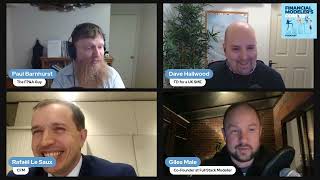
Paul Barnhurst hosts Dave, Giles, and Rafael Lusso to discuss how FMI's Advanced Financial Modeler certification shaped their careers. They cover modeling best practices, why the certification matters, and what skills separate good modelers from great ones.
There's one thing I want to make sure I get, which is local recordings from each of you, because that's what they use it records. And we just have to. You have to keep your browser open. So if you can hang on for one minute when we're done. Alrighty. Thank you, everyone, for joining us. We'll get started here in a minute or two, but as we're waiting for everybody to join, if you could let us know in the comments where you're coming from, that would be great. We could already see. Carlo has let us know. He's joining us from Naples, Italy. So glad to have you on here, Carlo. And we'll see who else we get. So we'll just give it one minute to let people join and then we'll get started. So we're super excited to have everybody here for this LinkedIn live on financial Modelers Corner. We have some great guests and we'll introduce them here in just a minute. So again, if you can let us know where you're coming from, just to get an idea. You know, our guests, we have all three are coming from Europe today, so it's evening for them and we'll talk a little bit more about where they're coming from. But, Carlo, you're also coming from Europe. So right now it looks like we have. Outside of me, I'm the. I'm the foreigner in the group.
You can tell it's nighttime from my background, probably that I'm in my conservatory because it's where I work. But in the UK at the moment, it's dark at about four in the afternoon, which. Which is pretty horrendous.
Yeah, it gets dark around 5 o' clock here, so I understand. All right, we'll give it just one more. About one more minute and then we'll kick it off. But if you're out there, you don't have to comment, but if you could, we'd appreciate just knowing where you're coming from. It's always helpful to kind of see the different places we have the audience from. Alrighty, give about another 15 seconds and we'll get started. All right, well, I'm going to go ahead and just get us started. My name is Paul Barnahurst. I'm the host for this event and the host of the podcast Financial Modelers Corner. In this episode, we have with us three amazing modelers, and we're going to talk about a little bit about their experiences in modeling. We're going to ask them some fun questions, and then we're also going to Talk about the FMI certification program, which all three have taken at least level one, and I believe a couple of them have taken level two. So why don't we get started with introducing our guests. We have with us today and we just had someone else join us from Nigeria, so great. We were getting people all over the globe. But Dave, if you just like to tell us a little bit about yourself, that'd be great. We'll start there.
Yeah. Hi, mate. My name's Dave. I'm a chartered certified accountant with ACCA and I work for a small business in the uk. We're a clothing retailer and we have our own menswear brand. And I took the AFM last year and I took the CFM this year. Currently pending a result.
Got it. Thanks, Dave. Giles, why don't you just tell us a little bit about yourself and what you're doing? Sure.
So I co founder of Full Stack Modeler, which. Which is a training company. You know, we. We try and get people as good as they can be at and modeling and data viz and analytics. And yeah, I'm a lifelong modeler, similar to Dave. I think I took AFM maybe two years ago and I am awaiting my CFM results with bated breath.
Well, good luck for both Dave and Giles on that second test. Why don't we go over to Rafael now?
Hello, Paul. Hello, everyone. So my name is Rafael Lusso. I'm a director at Blue C Luxembourg. I'm in charge of valuation and modeling advisory services locally. I took the CFM test, I think two, two and a half years ago, the EFM. I took it on the first generation, so I think it was October or November 2017. So yeah, that's a bit about my. And I'm based in Luxembourg, but I'm originally from Chile.
Thank you. Unfortunately, he didn't tell us he was still waiting his results or I'd really be worried. All right, well, I appreciate all three of you letting us know a little bit about yourself and just the audience. If you guys have questions throughout this, please feel free to, you know, add your questions to the comments and we'll cover them as we can throughout the episode. We want this to be as interactive as we can. So the next question I'd like to ask each of you, and maybe we'll start with Giles on this one, is how did you become interested in financial modeling and just building financial models? How did that come about?
I got really lucky. So I actually got a role as a modeler in my placement year from uni. I was the guinea pig at a company in the UK that I was probably doing it for cost reasons to see if they could get some cheap labor with a student. But it was a test case. Could a student handle the stresses of modeling in a sort of bid environment? So luckily it was sort of sink or swim, and I managed to swim. And I went back into that role after uni and I just loved it. I always gravitated towards problem solving and being that Excel person, really more so than, you know, worrying about becoming a manager or a director and things like that. And I've never really looked back.
So what is it you loved about it? You mentioned Excel problem solving, but what was it about modeling in particular that you loved?
I think it was just the fact that it was a test of your own ability. You had to use your brain in unique ways. And yeah, I really took to Excel quickly and I think is that everybody knows probably watching this, you can never stop learning things with Excel. I probably still only know 10% of what you can do. So I just loved it. And yeah, it's hard to describe why, but that was just the thing that I felt really passionate about from the moment I stepped into the workforce.
I mean, that's awesome that you're able to figure that out in uni and have that opportunity from day one. So, Rafael, how about you? How did you kind of get involved in financial modeling and what interested you in that? You're on mute, Rafael.
Thank you. Sorry for that. So, no, that's definitely an interesting question. I think the first time I knew that I started appreciating Excel was the first time I saw a professor of mine showing us in our project evolution course, a data table, a sensitivity table. And when you see how powerful this tool can be, I mean, you start saying, well, I mean, certainly there are many things that they can do around this early in my career. And I work at another big four with a shorter name for almost 10 years, always in. In the valuation and modeling department. And coming from Chile, I was working a lot with mining projects, with infrastructure projects, power energy projects. And it came to me, I mean, the importance of the models for all, the evaluation of all these type of projects was very high. And that's where I started paying attention more to the models. And I started seeing models that were better than others. And I. I promise myself that we'll be able to produce models of very high quality in order to be able to provide insight, fuller conclusions for our clients. And since that point, I think I tried to learn more and more about modeling and that would take me to FMI eventually.
Great, I appreciate that and thank you for sharing that. So, see, Dave, we haven't. Did I ask you back? I didn't ask you that question. We're going to go to you next, Dave.
Okay. Yeah. So one of the really great things about the organization I work for is that it's constantly changing. We've got new stores opening, we've got acquisitions going on, we've got disposals going on. And so more and more of my work over the last sort of five years has been more and more future looking, looking at different scenarios of we could open this store, we could open that store. And less and less about management, account preparation and looking into the past, which is what my main qualification was around, which is why I started looking more and more into modeling and actually found that's a really interesting part of my role. It's one of the more exciting things. And so, yeah, that's how I came to get really stuck in.
And you found you really enjoyed it, it sounds like. So that's great.
Yeah, yeah, it's great fun trying to build in as many sensible variables as you can without ending up with a really complicated model.
Yeah, that's always the challenge. The simplicity versus complexity. As I always like to say, try to keep it as simple as you can because your partners you're working with will make it complex whether you want it to be or not before you're done. And I see some smiles there. I think everybody can relate to that one.
That's good.
All right, so what we're going to do now, before we jump into the talk a little bit about the certification and fmi. We're going to change the order up a little bit on this one and ask you guys the rapid fire questions we ask in our episodes. What I'm going to do is I'm going to ask one of you all the questions, then I'll ask the next, then I'll ask the last person and I'll give you the opportunity to pick one that you want to elaborate on. So this is a fun section because one, you have to pick an answer. I don't want you to say it depends. I get. You could probably say it depends to every single one of these. I want you to, based on your experience, if you had to pick one or the other, which would you pick? We'll go through all of them. You'll get about 10 seconds to answer each question. Then I'll go to the next person, we'll run through them. And as I'M going through them. You know the audience. If you want to answer, feel free to throw what your answer would be to each of these. We'd always love to hear, you know, different opinions. We just had someone mention they're coming in from London in the uk, so. Great. Happy to have you. So, Dave, why don't we start with you on these rapid fire questions and I'm just going to work from right to left here on my screen. We'll go from top to bottom. So in your view, circular or no circular references in a model?
No circular references.
VBA or no vba?
A small amount of vba.
Horizontal or vertical model?
Vertical works for me.
Dynamic arrays in your model, yes or no?
Yes, but don't overdo it.
Okay. Workbook links, yes or no?
External Necessary evil in my business.
Yeah, I haven't had anyone say, oh, I love having them. So, named ranges or no named ranges?
No name ranges.
Okay. Do you follow a formal standard like fast or smart or one of those that's out there for your modeling? No. Will Excel ever die?
No.
Will AI build the models for us in the future?
Yes. Already happening.
What is your lookup function of choice? Vlookup Index, match, xlookup or choose index and X match. All right, there we go. You had to throw in that X match. Should we use sheet cell protection in our models?
Yes.
Okay, and the last one. Do you believe financial models are the number one corporate decision making tool? If. No. What do you think it is?
Yes.
All right, great. So we're going to run through that with Giles here. Next. Circular or nurse? No circular references.
Before we do that, can I just say I listened to all of your podcast episodes and I enjoyed hearing everyone else squirm under these and all. All I want to say now is it depends to every answer, but I'm gonna play the game.
So that's the whole goal, to make you squirm.
You want to give lots of detail for every answer.
Exactly. Yeah. So no circular references.
VBA or no vba.
No. Vba.
Horizontal or vertical?
Horizontal.
External Workbook links, yes or no?
No.
Dynamic arrays. Yes or no?
Yes, but that's the one I want to come back to.
All right, we'll give you all a chance to come back when we're done here. Named ranges versus no named ranges.
If it's black or white, they're there or not, then yes, named ranges.
Okay. Formal standards, do you follow them, yes or no?
Yes.
All right. Will Excel ever die?
Everything dies. I just need it to not die before me because I don't have a backup career.
We just. I. I gotta throw this up here just because I think it's a great response here. Danielle just joined us. Hello, everyone. Great to see you all. I love these questions, too. So there you go.
Daniel's done these, hasn't she?
She's been on the show. Yes.
Yeah.
Will AI build the models for us in the future?
Absolutely.
Okay, so what is your lookup function of choice?
Xlookup.
All right. You and I are on the same page there. Okay. So should we use sheet cell protection in our models?
Yes.
All right. And do you believe financial models are the number one corporate decision making tool? Yes or no?
I think people are the number one tool, but spreadsheets are the best supporting tool for them.
Okay, good answer. I like it.
No. So, no.
All right, so we'll come back to you. I know you want to elaborate on one. We'll come back to you once we've gone through all these. So, Rafael, are you ready?
Certainly. Yeah.
All right. Circular or. No circular references.
No circular reference.
All right. VBA or no vba.
No vba.
Horizontal or vertical?
Vertical for me.
Dynamic arrays. Yes or no?
Yes.
Okay. External workbook links? Yes or no? Certainly not named ranges or no named ranges?
No name ranges.
Do you follow a formal standards for your models?
Oh, PDC has a global financial modeling guideline, so I would say yes.
So you follow theirs versus the other ones out there. Makes sense. Will Excel ever die?
It will.
All right.
We'll take some time, but yes.
Yeah, I think everybody who says yes at least says it will take some time. Will AI build the models for us?
Yes, certainly.
Okay. What is your lookup function of choice?
Index match followed by xlookup.
Okay. And should we use sheet cell protection in our models?
I would say no, but.
Okay, fair enough. And do you believe financial models are the number one corporate decision making tool?
They are one of the important ones. I don't know if the number one, but I think that many decisions are not taken with based on models. And they should.
Yeah, I think there's a lot of times they probably should be used that they're not. But. All right, so why don't we. Raphael, we'll give you. Since you got the last one to go, we'll give you a first opportunity to elaborate. If there's any of those that you want to elaborate on your answer. We'll give you a minute here to elaborate on it. You can pick one.
Okay. I mean, I think that I could go. I could go with will Excel ever die? And I think that one. I think it's a tricky question. I think that eventually, I mean we see that there are many other software that are competing with it and I think that in terms of functionality, I mean we can find other elements that can. Other software that can be better. However, I think that it's very difficult to replace something that's universally accepted which is. I mean for the same reason that evaluation we're stuck with some methodologies that can be. That have been demonstrated not to be valid ones or the most relevant ones, but we still use them because everyone is accepting them. And to a very high extent the same happens with, with Excel. I mean you will not build a financial model in Python if it needs to be reviewed by your auditors, by your stakeholders that are not that do not know how to review this with other using other software.
Great points. All right Giles, I know you had one you wanted on elaborate on.
Yeah, dynamic array. So I mean if I were doing client work nowadays, which I'm not really doing in any of, I'd still be quite hesitant to throw in things like dynamic arrays and the newer stuff but I 100% believe that's where financial modeling is going to end up. I think I heard some feedback from the Collegiate Challenge. I think that might have been from you, Paul, that everybody was using dynamic arrays there already. So without a doubt I think the future of modeling is going to be dynamic array based. Let lambda. We'll see but. But certainly based on dynamic arrays.
Great. Appreciate that and I tend to agree with you on that one Giles. I think you are are similar on that Dave, which the one you'd like to elaborate on.
Yeah, I'm gonna elaborate a little bit on work but links and why I said I figured very evil. The people who say absolutely not are the people who don't have to deal with what I'd have to deal with. So we have to combine several kind of SBU's worth of historical data to get rolling models going and they come from different people. Because we're a small business, we don't have an enormous database we can connect Excel to. We don't have some, you know, tens of thousands of pound erm system you can just pull the data out in a single report. So unfortunately it isn't necessary evil. Obviously the reason I say evil is because people preparing the source data that you're trying to refer to move lines, they add rows, they add columns, they change headings and you can get around that a little bit if, if you're clever with your Formulas and you have indexing and matching going on all the time, but that really slows down your model. So our, our golden rule is before you give this model to anybody else, you must break every single link. So the links only exist to bring in the source data. Then you break the links before you let anybody else touch the model if you're giving it to other users.
All right, appreciate the explanation there. Each adding a little bit. We're going to move past that section and just talk a little bit about the fmi. I know each of you decided to invest in taking the certification. And so where I'd love to start is just why did you guys decide to take it? And on this one, we'll start with you. Rafael, what led you to decide to take the fmi?
I think that that's an interesting question. I mean, I screen CVEs from time to time because we need to recruit people and I cannot, I don't think I ever seen a CV lady that doesn't say that they have advanced Excel.
Okay.
At the moment, if everyone has advanced Excel, how do we differentiate one another? So I think that for me, I mean, I knew that I wanted to opt to be able to put in my CV at some point that I was proficient working with complex models. And when I learned about the FMI the first time, I said, look, it's certainly something that is going in the right direction. So that's why I did not hesitate to sign up at all on the first generation of the fmi. And I think it was a good decision. And that was part of the motivation to be able to show that there were differentiating features in this certification.
It makes a lot of sense, right? Because anyone can say they're good at financial modeling in a cv, but showing some certification or training or something beyond that, that really validates it, right? If I'm an accountant, I show my app, my cpa, people know I've hit a certain level. If you get your mba, whatever it may be, there are different things you can do to help validate that beyond, yes, I'm advanced in Excel, whatever that means, right? Or I'm an advanced financial modeler, whatever that means. Because everybody has a different idea of what that, what that means. So Dave, how about you? What. What led you to take the fmi?
Well, as I said, a lot more of my work was getting more and more forward looking and I was finding actually I didn't really have the skills, particularly around modeling a balance sheet, cash flow and P L. You kind of do that all the time, but modeling a balance sheet and some of the working cap requirements. I just didn't really have enough knowledge. And the chance came up with ACCA to take part in the first kind of group cohort. They did a strategic partner partnership with FMI. So it came up as part of ACCA's kind of feed of CPD that's available. So I took part in that. It was the first one. I think they've done at least one more and they're carrying on into the future. So if anyone from ACCA is listening in, the next cohort with them enrolls in early 2024. And you can study with people from the same organization. So, you know, you're all accountants, none of these FPNA guys. And, yeah, you get a small discount as well.
I saw that little.
Yeah, so the chance came up and it was really, really good. I really enjoyed it. And that's why I went on to do cfm, because I thought, actually, do you know what? I'm really enjoying learning all this stuff.
Great. Thank you. Giles, what about what you're about yourself?
It was easy for me, so I had members of my own community at Full Stack coming to me and saying they'd passed it or they were taking it and asking me questions. And I just hated that. I couldn't. I couldn't give them anything. I couldn't say, like, yeah, make sure you do this. Or it's. It's. These bits are tricky. So. So I felt a kind of growing sense of motivation to. To get through both levels, really, so that I could start, you know, interacting with my own members.
And that kind of answers a little bit of my next question. I know you run Full Stack Modeler. You're training a lot of people on modeling, and so I was kind of wondering why you decided to take it, because it felt like, okay, it's not something you need to be on your CV if you're training people every day, all day on modeling. So it sounds like it was really a motivation to be able to have those conversations and help your own students. Is that what I'm hearing?
It's part of it, but I probably say there's still like a credibility thing, even for me, you know? So, yeah, I train people and I'll do some. Some webinars on modeling, but I think you could still be somebody that does webinars for 40 minutes and takes a few structured questions. But does that mean that I'm really good at modeling? Do I actually know what to do if I'm under pressure? And I think one of the really good things about FMI is if you've got AFM or both AFM and CFM on your cv, that is a level of credibility that says you know what you're doing. And I do think, you know, if you were a hiring manager who knew about modeling and you had two people and one person had maybe slightly more experience, but the other had AFM and CFM on their cv, I think you would choose the person with AFM and CFM or I would if I was hiring.
Great. I appreciate that. And I'm curious. I know before we get to your answer, Raphael, for one second, you said you do some hiring. Are you starting to see people have that on their cv? Like, are you seeing that periodically where people may say AFM or CFM or. Not really yet.
Not really. I've seen a couple. There are other. But I think there are other tools now that have become more present. But yeah, I think that now there is more ways to justify that there is a certain level of competence. For me, the gold standard is still fmi, but we see others that are more basic, that are showing UCVs and that help us to differentiate the knowledge.
Sure. And I like how you said gold standard is fmi. I think the fact you see a lot of certifications where all you do is memorize. Right. I mean, I think historically a lot of the cfa, if anyone's taken that, I took level one, I felt like I spent forever memorizing formulas. And that doesn't necessarily test that you know how to do it in the real world. And I think that's one of the things I like most about FMI is. Right. It's an experiential experience. You're really building a model very similar to something you may see in work. Of course. Is it the exact same? No, but a lot of similarities. And I think that adds a level of, you know, credibility to something is to go, hey, I know they've been doing actual work they've had and not just memorize something and guess on a multiple choice test and hope they passed. Any thoughts to that, Dave? Curious your thoughts on that? I think you're on mute. There you go.
Yeah, yeah, sorry. I was just thinking, I don't. I don't really hire many people, so I. Well, not in finance anyway, so I wouldn't have seen it going around. But speak, being part of the community with FMI and also with acca, I can see that Ian is here, there and everywhere, all over the world, rolling this out with more and More. More people. So, although I don't think it's enormous yet, I think it will be. It's very quickly becoming the known standard for people who know what they're looking for. And so I can see it in, in the very near future.
Yeah, no, definitely. I know they've made a lot of, you know, strides in those partnerships. I believe, if I'm not incorrect, Giles, don't you include that in part of your package that people can take the fmi? Isn't there a kind of partnership? There's.
Yeah, we, we've got a bundle that I'm very proud of because it's, it's Full Stack, Modeler, fmi, maven, analytics and a season pass with the World cup team. So. So, yeah, you know, we try at Full Stack to lean into what FMI does a lot. You know, I personally love it. I, I tell all of our members and bear in mind our Full Stack members are doing a three stage kind of accreditation program with us. And I tell all of them you should be going and getting FMI on your CV when they get into our modeling stage.
Great. And so real quick, we're going to just switch gears here for one second. You also mentioned they get a season pass for Financial Modeling World Cup. So those who are listening who don't know this will be released a couple of weeks from now. But at the time we're recording this, last week was the Financial Model World cup and they had all the champions. And I know, Giles, you've competed in the different stages and why are you a fan of that? Why do you push people to kind of do the Financial Modeling World cup in your bundle?
Because it's. Because it's hard. I mean, I've competed, but I've never done particularly well because honestly, it's really humbling taking part in those competitions. I think it's very unique. And again, if you think of how unique FMI is, I think the World cup is really, really unique as well. And for almost everyone that's looking at it. And I've spoken to lots of people who've kind of thought about entering but then thought, this looks horrible. I don't want to feel stupid, I don't want to look stupid. Firstly, you could anonymize your name so you don't ever have to look stupid to anyone else. But also, like, just accept you're going to do badly at it. Probably for a long time, but every time you compete, you learn something. I got completely stuck on using indirect, which I've used a million times. But under pressure, with 30 minutes, my brain just melted. And that was it.
But.
But I'll never get that wrong again. I can promise you.
I can, I can confirm you'll get better. My second time was, I think my score was about six times my first try. So definitely I made progress.
Well, you were very brave because you went live publicly on your first ever attempt, which I had huge respect for.
Yeah. So then I proceeded to bomb, which I'm totally fine with. It was a good experience, but we won't talk too much about that, so thank you, I appreciate that. So, David, I'm curious. You know, you spent your whole career in corporate finance. It sounds like it was really that move when you started doing more forward looking from accounting that had you decide to take the fmi. So what I'm curious is, is how has it really helped you in your work? Have you seen it kind of help you day to day doing a better job in modeling? Or what are some of those things you've brought into the work place from the experience?
Yeah, absolutely. So first of all, we now have a, a really good rolling forecast. So every time we produce management data going back 12 months, we also produce a forecast fit for the board that goes forward up to up to 60 months. Also a lot of the kind of work I've been involved in over the last year, there's been some insolvency work, there's been some acquisitions, there's been new store openings, there's been decisions to close stores or all of those things have needed modeling into the future. And I think I've done a better job of every single one of those areas of my job over the last 12 years than I did in the preceding 12 years because of the skills that I learned. And part of that talking about competitions is just problem solving and working under a reasonable amount of pressure to come up with something quickly.
Sure. It's amazing how being under pressure changes things. Like you can do something when you're practicing on your own, when you have six hours to figure it out, but when you got to figure it out in 30 minutes, it often changes the game. So, you know, Raphael, I'd love to know how it, how having both AFM and cfm, how they've helped you in your work, you know, how they've kind of helped you in your job and the benefits they've brought beyond just having it on your cv. But maybe if you have an example you could share of how they've helped you in your work.
I mean, I think that it's Difficult to relate. But generally, I mean, what you see is that, for example, we were here in Luxembourg to give you an example, around half of or 80% of the work that we do is for alternative investment fund managers. Among them, the largest infrastructure funds worldwide normally have funds here. And we need to review the valuation for their assets. We need to assist them with portfolio valuation. The models that you will see that they share for us for valuation tend to be models that have, I mean, the same model that they use during the investment phase, mainly project finance models that have 5,000 to 10,000 unique formulas, more than 30 tabs, and being able to have in place or to be able to work around efficiently with these models safely, because the risk, the spreadsheet risk that you have with these models is very, can, can increase very, very quickly. The fact that you, that you can be confidently working with these models, I mean, helps you to work better and to provide better service to our clients.
Great. And I love that last part. A better service to the clients. You know, that's something you emphasize, Dave, right? You're able to roll that package up better for the board. So at the end of the day you really want to be better for your, for your clients, for your end users. I think that's one of the big benefits that I hear people talking about. So I'd like to get your thoughts, Giles. I mean, I know you know the industry well and obviously you provide training. So how do you kind of differentiate the FMI from the other programs out there? Like what makes it unique to you that you included in your training?
I mean, I think certainly the exam approach itself is unique and, and if I'm right, it reminds me of my SEMA days a little bit, but where you, you kind of have to study and then, you know, you've got an exam to get through. I kind of agree with everything Dave was saying earlier that I think, you know, Ian is building some amazing partnerships and I think it's only going to grow and grow. I think the level that you're tested at both levels, AFM and cfm, has been pitched really well. So afm, you have to do a certain amount of studying, as you know, you've got coming up, Paul. But if you do that and you learn the fundamentals of building a three statement model, you will pass because within reason, with a few tweaks, you kind of know what's going to come up. And then cfm, as I just found out in October, is a big step up and it's hard and I'm guessing The pass rate is a lot less than it is for afm, but it's appropriately hard and it can be a bit frustrating because you're going to study for things that you won't get tested on. Some of the things in the topic list, I think, lean really nicely on experience. So if you've got years and years of modeling experience in the real world, which I think Rafael and Dave have both talked about at times, you know, you build up this knowledge bank of. It's almost just like ways of thinking to solve logical problems. It's like Tetris. You've got to think of things visually and then. And then connect everything together. So I think CFM gives you a massive advantage if you've got experience. And. And yeah, it's. It's appropriately difficult.
It's probably what I would say.
Great. So I'm going to share a comment here and just remind the audience, if you have questions or comments, please add them in the chat. We'd love to cover some of your questions. So I think Danielle made a great point here as you were talking, Giles, and she said, said. And for anyone thinking about doing the cfm, one of the best places to train is the fmwc. But it's comforting to know that the FMWC is generally far more difficult than what you're likely to see on the cfm.
So if I can comment on this, I think Daniel is being very modest because so from. I took. I mean, I failed the first time I had this. I took the cfm, so which is. I mean, for me, it was one of the most difficult exams I've been confronted with. I'm a CFA charter holder, but I think this is. CFM is a very grueling exam. I mean, you don't know what to expect when you get. When you sit for the exam, because there are many different types of exercises you can get. And the second time, I took the preparation course from Daniel, which was one of the only few available courses at that time, and it was very helpful for me to gain confidence and to be able to pass the exam. So I think that certainly a financial modeling workup is a good preparation, but I think that Daniel has a very good course to prepare for the exam.
Yeah, I've heard great stuff about her courses. I know she has some to help prepare and she, she knows her modeling stuff as well. She's a great, great, great resource out there to follow on LinkedIn if you're not following her. I think everybody here and everybody in the financial modeling community knows she does a Lot of great work and the stuff she's putting out. So I, I totally agree with you, Rafael, but let's talk a little bit more. So we've mentioned FMWC is one way to prepare. Obviously studying for the certification is a way to get better at modeling. But maybe any other tips or things you found that have really help you to get better at modeling. I mean, obviously there's the easy answer practice, but you know, kind of. Any thoughts beyond that, Dave?
Yeah, perhaps not preparation for AFM and cfm, but listen to your users. If they ask for a certain thing, think about either building in or communicating with them. Why it's not a good idea to build in. And sometimes you do have to say no, that actually is too. That will complicate it or that won't actually make a big difference. Let's pick two or three things that are actually going to really impact the outcome scenarios. And let's not worry about what percentage credit card fees are going to be because it's great to add, but it's not actually really going to change the model.
I couldn't have said it better myself. There's something to be said for focusing on key drivers and learning to really hone in and do a good job of those instead of trying to guess 60 different variables at an average level. Because you've just complicated the model and you probably really haven't added a whole level of accuracy. So we'll go to Giles next on this. Your thoughts, Giles?
Yeah, I mean, just picking up on that. I think that that's one of the things you gain as, as you, as you get more years of experience, is an ability to see the, the materiality of things. And you'll hear this being said everywhere. But building things in a simple way, models and beyond models, is a really hard skill. It takes more time quite often to build things that are simple. So I would say, I would say that just to add to Dave's point. I used literally on my first job, I used to go around the office. Literally, I would walk around the office and I would say to everybody in different teams that I didn't know. Are you struggling with anything in Excel? Sometimes it wasn't pure financial modeling, but I guess the point of me sharing that is like be proactive in seeking other opportunities to test yourself to find challenges. Because the more you can test yourself, you might find yourself solving problems that you solve once and 10 years down the line, maybe in the CFM exam you'll use it once ever again in your life. But, but you can't get enough experience, so. So go be very proactive in finding it.
I. I think that's great advice. And there's two things I'd like to comment. I love when you said simple is hard because a quote I often teach whenever I'm doing design principles or stuff around modeling or Excel, I'm like simple. You know, simple is hard. Complex is easy. It is almost always harder to really make it simple. And one of the examples I give is I can write this nasty if if statement, nested if statement for something, or I could take the time to create a helper column and do some kind of lookup, which may take me more time initially and maybe a little harder to think through. But it's much more dynamic. It updates. It's easier for people to understand. Everything about it is better. But often we default to the nested if because that's quick and quick and easy, but it's really more complex for the end user. And the second one I really appreciated is, you know, asking people questions they have. I think forms are a great way around Excel or different things like that. Not as much as it used to be because a lot of people now ask Chat, GPT and, you know, Google and all those things to answer those questions. But we'll turn to Rafael next on this question. Any advice there, Rafael, from your end?
Yeah, certainly, yes. I think that a critical point is to understand the questions you want to answer. And that means that will help you to form your models, to understand how your models need to be structured. And also if you want to get better at modeling. I mean, whenever you want to start a model, my advice will be to unplug your computer and to take a blank sheet of paper and start drawing a map for the model and understanding how do you want your model to be structured because this will help you to have a cleaner structure in terms of your models and understand much better the flow of information. And I think that for me works perfectly.
I think that's great advice. It's like when they tell you to shut off your computer when you're building a presentation and jot down some of your thoughts on sticky notes. The example I often use is I compare it to building a house, right? If anyone's ever had a house built, you don't just hire somebody, whether they're qualified or not, as a contractor and start building. You start with a blueprint, then you find a qualified contractor, you do an inspection at the end. There's a lot of similarities. And so I really like that, you know, shutting it off and spending some time thinking about what that model is going to look like. I mean I didn't do that at first. You know, I didn't start in investment banking or somewhere where I got taught about modeling or Excel did my demotivating.
And quite, quite draining. And you might think, God, I'm never going to get anywhere with this because it's so hard.
Good advice. Thank you on that. So you know, I'll summarize what I heard there. AFM early in your career, as a general rule, cfm, you want some solid experience behind you before you take it, if you decide to take it. It's kind of what I'm hearing there. I want to share one comment that came in. You know, I'm wondering why it's not part of the regular graduation, at least the basics. So I'll comment a little bit on this and then I'll give any of you the opportunity to add your thoughts. I know in is trying to work to add it some some programs in colleges, I think in general college doesn't do a great job of adding modeling to the program and really learning details of modeling. They have so much they're teaching you around finance and other things. But I do know there are areas where they're trying to, you know, add it similar like you see CFA and there's some people who take it right out of undergrad and things they've done to try to incorporate that in the program. I do think universities in general should do a better job of teaching how to design a model and some of those modeling skills to help us when we come out. I'll give any of you three if any of you want to tackle that one, just raise your hand and I'll give you the mic.
No, certainly I think that, I mean I lecture at universities so I lectured at 11 business schools so far. There is one that I've been lecturing for the past six years which is grenoble collemanagement. And I think that the added value that we have as practitioners coming there is that we I mean you realize quite soon that the amount of exposure that the students, even last year students have had to working with Excel, working with financial modeling can be limited. Some of them had it through their internships, some of them don't have much. So whenever I lecture I try to incorporate this and I think this is part where we can add more values as practitioners. But as you mentioned, I mean I don't see that most schools are incorporating it systematically even if many of them are already conscious and they are moving towards the right direction is not something that we see everyone doing at the moment.
Great. Any thoughts from there? It goes. Giles Hand, go ahead.
Yeah, so I'm going to have to plug my vlog now because I was in Australia with Danielle and Ricard warnerlit from Mazars recently. So Ricard shared some really useful insights with me. And the main one that jumps out is that this whole idea of being a career financial modeler is quite a recent thing. So it almost doesn't surprise me that it's not kind of embedded in all of these kind of other establishments. I get the sense we're heading in the right direction, but yeah, I think if you went back 15 years, the idea of standards and certifications for a financial modeler's career was probably a little bit alien or at the very least, right at the start of, you know, what it's become now.
Yeah, I would agree with you. I remember in on one of the shows commenting, when he started his career, it was the wild, wild west, right? Anything went. Basically you just figured out how to build the model. And that was a little less than 30 years ago. So I agree with you. It used to never be that financial modeling was your career and you're seeing that more. I think those are good points. Any thoughts on that one, Dave?
Yeah, I was actually thinking along the same lines there. The more people carve out a bit of a career for it, the more people will start planning to go into it. And so that will generate a little bit more demand in the. The education sector, I think, for the getting those basics or something. You know, some people, they might not get the opportunity to try it, but have they done so at that stage, they might have thought, you know what, this really floats my boat. And I'm gonna. I want to do this as part of my career. And I think that's part of the journey that modeling is on as a, as a path. It's becoming more and more important. It's becoming more and more standardized, and there's discipline behind doing it properly. I also think some of the skills that it teaches you, like presentation, planning, good structure. You know, simple is hard, complex is easy. All of those things would be great to have in as early as possible for all aspects of your career. Because a lot of what we all do is actually not about the technical side. It's about communication. This job is about people. It's about talking to people. It's about giving them information instead of data. And the sooner you learn some modeling, the better you'll get at all of those things which will make you successful. Whether modeling is your full time vocation or if like me, it's just a chunk of your job.
I love what you said there around the communication and the other skills that are so important. I had the opportunity to present when I was at the training last week for the financial modeling World cup and I, what they had me speak on is what I've learned from interviewing over a hundred finance leaders because I've done this so much and one of the things I said and kind of joke, I realize this is going to be hearsay, but it's not about Excel, guys. It's not about your technical skills, right? You know, you're talking to people. It's really about having those conversations and the business partnering and understanding the business and being able to validate it. You, you need those skills to build the model. But if that's all you have, you've sold yourself short. You're not going to be able to do what the business needs. You need to know the business as you said, Dave, you need to know how to communicate. So modeling is one of those things that helps you communicate and helps you make help, helps people make smart decisions. But the model isn't your product in the sense of, as one person put it, he goes, the spreadsheet is not your product. The insights are. It's that process you go through to ensure you're making a smart decision. So you know, we're coming near the end of our time here so I can ask a question of each of you and if anyone in the audience has a question, feel free to put those in the chat. But what I want to ask if, if you could give our audience members, you know, those listening one piece of advice that would help them be a better financial modeler, what would that piece of advice be? And maybe we'll start with you on this one, Giles.
I've already said my one about going and being proactive. So I think what I would say is I think there's a roadmap and I've talked about this before, there's a roadmap of skills. There are layers that you can or steps to a journey that you can go on as a modeler. And clearly in Excel at the moment there's lots of new stuff coming out, lots of flashy things. I would say don't get too sidetracked by the new flashy stuff if you're right at the start of your journey. So if you still struggle with some of the fundamentals of like you know, logical problems, Boolean logic, flags, factors, tables, power query. All of this stuff. Like, don't, don't get sidetracked because you're seeing everybody using lambda and dynamic arrays. Just stick on your path and build the fundamentals as best you can. It's the whole thing. Like with driving a Tesla or having a fully automated car. I still think we should hold on to the skill of being able to manually do all of these fundamentals ourselves. Even if the world is going to change in the next sort of 5, 10 years.
Sure. Even if AI is going to build the model for us, we still need how to build it. Just like math, we still need to know how to do certain things in math. Even if we can pick up a calculator, there's value in understanding the underlying principles that drive whatever you're trying to learn. We'll go to you next. Dave, any thoughts there?
Yeah, not so much advice, but a tip I've given in response to people asking me, how are you so quick? Excel, press Control F1. Do you know what that does?
Go ahead and tell us.
Control F1. Hide your ribbon. Hide your ribbon. Force yourself to learn the keyboard shortcuts. Everything in the ribbon can be hit with alt. If you hide the ribbon and force yourself to learn keyboard shortcuts, before you know it, you'll be working twice as fast in Excel. And that gives you more time for thinking.
Great. So we got the. The keyboard shortcuts. Always a great one. Raphael.
I like the shortcuts. I have another one to add. So I think that. Embrace the fact that more than half of your time modeling will be about formatting and painting, which is cruel to think about. But we are visual animals. And for models to look, I mean, it's very important how the models look. And this, I mean, I'm not able to trust a model that's not properly formatted. Okay? So, I mean, this is a very difficult part, I mean, because that means that you will need to spend a lot of time formatting. Just choose a good podcast, like the Financial Models Corner podcast or any other, or good music, and plug it in your headphones and start painting around. Because it will be half of your modeling life, but enjoy it, because that will create models that will be aesthetically pleasing, functional, but also the mod. I mean, what I say some of my students, that the day you will die, your models will still be here. Okay? They are your legacy in this world. So you don't want people to think that you are. You were building crappy or bad, poorly Looking models love it.
Don't want garbage in, garbage out, or models that are just ugly to look at, even if they're well designed, because you have your, your management looking at them and you want to make it look good for them. It's important that they see it and it's easy to follow. So, great advice there. So, you know, we're pretty much at the end of our time. If anyone in the audience has a question, feel free, feel free to throw them in the chat. But we're going to move to last question here and we'll ask each of the of you this. If the audience wants to learn more about you or get in touch with you, what would be the best way for them to do that? And Rafael, we'll start with you on this question.
Let's say LinkedIn. That's the best way to reach out to me. I'm very active also in the local Valuation association of Luxembourg. For those who don't know where Luxembourg is, and because I know that this is between Belgium, Germany and France is the second country in terms of investment funds that are established worldwide. And we have a very healthy, growing environment of alternative investments and many opportunities for talented modelers and finance professionals.
Great. Thank you, Rafael. Dave.
Yeah, probably easiest to find me on LinkedIn, if you don't know me already. And once you've joined the fmi, I'll see you on the FMI platform. I'm always on there interacting with people.
Great. And how about yourself, Giles?
I'm going to take a second opportunity to plug my vlog that I haven't released yet because I'm also learning that it's very hard to actually produce a vlog. LinkedIn's the easy one. But I'm coming out with a vlog called Excel on the Road. I've just come back from Australia interviewing Danielle, who's in the audience, and Ricard and, and, yeah, but you will get updates if you just follow me on LinkedIn initially.
Great. Well, thank you, each of you for joining us today. And thank, I want to thank the audience for listening. If, if it wasn't for you, we wouldn't have this show. And you know, just a reminder, the show is sponsored by the Financial Modeling Institute. You know, if you're interested in doing the accreditations, if you go to their website, you use the code podcast, you can save 15%. And more important than that is, you know, just take the time to continue to invest in yourself to become a better financial modeler. All three of our guests here have invested in themselves that's the number one thing I'll say is they spent many hours learning and honing their craft, and that's really how you become better at financial modeling. So, again, thank you for joining us, and we've really enjoyed this hour with each of you and look forward to releasing this episode. So thank you, everyone.
Thanks, Paul.
Bye.
Thank you.
All right.
More from Paul




Trust and Leadership Lessons for FP&A From 100+ Top Leaders with CFO Jon Laudie






