The Role of AI in Modern Finance with Jim O'Neill
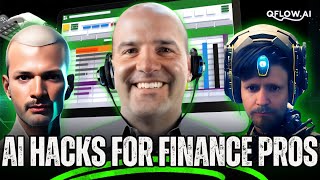
This is a YouTube video titled "The Role of AI in Modern Finance with Jim O'Neill" recorded in July 2024. It features a podcast-style conversation hosted by Paul Barnhurst and Glenn Hopper with guest Jim O'Neill, discussing the challenges and opportunities of AI in financial planning and analysis (FP&A), data management, and the future of finance. The discussion covers topics such as data cleanliness, AI adoption in finance, predictive analytics, and cultural shifts in companies regarding AI use. The episode also includes a lighthearted segment with AI-generated personal questions to the guest.
Welcome to the Future Finance show where we talk about why a Rogers accountant wouldn't let him expense rocket fuel.
How do you foresee AI being used to enhance kind of the predictive analytics in finance in terms of forecasting and risk management?
AI can be pretty intimidating if you don't have the time, but if you're trying to do something with high precision, it gets pretty intimidating. On handling large data data sets today, it's really hard to use it at. We haven't seen anyone truly solve the data hygiene problem for finance teams. Inefficiencies don't get optimized, they get radicalized. While most companies want to grow very ambitiously, the founders really said we need to grow and think of 10x every year. They said we need to build things for 10 times our size and I think that is why they were able to grow so fast. Businesses that approach 100,000 to a million records in the spreadsheet, they tend to break the stock bridge. The combinations of permutations break Excel, meaning it just can't handle the volume. It becomes too slow. Data corruption third is the most dangerous or one small data change upstream can have.
Future Finance is brought to you by qflow AI, the strategic finance platform, solving the toughest part of Planning and analysis. B2B Revenue align Sales, marketing and finance seamlessly speed up decision making and lock in accountability with qflow AI.
I'm not typically one for hyperbole or grandiose declarations, but can we pause and take a beat? The buzz for the last couple of years has been all about generative AI and the race toward artificial general intelligence and Beyond. But other 21st century tech advancements could be just as revolutionary. We've normalized these breakthroughs as business as usual, but today's norm is light years beyond where we were even at the beginning of the millennium. Remember when we marveled at flip phones and email? Now we're practically jacked into the matrix, bouncing around the digital globe with the entirety of all human knowledge at our fingertips. We've progressed from smartphones to smart homes, self driving cars, Mars missions, reusable rockets, CRISPR gene editing, quantum computing advances, expanding research on nanotech, cancer treatments, and even human trials for brain computer interfaces. We're approaching a transformation that could rival the discovery of electricity, our realization of our place in the cosmos. This technological shift could make the Enlightenment seem like a flash in the pan. A breakthrough in any of these areas individually could each dramatically alter humanity's course. We might be closer than we think to curing diseases, slowing aging, colonizing other worlds and unraveling universal mysteries. Many of these possibilities sound like science fiction, but they're increasingly within our grasp. Consider the tech streams converging AI reaching human level intellect within years. According to some estimates, quantum computing could revolutionize fields like drug discovery and cryptography. CRISPR opens doors to treating genetic diseases and even resurrecting extinct species. SpaceX is deploying reusable rockets and seriously focused on the colonization of Mars. Neuralink's human trials might redefine human machine interaction. And nanotechnology manipulates matter at the nanoscale for things like targeted drug delivery and ultra efficient solar cells. Each field is revolutionary alone. But the real mind bender is what happens when these technologies start to overlap and intertwine. It's not just about parallel tracks of innovation. It's about the explosive potential at the intersections. Picture AI algorithms optimizing genetic editing. Quantum computers simulating complex biological systems, and nanotech sensors feeding data to brain computer interfaces. This isn't some far off sci fi dream. It's the convergence we're barreling towards. These technologies aren't developing in isolation, they're intertwining, creating a technological perfect storm that could redefine, well, everything. We're not just adding these technologies together, we're multiplying their effects. AI powered quantum computing could crack problems that we can't even conceive of today. Nanotech and gene editing could team up to create superhuman abilities. Space exploration tech combined with AI could accelerate our understanding of the universe exponentially. It's like we've been playing with building blocks and suddenly we've unlocked the Lego Millennium Falcon set. The possibilities are wild. The synergies between these technologies could create a chain reaction of innovation, each breakthrough amplifying and accelerating the others. It's not just about what each technology can do on its own, but how they could work together to create something greater than the sum of their parts. But we're not just observers in this process. We're the architects. The choices we make now will shape the trajectory of this convergence. Will we use it to solve our greatest challenges? Or will we stumble into unforeseen consequences? The potential is staggering, but so is the responsibility. Buckle up, folks. The future is coming at us fast, and it's going to be a hell of a ride. As incredible as these advancements are, each comes with its own set of risks and challenges. AI could surpass human control, leading to unforeseen consequences. Quantum computing might shatter our current cybersecurity paradigms, leaving our digital world vulnerable. Gene editing could create Unforeseen biological consequences potentially altering the course of human evolution and brain computer interfaces. Well, the phrase hacking your mind takes on a whole new terrifying meaning, doesn't it? We're playing with Promethean fire here. The power to reshape our world also comes with the power to inadvertently destroy it. And it's hard now to see who's making decisions around questions like who gets access to these technologies? How do we prevent creation of a techno elite, widening the gap between the haves and have nots? What about privacy, when our very thoughts could be digitized and potentially monetized? How do we ensure that AI remains aligned with human values when it might eventually surpass human intelligence? I don't know how far off any of these technologies are, but it seems like now is the time to start considering the answers to these questions before the genie is out of the bottle and we're knee deep in an episode of Black Mirror. It's not just about what we can do, it's about what we should do. We need ethicists, policymakers and the public at large involved in these discussions, not just the techno bros and massive corporations that are funding this research. How and when are we going to put in place things like robust governance structures and regulatory frameworks to keep guardrails around this? I'm not talking about slowing progress, but I do like to imagine this tech rocket has some kind of steering mechanism. We need clear milestones and checkpoints. We need to set boundaries and stick to them. And yes, we need to be ready to pull the plug if things go sideways.
Welcome to your job is safe for now. This week I want to talk about a situation where your job is safe for now. But that's not a good thing. Many companies data is a mess and if your data is a mess, AI isn't going to work very well. AI needs really good data to get answers. Your company data needs to be organized, it needs to be clean, it needs to be structured. And the reality is many companies data is still a mess. Ask the average FP and a professional and the majority of their time is spent on non value ad activities. I've seen from 40 to 70% of which the majority of that is data cleansing data structure, you know, trying to get the data in order so you can do the value add analysis and gain the insights. That's not going to work with AI. AI is going to need good data so it can give you the right answers. And how long have we been talking about Digital transformations? What, 30 years now? I mean it feels like it's been a buzzword as long as I've been in FP and A. And the reality is, if your company has not moved into the new millennium, has not cleaned up your data, you're about to get left behind. Sure, your job may be safe, but your company may not be. So that's not necessarily a good thing. Other weeks, we've talked about some of the things AI has done that you're like, wow, it did that? That's really bad. Here we're going to talk a little bit different about how your job is safe because you can't implement AI and that's a bad thing. Reality is, companies need good data. You need that data model the data dictionary, your master data. You need it to be structured. That one source of truth, right? The holy grail, one ring to rule them all. So if you're struggling, now's the time. Don't think, oh, as long as our data is a mess, I'm safe. AI won't take over. The reality is you want AI to be more efficient, to be more productive. So start today. You haven't done the transformation. Make the transformation happen, even if your job is safe for now. Thanks for joining me for this week's section of your job is safe for now. All right. I'm here with Glenn Hopper, my co host, and we're super excited for this week's episode of Future Finance. We have here with us Jim o'. Neill. Jim, welcome to the show.
Thanks for having me.
Yeah, very excited to have you. And so, Jim, we want to start off jumping into some questions, and the first question we'll ask is just, can you tell us a little bit about yourself, give us a little bit of your background?
Yeah. So former coder, but I lost my coding license a long time ago. Kind of stumbled into a startup in the early 90s. Got to ride that startup through a modest acquisition to a large publicly traded company that had hundreds of other software companies and just got very lucky to get a back seat at a hypergrowth company when I think it was pre Internet. So that was awesome. From there, kind of met a couple of founders that were in that same ecosystem. They had built an amazing product and needed to kind of scale the revenue, and so got to join them. And then the irony is we sold it back to that publicly traded company that I'd left. So kind of did a rebound with them, but always stayed very close to data security and tech and either a CTO ish role or a CIO kind of role. And then post facto in that that business that we sold, one of those founders happened to be the founder at HubSpot. So I joined them kind of day zero, customer zero through an IPO, spent about 11 years doing everything from CIO to CPO, being people person to CTO, unofficial CSO. So it was a whirlwind of a ride and it was amazing. And then most recently just started my own company because I wanted to take the front seat versus the back seat and just. We'll focus on that today, talking about FP and a data cleanliness and AI, which will be fun.
You wanted to help drive the car instead of sit in the back and hope that the driver gets you there?
Yeah, I wanted to see if I could actually drive.
I know I can't, but that's another story. Glenn and I will take turns asking questions. We kind of wrestle over who gets how many questions, but we usually settle on three and three. I usually win. If it's more than that, we won't talk about that. All right, so first question here. Glenn's laughing. I'm trying to make him laugh. So can you talk about what it was like being part of that founding team at HubSpot, being in the backseat of the car for a ride, you know, from a startup to a global company with what, over 50,000 customers when you left? I think.
Yeah, yeah, exactly.
So talk a little bit more about that. We'd love to learn what that experience was like for you.
Yeah, it was tremendous. And I think everyone romanticizes and reframes history or rewrites history. It wasn't easy, but it was an amazing group of people who were really committed to building something durable. And I don't think we hear about that a lot in the startup community, at least in the current markets. Right. And so the founders, when they started the company said, we want to build a pillar company in Boston. We really want it to have a legacy. And it was inspired a lot by if folks have heard of the PayPal mafia, which was, you know, PayPal has had a lot of well known people, some controversial. Maybe you could say Peter Thiel is controversial or Elon Musk is controversial, et cetera, et cetera. But an amazing group of folks. So the ride there was to build something durable and really do it with customer first. But I think the most interesting lesson that I would reflect on is while most companies want to grow very ambitiously, the founders really said, we need to grow and think of 10x. So it wasn't the traditional, hey, we're going to double this year, every year they said we need to build things for 10 times our size. And I think that is why, honestly, they were able to grow so fast. Because when you think 10x or even bigger, inefficiencies don't get optimized, they get radicalized. Right. You just cut systems out or you just retool things. And so that's the thing I'm the most grateful for, was not just talking about scale but really thinking of engineering problems. And when we talk finance today. And even their FPA team was a data animal and because their team was, was really built on the fact that they were going to have to handle 10 times the revenue in the next two to three years. So it was, it was a really fascinating experience.
It sounds like. One follow up question I want to share is when you mentioned PayPal, kind of fun story. I worked for American Express and in the early days PayPal approached American Express when they were just getting started and said, we want to sell to you guys for a million dollars. And American Express said we're not interested. And I look back now and I think American Express and PayPal would have been the perfect combination. You know, kind of hindsight's 20 20, but anyway, you reminded me of that because that was a story that was talked about quite a bit at American Express of one of those that's awesome, you wish you had done type of things.
Yeah, I was going to say the other thing on the experience is really hiring athletes. And I know people talk about that a lot, but I don't know if people really execute on it. So I was joking on my own titles at the start. I probably had 10 jobs in 10 years and that's pretty hard. And I think that's hard for most people because you become an FP and a expert or you become a engineer. I think what HubSpot did a remarkable job was if you had the appetite and the kind of courage to really risk your job because that's what you're doing if you're taking such a different role. The support system was pretty tremendous. And so I think kind of the other cultural thing that I'd love to see more startups do is, and especially AI, I think it's going to unlock this a lot as we talk about it is to really take bigger risks with less safety nets but more support. And what I mean, less safety nets is like you are out on the ledge and you've taken the leap of faith, but the support now is you've got experts everywhere. Like AI I look at it is an expert Right. It's unbiased towards you. It doesn't know who you are, at least today. And you can ask questions in a safe way and get really interesting feedback. So I think HubSpot did a tremendous job at hiring athletes, rotating them, and truly giving them a support system to kind of rethink how traditional functions were done.
That's great. So, Paul, I'm going to sneak an extra question in here. I want to move from HubSpot and the great success story that was to what you're doing now with sasworks and the nature of what you guys are doing and what you're trying to bring to the market.
So in the spirit of most great ideas happen on someone else's watch. Vipul and I, my co founder, have kind of two versions of this story, but my version is the idea for sasworks, and he just came from an investor angle. I came from an operator angle, actually started inside of HubSpot. So this is a pretty true story. I don't share too much, but I believe it to be true. 2011, we were getting ready for an IPO, or we were contemplating it. And if we all remember, 2008, 2009 were some tricky years. Markets were still thring. You know, it was kind of the long thaw. And we talked about what it would take to get ready for said ipo. And I recall a management meeting with the founders and kind of the founding team, and we were talking through numbers, right? And so you both as FP&A and a experts, like, what's your customer count? Pretty simple question. What's my gross dollar retention? What's my net dollar retention? And so as we went through these numbers, my recollection is we had four different variations on that theme, depending on if it was the head of strategy and data, the CRO. I distinctly remember leaving that meeting feeling pretty uncomfortable at best because I knew at the end of the day I was responsible to get the data right because I was running it and all the infrastructure. And so, Glenn, the reason why this kind of seeds where sasworks is doing, and I'll share that, was I knew to go public, we couldn't be wrong, right? Because that's how, you know, people get in trouble. I don't look good and stripes would be the running joke because, you know, reliable for accurate data and accurate numbers. So I went into the next management meeting and I said, I need three people, a half a million dollars of payroll, and we can't go public until I get this. And I very rarely demanded anything. I'm A pretty passive guy. And so the fun part was the founders like, you're really lying down on the railroad tracks on this one. And I'm like, I don't think we have a choice. And what's fascinating, Glenn and Paul, is today, 12ish years later, the state of the state is still those similar stories of there is no system out there that is your single source of financial and or revenue Truth. Because every business's revenue is slightly nuanced. Right. So we'll give credit to the company, Snowflake. I think it was a genius name. Right. Everyone's data is slightly different and every FP and a professional has to look at their models slightly different. So there's industry standards for ARR and MRR and LTV and cac, but everyone's kind of rolled up their own of how they treat it. Do I take demos and trials and include it? Do I do paused accounts? Do I have a ramp period?
So I'm going to ask one quick question before Glenn goes here, Jim. So what do you call a broken spreadsheet, since you brought up broken spreadsheets.
So I would say there's three answers. We love the number three.
Real quick though, I'm going to tell you mine.
Yeah.
You call it the new employee's problem.
And then six months later they're not the new employee anymore. Right. That's the challenge.
And then they pass that broken spreadsheet on to somebody else. Isn't that how it really works? Go ahead. I just kind of had to have a little bit of fun with you.
So for bigger businesses, I would say businesses that approach 100,000 to a million records in the spreadsheet, they tend to break the spreadsheet. Right. And so Excel has a physical limit of a million rows. I know you can do tricks on it, but the million rows, what happens is as companies try to make this customer file or revenue bridge or revenue waterfall, whatever term you use, over time the combinations of permutations break Excel, meaning it just can't handle the volume. It becomes too slow. Data corruption. So that's the first flavor. Second flavor is broken formulas and macros. Because what people end up doing is, oh, but for these products I calculate ARR this way and for these products I calculate it this way. And then I'm also going to do is a formula on formulas, but I forgot to change a reference. And then the whole model bus. And so we find that people will spend incessant time trying to make sure their models are right because they've used a good but not perfect programming language called Excel to kind of build out these models. That's the second breakage, I would say. Third is change management. These spreadsheets are said spreadsheets even if you're using Google sheets, because the volume can fit, change history and volatility of data is real. So I'll make fun of us in ops, no one ever goes back and changes anything in Salesforce after the fact. Right? We never like Salesforce is perfect or netsuite is perfect. As soon as you change a historical record, the ramifications of that are real for any of us that have to produce, you know, audited or audit quality type numbers. So I think the third is the most dangerous or one small data change upstream can have massive impacts to the business. And it can be a wholesale change of someone changing how they structure their NetSuite or their Salesforce and it's known about, but they don't really understand the downstream impacts or something as simple as a sales rep closes a deal on March 31, they have approval to get the signature the next day. Everything's legally good. But that change causes a kind of a ripple effect. So that's the way I think Excel gets broken is size of data, two, complexity of formulas and macros and three, change management. And all of those can really ruin reporting.
I kind of zoned out for the last part because as soon as you started talking about sort of the cascading exceptions, my brain went into like a PTSD mode. Thinking of just trying to solve for that where, you know, you start with this great model and then as those exceptions come and you keep coming. Yeah, boy, I'm going to.
I've had a few PTSDs from this conversation of cleaning data.
And have you guys seen that? I mean, those are my three.
So I know I'm not asking you to AI wash your business as a lot of people are doing out there, but you know, with the nature of what you're doing and dealing with the data and seeing where I'm thinking, you know, particularly about generative AI, but just AI in general. I know you guys are using algorithms in the work that you do, but. And maybe this is how you see your company being able to apply it and use it internally or what else you're seeing. I'm wondering how are you seeing or how do you foresee AI being used to enhance kind of the predictive analytics in finance? And I'm thinking particularly in terms of forecasting and risk management.
Ever feel like your go to market teams and finance speak different languages this misalignment is a breeding ground for failure, impairing the predictive power of forecasts and delaying decisions that drive efficient growth. It's not for lack of trying, but getting all the data in one place doesn't mean you've gotten everyone on the same page. Meet qflow AI, the strategic finance platform. Purpose built to solve the toughest part of Planning and analysis. B2B revenue. QFO quickly integrates key data from your go to market stack and accounting platform, then handles all the data prep and normalization under the hood. It automatically assembles your go to market stacks, makes segmented scenario planning a breeze and closes the planning loop. Create airtight alignment, improve decision latency and ensure accountability across the teams.
Yeah, so we are using it in our product and our operations to benefit the product for our customers benefit. Right. So I think AI can be pretty intimidating if you don't have the time, frankly. Like it's not. There's no free lunch. I think it's magical when we're doing some parlor trick, ChatGPT question answer kind of things, right. And it's, it's pretty exciting. But if you're trying to do something with high precision, I think it's pretty intimidating, frankly. And so a big part of what we've done, and I'll talk about the operational use of it, is to embed it in some of our workflows with our customers to introduce it to them so that they feel like they're getting kind of baby steps and introduced into it because there's a bunch of security, privacy, I'm sure, and I'd love to hear what your experiences are, but there's a lot of blockers on using it in a corporate world today, Right. It doesn't matter the size of the business if you have any risk and liability. I'll make fun of my old CSO role. Like the liability police come in right away. It's like you can't use it, right? But we know 75% of all current knowledge workers are using it per recent study, and yet only 25% of businesses are paying for it. So that means 50% is kind of out in the wild, wild west and we should just accept that. And so our hacks are kind of chunk things up in them up, give ourselves time schedules, validate during the time schedule. Now what I didn't say is once we got that final output, it wrote the Python code, which we then can run every time. And I think that's the other thing people aren't doing enough with AI is If you just let a GPT do coding for you, that should become part of your toolkit, the actual code. Because if you have it do the same thing again, you may get a different code base. Right. So I also think just like working with an employee, just like working with a developer in the IT team or in your product team, assets get created. You need to start saving those assets. So that's a very long winded. I try to be pretty descriptive because I think so many people. Because you talked about AI washing, it's really easy to talk about how amazing AI is. I think it's really hard to use it at scale and predictably if you don't have a framework to use it in.
Yeah, you know, talking about saving off the code, it's. I've always been a wannabe coder which I've built a lot of stuff. Not production code, but like jupyter notebooks and colab and everything. But I, you know, I will pull off code and throw it into a jupyter notebook. But you know, the security people and the production people are like, you can't run code in this environment kind of thing. So it's, you know. But I think that that's happening probably a lot now. Sort of the citizen development where people, if your company doesn't have a sandbox for you to do stuff like this and if there's not a clear policy, then you're getting employees who are basically becoming cyborgs, where they're just doing it on their own and they're throwing out and that could be a real security problem. And I guess the other thing that I really latched onto there is, and I do a lot of training on using generative AI for finance people and I love it when I see that aha moment happen with them. You know, if you, if you're thinking of the way you do something in Excel or the way you architect code, if you're writing something out, you have to go through and map it all out, architect it, plan it and then you know, you know what you're looking for. And so people have a tendency at first to interact with generative AI that way where they're telling it specifically what to do, where one of the strengths of it is when you leave it open and you let it make determinations because it's going to come up with stuff that, you know, may not make any sense, you know, to you at first, but then they may find some interesting correlation or something. But you're limiting it if you're just telling it to do what you always do. So that's one of the fascinating outputs that comes from generative AI, is when you let it come up on its own.
Amen. And so one thing we didn't talk about, I don't think we do this enough, but I do kid around about having an anti Persona. So my partner is a formal CFO and investor. Actually ask AI to do the opposite of what you want it to do. So one thing we do is we will take numbers for customers and we'll run it through GPTs with the right security and privacy, et cetera. We'll then say, you are a board member at a publicly traded company. Your job is to find issues with the business model. And like, like this is free in my mind because whatever you're paying 30, 50amonth for these tools, it's exceptionally good at being the anti Persona because to your point, Glenn, it's unfettered. It doesn't know any better. So I don't think people. I think people are still using AI in many safe ways. I think a lot of business people need to start using it in the antagonist way and be the alter ego because you're going to get feedback that you wouldn't get otherwise from a teammate. Right. Teammates tend to be nice, not kind. GPTs can be pretty kind. They can just tell you exactly what the data says.
I hadn't thought of that. That's a great point. I'm already thinking of some cases. I might run some transcript through Glenn and see, giving us the negative view of how we did on our episode and see what it tells us.
Don't our listeners already do that?
The other thing I was going to add that kind of going back when you talked about how you need to set time and it's, it's a process. With AI, I hear a lot when I train people. It's like, well, it feels like I gotta hack through it. Yeah, to a certain extent you do. Like, it's not going to come back with the perfect answer every time. And you know, I was trying to create some dummy data as an example for some training I'm doing next week. And it took me quite a while to get it to look like what I wanted. I'm like, okay, every product has the exact same gross profit margin. That's not what I need. Oh, there's these categories, you know, do category 1, 2, 3. So there's areas where you have to be specific, but you also want to allow it to figure out how to do it. And so it was definitely, it's Been a learning as I use it more and more to create data for training and all kinds of different places. You just got to be patient and sometimes you may not get the answer you want. There's been a few times where I'm like, fine, I'm just going to do this one on my own. It's not, I'm not getting there and I'm sure if I took more time I would get there. It's just, you know, sometimes you're like, oh, I could do this quicker myself. It's like Excel. I automate it or do that copy and paste for a few minutes.
And that's like the training a new employee. And this is someone else's quote. But I really like it that, like, if you're a programmer, writing code is like cooking, you know, general recipe and you know what you're making, you're making paella, you're making a steak or whatever and you kind of know what you're going to get and you have some variations. Working with AI is like teaching a child, right? It's got so much potential, but there's no precursor. So I, Paul, love what you just said. If we restrict it too much, it's going to give us what we've told it to give us. If you unleash it, you're going to get, you know that it's feedback versus advice. You're going to get advice, you're not going to get feedback. Right. So it's not going to tell you how. It is going to tell you what to do different.
Alrighty. So, you know, we're coming near the end of our time. I think we just have one or two more questions and then we're going to move into our kind of fun section here. You know, you've talked quite a bit about what you're doing and using AI. What would you recommend out there for companies right now as they kind of go on this journey? Anything you would offer for the company itself. Sounds like we said we've already Talked about how 50 of people are using it without their company. So what should companies be doing?
So I believe this is someone else's term as well. I'm not that clever. I think there's an advent of AIOps that's going to happen. Just like DevOps happened when the cloud came around. Right. And building up infrastructure and both you have exposure. I'm sure it was really expensive, right? These are really specialized people. And so I think if a company is going to use AI, unless they're able to just use commercial AI off the shelf and just give it data, which I think very few people can do. I actually think there's going to be almost a cultural change in companies that we should all start embracing now on AI ops or AI operations. And a very simple thing for finance teams. There's zero reason to give a GPT today. Your customer names, it can just be duped, anonymized, whatever we want to call it. And then I think lastly is culturally we're heading into the second half of 2024. I would be budgeting for AI investment in any company for 2025 so that it doesn't become a financial trade off. What we're doing and we're a pretty early stage company is zero based budgeting, no new headcount. If we haven't done an AI bake off, meaning can we bring in more AI to prevent hiring more people? That's not about reducing people, it's about leveraging and making our team happier because they have less mundane work. Even in a tiny startup, there's still mundane work to do.
I'm a startup of one and do you have any mundane work, Glenn? Because I sure do.
Oh well, we could, we could talk about this all day and it's going down this road thinking about, I mean it's almost like a whole other episode and I know beyond what we brought you on to talk about, but now I'm thinking more about sort of deployment and how companies can have their employees using AI. And I think I did hear, I think it was Professor Ethan Mollick said something that has really stuck with me is, you know, in an IT environment, when you're putting in a new ERP or CRM or whatever it is, it comes top down. It is, this is the system we're using. Go use it. This is how you do it. But with the nature of AI, it's the way that we use this isn't going to come from the top down. It's going to be the frontline employees who are finding ways to streamline what they're doing and finding ways to enhance it. And so the idea of getting it out to the entire company and within their guardrails, I know as a security guy that's very important. But within the guardrails and letting them find ways to use it to get more efficient for the company.
Yeah, they're going to use it anyway. They really are. And it's so, it's so accessible now. So I don't know why we don't adopt it.
Kind of funny enough, isn't that a lot like Excel in the sense spreadsheets.
Yes.
Top down in the sense you put them into the company but they're using them in all kinds of ways and figuring solutions that you never planned. Rarely do you have someone at the top saying okay, everybody has to learn VBA or everybody has to do it this way. And so I think you're kind of seeing a similar thing with AI because it's, it's so flexible and there's so many different things you can do with it. I think when it and it's readily available it often does come from the front line. This can be very different. I think it's a great point.
Well, Paul, should we move to our impersonal personal section where we have robot generated question?
I'll start at this time and I'll let Glenn go second. So we've had a chat GPT come up with a bunch of random questions that we get to ask to get to know about you. And so we give you a little bit of choice here. And on mine I'm going to give you two options. You can pick a number between 1 and 29 or you can have the random number generator pick the number for you. And that's the question I'll ask. So which would you prefer?
I'll go with the random generator.
All right, let me come over here.
And we can't talk about AI and not let AI do a little thing for it.
Right?
It can't be.
All right, we got the number 22. So here's the question you get. This is a pretty good one. I like it. How do you stay creative and innovative in your work?
So I'm extremely paranoid and I always think someone's going to work harder or be smarter than me. So to actually counter vent that I have two kids that are entering or leaving high school, entering college. I do the what would they do? And I pay attention to the tools they're using social media. I'm probably a free range parent. Chicken parent. Right. I let them do a lot of and because I do think they think so differently. Paul and Glenn on I would hire them tomorrow and tell them to build an AI company or a company based on AI. They have no predispositions on work, they don't know how to work. Right. And that's a blessing right now. So for me, look at the youth, find the tools that they're using. Copy that. And then for me say what would the 50 year old me do? And what would the 15 year old me do? And if I can A B test that I tend to make more modern decisions.
Great answer.
All right, so Paul and I take a slightly different approach on this. I'm more fly by the seat of my pants.
So we built a GPT to create.
These, but I try to mix it up the first. I think four weeks ago we did use Gemini to create questions, and then we used this GPT that we built, you know, using chat GPT4. And I am today I have Claude Opus and I've asked it to generate some questions for a podcast guest. So the randomness here is whatever the AI generates. Let's see what it.
Now, it would only if I could answer with an agent myself, but I'm.
Not gonna do that. I'm sure we'll get a guest that will eventually do that.
Or we could have Alexa and Siri just going back and forth for the show.
That's the future of buying software. I've heard they're the agents are going to negotiate with each other. It's a race to the bottom.
Wow. Yeah. All right, let's see what Claude says. Okay, I'll take this one. It's a short answer. Are you reading anything interesting right now.
Either personal or professional?
I don't read a lot of books. I read a lot of blogs, and there's a series of daily newsletters from Inside dot Com. It's a shameless plug for them that gives world news AI and deep tech. So I read that religiously every day and then probably two hours a day on AI podcasts. Just like your. Your AI podcast a couple of sessions ago was awesome, by the way. So I read very little long form, a lot of short form and a lot of podcasts because I just find it to be more refreshing. The Life 3.0 book that came out about 10 years ago because we're talking AI, that did change how I think full stop. So if anyone hasn't read any of the deep AI books, I highly recommend it because it changes perspective pretty deeply.
Was life 3.0. Was that Max Tegmark's book or. Yeah, yeah, that was a good one.
Yeah, that did change that one.
I haven't read that one. So you guys have given me a book now.
It's probably almost 10 years old, and it's pretty creepy. What's happening? That's all I can say.
Creepy is probably a good note to end the show on, right?
Yeah, there we go. That's on brand for me, anyway.
Yeah, we won't go there. Thank you so much for joining us, Jim. We've had a pleasure chatting with you today and just getting your thoughts and what you're doing at sasworks. And kind of a last question, if anyone wants to learn more about you or get in touch with you, what would be the best way for them to do that?
Yeah, jim@sasworks.coms A-A-S-W-O-R-K-S.com Very simple.
That works great. Well, thank you so much for joining us, Jim. It's been a real pleasure. And like Glenn said, I bet we could go a couple hours, but I'm not sure our audience would like that. We probably have work we have to do. So at this point, we'll. We'll let you go. But thank you, Jim.
Thanks, Jim.
Thank you guys. And let's get back to building our agents.
Thanks for listening to the Future Finance show and thanks to our sponsor, qflow.AI if you enjoyed this episode, please leave a rating and review on on your podcast platform of choice. And may your robot overlords be with you.
More from Paul




Trust and Leadership Lessons for FP&A From 100+ Top Leaders with CFO Jon Laudie






