Why Skills & Storytelling Matter More Than Degrees in Financial Modeling – Rachit Jain
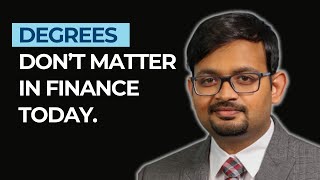
This is a YouTube video titled "Why Skills & Storytelling Matter More Than Degrees in Financial Modeling – Rachit Jain" published in November 2024. It features a podcast-style interview hosted by Paul Barnhurst with guest Rashid Jain, discussing financial modeling, the importance of curiosity, critical thinking, storytelling, and the integration of data science in finance. The conversation covers practical advice for aspiring financial modelers, the role of trust and communication in model usage, and the future impact of AI on financial modeling.
Degrees don't matter that much. They are definitely one of the mediums of how you could learn. But today online learning is huge.
In your view that financial modeling is a way of thinking.
If I am curious, I always think there's something to learn. I become curious about it and then I have questions about it and then I start learning about it. The only fear I have in my life is that I should not lose my curiosity.
Worst financial model you built worked with.
Had a cash flow statement. It had a P and L statement and a balance sheet statement, but three of them were not connected. I usually look at financial modeling as three pillars, ppt, people, processes and technology. If you notice any of the financial models, those three pillars have a major contribution.
Anything you found that how you present.
The model that should be trusted. The second part is storytelling plays a big role. Third and final follow ups Any advice.
You want to offer our audience? Maybe one piece of advice around financial modeling.
One thought for all the people who are trying to pursue or get into an actual modeling job is to foreign.
Welcome to Financial Modelers Corner where we discuss the art and science of financial modeling with your host Paul Barnhurst. Financial Modelers Corner is sponsored by Financial Modeling Institute. Welcome to the Financial Modeler's Corner. I am your host Paul Barnhurst, AKA the FP and a guy. This is a podcast where we talk all about the art and science of financial modeling with distinguished guests from around the globe. The Financial Modeler's Corner podcast is brought to you by the Financial Modeling Institute. FMI offers the most respected accreditations in financial modeling and that's why earlier this year I completed the Advanced Financial Modeler from FMI this week. I'm thrilled to welcome to the show. Rashid Jane, welcome to the show.
Thank you Paul. It's an absolute pleasure to be on your podcast.
Yeah, excited to have you. I know we've chatted a few times before we got to the recording and I've really enjoyed that. Right, here we go. Tell me that horror story. Worst financial model you built seen, worked with what? Wherever you want to go with that one. It's Halloween. I know you have a horror story.
Oh yeah, I have. I have quite many, but I would focus on a few. Like I would probably throw out like two of them and I would say like I've built probably a few of them as well, but the two that stood out. One of them was a model where this was one of the companies that I was working for previously when I joined the corporate model had a cash flow statement. It had a PNL statement and a balance sheet statement. But three of them were not connected. The thing that I was surprised seeing right out of college was that the company was forecasting the balance sheet items as a time series instead of really connecting with the dev model or the cash model, right? And the cash was a balancing figure. So I think that was a nightmare to me, you know, because I was surprised to see like how the decisions were being made. Cash is a principal component of financial model in order to like guide any strategic decision, you know, how were they doing it previously? So the first task that I took up after joining that company was to build a 3 statement. And that's where since then I have been trying to, you know, excel myself in three statement model. And at this point of time I would say I am, I can consider myself as an expert in three statement model, but that's one of them.
That doesn't surprise me that that would be one of them. That's a nightmare.
Absolutely. Like I usually look at financial modeling as with three pillars, right? It's, I usually call it ppt and I think I've heard that term a few times from other people as well. Basically people, processes and technology, right? So if any of your pillars, if you notice any of the financial models, those three pillars have a major contribution. So I think this was one of the people thing to the financial model. There was another example, and this is in one of the recent companies where the financial model and the forecast that it was doing was not nearly close to the accounting data. So here I would say it's the processes and the technology part that kind of was abused or didn't play well. And what happens is that if your accounting data is very different from the model data which, you know, you're forecasting your revenue, you are forecasting your cost. Let's say the front side of the company or the sales side has a different database or is generating a different data than your counting data. So the model maybe is relying or leveraging one of the sales data or the front end data, but the accounting data is completely different from that, especially for a financial company.
Right.
What happens is, let's say if there's a few accounting entries which are very important, for example allowances, right? Provisions for bad debts, right? For example, those are really accounting entries, right? Those are like some assumptions that are taken now if, for example, if the charge of data is not correct or if the front end data is very different from your accounting data, what gets booked or what gets allowed in your books as reserves is very different and your income forecast can completely get hosed.
Right.
So that's what I saw. I think data plays a very big role. Kind of garbage in, garbage out. Right? So this was another example where, you know, it was a very horror story.
Yeah, thank you. Thank you for sharing those two. So can you tell our audience a little bit about your background, how you got into finance, what you're doing today, a little bit of your story.
So I think since back, since, you know, in my childhood, as far as I can remember, I always wanted to be in finance. So that was a decision that wasn't that it was very clear in my mind that I'm going to go for that. So I went for my graduation. I did a bachelor's in commerce from a very reputed college in my hometown in India, it's called Kolkata. Did three years of that parallel. I started doing my cpa. So the CPA in India, it's called Chartered Accountancy Works. You can start it after your, you know, after your school, as soon as you start graduating. The thing about that is. So I started my journey with auditing and I started with Deloitte, the Indian chartered accounts. Since he has a mandatory training of three years, that has to be done. So that's where I started. And then once I completed my cpa, I moved on to hp, Hewlett Packard and their audit, internal audit division. When I was in the internal audit, there was an audit given to us. It was kind of an operational audit where we were also doing the scoping of the audit. It was a very interesting audit because HP had gone through a huge demerger. It was the biggest demerger of that time and probably even now, it's probably the biggest demerger. So HP split up into their printing division and the services division. And we were given this audit to audit the legal entity structure of the demerged companies. So I was part of one of the companies and we had to audit that. And I was working in India at that point of time. We traveled to the us, met different teams like the tax team, the transfer pricing team, the legal team, to understand why that structure is made, how that is made, because it was a very important part of transfer pricing. When I was doing that, I learned a ton about financial models because before that I, I wasn't very much aware of three statement modeling. You know, I, financial modeling. I couldn't, I, I couldn't even imagine there can be a separate team within FPNA just for financial modeling, because I had seen many companies doing that. So at that point of time. The, you know, I met a couple of teams including controllership, taxes, transfer pricing, like modeling and then integr model between, you know, those teams and very strategically putting those legal entities together. So that was the first interaction I had with a financial model. At that point of time. I decided, you know, I'm really good at this as an auditor. I understood that process, made a flowchart out of it, presented that whole flowchart and the whole process to my larger auditing. I was very appreciated. I even got recognized by the. I think the lady was the finance head of America at that point of time. So that gave me a boost of confidence.
Right.
So that's when I decided I want to go for, you know, I definitely want to do this. So what I did is within hp, I was an internal audit, started contacting a few people in the FP and a team showed them my work on the legal entity audit and why I wanted to move right to FP and a. That's when I got this offer. So it was an internal move from internal audit to FPNA within hba. That's how I started my career. During that process, again, I learned about quantitative finance. I was very intrigued about it. I definitely wasn't exposed to a lot of coding, but I had done some VBA by then and I was pretty good at it. So I took the leap. I was married by then. I came to us, did my master's in quantitative finance for two years. I finished actually this course was for two years, finished in one and a half years, got a job and since then have been working in financial models.
Thank you for sharing a little bit of that. Any advice you'd offer for others looking to get more into financial modeling, you know, make that a transition from the accounting to doing a kind of a modeling role. Maybe they're in audit accounting, you know, some other area and they really want to be working primarily on models. Any advice?
Absolutely. I think it's very important to understand, like what part of financial models do you like? Right. Or which part of FPNA do you fit into? Like, I think everyone has different skills even within fpn, right? So for example, I can say that I'm very good at three statement modeling. There can be another person in my team who is very good at SQL, but he doesn't know three statement modeling. And that's perfectly fine. There can be another guy who is really good at communication. And you know, I mean, communication is a part of parcel of everything that you do. But you know, you can have different skills and all those skills are useful for. So it's, I think I would say first it's important to understand why you want to go into financial modeling or fpa.
Right.
For me it was the numbers that attracted. It was the, you know, I love to think and you know, start from a blank page. But there are people who become anxious or have, you know, working out of a blank page. So I think it's very important to understand what you are good at and what you are not that good at. And once you decide that there is a part in financial modeling that you are really going to, you know, work with, just start with communicating and networking with people who are already in that field.
Right.
That's what I did. And start practicing some of the models. You could take a financial statement for any of the companies, download it from, you know, their 10k statement or thank you statement, start understanding it, make a three statement model. I think the first three statement model that I made, you know, taking a 10K was of lightning club and I loved it. You know, I, I remember that after I made the 3 statement, even invested in that company because I thought there's prospects. So start. That would be my advice.
Yeah, got it. Thanks. Great, great advice there. I love the networking, communicating and also building your skills. Talking about building skills. I know you're a big believer in lifelong learning. You've done a lot of schooling and different things. How has that, that idea, that mantra, always trying to learn. How does that make you a better modeler?
Sure, that that's a great question. So when I think about that, right. Like why did I go for multiple masters or why do I keep learning? I always feel the urge of, you know, keep learning.
I was gonna guess you just like pain. That's not it. You don't just like pain. Yeah. Anyone who does multiple masters, speaking as someone who did multiple masters, they just like pain is what I thought.
No, seriously, I would still say like degrees don't matter that much, right?
No, they don't.
They are definitely one of the mediums of how you could learn.
Right.
But today online learning is huge. But I think when it comes to lifelong learning, for me it relates, you know, to, you know, increasing my confidence levels.
Right.
Getting some kind of self satisfaction.
Right.
So if you, if I am curious, which I am most of the time, you know, I always think there's something to do.
Right.
If you show me a few Excel functions, I don't know, I would be intrigued and I would be curious to know more. Right. So that's how I think my journey has led me to here. So as I said, when I was in audit, I came across a financial model and I was intrigued about financial modeling. Then when I was a financial model, I got intrigued about quantitative finance because I came across vba. Similarly, when I was a financial model, I came across some data science stuff. So I'm doing some of data science stuff now. So it's always like a point where I learned something about data and then I have questions about it, I become curious about it and then I start learning about it. So I think the only fear I have in my life is that I should not lose my curiosity.
Right?
Until I have my curiosity, I would keep learning is what I feel 100% agree.
I think one of the best skills you can have as a finance professional, FP and a model building anywhere where you're at is being curious. I think that's true of any role, but particularly in finance when you have to learn so many different things around the business, right? We're a support function. You got to learn how everything else works. I think curiosity is huge. But I want to ask another question. I think it kind of goes along these ways, but when you and I chatted, you mentioned in your view that financial modeling is a way of thinking. Can you elaborate on that or tell our audience what you meant by that? What do you mean when you say modeling is a way of thinking?
So this is kind of what I want to really communicate here is that one of the key components of doing financial model is first is like thinking critically, right. Critical thinking is part of it. Like in general, like how would you classify a good model or a bad model?
Right.
What is a good model? What is a bad model? I would say in my own terms that a model to which if you throw a good quality of inputs and it throws the correct result, that's a good model. But if you throw bad inputs to a good model, it would still throw a result that is reasonable. But if you throw any kind of input could be good or bad to a model which isn't good, the results could be the same.
Right.
And it doesn't change the result. So to me, modeling is something which helps you to understand. I think there's a very famous statement that you always quote, models are always wrong, but some are useful.
Yes.
George Box and I love that quote. Yeah, it's very popular in the statistics community as well. And what is meant by that is that when you have to model anything, right. It could be for the firm that you're working, it could be something related to your personal life even, right. Is that you want to understand what's going to happen in the future and what's happening currently and how both of those situations would relate, right. How would things move in the future?
Right.
So when you have, when you have that question, you take a blank page and then you try to understand and jot down all the points in very simple terms. And then as you understand more and more and you go into that model things, you also start doing some complex modeling. That's how you actually structure a model.
Right.
So I would say, like when it. When I said that, you know, financial modeling is a way of thinking, let's say you have a decision to make in your life, right. Where you have to buy a car or buy a home, right. And I can give you a personal example. I was looking for some houses, and I was probably three months into the process of looking into houses, and then I started doing some math. I, you know, put all my personal finances in a paper. I put where I want to be in terms of financial terms and let's say 10 years from now, right. And I did a lot of math and I understood that this math is not making sense, right. So I made a decision because I made a model. I'm not saying that all decisions should be made quantitatively, but if you have a goal which is quantitative, like having some kind of fun, you know, financial position in your future at that point of time, a model is really helpful.
Right.
When I was in India, I made a model for my friend where he wanted to understand, you know, how he could save taxes.
Right.
So I understood his personal finances. I made a model for him and it helped him. So I think it's. Once you. A good modeler is a person who definitely understands simplicity as well as the complexity of a financial model. There's again, a very famous quote that I always, you know, keep reminding myself of is when you are constructing a financial model, everything that is simple is false, Right. And everything that is complex is unusable.
Right.
So it has to be some kind of a middle ground. And that middle ground actually comes from a place where you have a goal in place and then you start modeling it on a blank page and start going step by step.
Yeah. I mean, at the end of the day, we're trying to approximate something that's going to happen in real life, right. If it's too simple, it loses some of its usefulness. Often there are times when maybe you can keep it super simple and be useful, but it's Hard. And when it's super complex, it's a matter of time till people stop using it. Just a question of when, not if. And so, yeah, there's a total art in trying to find that right balance and know when does it make sense to be detailed? When do you have to make it a little more complex? Yes, we all want simple formulas. We all want it to be simple. And that's the goal. And there's a good reason for that. But there are times when you have to add more complexity than you want. But that's when you need to know your audience. You need to know, can it work in this situation? What are the benefits? And then, you know, just make a smart decision. And that comes with experience. Hence why so many of us have horrible models early in our career. Because we don't have the experience.
Absolutely. I think I, even now I make models which are not like 100% like, you know, accurate or no model can be accurate. It's always based on the inputs that you're putting.
Yeah, totally get it. I. I'm with you. You know, since you mentioned you've modeled, you know, a few things in your life and help people model decisions, I want to ask you a question that we often ask our guests. What's the most unique, funnest, interesting model you've ever built in your personal life? Could be fantasy football. I had one person to build a model of the track. How many times a show used profanity in it because he found they used it a ton and he wanted to know, so I've had all kinds of answers before. What's yours?
I don't think I have a very story that's as funny as, you know, morning profanity.
Yeah, that was a pretty good one.
That was a pretty good one. Yeah.
Yeah.
But I would say at one time I used to go on hikes a lot, right? I still go on hikes. So there was a year when I was financially a little bit tight, right. So I had to take decisions strategically and I had to make my budgets and I had to abide by. So I made a financial model as to how I could keep my day to day, survive through my day to days as well as keep my hiking trips alive.
Right.
So I made a financial model for that. And I remember that I'm big on Starbucks coffee. So I started putting, you know, how much I spend on my coffee every day and Starbucks, right. So you spend about $6 every day if you have Starbucks coffee every day. And if you multiply 6 by 30, that's almost the right and a hiking trip doesn't cost that much. But I think three, if you can save $360 a month, that could well sponsor your hike. So I think the result of the financial model is that, you know, I saved on my coffee budget and I went, I kept going for my hikes.
Love it. Two funny ones I think you'll appreciate. Neither of these I've shared on the show. These are people I know. You read an article where there's one guy who tracked in a model how much he paid for every piece of clothing he ever bought, what the brand was, how many times he washed it before he got rid of it, and so what was the cost per wear to make sure he brought the brands that had the greatest value? And I'm just like, nah, too much work. Sorry, I just can't do it.
I would say that's like overfitting financial models in your life, you know.
But if it made him happy and it's what he wanted to do and.
It was, go for it.
But yeah, I'm with you. It's like my other friend that built out to schedule in an Excel file down to the minute because he was so busy. No thanks. I don't want my day scheduled to the minute. It's plenty busy enough as it is.
You should definitely you have to think about the details when you're making a model. At least this example states that that person went into the details right FP.
And a guy here. And as you know, I am very passionate about financial modeling in the Financial Modeling Institute's mission. I have been a huge fan of the FMI for years and I was super excited when they decided to sponsor the Financial Modelers Corner. I recently completed the Advanced Financial Modeler certification and loved the entire experience. It was top notch from start to finish. I am a better modeler today for having completed the certification. I strongly believe every modeler needs to demonstrate they are a qualified financial modeler and one of the best ways to do that is through the FMI's program. Earning the accreditation will demonstrate to your current and future employers that you are serious about financial modeling. What are you waiting for? Visit www.fminstitute.com podcast and use code PODCAST to save 15% when you enroll in an accreditation today. Yeah, it gets back to that. Finding that right balance. One of the things we all know we talked a little bit about this models are to help guide decision making, particularly strategic decision making. If we build a model but we don't use it to help make better decisions to help guide us. Not the only thing we're going to use, but for not using there. I think most people would say you probably don't need the model, then it's a failure. When you're building models, you're working on it. How do, how do you ensure that the model actually gets used in the decision making process? Anything you found that you know helps? Is it how you present the model? Is it making sure everybody knows the inputs buy in? What, what do you think is kind of key there?
Sure, Paul, I think it's a great question and I would let me divide this answer into like two or three parts. Sure. Because I really want to answer this in detail. So the first part is, I would say there should be trust in the model. And it's not only you who have, who has to trust in your model, but the executors or the decision makers in your company have to trust in the model.
Right.
And how can that trust be built in the model? Either you have presented results in the past which align with the company data or the outcomes that the company has seen so that can build the trust, or you present the details behind the model like the inputs you have taken, the methodologies you have applied and explain that to your executors and you can also present some stress scenarios, or you could just lay out how the financial model works and through the detail and that can build the trust. Whatever the way is, the point is that the executive should have the trust in the model.
Right.
So that's one. The second part is I feel storytelling plays a big role.
Right.
So let's say you have done some analyses, you have come out with some kind of red flags in the business that you want to report to your executive, or you have come out with some kind of opportunity, could be in terms of cash or profits, and you want to present that to the executive. And how would you communicate that?
Right.
Like you could. I think there is definitely an impact to be created by storytelling there. You have to communicate, you know, why there is an opportunity. How, how do you see the opportunity to be there or why do you see your risk there? So storytelling is the second option. And the third and final part in case of strategic decision making is follow ups. So there have been numerous times, I think, where, you know, I've presented things, done some ad hoc analyses and everyone is aligned on the call. They trust, they have trust in the model, but they are busy people.
Right.
You are not the only person who are presenting them with opportunity or risk.
Right.
If the company is huge. If the team is huge, there are other people, there's tons of things to look at from their perspective. You have to keep following up.
Right.
And you have to keep it in your. You have to probably make some notes if you can't remember. But you have to make sure that they are kept aware every week, every month that this is something that is still on the parking lot and we have to think about.
I love the first first one and third one really resonated me and I think all three are great. But the first one when you talked about trust, I love the example in From FMI gave where he's like, you know, when you get in your car, do you pop the hood and look under it and make sure everything's working right or do you just press the button and expect to be able to go or turn the key? I'd say 99.9 of us do that right versus looking under the hood. It's very similar with the model if you're taking the guy all over the place and there's no structure, even if you're right, like you're bouncing from sheet to sheet, you're losing trust that whole way through. A lot of that trust part comes down to good design. There are so many other things involved. But that's what I kind of thought of is when you have a well designed model that's easy for them to follow, it's much easier for them to trust the model even though you may be wrong. And the person who has that sloppy model could be right even though they're, you know, there's no right, but you know what I mean, more accurate. They're going to lose trust. Obviously you want both, but that's the first one. And then you know, with the, the last one, you said on follow up that that is huge. Often everybody gets excited in the meeting but you have to make sure that the assignments, the things happen. I'd say it's especially true as an FPA professional. It's one of the biggest things is hey, we tell all the problems that's happened at month end, making sure you follow up on those and you're giving recommendations and changes are happening to improve the business.
Absolutely, absolutely.
Yeah.
All right, so you got a little bit of everything here. I know you've done finance, accounting, quant, you've also done some data science, you know, R Python, other things. How is how has having data science skills and having learned data science, how does that help you with your modeling?
Absolutely. I think a lot of people think about data science as a different world than fda, right. We have been thinking like that today. We are not in a position where data science is completely integrated with fpna. When I think about as an FP and a guy, I would say we always focus on explanatory analysis. We find variance between actuals and forecasts or actual and budgets. And then we try to attribute those differences to, you know, where that difference is coming from and do an attribution analysis that. And then we try to do an explanatory, explanatory analysis where, you know, we present to the board why those variances are there. You know, is it because of some of the business drivers or is it because of economic scenarios, macro scenarios and whatnot. But when it comes to data science, what I've learned and what is really useful is explain, explore exploratory analysis, right? Where you basically look at data from a very unbiased perspective, having no opinions about the data whatsoever. Whereas in case of FPNA we look at data with some kind of opinion and understanding that what that data is going to tell me. But when it comes to data science, it's the understanding is the first thing, you know, how you go about it. You do a ton of statistical analysis just to understand the data. You look at the distribution of let's say a variable. You know, you try to understand is it normally distributed on a very basic level, does it have some kind of skewness kurtosis? You just try to understand the data and then you do more explo exploratory analysis to understand the data and you keep doing it. And I would say Data science is 80% about exploratory analysis at, you know, it takes 80% of the time and then the 20% time goes on modeling. And I will give you an example here. For example, I am in the financial industry, right? So for us interest rates is very important, right? But when we look at interest rates, I could, in my models I could simply rely on let's say the CME Fed Watch tool take the future forecasted interest rates from there it would even go the auditors, right? I don't have to create a member to explain them why I have taken those. But the CME Fed Watch tool would only give you a forecasted interest rate for let's say a year or a year and a half maximum. But when you do a five year modeling, right, you need a more sophisticated model when it comes to interest rates because there's a ton of factors that influences is the macro factors, geopolitics right? So when I was doing quant and even in data science, what I learned is about models like there's something called Hull White model, Vasichek model model, CIR model, and this is just an example. Those are basically interest rate forecasting model, which basically the even the Fed uses to forecast interest rate changes. And what it does is it takes a long term target interest rate and then kind of mathematically arrive at a mean reversion rate to understand. So this is one example where if you don't have a logical way to estimate and interest rate in the future, it's better to apply some of those models than just do guesswork, right? That's one place. That's one place where I can easily apply what I've learned in a data science course. I already talked about exploratory analysis in case of data a ton of times. We also deal with, especially in the financial industry, I'm sure in other industries as well, variables which are very random, which you can't predict. Let's say demand, right? Demand. You could go to your sales team, you could ask them, you know, where do you see the demand to be? First of all, there's always a wall between finance and sales which should be broken, but in a lot of companies it's not, right? But do you have a roundabout, you know, do you have an alternative to. That is something that data science presents, right? That if you can't predict a variable on a reasonable basis or a variable for which you can't find drivers, reasonable drivers in your forecast, that's where quantitative modeling comes in, right? You have a couple of things that you could rely on, models that you could use to predict those values. Now what these models do exactly is if you have heard about black Scholes, right, that people use to price auctions in, right? That's based, that's nothing but a random process, a stochastic process. It's based on Brownian motion, which is a very complex topic, but a way of predicting random movements. For example, if you are making a model, what's the first thing that you would keep in mind? The most important thing for a model, in my opinion, when you are doing a forecast or a five year plan, is that you make sure that the business doesn't have a single point of failure. I think I heard it in one of your podcasts. I think it was with Carl Seedman when he talked about that modeling is not black or white, right? It's basically when you project something in.
The gray area, right?
I think he said that where he said that, you know, there's a range of possibilities which fall in the gray area which are acceptable to the company. If it's black, it's a single point of failure. Right. So when it comes to like creating those scenarios and making sure that those single point of failures are avoided in all the scenarios, all the possible outcomes, that range of outcomes that you're presenting to the board or you're modeling in your financial model.
Right.
In those cases, scenario again, data science comes in, you can use Monte Carlo simulation, for example, to understand the volatility of your particular variable. And probably I'm going a lot into quantitatives now, but that's how data science and quant can play a huge role in FP&A. And I think apart from learning tools like python R or SQL, I'm not saying that it's 100% important for a guy in FP and A to understand all of this, but definitely if you understand this, you have an edge over others.
Right.
You have ways to make your model a little bit more sophisticated, understandable, auditable.
Right.
Makes sense. Yeah. There's definitely benefits to having it. You don't have to, but there are definitely benefits. All right, we're going to move into our rapid fire questions section. How this works is you have to pick a side on those that are yes or no. You can't say. It depends. At the end you can elaborate. A one or two. You get no more than 10 seconds for each question and I'm going to run through them and then at the end there's one or two that a little more context, but we'll start with this first one. Circular references. Yes or no?
Absolute no.
Vba yes or no?
Yes.
Dynamic arrays in your model. Yes or no?
Absolute yes.
External workbook links. Yes or no?
Yes, but with an asterisk.
All right, well, we'll find out. The asterisk at the end. Named ranges. Yes or no.
I haven't used. Maybe I have used, but I can't remember. So I would say no.
Okay. Do you follow one of the formal standards out there, like smart or fast? Like a formal standards board when building your models?
I think there was one instance where I use a fast model. Okay. But it was way back in time. Yes.
Should financial modelers learn power Query?
Yes.
Should financial modelers learn Python, Python and Excel?
Absolutely. Gives you an edge, but not necessary.
Not necessary, but beneficial. What about power bi?
Yes.
All right. What financial statement is most important? P and L? Balance sheet or cash flow?
Honestly, I think all three of them. But If I have to answer, a compelling answer would be balgy.
Okay, I agree. They're all important. Right. With all these, there's a lot of context for sure.
Yeah.
Will Excel ever die, yes or no?
I'm going to give a standard answer on this. I don't think in my lifetime.
That's not an uncommon one at all. Will AI build the models for us in the future?
Yes and no. I think I have a few things to talk about here, but a clear answer would be yes.
Okay. And we'll come back to that one. We got the asterisk and we got this one. Do you believe financial models are the number one corporate decision making tool?
Not the number one.
What do you think is then? What do you think is number one?
I think the number one is definitely, probably the intuition of the decision makers. We always try to guide and communicate or storytell executives as to what the financial model indicates. But ult, ultimately there are still decisions being made that, you know, goes opposite to what a financial model says. And I've seen that happening. So I would say it's always the human element more than a financial model.
Fair enough. What is your favorite Excel shortcut?
I actually use shortcuts all the time. I hardly use my mouse when I'm using Excel, so I have a few of them. The one shortcut that I use very often is like control C, control E S, could be V, F, E, alt.
Pay, special value, formulas, formats, whatever it might be. Exactly. I use that one a lot.
Exactly. And I would say another one is I don't know. So it's alt and the semicolon. It's when you have to select particular cells within a range of cells.
Got it?
Yeah.
What is your lookup function of choice or you would choose vlookup Index match. Xlookup Something else.
I have been using xlook lookup a lot. To the extent that I have, I might have to like even recap my knowledge on index match. So I would say xlookup.
Yeah, got it. No, I understand. I use xlookup most of the time these days too. Right. I think there is at least two you wanted to respond on. I think there was an asterisk around. Was it external workbook links that you had an asterisk on?
I think that's a clear. Yes, I would say like it definitely some kind of methodology or, you know, standard that has to be set when using external workbook links.
All right. There was one other you wanted to elaborate on AI and building the models in the future. Let's get your thoughts on that.
So when I think about AI, right? How can AI replace financial models is we spend a ton of time in modeling things and, you know, even to identify, like, what's the best function, what's the best formula, what's the best horizontal, vertical, what should I, you know, what methodology should I apply in my model? I think that's where AI can automate things to a large extent. For example, you could just give commands, right? Maybe could be voice commands or written commands that, you know, I want to do this with my data or I want to, like, filter my data by this. Every time I look at this data. And that gets done. And the financial model gets made by itself using AI. But I think what cannot be replaced is the decision making, the analyses, the critical thinking part of the financial modeling, that still would be a responsibility of the modeler. But when it comes to, like, spending time on Excel or any of the tools as to, like, how that thing is to be built, what formulas to be used, I think that part would be replaced by AI very soon.
Got it. I think there's probably a lot of people that share something similar. I get all kinds of, you know, different answers on the show. It's always a fun one to get people's perspective on. All right, we're coming up on the end of our time. I've really enjoyed chatting with you. Just two questions last. The first is any advice you want to offer our audience. Maybe one piece of advice around financial modeling or something else that you kind of those parting thoughts you'd like to leave our guests with.
Absolutely. I think one thought for all the people who are trying to pursue or get into a financial modeling job is to understand that critical thinking is one of the major part of it. And the next thing would be probably communication skills or storytelling skills. So I would say anyone who wants to get into that field, it's important to, like, imbibe those skills before you actually get into a financial modeling job. It's very similar to, let's say if you're going to do a master's in your Quant, you are 100% prerequisite that you know, Python and R, for example. Right. So it's. It's always said that, you know, even let's say when you are doing a CPA before you appear for the final exam, you should be a cpa.
Right?
Because it's, it's the name that comes later. So I would say just start practicing those critical thinking skills. Try to understand what's going in the macroeconomic scenario. There's a lot that's going on now, right? Geopolitically, even within us, socially. Try to understand what's going on because all of that impacts every business.
Thank you. Appreciate that advice. Last thing, if someone's listening to this and maybe they want to get in touch with you or learn more about you, what's the best way for them to do that?
I'm pretty active on LinkedIn. I think I check my LinkedIn account at least once in a day, So I think LinkedIn is a great way to reach out to me.
Got it. I wish I only checked mine once a day. I won't. I won't even admit how much time I spend on LinkedIn, but it's less to be. I'm making progress. Thank you so much for joining us for Shit. I really enjoyed the conversation, you know, getting to chat with you for a few minutes and just seeing your perspective on things, because that's what I love about the show is everybody brings a different perspective and different lessons that we can learn from. So thank you for sharing yours. And you have a great rest of your day.
You too. It was great speaking to you. Thank you so much.
Financial Modelers Corner was brought to you by the Financial Modeling Institute. This year I completed the Advanced Financial Modeler certification and it made me a better financial modeler. It. What are you waiting for? Visit FMI@www.fminstitute.com podcast and use code podcast to save 15% when you enroll in one of the accreditations today.
More from Paul




Trust and Leadership Lessons for FP&A From 100+ Top Leaders with CFO Jon Laudie






