Why Unified Systems are More Important Than Ever in the Era of AI with OneStream CEO Scott
In this Future Finance Show episode, host Paul Barnhurst and co‑host Glenn interview Scott Lischinski, President of OneStream Software, about the strategic role of unified enterprise performance management (EPM) platforms in the AI era. The conversation covers OneStream’s recent take‑private by HG Capital and how the new ownership enables a longer‑term, AI‑first R&D roadmap. Scott explains OneStream’s unified architecture—a single data model, metadata layer, calculation engine, and workflow that eliminates fragmented point solutions—and why this foundation is essential for reliable, finance‑grade AI. The discussion delves into OneStream’s Sensible AI portfolio, including specialized finance agents (analyst, search, deep analysis) that provide contextual, near‑100 % accurate answers, contrasted with generic large language models. He describes built‑in transparency mechanisms such as chain‑of‑thought reasoning, drill‑through traceability, and a validation framework that benchmarks forecasts against historical data using metrics like MAPE and MSE. The episode also highlights the distinction between probabilistic generative AI and deterministic machine‑learning forecasting, citing customer results of 24 % forecast accuracy improvement and 86 % time reduction. Scott shares his career path from GE Capital to consulting to OneStream, emphasizing the shift from manual Excel‑centric work to AI‑augmented finance. They discuss talent implications, noting that 89 % of finance students feel AI‑ready versus 54 % of professionals, and the need for upskilling. Looking ahead, they predict a move from systems of record to systems of intelligence, continuous planning, and deeper integration with Microsoft’s productivity tools. The episode is sponsored by Qflow.ai, which offers a strategic finance platform for go‑to‑market alignment.
Chapters
Welcome to the Future Finance Show, where we talk about treasury management on Mars.
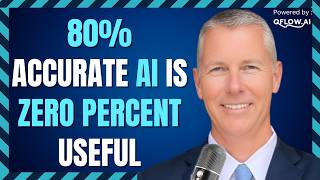
Now in this AI era, the question isn't whether you have AI, it's whether the underlying architecture allows AI to work effectively. You can't run a high-speed train on fragmented tracks. Without it, AI can ultimately scale confusion within the business. But really with that unified platform, Paul, that's what really helps to scale intelligence within the business. Instead of having to build up this great capability to go and climb the mountain, I think we've lowered the mountain now. We aren't delivering the general practitioner. What we're delivering is the specialist surgeon, if you will. Today's guest is Scott Lischinski. He is the president of OneStream Software, the enterprise finance platform that unifies financial and operational data, embeds AI for better decisions and productivity, and empowers the CFO to become a critical driver of business strategy and execution. Specialized native agents, which is what we've now brought within our Sensible AI portfolio, is really that deep contextualized understanding of your data, of your business. In order to really build that context, if we were to deliver an answer that was 80% accurate, it's 0% useful to our end customers.
We need to deliver capabilities that are highly performant, but that have near 100% accuracy and the answers that they invoke, the magic black box problem where the agent goes out, does a bunch of work, and then comes back and gives me an answer. How am I going to defend that? How do you guys address that for something that truly is working agentically?
It would be pretty indefensible to walk into the CFO's office with a forecast and say, well, Sensible AI Forecast produced them. Just trust us. Yeah, it's a great question. And to your point, I look at it where now we're entering what I would call the next chapter of AI.
Future Finance is brought to you by Qflow.ai, the strategic finance platform solving the toughest part of planning and analysis. B2B revenue aligns sales, marketing, and finance seamlessly, speed up decision-making, and lock in accountability with Qflow.ai. Welcome to another episode of Future Finance. I'm your host, Paul Barnhurst, and this week I'm joined by my trusty, uh, co-host. Did you call yourself Stinky or was it the Moose, Glenn?
That's for our morning radio show. That's— you weren't supposed to say that on air.
Oh, that's right. Well, so my co-host Glenn is here with me. How you doing, Glenn?
I'm doing good. I'm excited about today's show.
Do you want to do the honors and introduce our guest? We'll just jump right into things.
Absolutely. Scott, welcome. I'm going to introduce you to our audience here and we'll dive right in. Our guest today is Scott Lischinski, President of OneStream Software. For anyone who follows the enterprise finance space at all, you probably have seen the news recently that OneStream just completed its acquisition by HG Capital at a $6.4 billion valuation, now taking the company private after about 18 months on NASDAQ. So Scott's joining us at a pretty pivotal moment. His path to the president's chair has been a pretty interesting one. He started in corporate finance at GE Capital, then co-founded a consulting firm called Bluestone International, spent nearly a decade as a managing director at Huron Consulting Group leading finance technology transformations, one of Paul and my favorite topics. And then he joined OneStream in, in 2021. Before being promoted to president in January, he was running OneStream's AI business unit. Where he drove 60% year-over-year growth in AI bookings. So he's not someone who just talks about AI in finance. He's been building it and selling it. And today we're going to dig into what AI actually looks like when it's embedded inside an EPM platform, how finance teams are learning to trust it, and what all this means for the future of finance. Scott, welcome to the show.
Glenn and Paul, it's great to be here with you both and looking forward to the discussion today.
I think the timing, it's got to be, you know, it's interesting out for us outside as an observer. But for you guys, I imagine it's quite a time. The HT Capital acquisition just closed, taking the company private, like I said, after 18 months as a publicly traded company. What is going private at this point? What does it mean for R&D investment and the product roadmap? Like, how does that change what you were doing as a public company?
Yeah, and to your point, it's a really exciting time right now in the journey for OneStream. We obviously have been on a high growth trajectory, you know, really since the inception of the company. It was a great opportunity. When we took the company public and as you said, had the opportunity to operate in the public markets for effectively 7 quarters. But now as we start this next chapter and particularly in this era of AI, it's an incredible opportunity. I mean, first of all, if you look at how we perform to date, you know, we've had strong performance going into this next chapter of the company. And really we look at the new partnership now with HG as an opportunity to really continue to focus on our AI-first strategy as a company. Instead of having to have the adherence to a 90-day calendar quarter, which we did in the public arena, this is now the opportunity to really focus on more of a long-term view on our R&D strategy and do so without the constraints of quarterly earnings pressures. Now obviously, Glenn, we'll continue to be disciplined in how we operate the business, but this really allows us to accelerate on the investments in areas that'll be most impactful for our customers. Again, that gets into the AI-first strategy, that gets into our product roadmap and also allows us to continue to invest in our partner ecosystem. So all of which should be really to the benefit of our customers.
I'm biting my tongue right now to keep from going down the, like, OpenAI going public, Anthropic and all that. It's in recent news. You've seen, I did see something that, I don't, Insider, some analyst said no way OpenAI could even consider going public for another year because of they don't have the controls in place and all that. And I think sometimes companies, I mean, obviously with the capital concerns that they have, I understand why they're doing it, but sometimes companies put that level of reporting requirement on a little early. And I know you guys are obviously more mature like that and you're not under the massive spend pressure that OpenAI is, but being able to not have to live and die by the Qs and being able to step back and take that more longer-term strategy, that has to be a significant, it gives you more ability to think. Long-term, not just quarter to quarter.
No question about it. And particularly right now, when you look at, you know, I think in my nearly 30 years of working professionally, I don't know that I've ever seen a pace as quick or as, you know, as rapidly evolving as the current markets that we're operating in. And so for us, again, this is just an incredible opportunity for us to really double down on the strategy that we've known to be true, that HG, we have a high degree of alignment with our new business partner in HG. And so for us, it's really an opportunity to drive further acceleration on that strategy and deliver even more, more value for our broader stakeholders. So that gets into, again, our customers, our partners, our employees, and the HG team as well. So it's a great opportunity and really starts what we believe is going to be the best chapter yet written for OneStream.
I will say HG Capital, I've had the opportunity to talk to them, some of their analysts every year. We, talk about the market. I've worked with several of their portfolio companies. As you know, anyone knows publicly, they own several in this space beyond just OneStream. And so I've always been impressed with their philosophy here and enjoyed working with them. So I think you're getting a really good partner that probably knows the space as well and as deep as any of the private equity. I mean, you just have to look at their portfolio and it's pretty obvious that they big stake in this space and they know what they're doing.
Would strongly agree with that, Paul.
You got a good partner there. So I'd love for you to take us through your career arc, right? GE Capital to founding your own company to consulting and now making the jump to a software company. Kind of what pulled you to one stream and maybe just take us a little bit through that career. It's always interesting to hear how that journey goes because I'm going to guess 30 years ago when you started or 25 or whenever it was, this wasn't the path you envisioned if I had to guess.
So it's interesting, you know, and again, each chapter is kind of served a role in or, you know, has had influence in into kind of the direction into where we are today. So, I started off, as you said, in corporate finance. So, started off, you know, working in FP&A at GE Capital for a number of years. And that really served as my introduction to the world of technology. Because at that time, I had the privilege to be brought on board a team that was really running a finance transformation program at GE. And what's interesting there is at that time, we were going through the Intrepidation, on do we transition off our Excel spreadsheets into this big world of enterprise software? And we sit here and we laugh at that now, but I would argue there's a similar intrepidation right now when we think about how we drive enterprise adoption of AI in the ecosystem. But I'm gonna park that for a second. But so to your point, I started off in, you know, really in the Office of Finance, and that helped to build a deep appreciation of the job to be done for who is now ultimately OneStream's customer, which is really, as we serve as the AI-powered operating system for the Office of Finance. I then left GE, had the privilege to serve as one of the two co-founders of a, of a really a technology consultancy. And we figured that if the capabilities that we're bringing to GE were delivering value there, there's a bigger opportunity than serve there for a number of years. That business was ultimately acquired then by the Huron Consulting Group. And then spent nearly 8 years at Huron helping to build out their bigger technology consulting practice there. And part of that, Paul, really, that experience afforded me the opportunity to get a broad, you know, a broad range of exposure, not only in terms of the transformation that we were delivering for customers, but also across a broad continuum of different technology platforms. And so really where that started to form my view on really the broader technology ecosystem is a lot of the work that we were doing, you know, fell under the umbrella of really finance transformation was being delivered by a lot of point applications and point solutions. And I felt like while we were delivering, you know, that initial incremental value for the customer, the overall job to be done left the customer with a high level of technical debt. And so I started to look at it and really there were 3 things. Number 1 is, is again, the recognition on the capabilities and the solutions that we were delivering for our customers was again being done with point solutions. So that being number one around technical debt and looking for ways to better deliver that. Number two, when we start talking about, you know, really a platform in the market, it was also the recognition on there are also a lot of bespoke processes that would be better served by being brought into or on top of a unifying platform for the customer. And then number 3 was the recognition of machine learning and even more broadly artificial intelligence was starting to pick up more and more focus by customers. So I started to have the reflection then on where is the place that is really gonna help really deliver on the objective, on the job to be done for the customer on a common unifying platform and bring these modern capabilities that the customer has come to expect with artificial intelligence. And that obviously is OneStream, where, you know, at OneStream, our, you know, our, if you look at us as an organization, our vision again is really serving as the AI-powered operating system for the Office of Finance. And really the mission as we serve our customers is to really empower every finance organization and every finance end user to exceed their potential on what it is that they can deliver. And so OneStream really is, you know, kind of the perfect place to be, you know, in this area.
Actually, as you're talking, I realize, you know, we're all very familiar with OneStream, but a lot of our listeners may, you know, may be in the SMB space or aren't familiar with really the whole EPM model. Can you give us the, because as you're talking about this, it sounds in a lot of ways like the, you know, the holy grail of yes, that's what I want. But, you know, a lot of our listeners may not have ever encountered an EPM before. So if you can tell us a little bit about OneStream, you know, the kind of the elevator pitch, 2-minute version of it. So, so that our listeners understand.
I talked a little bit around OneStream serving as that AI-powered operating system for the Office of Finance. So when you think about OneStream, you know, we really serve as that unifying platform for our customers to bring together not only their consolidations and close capabilities. So if you think about how our customers— when you think about the Office of Finance, there are a few core tenets that our customers look to OneStream to deliver on. Number one is how do we deliver their consolidations and close process, everything around how they ultimately produce the actuals, but also bringing those together and unifying that, that workflow with how our customers plan and forecast the business as well as drive all of their reporting and analysis. And so part of what's really notable here, and this gets into how we ultimately think about, you know, defining or putting clarity around a unified platform, you know, unified platform is not a bundle of loosely integrated tools or models. It isn't a, you know, it isn't multiple applications sitting on top of a data lake. When we think about a uniform, really a unified platform, Glenn, really what that is, is a single architecture where data, metadata, logic, and workflows all operate on the same unified model in real time. And that is what OneStream has delivered, is that capability. So when we think about just to further break that down, Glenn, You know, you think about a data model that gets into how our customers have their actuals, their plans, their forecast, as well as operational drivers. One metadata layer. So all their dimensions, their dimensional members, their hierarchies, and their business definitions. One calculation engine. So you're not having to deal with synchronization or the reconciliation across point tools and also one workflow layer. So specifically for planning, consolidations, reporting, all unified together. So the one and one stream has never been more important than it is today.
You'll notice Paul is wearing his Excel gear. I think he's feeling threatened. But in this, for our viewers, Paul's got his function hat on and his Excel MVP as well. But actually, Paul, I know you had a question about that, but it's, I think for anyone who hasn't worked in a system like OneStream before, it may be hard to visualize.
Yeah, you know, Glenn, as far as the hat and shirt, let's see, I did an Excel community hour and a half and I did a bunch of training around Excel and I didn't change that. That's what it comes down to. I actually thought about like, probably should change. I don't have time. We're just going with it. So there you go. No, no offense to OneStream. I love the planning tools as well, but today is an Excel hat. So we'll have a juxtaposition for people, reminder that no matter what tool you use, you're probably going to use Excel or a spreadsheet along the way. All right. So as we talk about unified platform, Scott, I'd love in practical terms, what does that look like for a Fortune 500? You mentioned, hey, unified cube, workflows are aligned, but comparing that to a legacy stack of tools, kind of walk us through what that looks like.
So I talked earlier around, you know, again, kind of that common data model, but part of what's notable within OneStream is the flexibility. And Paul, to tie back to the Excel connection, it's not lost on us what the customers expect in terms of end user experience and the flexibility. So while we do have that common data model, one thing that's notable about OneStream is what we refer to as our extensible dimensionality. So that allows the customer then to look at the business under a, you know, again, going out, whether it's on a geo basis, whether it's on a business unit basis, whether it's on a product basis, and whether you're looking at it for financial planning or operational planning, to have the flexibility in that common data model to support the distinct needs of the customer from a design standpoint. So this all becomes really important because again, when you think about one stream, and, and I'll tie that in where that becomes important later when we start talking about artificial intelligence, But I think what's notable here is where and why this becomes important. When I start talking about the difference between integration. So when I hit on it earlier and I talked about one data model, one metadata layer, one calculation engine, one workflow layer, you know, really being kind of the keys to the one and one stream. Now, the difference, though, Paul, is when you start to carry that forward, you know, the difference between you know, will we see point solutions being referred to as more integrated solutions versus OneStream, which is much more of a unified platform. Those differences become even more notable now in this new era of AI. So, you know, when you think about, you know, historically finance teams could survive that level of fragmentation in point systems because they accepted the need to go out and do the reconciliation across inconsistencies, whether it was in terms of calculations or how you were tying out, you know, forward-looking either the budget or forecast to actuals. But the point being is, you know, in addition to accepting those, you know, the need to go out and do the reconciliation on those inconsistencies, you know, prior to AI, I would also say, though, Paul, that planning cycles were typically slower in nature, meaning you were going out and you were doing a planning cycle, let's say, every month or every quarter. So, you know, the insights, those, the latency there historically was tolerated. When you fast forward to where we are now, AI really starts to change the rules on this. And what becomes notable here is that AI really amplifies that fragmentation risk that I was talking about earlier. So, you know, you, and the metaphor that we oftentimes use is, you know, when you start thinking about fragmentation, and how in an AI world, you know, it shifts really from inefficiency to AI. Now in this AI era, it really becomes kind of structural failure, if you will. And you can't run a high-speed train on fragmented tracks. And so now with AI, what's notable about OneStream is, you know, we see our customers starting to move from, you know, from what before were these less frequent processes And really with AI now, Paul, what we're seeing with OneStream and with our AI capabilities is many of our customers are moving more towards what we would refer to as continuous planning. So not periodic or continuous close processes. So forecasts update dynamically, you know, based on actuals as well as updates to some of the drivers that they're using. And AI models then are operating on this near real-time, but also, you know, financialized data within OneStream.
Thank you for that. And when you mentioned, you know, kind of the, you mentioned the rail system, I couldn't help think of a comparison between US and Europe when it comes to rail. We have a hard time running high-speed rail because it's pretty disconnected here in the US. Where Europe, it's much easier to run, much tighter, also helps the geographic, but you know, kind of that comparison as you talk about, and I get it right in today's age. The AI is that decision layer. And if all your data is fragmented, it's much harder for that decision layer to help you make better decisions. Sure, you can still get some efficiency, but you're missing some things when things are fragmented. So that, that makes sense to me. I get what you're saying.
And Paul, I would just tack on to that, you know, now in this AI era, the question isn't whether you have AI, it's whether the architecture, the underlying architecture allows AI to work effectively. And so, you know, a unified platform isn't a technology preference per se. It's really the foundation in an AI-driven finance function. And without it, you know, AI can ultimately scale confusion within the business. But really with that unified platform, Paul, you know, that's what really helps to scale intelligence within the business.
You know, we talk, let's shift a little bit to what I call the Feels like the topic of the year, agents. You may have heard of them. I'm going to guess.
We wouldn't have a discussion without them.
Yeah, exactly. I know you guys have launched a few different agents. You have a kind of finance analyst, operations analyst. I think it's search and deep analysis. So, you know, first, when we say agentic AI, kind of in the context of finance close process, where audibility matters, what does that actually mean? Like, How do we think about it? Is it this all probabilistic process? Is it deterministic? Maybe talk a little bit about agents, help our audience understand how, what, what that means in this finance environment.
Let me start with a little bit of the, of, of some of the background and some of the context. You know, I think what's interesting here is as we move forward, you know, agents are really becoming part of the workflows on how customers expect to experience and interact with you know, with their, you know, with the solutions that they use to run the business. And they're expecting to be able to operate, you know, leveraging more natural language to interact with their systems and with their data. So that's a little bit of the background here. But I think what's notable and what really makes agents come to life and I also want to take a minute there, Paul, just to also kind of bring in into the discussion the distinction between when we start talking about agent capabilities, I'd also kind of highlight the distinction here between general purpose agent capabilities versus more what I would call kind of finance grade agent capabilities. And I think it's a notable distinction to bring in, into the discussion, Paul, because, you know, just general large language models out there, you know, are obviously trained on large, broad, generalized datasets. And those are incredibly, you know, those are incredibly valuable and they're great at going out and doing things like drafting narrative summaries and commentaries there, maybe doing some general explanations on trends and maybe generating, you know, some conceptual perspective for the end user. But what they really start to struggle with you know, in, in comparison to, you know, more specialized native agents, which is what we've now brought to, to your point within our Sensible AI portfolio, is really that deep contextualized understanding of your data, of your business. And in order to really build that context, that ties back to what we were talking about earlier in terms of that underlying data model within a unified platform. So to further elaborate on that, if we were to go out and ask a generalized or a general large language model a question and we're sitting in the function of finance and you were to ask it a, a very detailed question around, let's say we were looking at something like EBITDA or free cash flow, and we wanted to look at that in a line of business, in a geography for a specific product line, year to date compared to prior year. To have that level of contextual understanding, it really doesn't exist in a generalized capability. So what we've done with our agents, Paul, and specifically our analyzed— our analyst agent, rather, is we've delivered that detailed contextualized understanding within one stream. So, you know, what we've come to appreciate is if we were to deliver an answer that was 80% accurate, it's 0% useful to our end customers. We need to deliver capabilities that are highly performant, that are rapidly delivered, the responses are quickly delivered to the end user, but that have near 100% accuracy in the answers that they invoke, that we invoke our agents to go out and deliver for the end user. So I think what I'd start off with is, you know, our agents, to use maybe a bit of a medical metaphor, We aren't delivering the general practitioner. What we're delivering is the specialist surgeon, if you will, in the medical field that has that detailed contextual understanding of our customer's business informed by that underlying data model that now is moving more into Agenta capabilities. So not is it only— not is it now— not only is it going out and able to produce highly informed, highly accurate answers, but it's also now getting towards the place where it's actually getting into orchestration of capabilities, workflows, visualizations for the end user.
Ever feel like your go-to-market teams and finance speak different languages? This misalignment is a breeding ground for failure, impairing the predictive power of forecasts and delaying decisions that drive efficient growth. It's not for lack of trying. But getting all the data in one place doesn't mean you've gotten everyone on the same page. Meet Qflow.ai, the strategic finance platform purpose-built to solve the toughest part of planning and analysis: B2B revenue. Qflow quickly integrates key data from your go-to-market stack and accounting platform, then handles all the data prep normalization under the hood. It automatically assembles your go-to-market stats, makes segmented scenario planning a breeze, and closes the planning loop. Create airtight alignment, improve decision latency, and ensure accountability across the team.
Paul, I've got to say, first off, I'm impressed, uh, that you brought up agents before I did this time. There's a place for everything.
Go ahead and rant. Get it off your chest, Glenn.
No, I'm not going to go down that. I'm not going to bore Scott with that. However, I mean, you know this. I don't mind boring you, Paul. You've been listening to it for 2 years. And my whole rant around the agents is people, as we rode the Gartner hype cycle, people were calling everything an agent. They didn't truly mean it was an agent. The idea, and obviously in 2026, these models have gotten much better at going off and performing long-form tasks with fewer prompts and able to go do the work. It's, and I've been building bespoke agents. I'm doing agents in air quotes now because to get that deterministic result, to the end user, it may look like an agent, but I was building pathways that go through a very deterministic process. and then maybe there's, you know, some AI layers where AI can help. And then at the, at the other side, user gets it back. It feels agentic or whatever, but you know, the truly agentic idea that it's a conditional loop and that it's going off on its own and figuring it out and it's gonna come back to you then, that's amazing. And it, it really, I've, I've been, uh, angry about people calling things agents that weren't doing that, but it so far this year, I really am seeing that. But what I worry about in that is the same thing when I'm talking to controllers, okay, that's the magic black box problem where the agent goes out, does a bunch of work, and then comes back and gives me an answer. How am I going to defend that? And I wonder, how do you guys address that for something that truly is working agentically?
It's a great question. And, and to your point, you know, I look at it where now we're entering what I would call kind of the next chapter of AI. So we're now moving beyond pilots and prototypes. Into true enterprise scaling, and that gets into how you drive end-user adoption, how you think about, you know, ongoing sustained success for the customer. And you're hitting on a really key piece because in addition to change management, which you would obviously expect to be a key component of that, you know, part of that, Glenn, gets into how do you, how do you drive that level of trust in what these agents are ultimately, you know, what they're ultimately producing, the insights that they're delivering. And you don't build confidence in AI outputs in finance by asking people simply to trust the model. It really gets into a heightened level of transparency and explainability. So, you know, part of what we've done by design and with a high degree of intentionality, so when we've, when we started partnering with our customers, we do early access programs, Glenn. So we have a number of customers that engage with us And we've done this both with what I would call kind of our quantitative AI capabilities. So when we released our AI-powered planning and forecasting capability called— it's Sensible AI Forecast. And then very similarly with our Agenta capabilities, our agents, whether it's analyst, search, or deep analysis, you know, part of the, part of the consistent feedback there from our customers is the expectation on a heightened level of transparency. So part of what we built into our Senseable AI portfolio are a few different things. Number one, you'll see again, when you go in and ask a question within OneStream, ask our agents a question, we built in what we refer to as chain of thought reasoning. So you can actually follow the logic that the agent is going through. You can see as it, as it ultimately invokes and starts to interact with the underlying data model. and you can literally see the drill-through to allow our customers to have the traceability. And what's notable there, Glenn, is, you know, in every AI-generated output, you need to be able to tie back to a governed data source and the ultimately the underlying data model within OneStream. So chain-of-thought reasoning is incredibly important. The second piece that I would bring up there is really what we would call kind of the validation framework. So when we get responses, you know, from our, you know, from our Sensible AI solutions within OneStream, we also tie those out and we, you know, similar to what you brought up in terms of the level of discipline and rigor that you would expect, whether it's in the finance and/or controllership activities on the accounting side of the world, we actually tie out. So we benchmark our AI outputs against historical actuals and known baselines for the business. So we're always tying out and we use, you know, we ultimately track performance over time and use very objective metrics, things whether it's mean absolute percentage error, mean squared error, and use objective quantification capabilities to go out and always be tracking back to ultimately determine, you know, how accurate are these model results? And then ultimately establish, you know, really tolerance or performance thresholds. So, you know, if I tie that back to Senseable AI Forecast, it could be forecast accuracy bands, Glenn. It could be variance explanation, completeness. So we actually start to track these metrics and use telemetry within OneStream to make sure that we're delivering, again, what I would call kind of finance-grade AI capabilities that again, because 80% accurate is 0% useful, we want to make sure that we're always holding ourselves to a high standard there and building these capabilities into OneStream and getting into things like we also build in what we call, you know, our, you know, kind of the feature and event explanations within our, as an example, if you look at our AI-powered planning and forecasting, We've built in a feature and event explanation capability to drive transparency to the end user because it would, it would be pretty indefensible to walk in to the CFO's office with a forecast that we simply look at and say, well, how were these results produced? Well, Sensible AI Forecast produced them. Just trust us. What we do is we build an incredibly detailed level of explainability into our solutions that allows the end user then to engage with those results and be able to defend and explain those results, Glenn.
And I think it, I mean, you didn't, didn't say it, but I, based on, you know, the, the forecasting model and, and the, that you're using, it's important to, the distinction between generative AI and machine learning that is used in a forecast is very different because generative AI probabilistic, going to create something new every time in your chatbot. But the machine learning is, you know, can be very determined. I mean, it's going to, given the same inputs, you're running it through the algorithm. And that's like the trust that people have around AI could be based on ChatGPT lied to me about something. And it's different if you're looking at a machine learning forecasting model. And I think that's an important distinction to make.
It absolutely is. And that is, again, where that term of unification becomes incredibly important because we've now brought, and to your point, making the distinction between generative AI versus machine learning planning and forecasting, two very different things. But to your point, there's an incredibly high standard as we move from probabilistic into deterministic capabilities here. And the unification is important because what we've done now is we've unified those machine learning capabilities natively within the, the very business process or workflows that our customers are running on OneStream. So I'll stay with planning and forecasting for now. And the expectation there is you're moving more towards a deterministic model where you have a very predictable behavioral pattern on if I run this forecast, how does it ultimately impact the P&L? There's a much greater expectation there. Because you're using that to drive data-driven decisions within the business. So again, you know, where we see that now, Glenn, and I'll just share with you, you know, part of the outcomes that we see there, Glenn, is now by— we see more and more of our customers moving towards, you know, not the exception, but the norm where they expect machine learning generated plans or forecasts to serve as the baseline plan or forecast for the business. So it's the first forecast to react to. What's notable there and kind of the evidential support of how our customers are moving towards that, Glenn, is we're seeing now on average, and we've had the privilege to partner and deliver, you know, at this point, you know, hundreds of different use cases for our customers. We've seen our customers now be able to improve forecast accuracy by 24%. And all the while reduce the amount of time spent generating the plan or forecast by 86%. So, and again, that all gets into those traceability and transparency metrics that I talked about earlier. But all of these concepts are really reinforcing one another.
Watch this humble brag, Paul. Go ahead. You're off your chance, Glenn. I love everything you just said. So, during COVID I wrote a book about using machine learning in finance, and guess how popular that was? No, you know, it was maybe a little bit early, but—
I have it on my shelf, Glenn.
Only because I gave you a copy. I made you— I kept sending them to you and you kept— Nobody wanted to talk about AI back then. And it makes complete sense that you're in this role now coming up through the AI side. And it's people only start, you know, going back to Netflix movie recommendations or Amazon product recommendations or self-driving cars that have been around. Somehow that's was just whatever, something happening behind the scenes. But then generative AI that people can talk to and get these results. And some, you know, it's a jagged frontier, so some can be amazing and some can be completely hallucinated, but we, we all see the potential of it. And I'm wondering from, you know, there's an application, there's plenty of applications for generative AI in financial planning and analysis and in, in finance. You just have to know where to use them and what guardrails to put on them. But I'm wondering if people, you could be the, the greatest controller, the greatest CFO in the world with your lane specific to finance and accounting. Now you have to be a, a pseudo-technologist and figure out this technology that at times can look like magic. What, I mean, what is the difference between, I don't know, like I do encourage experimentation with off-the-shelf tools like ChatGPT. You can see that and understand it, but a lot of times people have a hard time seeing the difference between that and what you guys are doing. I know we've already covered the machine learning piece, But, and you referenced this earlier, but maybe dig a little more into the case for a, you know, AI that's purpose-built for finance and how that differentiates. And I think you've already covered this a little bit, but it's just, I think it's really important to talk about that difference between, well, I vibe-coded this thing and I'm, or I've got, you know, Claude to do a Sarima forecast for me and it came up with a chart that looked pretty cool, you know, There's a big difference between that and what I've done in, in the way you guys are delivering.
Yeah. So, so again, when, when, when you think about, and, and I'll use that same metaphor, um, where there are general, you know, what I would consider to be kind of the, the generalized large language models, which obviously are, you know, what generative AI is built on top of those LLMs, you know, that, that again are really trained on broad generalized datasets. So a lot of the publicly available information, and they have a really, you know, strong capability of internalizing that. You know, you can take some of your financial data, typically static data extracts out of your data lake, data warehouse, and push it over there. But really what we've come to appreciate is, you know, the, particularly in the Office of Finance, there's a greater expectation there, an expectation that these capabilities, when you're asking questions, number one, are highly accurate. So as I said earlier, 80% accurate is 0% useful. So there's an expectation that the results that these generative AI capabilities are delivering for end users are incredibly accurate, number one. Number two, there's an expectation that they're highly curated, highly contextualized on your business, meaning they have that very detailed, very explicit understanding of how you look at, how you think about, how you model your business. To really get that detailed contextual understanding, it has to understand how you roll up your actuals, meaning, or how you prepare your plan or forecast. To get that detailed contextual understanding, it has to have a deep, detailed understanding of the data model that you use and how you report, how you plan, or how you close the books as a, as a company. And then the third aspect of that then, Glenn, is it has to be trained on your proprietary data set and be able to do so in a secure, trusted environment. You don't want to push your data out outside of, and push your data out to these publicly available models. He'd rather bring the models to your data and make sure that you're not exposing particularly, you know, finance and/or accounting data. Obviously, I think we can all, you know, appreciate how the, you know, the level of security that goes around that. And OneStream serves as the book of record you know, for our customers. So that is part of what our customers have come to expect. So just to close that off, Glenn, is we've delivered that highly curated, highly contextualized, deep understanding in contrast to these general models. So when our customers want to go out and they either want to orchestrate some type of capability, whether it's reporting or visualization in one stream, and they want to do that and ask, you know, very detailed discovery questions around their data to unlock informational insights that before were very hard to get at. Now you can leverage the Agenta capabilities in OneStream to automate the orchestration and the creation of those insights. So creating any form factor visualization of those insights. But not sacrificing or subjecting the business to trade-offs around the level of detail or accuracy of those insights. That is what's fundamentally different in what it is that we've delivered here.
So there's the context that it gets during training and the sort of guardrails that come with that, but also the context that it gets from, one, understanding the system, the universe that it lives in, and two, that very unique customer data that it knows the schema and the semantic layer of how to access all the information and everything. So keeping it within that universe, it's not going to go off and hallucinate because it, you know, it does a model, even the best trained model in the world that is trained on publicly available data isn't going to have the context of your business and your company and all that. So I guess what you're saying, so a lot of that I guess, is training time. But then there's— it's happening at inference as well, just because it knows the system and it's already been given the context, right?
That's right. And that is part of, you know, part of the rationale. Obviously, we, you know, we share a strong partnership, you know, with Microsoft. And, you know, we look at our partnership with Microsoft as really a force multiplier. You know, when you start thinking about that, you know, with Microsoft, RSIs and OneStream, the value that we're delivering to our customers, but You know, with Microsoft, I think what's notable here is, you know, kind of that power of three model. But this is also why Microsoft is now bringing our agents, you know, into their productivity tools. So into O365 there is to surface our agents in some of their productivity tools as well. And, you know, I'll tie it back, Paul, to your Excel shirt from earlier. Like, that is kind of the power of three when you start thinking about OneStream, Microsoft, and our expansive SI network as well.
Microsoft has its hands in just about everything. Always, always a good partner to have. They've done a lot of really good work. So thank you for sharing that. So I want to shift gears a little bit. And, you know, there's some research that you guys did recently. And in there, they mentioned that 89% of finance students kind of feel AI ready.
Right?
If you look traditionally, when someone came out of their career, students generally didn't feel ready for the real workplace, right? There was a real learning curve. But you ask senior professionals and only 54% kind of say they're ready. What do you think that inversion means for companies? How's that going to change things? I'd love to— and I get there's no right or wrong answer here, but just kind of your thoughts on that and what it means for talent upskilling and kind of the future in finance as we see a lot of uncertainty and a real change on how prepared people are for certain things.
Yeah, history doesn't repeat itself, but it certainly rhymes. You know, the early part of my career, I started off in corporate finance and back then really the, you know, the superpower was how good you were at building Excel models and doing financial modeling in finance. You know, you fast forward then and kind of that next big chapter out there was the ability to, you know, to have superpowers in enterprise software. So, you know, were you, you know, were you a distinguished architect in the OneStream world that was capable of doing really, you know, really robust things in OneStream? And I think the next chapter that's opening up now, Paul, is really, you know, an AI-driven chapter, which is now allowing us to, to really compress the value of traditional FP&A work. So things like, you know, when you start thinking about some of the tasks that historically we spend an inordinate amount of time working through and dealing with, whether it's reporting or generating a forecast or creating, you know, narration or narrative documentation, like now with AI, a number of those activities become automated. And now it allows us to kind of rethink where and how we spend our time. And so to your point, like the level of AI proficiency and some of the, you know, kind of reskilling that's required with this becomes a real thing. And so, you know, and it's important. But I think what's notable, though, if we were having this discussion 2 years ago, I think the approach, you know, the metaphor I would use here is, you know, you'd have to go through a lot of training to be able to go and climb You know, to climb the mountain. I think now with the way agentic AI has evolved and accelerated, and particularly when you think about your own personal use and when you have questions or you're looking for information, where do you go nowadays? You know, you go out to, you know, some form of AI, whether it's Claude, whether it's, you know, OpenAI and ChatGPT, and you ask questions there. And so my point is, is now I think instead of having to build up this great capability to go and climb the mountain, I think we've lowered the mountain now by bringing these capabilities into where our customers work. And that is, again, the importance again of unification is now in addition to our native agents that we've delivered in OneStream, we've also opened up, you know, using MCP server capabilities. We've now brought, you know, some of these, some of these large language models and generative AI capabilities natively within OneStream as well. So you have a different form factor, to help drive some of that, you know, some of that knowledge base for our end users. So you can access— it's almost bring your own agent now within OneStream where now you can bring Claude or ChatGPT into OneStream. You know, we've trained it now on a lot of the, you know, a lot of the publicly available product documentation that's available. And it helps to inform those end users and give them the knowledge base they need for self-sufficiency. So just to close it off, Paul, I would say, you know, 2 years ago, if we were having this discussion, the approach would've been fundamentally different. It would've been a pretty significant overhaul. And don't get me wrong, there's still some, you know, reskilling that's taking place in this era of AI. But I think with the rapid advancement of some of these agentic capabilities, we've lowered the hurdle to become proficient and self-sufficient with AI.
Go ahead, Glenn. I could tell you're chomping at the bit. Yeah.
Well, it's actually, I'm thinking I want to ask you the question that I'm asked every day. The pace of change, and we've referenced it a couple of times during the show, it's so rapid and it's also so, as I said, jagged before too, but it's, we rocket forward and then you hear about some really dumb mistake and you hear there's pressure now. It's been growing each, each year, probably since ChatGPT 3.5 came out for not just finance, but all work functions to change. How are we going to get more efficient? What does this mean? Are we all going to lose our jobs? Are we going to be replaced by robots? And it's hard to see where that is right now because right to, maybe I'm, I'm too much of an optimist, but to me right now, I see AI being very good at specific tasks. And if your sole function was to swivel chair data from one system to another, that's probably been, you know, kind of on something that was ready for automation for a number of years now. But for the key contributors, I picture we're, it's moving. I'm going to do this, Paul. I'm going to reference another quote I say all the time, but I think it's really relevant here. Cliff Stoll has a quote that I use all the time, and I use it sort of inversely to the way he said it, because I think that as AI gets better, it moves up the chain. But the quote is, data is not information, information is not knowledge, knowledge is not wisdom, and wisdom is not understanding. So I picture AI just kind of getting better, like the automation, you know, RPA did some level of work and transforming data we could, we could do, and we're kind of moving up, but it's happening quickly. Tools like OneStream, and we're now connecting more and more. I mean, I don't know, I'm asking you to put on your futurist hat here. Like, what do you see happening with EPM and the FP&A function, like, in the next 3 to 5 years? And I know there's not really a single answer on this, but I'm asked it every day, so I'm leaning heavy on you to help me out here.
And maybe to draw off the metaphor that you're using there, I do believe that, you know, particularly when you start thinking about performance management and OneStream in that area, you know, we are really moving now from systems of record to systems of intelligence. And I think, you know, we're seeing it, whether it— we're seeing, you know, automation of some of those highly repetitive, that are just time-intensive activities, those highly repetitive activity, we're seeing automation now of some of those highly repetitive activities, whether it's things like account reconciliations, we're seeing our customers now being able to compress some of those down. But what I do think is notable though, is when you look at it, there's still the human in the loop, even in this future version, for finance. I mean, at the end of the day, you know, you need humans in there that understand the context, that have judgment, that drive decision ownership on some of these activities, Glenn, and that really understand kind of the system, you know, what I'd call kind of the overarching, you know, system design and kind of the orchestration across these areas. And you do need someone who, you know, can go out and ultimately understand the logic behind how some of these decisions are being driven. And be able to make decisions on top of that data. I think part of what's, you know, what's also notable here though is, you know, at the end of the day, Glenn, you know, the future isn't another layer of tools. You know, this is where we really believe, again, it's a unified intelligent platform. And we do believe that, you know, the winners in this next era won't be the companies with, you know, the most features necessarily, It'll be the ones with the most intelligent unified platform powered with AI. And that's the future that we're ultimately building towards at OneStream is bringing those capabilities where we're trying to allow our customers to really focus on the job to be done, the most efficient way to do it with the most effective and performant outcomes from that.
Exciting times. And I do, I, I, you know, the going private right now makes a lot of sense and being able to really lean into everything that, um, that you guys are doing, and it really is going to be required to move quickly and to go more towards that long-term thinking to kind of continue riding this wave and be on the front of it. So this has really been a fascinating episode. We do, at the end of it, we have a couple of— I don't know, Paul, do you want to explain? I think you do a much better job explaining.
Sure, I'll be happy to explain this. So basically, we throw some random questions at you and see what you say. Now let me give a little more context. There's the very short version. We feed AI the internet, which it has access to, the questions we came up with, your bio, and we ask it to generate 5 kind of fun, unique, sometimes we'll throw in the word quirky questions, and we see what it comes up with. So we use a different LLM. We just pick one every week. We don't have a rotated series. You say, ah, I feel like doing this one or that one. We come up with questions and we, we don't use the exact same question every time. So Jen. Or Glenn came up with these with AI. Which model did you use this week, Glenn?
I used, uh, Opus 4.7 for these because I realized this morning, and I was in Opus, which I am most days, in Claude, which I am most days, I realized that we didn't do the AI-generated questions. I quickly dumped in LinkedIn profile and told Claude to go search the internet and see what we could come up with. So that's where the questions came up with this morning.
So one time I gave it the LinkedIn profile, it told me I can't search LinkedIn. I don't have a user account. I'm like, yes, you can look at a profile.
So we do it slightly different. Paul gives you an option. I just let the bots choose completely. So Paul, what's the option?
Yeah, so you get one of two options. We call it human in the loop or AI all the way. So how the human in the loop works is you get to, uh, pick a number between 1 and 25 and I'll ask that question or two, the random number generator picks a number between 1 and 25. 5, and I'll ask that question.
Let's go with lucky number 7.
7. All right. You've spent your entire career in Chicago. Read these ahead of time. So if something's wrong, that was AI, not us.
Blame the AI.
What's the one restaurant you take every out-of-town client to?
Only one. Well, I've primarily lived in Chicago. I've had the opportunity to kind of work and live in a variety of different places over the years. If I was going to one restaurant, now keep in mind, I don't get out as often anymore now. We have two young kids, so our life is a little more limited on that. But I would say if I was going to go to one restaurant, it might be Twin Anchors in Chicago.
All right, Twin Anchors. I'll have to try that next time I'm in Chicago.
Where is Twin Anchors?
Twin Anchors, it's a staple of Chicago. It's been around for probably 100 years now. And it's an old school barbecue and rib restaurant in Chicago. It's been in a number of movies. So it, it does have some notoriety there, but it is a staple in the city.
Glenn, we might need to keep this podcast on the road.
Yeah.
There we go.
Yeah. I'm in Memphis. So I hear about a good barbecue place in another city. I'm immediately ready to fight. I'm now I've got to check it out. Let's see. So my approach to these is I feel like wrote the questions. I just ask it. To pick the best one. And hang on, let me submit this really quick.
And who knows what AI uses for best, right?
Yeah, no, actually I just said it, I just told it pick one, not pick the best. So it picked number one, Paul. I said pick one and it gave me number one.
I think there was a prompt issue there, but we'll let it go this time.
Not a bad question here, I think, assuming it didn't hallucinate this. You are a Michigan State Spartan. Do you have a go-to game day tradition?
So we have two young kids. So I will say when it's a college football game day, you'll find that there's a lot of green being worn in our house. So big fans of Michigan State football, which has been tough over the years, but more importantly, Michigan State basketball. So, you know, if I'm home, you'll find that oftentimes I'll be watching the game. We are with our daughter and with our son wearing full green and white.
Love it.
They got a good basketball program for sure. It was one of the best coaches out there. No question.
That's right. Well, this is fun, guys. I appreciate, we as OneStream also, you know, appreciate the partnership on this, the opportunity to join the two of you today. Whatever I or we can do to help, and particularly obviously as we build towards the, you know, the Forward Finance panel at SPLASH, let me know if there's anything more that I can do to help in preparation for that.
Really appreciate it. So Scott, thanks so much for coming on.
Yes, thank you, Scott. Glenn, Paul, great to be with you both. Appreciate your time. Look forward to the next discussion. Thanks so much.
Thanks for listening to the Future Finance Show, and thanks to our sponsor Qflow.ai. If you enjoyed this episode, please leave a rating and review on your podcast platform of choice, and may your robot overlords be with you.
More from Paul




Trust and Leadership Lessons for FP&A From 100+ Top Leaders with CFO Jon Laudie






