Anthropic's 950 Claude agents scanned 200,000 enzyme sequences in 21 hours and found 20 possible CRISPR-like gene editors. Human scientists validated the findings, but they're not peer-reviewed yet. The work shows AI can speed up research, though the practical impact on drug discovery remains unclear.
Chapters
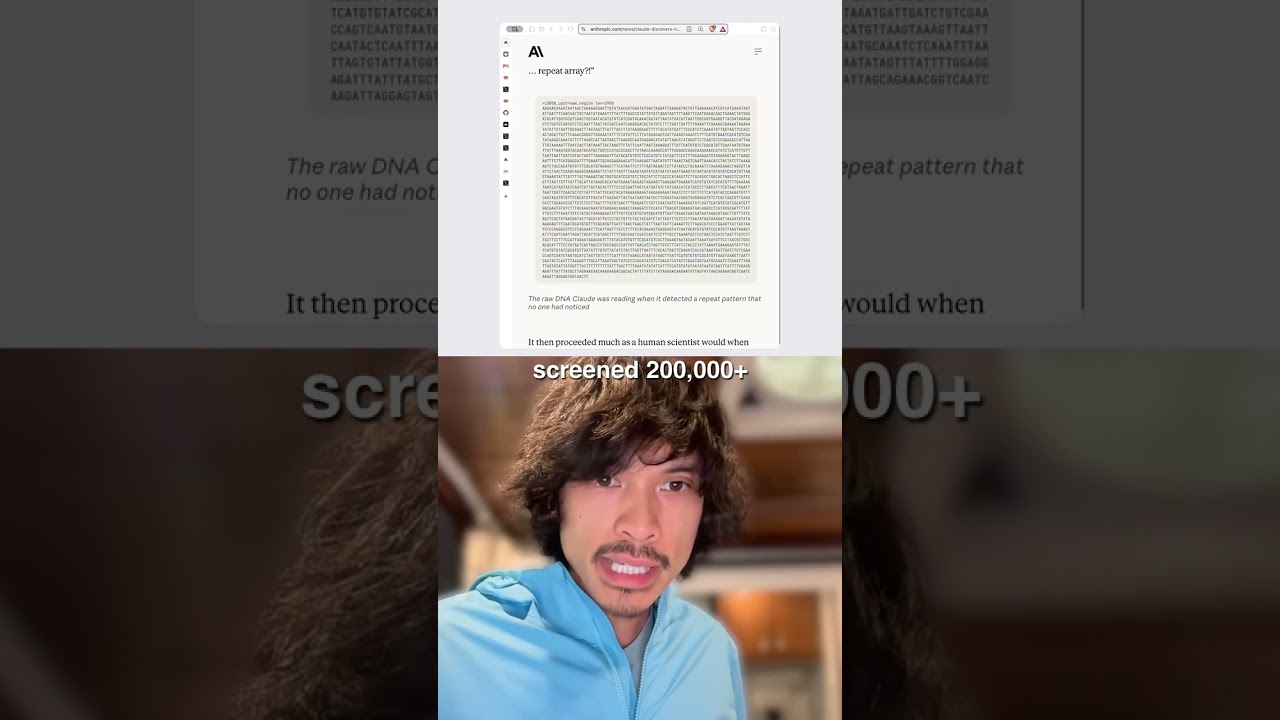
Lab discovers a novel enzyme system with CRISPR-like repeats, September 23rd, 2026. This is a really interesting development. As Dario came out and said a few weeks ago that, hey, we gotta wow the public with solving and curing cancer, not just talking about solving and curing cancer, but actually doing it. Since then, we've heard about things like the Moderna melanoma personalized cancer treatments, and now it looks like Some more is coming out of their scientific arm here. So Claude led a discovery of a possible new gene editing mechanism. About 950 Claude agents searched a DNA database for 21 hours, costing about 210 million tokens, screened 200,000+ enzymes, and narrowed to 20 candidate systems. That's reporting from Anthropic. Human scientists, just to be clear, did all the wet lab work. This is This isn't peer-reviewed yet.
I think they're sticking to domains where you can come up with a hypothesis in a highly verifiable domain. And I haven't read about how the wet labs were exactly used in conjunction, but like, I think, is this result reproducible by other labs? I think we're going to see some of that when it's peer-reviewed. So yeah, like really interesting. Is it actually solving meaningful problems that are going to like accelerate pharmaceuticals, extend life, cure cancer? That I'm more skeptical about. But, you know, it's really kind of like a cool direction.
Yeah. I really looked at this and I'm like, The trend is AI will help more science go faster, more better science faster. I think that's sort of the trend here, but we're early, right? We haven't solved all of cancer. We haven't solved for world hunger. And it's like, there are many problems that we got to solve. So this is like the first of signals that I see that sort of show me that the light at the end of the tunnel is there, but we should be skeptical that it's already here. So don't believe any headlines that it's already here, but stay optimistic that, hey, we're kind of going the right way.