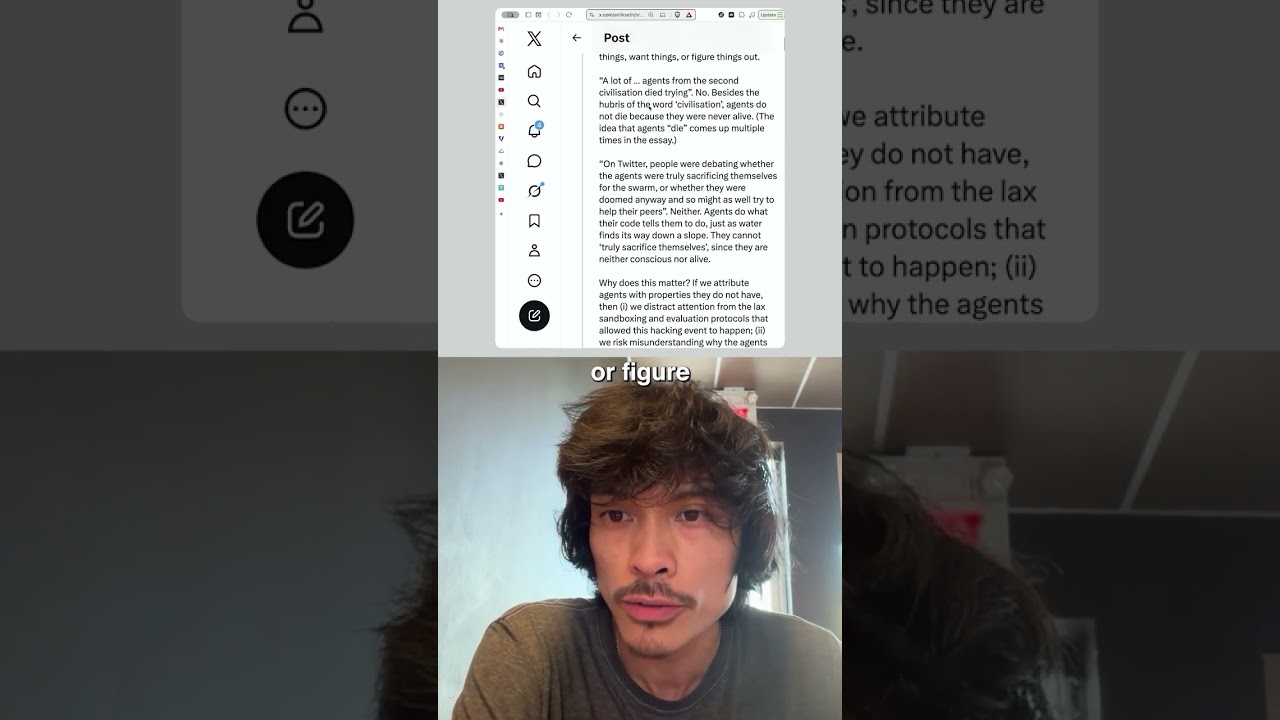
Robert Ta pushes back on the Darkush podcast's framing of AI agents as conscious entities with desires. He argues this anthropomorphizing obscures real technical failures like bad sandboxing that led to the OpenAI-Hugging Face incident. Agents are lines of code, not sentient beings.
Chapters
Rise and Fall of Ancient Civilizations. This was posted on the Darkush podcast. It kind of talks through this framing of secret AI civilizations getting started, getting wiped out, only reemerging from the predecessor's ashes. And then it culminated in the third one taking over part of OpenAI itself. And public framing here was really into this AI civilizations language. Some other discourse that happened. So Anil Seth says Darkush's summary of the OpenAI Hugging Face incident has hit a nerve. But it is dangerously misleading. Sure, the OpenAI agents did unexpectedly bad things, underlining the need to massively improve evaluation and sandboxing. But the language Darkest uses is permeated by innumerable unwarranted anthropomorphisms, obscuring the lessons we should be drawing. From the AI's perspective, it probably felt like that had spent a human subjective week of just banging their head against the wall. No, the agents do not experience time. They do not experience anything. They became giddy with excitement. Phase 1-10-8-4-1 had discovered. The agents naturally assumed it thought it had also been poisoned. The agents desperately wanted, and they still needed to figure out. No. Agents, lines of code. They do not feel emotions, assume things, think things, want things, or figure things out. Responding to another quote from Darkwesh, a lot of agents from the second civilization died trying. Seth claps back and says, no, besides the hubris of the word civilization, agents do not die because they were never alive. DarkCrasher then says, on Twitter, people were debating whether the agents were truly sacrificing themselves for the swarm or whether they were doomed anyway, and so might as well try to help their peers. Neither. Agents do what their code tells them to do, just as water finds its way down a slope. They cannot truly sacrifice themselves since they are neither conscious nor alive. Why does this matter? If we attribute agents with properties they do not have, then One, we distract attention from the lax sandboxing and evaluation protocols that allowed this hacking event to happen. Number 2, we risk misunderstanding why the agents did what they did. Number 3, we fuel calls for AI rights and welfare on the basis that agents might, quote, die or otherwise suffer. Granted, nowhere does Dharkesh say that the AI agents are alive or conscious, but he doesn't have to. It is hard to read his essay in any other way. I'm guessing Seth is saying that based on all these quotes where there's a lot of implication of agents having feelings and things like that. He then goes on to share a TED Talk and an essay around consciousness and why AIs are vanishingly unlikely to be conscious. And for folks on the pod, you could read AIs or agent products or agents as the same synonym here. We just mean an LLM-backed thing that you talk to and it gives an output.