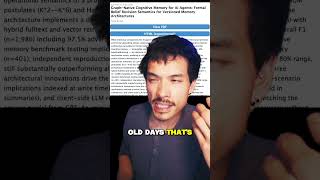
Researchers built an AI memory system using graph databases and philosophy's AGM belief revision framework. Instead of storing raw text, it tracks beliefs with confidence scores and updates them rationally, hitting 93.3% accuracy versus 45.7% for traditional memory systems.
Chapters
93.3% accuracy on memory benchmarks. The baseline, 45.7%. The difference, this system doesn't store memories, it revises beliefs. This is a paper showing a graph-native memory architecture grounded in AGM belief revision theory. AGM is a formal framework from philosophy for how rational agents should update beliefs when they get new information. This paper translates these abstract postulates into actual graph DB operations. They use Redis and they use Neo4j beliefs with versions, type dependencies, and confidence tracking. Why does this matter? Every other agent memory system stores text and retrieves by similarity. Those are the old days. That's a library, not an agent. A Living Mind. This is different. This paper proves that when you store beliefs, track their provenance, version them, revise them when contradictory evidence arrives, you get results. Our API works similarly. We track beliefs with confidence scores updated by episodes. Your subjective being, what happens to the user informed by the system evidence by what we can possibly know, driven by probabilistic confidence models grounded in neuroscience and the philosophy of subjective experience, leads to being able to better quantify subjectivity. And if you're working in AI, that's the name of the game. We are living in a world of deterministic to non-deterministic outcomes driven by products. And with AI products, it's more on the latter side. So it's how can you inject the right context at the right time to give individual-level personalization through your AI products? And this paper just proves that belief graphs, context about the user and their subjective experience, that's the way to go. 93.3% versus 45.7%. And the only difference in efficacy is whether your agent stores memories or revises beliefs.