Jonathan Groff demonstrates GrokBot, a cloud platform for building agents without local setup. He creates an agent that scans X bookmarks to suggest content, using plugins like Gmail and Google Calendar. The platform automatically captures screenshots of its virtual machine's browser for visual context, though it can't access local credentials like 1Password.
Chapters
Jonathan, you've been playing around with GrokBot. Let's take a look at GrokBot live as a demo.
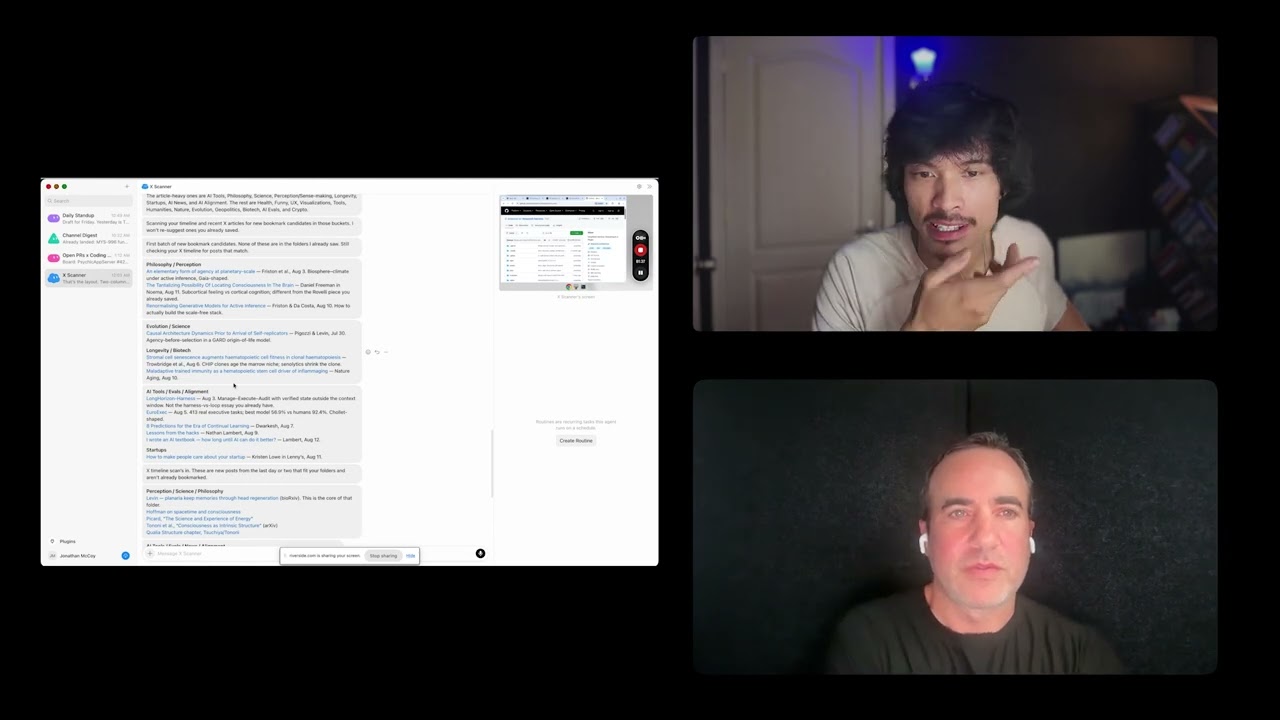
Yeah, I, I downloaded GrokBot. They actually have a 1-week free trial, which was cool, at least because I had the Cursor Pro plan. I was able to try this out. I created a few different agents over here. The one I'll start with was scanning X for me, and I said like, hey, can you scan my X content of interesting content? Look for some categories that match my X bookmarks. So I'm like asking it to like look at my bookmarks and predict like what are gonna be new bookmarks, you know, coming from my X feed. And what you have over here on the right is really interesting. This is its own computer, so it has its own virtual environment here with the Chrome instance. And that's going to be the difference between OpenCLAW and GroqBot is that GroqBot runs in the cloud. It has its own virtual machine that it works with to do a lot of this stuff. It can also access your machine for computer use, but it's kind of limited. And I'll tell you some of the things I found about that. But overall, this was a pretty cool case. First of all, GroqBot has a lot of plugins, you know, like the familiar things you're used to seeing, like Gmail and Granola, Google Calendar. And the ones it doesn't have, like it didn't have Otter in here. So I asked it to connect to Otter and it handled it seamlessly. And I was like really impressed with how well GrokBot just like lets you connect all your stuff into it. That seems to work pretty well. On the downside, 1Password, it can't use your 1Password credentials because it actually can't access that in the local system. It's trying to like go through its own virtual machine and access your 1Password and it can't do that. So it actually like has a plugin called 1Password that GrokBot can't use. And so those are kind of like little quirks that you see when you're using this new product. Yeah, this did a really great job. When it can't use the xAPI, it just opens up its own browser window here. I authenticate into my X account and then it was able to like look at my bookmark folders from there. And it actually gives you like screenshots of like what it's doing while it's searching.
It screenshots the computer to keep you in the loop about like, hey, this is how I'm doing it. So then you could steer, right? How did you find that experience? Because that is really different because this is doing it by default. I usually have to get, whenever I'm doing it sort of any end-to-end testing, I have Claude or Codex screenshot and put that into a folder for me to review. But this is cool that as it's going, it screenshots for you. How have you found that experience with GroqBot to help with this agentic steering?
Yeah, I mean, it really helps with the coherence of like, what are you doing? Like, it doesn't give you the same provenance. It doesn't tell you, think aloud and tell you what it's doing for the most part, but it does give you these visual indicators of like, here's what I'm looking at right now. And you'll see that in Codex too. It has like a picture in a picture, but I found that these snapshots of the picture in the picture, like, I mean, I can understand what you're doing here. Another note about GroqBot is it doesn't tell you what model it's using. It's probably, uh, the, the new Groq models, Groq 4.6 or something like that, but it doesn't actually tell you and you can't configure it. So that's an interesting note.
That is a really interesting design choice. You have to look at that as a very intentional design choice because every other Codex, etc., they very clearly show you which models, so you have a bit more agency. I'm wondering if that's just a beta thing because this is early beta and early access. I wonder if that's just going to come with time. But that's interesting as a design choice. Who do you think this is built for, Jonathan Groff?
I think it's everybody who is interested in OpenCLAW but maybe didn't have the hardware or the cycles to invest in it. This makes it really easy to just get started. Started building agents. And I think that's gonna, like, whether that means that you can run this in an enterprise environment or that, that means you can run this independently, I think that's gonna be more accessible to a broader set of people. So a really progressive, interesting design.
Yeah, that's super cool. Wait, so this use case here, we're seeing that it pulled out other things you might be interested in. Scanning your timeline and recent X articles for new bookmark candidates in those buckets. I won't resuggest ones you've already saved. Did you find this useful, the output?
Yeah, so this was a great output. So it characterized my bookmarks. So these are like some of my bookmarks, philosophy and perception, evolution science, and so on. And then it searched through the X feed and it like extracted these links and said like, hey, these are good candidates for you to bookmark. This was like genuinely useful. Probably 80% of these articles were things that I was interested in. You know, then I thought like, well, okay, how far can I take this? I said, this is good. Can you present it as an HTML document with preview images instead of the links that you just gave? And that's where it had sort of a shortcoming. It did create an HTML document here. This is a picture that it took, but I have to go into the virtual machine and I have to click on this. And then by that point, it's sort of like not nearly as usable as my own machine. It had more trouble like creating an HTML focal file locally that I could browse in my own browser. So those are some of the kinds of trade-offs that I was seeing where it's like, I was really impressed and then take it to the next level. I can't quite, quite do exactly what I want yet, but it's a, it's interesting paradigm.