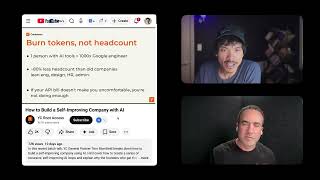
Robert Ta and Jonathan outline how to build companies where AI improves itself through closed-loop feedback. They cite founder heuristics: AI founders hit five times more Demo Day revenue, should burn tokens not headcount, and one AI-augmented employee can match 1,000 engineers.
Chapters
Here's the YouTube video, How to Build a Self-Improving Company with AI, and this is their thesis. AI is not something you bolt onto the side of a company. The company itself has to be built with self-improving AI loops from the ground up. And he riffs on Jack Dorsey's now super viral trending article, From Hierarchy to Intelligence, talking about how why we organize ourselves into traditional hierarchies has always been because there's an underlying assumption that humans need to be in charge of information flow, like giving orders, decision context, just the right context at the right time to the edges of the organization, up through the chain, all the way up to leadership and all the way down to people executing the work, foot soldiers.
Mm-hmm.
So they had, like, well-defined hierarchies— that's sort of here with well-defined spans of control. And those were their management levers, making sure that there was enough span of control, we're not reaching over a certain max that they had set. The whole idea is, hey, with closed-loop agents and with AI in general, why not just make everything queryable in the company and you build AI loops and deploy them around parts or functions of your business? So you have sensors that get data, you have some level of policy layer, like he talks about, a tooling layer, quality gates, perhaps where you have your humans evaluating artifacts, evolving grading rubrics to evaluate better, and learning mechanisms. And the whole idea is, hey, get this recursive self-improvement learning loop deployed across your entire business. They had this TL;DR for all founders, AI founders,, and they said that AI founders in their recent cohorts or batches of founders are getting to Demo Day with 5 times more revenue than previously, which was a really cool stat. And they had these other sort of, uh, num— numbers among their advice. Burn tokens, not headcount. One person with AI tools is equal to 1,000 Google engineers. 80% less headcount than old companies. Lean engineering, design, HR, and admin. And a clear statement, if your API bill doesn't make you uncomfortable, you're not doing enough. Jonathan, that was a bit of a mouthful, but "How to Build a Self-Improving Company with AI." I think you and I both watched this, and this is on the back of Jack Dorsey's "From Hierarchy to Intelligence" article, and on the back of the recent YC video from Diana, on building a queryable AI-native startup or a company. Thoughts on this?
Yeah, so you mentioned the video from Diana who echoed a similar approach, right? I think, um, we're seeing Gary Tan, uh, also echo, uh, the, the similar approach from YC and he, he's showing how he uses it in his own applications with the release of GStack and GBrain and stuff like that. Then I even, there was another video that's just, just come out like a couple days ago, um, where they again reiterated the same kind of form factor. And I think it's actually kind of refreshing to see the leadership from YC where they're saying, we're building tools internally and this is how we're doing it. And we're also advising a lot of our startups and this is the form factor that we want to see. And so you get this kind of like AI-native blueprint that's like maybe the YC religion for AI to go into AI and how— Yeah. How to like leverage these tools to make a successful company. The loop is kind of at the core, like, you know, as in learning loops that get better and can do the things that your business need to do. Um, there's a lot of like practical, you know, like indexing your data, creating policies, policy layer, and getting this to work together. Like it's actually a pretty helpful blueprint. And I don't think it's the kind of thing that you say you want to like, okay. how do I do this exactly in my company, but rather like you're taking the core principles that they're putting out and you're trying to like modify them for your own company and get— push your own company to this set of heuristics that is like what a successful company looks like that uses AI to be an AI native and deliver product. Yeah.