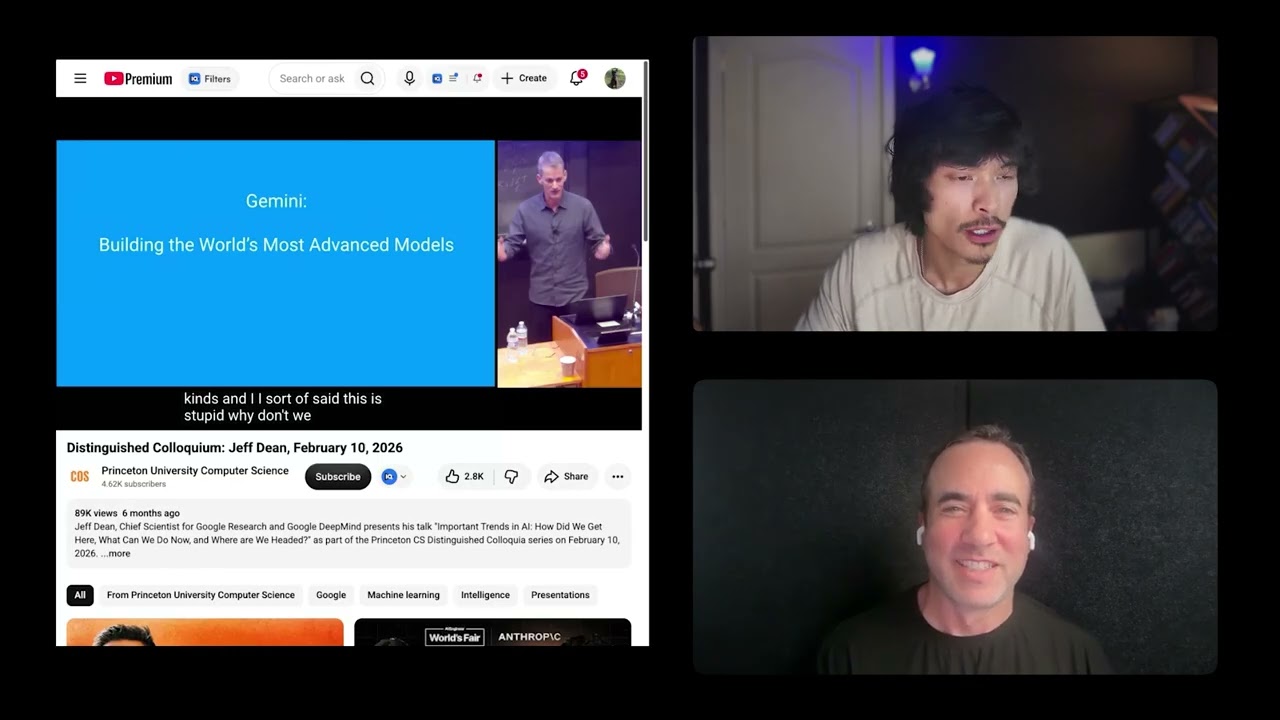
Robert Ta summarizes Jeff Dean's talk on AI's past 15 years. Dean argues progress comes from bigger compute and data plus better architectures, not just scale alone. He walks through Google's infrastructure evolution, from Word2Vec to TPUs to Pathways, and explains how transformers beat LSTMs by removing sequential bottlenecks.
Chapters
Jeff Dean just left Google. He was employee number 30, and there was a lot of news around this, which is, is Google AI dying? And a lot of famous names that have left Google DeepMind and their AI initiatives recently, Jeff Dean being one of them. He was the chief scientist for Google Research and Google DeepMind. This is his talk on important trends in AI and how did we get here. And I'm just going to summarize the talk. This is Jeff Dean, and if you're an AI builder and you want to know What is the history of AI? What are the most important trends? How do you get up to speed? How do we get here? How, what can we do now? Where are we headed? This is from Geoff Dean. So a few points that he makes. Number one, AI progress has been driven by scale and algorithms, not just bigger models. And he argues that the last 15 years of AI came from 2 multiplicative forces, dramatically more compute and data and dramatically better architectures. That leads to not just incremental additive gains, but also compounded orders of magnitude Step function improvements. Google's AI infrastructure evolved alongside the model. So Dean kind of walks through Google's progression from distributed network training with their Disbelief tool, unsupervised learning on millions of YouTube frames, Word2Vec as a tool, sequence-to-sequence models, and eventually the TPU program. And then he goes on to explain transformers and sparse models and pathways and how that fundamentally paved the road for larger-scale AI. And changes there in industry. So he explains why transformers replace LSTMs by eliminating sequential bottlenecks through attention mechanisms. And everybody, I think, has seen like the whole transformer paper now, if you're in the AI game, like, you know where this came from. He also discusses sparse MOE, or mixture of experts models that activate only relevant portions of a network, reducing compute while increasing capacities, and that Google's Pathway systems abstracts tens of thousands of TPUs into one virtual computer. And that automatically handles hardware failures during massive distributed So really cool behind the scenes peek at like, what does massive distributed training look like? He then talks about modern LLM capabilities coming from many complementary innovations, not like a single breakthrough. He kind of talks about chain of thought reasoning, which improved difficult problem solving by allocating more inference compute, knowledge distillation, which compresses powerful models into cheaper ones, AKA Gemini Pro distilling into Flash. And then, you know, DeepSeek and GLM and all of those that we've seen in the US versus China AI war. Reinforcement learning, how that shapes model behavior. Speculative decoding, which dramatically speeds up inference by using smaller draft models that predict multiple tokens ahead before verification of a larger model. So a lot of technical stuff. And a few more notes here. He mentioned that scaling AI requires organizational innovation as much as technical innovation. And I thought that was one of the coolest parts of the talk. What he learned about Gemini is that In the execution of Gemini for Google, Jeff says scaling AI requires more organizational innovation because Gemini involved over 1,000 researchers distributed across the globe. Anybody who's just even trying to get family members together across the globe or even together for dinner, you know it's a cat-herding exercise. So thousands of researchers trying to innovate at the front lines. Oh my gosh. So Google coordinates development through thousands of internal RFCs, requests for comments, shared benchmarks, continuous experimentation across multiple model sizes, and async collaboration. And he emphasizes that the most important idea is really just start at like small pilot experimental scales. So any AI builders out there thinking about big bangs and stuff, always ground in really good engineering research. Start small, right? Small hypotheses. And Dean also believes that the next frontier of AI agent collaboration is trillion-token knowledge access, and future systems will likely involve humans coordinating many specialized AI agents rather than interacting with a single chatbot. Jeff Dean then goes on to say he predicts advances in retrieval systems that effectively extend context from today's million-token windows. This is at the start of the year. So he was saying million-token windows towards trillion-token accessible knowledge bases with efficient inference, specialized hardware, and AI-assisted chip design. One last thing he said is misinformation. He sees misinformation, not artificial general intelligence or AGI, as the most immediate AI risk, which is really interesting coming from Dean. During the Q&A of this, he argues that engineering and guardrails can mitigate many long-term AI safety concerns, while realistic synthetic media poses a more immediate challenge. He talks about reducing hallucinations, Google increasingly relying on multiple reasoning rollouts, self-verification, additional inference time computation. So his advice to people, researchers out there, builders out there, uh, without access to massive compute is to pursue fundamentally different ideas at a small scale rather than chasing incremental benchmark improvements. Really great talk. Would highly recommend anybody who's an AI builder that wants to kind of know the, how did we even get here as an industry? What is possible today and where's the industry headed? This is about 6 months old, but I find that, well, a lot of what he says still sticks and the principles and thought leadership, definitely I see that evolving in the landscape and I'm really excited to see what he, what he does next here.