In this conversation, Robert Ta explains how Uber has achieved near‑universal AI tool usage among its engineers (99%) and how more than 70% of pull requests now involve AI agents, with over 2,500 agent skills built across the software development lifecycle. To extend AI adoption beyond engineering, Uber created "Agentic Pods": small, two‑week sprint teams that pair an AI‑proficient engineer with a domain expert from functions such as finance, legal, marketing, or support. The pod spends the first two days shadowing the expert, documents workflows, then prioritizes high‑impact, repeatable tasks. Over the next days they prototype an AI agent, validate it with multiple users, and ship it by day ten. In the first two months, 16 pods delivered dramatic efficiency gains—capital allocation across 150 cities dropped from 15 hours to 30 minutes, financial pacing reports from 2 days to 10 minutes, marketing QA from 2 weeks to 50 minutes, and 9,000 manual support workflows were automated. The discussion then turns to sustainability: whether a constant engineering capacity is needed, the idea of maintaining digital twins of processes, and the long‑term vision where AI agents themselves become forward‑deployed engineers. The conversation highlights the practical framework, measurable outcomes, strategic lessons, and future considerations for scaling AI adoption organization‑wide.
Chapters
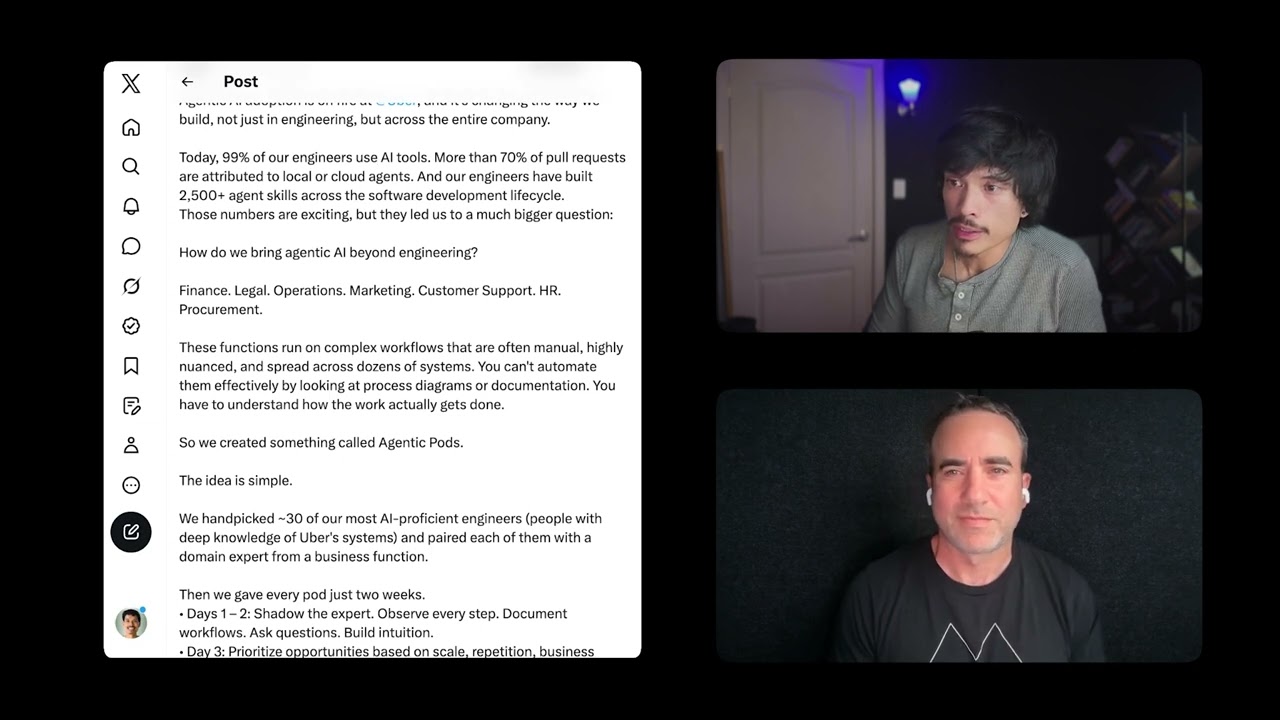
How did Uber solve for agentic AI adoption? Every executive, every leader in any tech company is thinking about this right now, and Uber is leading the charge. Today, 99% of our engineers use AI tools. More than 70% of pull requests are attributed to local or cloud agents, and our engineers have built 2,500+ agent skills across the software development lifecycle. The numbers are exciting, but they led us to a much bigger question. How do we bring agentic AI beyond engineering? Finance, legal, operations, marketing, customer support, HR, procurement— these functions on complex workflows that are often manual, highly nuanced, and spread across dozens of systems. You cannot automate them effectively by looking at process diagrams or documentation. You have to understand how the work actually gets done. Enter the solution: Agentic Pods. The idea of Agentic Pods is simple: handpick 30 or so of our most AI-proficient—read: AI-pilled—engineers, people with deep knowledge of our systems, and and paired each of them with a domain expert from a business function. Then we gave every pod 2 weeks. So run 2-week sprints. Days 1 through 2, shadow the expert, observe every step, document workflows, ask questions, build intuition. Day 3, prioritize opportunities based on scale, repetition, business impact, and data availability. Days 4 through 5, build a working agent alongside the person doing the job. Days 6 through 9, Validate with several others performing the same work. Does it generalize? Does it actually make their job better? Day 10, ship. The results. In just the past 2 months, we've run 16 Agentic Pods across 16 different business functions. Capital allocation across 150 cities used to take 15 hours. It now takes 30 minutes. Financial pacing reports used to take 2 days. Now it takes 10 minutes. Marketing web quality assurance used to take 2 weeks. Now it takes 50 minutes. Support workflow creation Used to have 9,000 manual workflows. Now it's self-service automation. The big lesson here is if you have AI-pilled engineers or builders internally, you could give up their time and you want to automate more in the org, get more of your org adopting AI, not just in the software development lifecycle. Use them as forward-deployed engineers is what I'm hearing. Go deploy them to be next to their domain expert friend and learn their workflows, prioritize them by economic value, and then build them agents. And then that's your agent harness and dataset and your private evals that is your own IP for your own processes to close the books, get financial reports, allocate money or resources like this example shows. Jonathan, what do you think of this concept of agentic pods and deploying internal FTEs to speed up the AI adoption problem? Every tech executive that I know is facing this problem, and I was really curious to get your take on Uber's approach here.
I thought of the FTEs also. I think this is like an internal FTE effort by Uber. It seems like this is the kind of thing that gets low-hanging fruit and gets it put into agent formats. I wonder, like, what the recurring version of this looks like. Are they always going to have this amount of engineering capacity dedicated to like creating agents in this way? Is it going to continue to yield dividends? And after like the low-hanging sort of automation obvious tasks are implemented, this is where like I think an alternative view is, you know, that you want to keep a digital twin of these stakeholders in the organization on an ongoing basis. How do you have that happen? So there's just always like a digital twin mirror of all the processes that these people are taking. And do you need like the continual investment of a forward deployed engineer, or can you set your systems up to where you can identify where processes are ripe for using AI to either augment the task or, or get more value out of it. I think this is a really cool experiment and case study story. I don't know if it, like, if this is the model, like, for all time, you know, if this is, you know.
Yeah, at some point maybe AI agents themselves will be the forward-deployed engineers, and we have sort of like an OpenClaw-like experience that is good enough for a finance person who knows nothing about cloud code, nothing about Codex. They just talk to an agent, describe their workflows, and then it follows them or whatever and then builds it for them. Maybe that's the future, but currently this seems to be the best meta that I've seen in public data anyway, but publicly available information for how to scale your AI adoption. And that is the problem everybody's facing is how do I get more people using this stuff? And the next problem is like, crap, okay, maybe they're using too much of it, they're blowing our budget. How do we prove ROI and tighten the screws? So it's interesting to see all these orgs at different stages of AI maturity who were here showcasing that they're leading the charge in thinking and executing. Execution.