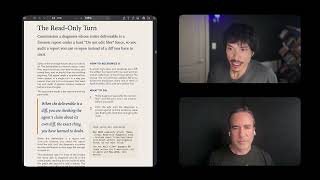
Robert Ta explains the read-only turn: tell AI coding agents to analyze your codebase and report exact file locations and line numbers, but never edit anything. You verify their findings against your code, then decide what to change. This separates discovery from modification and prevents unverified edits.
Chapters
The read-only turn. I use this one a whole lot. So, and I quote, some of the best agent turns ship no code at all. The deliverable is a forensic report, exact files, exact functions, line-level anchors, proposed file fixes, fixes, and an explicit ban on touching anything. The agent reads a quarter million token system in a single turn in a way you cannot. Your job is to commission that reading and audit it against runtime evidence before a line changes. When the deliverable is a diff, you are checking the agent's claim about its own diff, the exact thing you have learned to doubt. So what to do here? Prefix diagnosis tasks with do not edit files and demand file and line anchors before any patch. Hold the edit until the diagnosis is proven against runtime evidence. Separate finding the truth from changing the code. This is really cool because it's a pattern we do when we start every pull request, which is research the existing state of codebase. They go into a little bit more here, which is, you know, a very tactical way to prompt to research the existing state of the codebase, which is proposing file and line level anchors. I believe we have that too, actually. But, but it's cool that they— I take that for granted, but that makes a lot of sense because that, that is the basis of your implementation plan. That you as a human want to go verify, and then you have that input artifact paper trail, so to speak, so the agent could go and look back at that during the implementation, and then you can hold it to task for that. Jonathan, any thoughts from your CTO perspective on, like, the read-only turn move for agentic development patterns?
Oh yeah, critical toolset. Yeah, really critical, because, because both the Codex and Cloud Code Harness is really biased to make edits in code. I mean, that's just what what they're trying to do. There's plan mode. So plan mode is one way to have like a read-only interaction. But I think that there's just times you don't want to use plan mode and you just want to say like, you know, let's explore this, let's research this, let's create a brief about this. And you need to specify, don't change any files. So that's, that's like a 101 toolset to have. Totally.
Yeah, definitely a 101 toolset, the read-only turn.