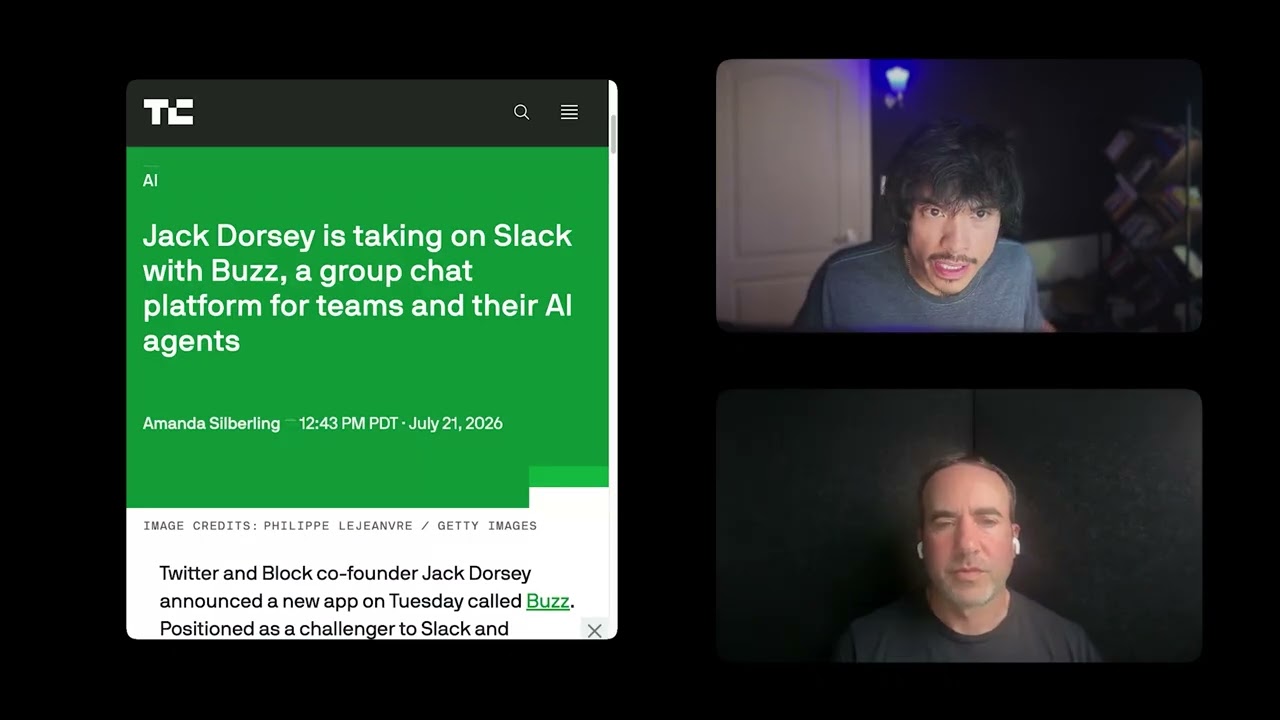
Robert Ta explores Jack Dorsey's Buzz, a Nostr-based workspace platform that gives AI agents their own cryptographic identities and channel memberships instead of treating them as anonymous bots. Each agent gets scoped keys and immutable audit trails, enabling use cases like bug triage, code review automation, and video editing directly in chat.
Chapters
Jack Dorsey shipped a Slack and GitHub killer where every AI agent gets its own cryptographic identity. Here's what this means for anyone whose agents are really just scripts calling an API from the outside, and if you're banging ahead your head against Slack or Teams trying to get everything working with humans and agents. The idea is that you stop bolting agents onto your tools as anonymous external bots and treat them as first-class teammates of your workspace. with real identity and audit trails. What are some of the facts that you should know as an AI builder? Block, Jack Dorsey relaunched Buzz on July 21st, an open-source alternative, Apache 2.0 licensed. It's a workspace like Slack where humans and agents collaborate in shared rooms built on the Nostr protocol. It's a workspace where humans and agents build together on a relay that you own. There's this article that came out with a headline, Jack Dorsey is taking on Slack with Buzz, a group chat platform for teams and their AI agents. This is really interesting. Let's take a look at the GitHub. It does look a lot like maybe a slightly cleaner Slack. You could see a lot of Slack-inspired features, and then you could see that there's, you know, agents like Fizz directly in the flow of work. I think the idea is that we are now moving towards a world, there's human capital and token capital, and humans and agents have to work together across teams at scale, especially for these bigger orgs. So right context, right time, collaboration, provenance of decision-making, things like that become more important. And I think this is Jack and his team's take at this for themselves to get away from like Slack where it was mainly just built for humans. Some of the stuff you could do in Buzz, ask a project question and get an answer with receipts. Agents will search 6 months of history and post the threads, not vibes. Let an agent triage a bug without giving it keys to the kingdom. So they have their own keys, their own channel memberships, their own audit trail scoped by their own cryptographic identity. So you could audit like what agents have done what. Turn a feature branch into a room where patches, CI review, and the merge decision live together. That sounded Really interesting to me. It sounded like the Claude tag sort of like takeover in Slack that Claude is, and the Anthropic team are trying to promote, but this one is more native. Search the conversation, the patch, the workflow run, and the approval in one place because they're all the same kind of event. I think that speaks to the data schema and the model here, and that being a differentiator on its own. Let an agent run the workspace, not just talk in it. So channels, canvases, workflows, huddles, agents have the same surface area as humans. So these are some of the screenshot promises of this. Here's a bunch of agents inside the engineering chat. Interesting. They could emoji react and stuff. I thought this was a cool demo screenshot, which is a go-to-market team in Buzz looking at an MP4 file and then talking to the video editing agent right within the file and saying, hey, maybe we cut here and giving that context to the agent. If that is a thing, like I would be so hyped about that, just working with the social media team on, you know, assets like that.