Robert Ta and Jonathan discuss Boris's framework of five roles—Prototyper, Builder, Sweeper, Grower, Maintainer—that could replace traditional product and engineering titles. People often span two or three roles regardless of job function. Pre-launch products need Prototypers and Builders; mature ones need Maintainers and Growers.
Chapters
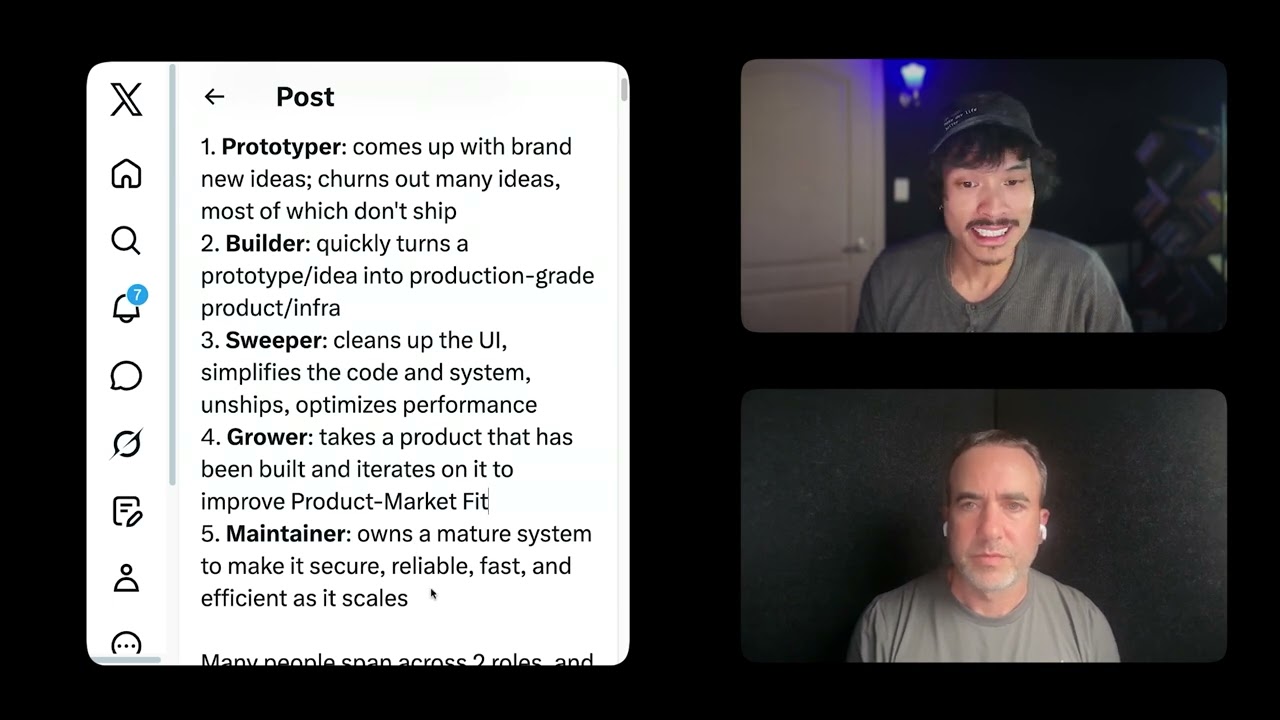
as engineering, product, design, DS, et cetera, melt into a new kind of role, I was reflecting on what roles might look like in the future. Boris says, for example, when I look at the Cloud Code team, I see what I think is 5 archetypes. And if you're a head of product or head of engineering or staff IC, developer, PM, uh, even on the design side, you're thinking about how does the traditional SDLC evolve? And I think this is such a great way to put it. 5 archetypes. From the creator of Cloud Cook. Number 1, the Prototyper. This is a person that comes up with brand new ideas, churns out many ideas, most of which don't ship. I think that's a key thing— most of which don't ship. This is just innovation idea factory.
Number 2, Builder.
Quickly turns a prototype or idea into production-grade product or infra. That's important delineation there. Number 3, Sweeper. This is a person that cleans up the UI, the front end, simplifies the code and the system, unships optimizes performance. So cutting down and paring down to refine the experience on both sides.
Number 4, the grower.
This person takes a product that has been built and iterates on it to improve product market fit. You could make a product, but you also need to grow it and monetize it and get users and retain them and get them engaged and all those things. And so that, that's this person's responsibility. Number 5 archetype, the maintainer. This person owns a mature system to make it secure, reliable, fast, inefficient as it scales. So Boris says that many people span across 2 roles and sometimes 3 roles. He says that he notices that these roles are not really tied to job function. And at Anthropic, one of the leading labs out there pioneering AI-native workflows, at Anthropic, some designers match category 1, some 2, some 3. Same for engineers, PMs. A healthy team needs a mix of these depending on the product and some considerations. Product that is new or pre-PMF, needs people that are strong at categories 1, 2, and 3. So Prototyper, Builder, Sweeper. A product that is growing and has some PMF needs 2, 3, and 4. So Builder, Sweeper, Grower. A product that has strong PMF needs 3, 4, and 5 and some 2. So that's Sweeper, Grower, Maintainer, and some Builder. He's saying maybe product roles of the future will look more like this and less like the domain-specific roles of today. So we have enterprise clients, they're trying to figure this out. I don't think anybody's figured it out. This is a great piece of thought leadership. What are your thoughts from a CTO perspective on the evolution of the product management role and software development lifecycle, Jonathan?
Yeah, it's a really interesting week because in addition to this post from Boris, there was Lenny's podcast with Andrew Ambrosino, and he described a similar type of role dissolution and similar kind of like mechanics of these product management teams getting rebuilt, the product teams getting rebuilt. This is the frontier labs. They're the ones probably using AI the most and the soonest. And this is like an interesting signal about how the reshaping is happening. We're trying to figure this out on our own team, like how exactly are the AI tools augmenting and changing our work and our roles and how do we work together on that? We have customers who we're talking to about how their product teams are evolving. I was seeing kind of a nice lens for, uh, like since making this information, I think it also overlaps with this narrative, probably a mistaken one, that AI is an automation tool that will replace jobs. I think that the product team is on the front edge of this, and it shows what the technology meeting the roles actually looks like.