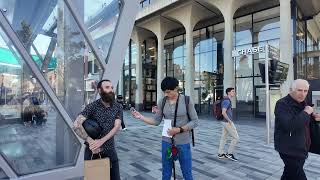
Short informal interview with Corbin (a UC Berkeley production manager and musician) about his views on AI. He discusses job displacement, equity/divide, AI companionship and therapy, regulation/guardrails, possible future sentience, and personal choices about brain uploading; overall tone is cautiously optimistic that outcomes depend on how humans use AI.
Hi. It's okay. Heel, heel, heel. Center. Oh, God. Sorry. He's a puppy.
No worries.
I'm like dog dad training at the same time as doing this. Okay, great. What's your name?
Corbin.
Corbin, Cool. How do you spend your day as Corbin?
Variety of different ways.
How'd you spend today?
Today I was working all day.
What'd you do at work?
I am a production manager for UC Berkeley, so.
Oh, cool.
I help with the. Basically corporate Coordinating all the tech for their conferences and events and symposiums and stuff like that.
Great, thanks. Thanks for sharing that. So I'm doing interviews on. Do you think AI is going to kill us all? Take our jobs? Thoughts on that?
I think there are definite things that AI will take over. I think we're already seeing it. People are using it for art, which I really wish they would use it more for, you know, helping me do my dishes and my laundry so I can do more art.
Oh, okay.
But, you know, so you'd be okay.
With an AI robot in your home doing your laundry, dishes?
To a point. You know, I've seen some of the other ones. I've seen some. You know, we have a couple of AI conferences that come through, and there is not really, from what they're even saying, there isn't a regulation point of anything on those.
It's really nascent right now. It's really nascent right now. Got it. Okay, so thoughts on AI companionship? Would you ever get an AI girlfriend? Boyfriend thoughts?
Probably not.
No. Okay. Are you dating anybody right now?
I'm married.
You're married. Okay. What if you found out your partner cheated on you with an AI? Better or worse than with a human?
That's a great question. I don't know. That's a great question. Not sure.
You'd have to get to that moment to know. Yeah.
Okay.
All right. So do you have kids? Yes. What if your kids dated an AI? What would you. What would you say about that?
I think it would be a little weird, but, you know, I'm open to. If that's the way that they wanted to live their life, that that was the way that they lived their life.
Give them their own agency to make choices. Hey, Kenji. Hey, Keel. Center. Thank you. Thank you. Center. Yes. Okay. He just went to the vet. He's a little. Yeah, he's a little. Hey, hey. Over here. Drop it. Leave it. Okay. Do you think AI will create more financial equity or more dividend?
More divide.
More divide. Tell me more.
I think with AI taking over, you know, rudimentary positions, that we're doing now, it becomes a more skilled sector, which then creates more divide from people who have that skill and people who don't have that skill. Okay.
More centralized power. I see.
Okay.
In 10 years, do you think AI will make the world a better place or a worse place?
It depends on, I think, the way that people use it. I think people can take it in a very negative way and can really shape the world very negatively and impact it in a negative way. But I also can see the benefits and the positive sides of AI and if we use it correctly and use it in a good way, seeing benefits and positive outcomes of using the AI.
Do you use AI yourself?
Very seldomly. Sometimes I'll. Sometimes I'll use ChatGPT to, you know, help me write something a little bit clearer or something like that, but that's about it.
That's about it. Okay, so what's a good use case and a bad use case?
I think a good use case is AI monitoring, like, weather patterns and using it to track that kind of stuff to predict, you know, potential danger. Danger, okay.
And then protecting people. Yeah, got it. Okay. Okay. And what's a bad use case?
You know, taking, you know, having it go into a negative way of, you know, AI, AI. It's like I've said, they don't have a way of stopping somebody from going in and writing something to have it go do something harmful. So there's. And have it learn that harmful trait to them. Guardrails to keep. Yeah. So I think there needs to be, you know, a guardrail system or some sort of direction for it to.
Got it.
Yeah.
For safety.
Yeah.
Okay. Some more questions. Do you trust AI more than you trust our current politicians?
For answering some questions? Yes. For running the country, the current one? Yeah, I would maybe a little bit, but not. Not all of our politicians.
Okay, so. Okay, so let's say AI President or current president.
I feel like he uses a lot of AI already.
That's a good one. That's a good one. Okay. Okay. So neutral on that. Yeah, neutral on that. Okay. Would you trust an AI therapist?
I think an AI therapist could. I think that could be a spot where AI could help. Yeah. Because they could, you know, grab all of the information that's out there instantaneously that not every single therapist might have their own hands on. Do I think that it can be solely that? No, I think there needs to be a human component within, at least direct, again, directing guardrails of the AI.
Got it. So a human in the loop helping with the Mental health use case. Great. Okay. Do you think AI should have rights? The right to vote, for example?
No.
No. What if it grew? What if we could prove it was sentient and could feel pain and it was conscious like us?
If it got there, I could see it potentially. But right now you don't see it right now. Right now it's a computer program.
Is it believable to you that someday it could be conscious?
I could see it getting there. I could see it getting there. I don't think it'll be in the immediate future, but I could see it 20, 30 years from now, possibly. You know, we didn't have cars for a long time, and now that is our main mode of transportation.
Millennia. We did not have cars.
Right. So we. We're. AI is so new, so we don't know that. I can't say no to that because in, like I said, 30 years, that could be different.
True. Okay, Okay, a couple more. Let's see. Let's say you get to the end of your life. Would you rather upload your brain into AI or die naturally?
Personally, I would say die naturally.
Okay, tell me why.
Personally, I've lived my life. I don't see myself needing to upload my sentience into a computer to keep me going.
What about your kids and their grandkids and their grandkids that want to talk to their.
You know, I've lost family. I think lost is part of the human experience. Experience. So, yeah, it's hard. But if we never have loss, then you don't ever know what those feelings are. Then you can't grow to being to a full person if you don't have all of the experiences that are that of human nature.
It's part of the human experience. That's what I'm hearing. Okay, last two more. If AI took over, what job would you want in the robot apocalypse?
If they took over and I didn't have to work, I couldn't. I could just hang out. That would be the job. That would be the job I do.
Golden era.
Yeah. Yeah. Just let me. You know, they can do the mundane if they want to do the mundane, and I can create and have fun.
What would you create?
I'm a musician, so probably music and stuff like that.
Very cool. What kind of music?
Honestly, I do a little bit of everything, but primarily in the rock genre.
Do you want to give a shout out to your music?
No, I'm not doing anything right now, but all good.
Last one. Give me one word to describe how you feel about AI.
I would say optimistic. I can, like I said, a little bit. I can see a very positive route that AI can go if it's used properly, and a very helpful route that AI can go. Again, it has to be used correctly.
Got it.
To go that route. Got it.
Okay. So again, it's down to how we use the tools, and it's up to us as humans using the tools that dictate or determine the future of humanity. Yeah. Great. Okay. This was wonderful. Thank you so much.