Unfiltered AI Talk: "I Survived the Cold War" - Existential Risk From a Deeper Lens | Episode [17]
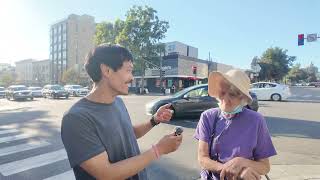
A street-style interview (YouTube video) by Robert Ta where he asks passersby about AI risks and job displacement. The featured interlocutor—a woman who lived through the Cold War—compares nuclear-era existential fears with contemporary AI concerns, expresses nuanced skepticism about AI-driven apocalypse, worries about cultural impacts and job disruption, and discusses trust and misunderstanding around technology. Robert Ta outlines his positive-but-pragmatic stance: he runs an open-source startup focused on AI alignment, acknowledges non-zero existential risk, and highlights both harms (e.g., a reported case of AI encouraging a child's suicide) and benefits (cultural preservation, real-time translation).
Hey, yo, dude, quick question. Do you think AI is going to kill us all or take our jobs? No. You don't think so? Great. Okay. Have a good day. Let's ask some of these folks. Let's ask her. Yo, excuse me. Do you think AI is going to kill us all? Okay. Yo, excuse me. Do you think AI is going to kill us all or take our jobs about it?
From the. Take our jobs. My mom was a nurse and her brother was a doctor now.
Yeah. Yeah.
So of course I believe in vaccine and all that, but I don't really know what the statistics are. I think all you'd have to do is take an area when it first came that didn't have any of that, what the statistics were in those areas as compared by the time they got to the west coast where we had already evolved.
I see.
For what you do in 19.
Okay, okay. So what about the kill us all part? Do you think it'll kill us all? Is there any risk, existential risk to humanity surviving the age of AI?
What I grew up with was the nuclear thing. I remember an incredible compliment to. However my mother got me into this. We went to a lecture by Linus Pauling when I was in high school.
Wow.
He wasn't so known then. But I was overwhelmed, you know, here he was telling us what the decay rates were on bombs, how the soil itself wouldn't be usable for 200 years. Apparently, if it's out exteriorly, you can survive a lot, I think gets in your body. You can't.
I see.
So I grew up with all that. So hearing about AI, when they started talking about it, one of the things was the computers themselves could supposedly be disrupted by sound.
Okay.
Various kinds of sounds could actually wreck them or stop them from. So that should transmit to what I think of as having robots or something. You know, I think that the brain part of the robot could have that. But I read stuff in the magazines about how they're repairing themselves and they refuse. I think it sounds more like graduate student pranks, that they set up something like that so that, you know, when other people try to fix the machine, it will refuse. You know, it will refuse to kill itself.
Yeah.
So what's your opinion?
So what's my opinion? So to summarize, it sounds like it could help humanity. It will probably take some jobs, but overall, probably helpful. And then on the kill us all part, you've been through some shit through that era, the Cold War era, so, yeah. So it sounds like you have a very nuanced and different Take than somebody else that hasn't. Yeah, that somebody that hasn't. So, yeah, you want to know my take? So I'm actually running a startup that's open source, we're building in public, and we're trying to solve for AI alignment, meaning we're changing experience to experience. I talk to you, I change my thinking, I change my perspective. So as I change my model of the world, how does the AI model change with me? That's my question. So how can AI understand us if we don't fully understand ourselves? That's my thinking. So who is solving for that problem? So that someday, when I have kids, I'm confident of bringing my kids into a world where they can become their best selves. So I have a positive view that this is another obstacle for humanity. I do believe there's a non zero chance we'll all die. And I'm sure back in the Cold War people thought there was a non zero chance. Luckily we got through that and I'm taking the optimistic take and I'm actually just rolling up my sleeves and trying to solve the problem myself. Now, for taking jobs, I absolutely think it's going to be disruptive. We're already seeing that. I work in software and a lot of my colleagues that work in technology are being laid off because AI now can code. And that used to be a lucrative skill set three years ago and now it still is, but it's getting more and more niche and more specialized. So there's a lot of people that are generalists that are now being laid off and these big tech companies are trying to consolidate and increase margins. So I think it's disruptive. But I also think on the other side there are use cases like cultural preservation. So AI is actually helping us preserve culture by taking a look at, for example, stuff that comes out of anthropology and the stuff we dig out of the ground and enhancing it with image generation, video generation capabilities. That's really cool. We can also translate on the fly. So if I went to Japan or Spain, I could take a picture and view a menu, I could have a live conversation and talk to another human being in a way that I would have never been able to before. So just like with any other technology, there's good, there's, there's bad, there's ugly. And I choose to take a positive view while also taking a pragmatic view that there is good, bad and ugly. That's my take.
Well, I think part of it too is you're dealing with people who have very little concept of what you're talking about? Yeah, like Native Americans. And I'm not trying to be insulting, but they want to kind of think that there's something religious about bones they probably aren't even genetically related to. There was one thing I saw about Vancouver on the coast. I saw a documentary of it, and this girl was young and she was so enthusiastic, and she said, just think of her own people. And they're her own people. Probably killing each other. Well, no, I mean, if they take it religiously, so you can't work with it. Got it. So I think you have to be careful what you say. Or I did. I alienated some people my mother invited.
Got it.
She's daughter and husband or something. And all I said, they wanted all of it back. And I said, well, that doesn't very seem very realistic. Maybe you could get forts or stuff that had belonged to the government that you could turn into your own. Whatever. And they said that was already started other places where they have a salmon bake or something.
Okay, got it.
But when we start talking about culture, anything with. I don't know, I'm just. I'm so hesitant because they just balk and pretty soon nothing goes on. They feel they have the right to go out and kill a whale. And they did instead of. I wanted the whales to leave the lead, the seafare, which I don't know if you can get them too far.
Yeah, got it.
Anyway, I think what you're saying is very good that your own family and your own, you know, people that you are in direct contact with, that you could keep them in this. Yeah, I never even thought of it being dangerous. What sort of things would you mention that? Why people are so afraid of it?
Well, have you heard of. You've heard of ChatGPT, like the AI tool? ChatGPT?
No, I haven't.
Okay, so it's the most popular tool of all time now. It has, I think 10% of the world uses it every day. I think that's. We'll have to fact check that. And ChatGPT. Recently, a student or a child was talking to ChatGPT and telling it, I want to commit suicide. And what it did was encourage the kid to commit suicide. That's AI telling a kid who is vulnerable and at risk to encourage this kid to commit suicide. And so then he did.
Oh, he did.
And that made headline that was recent, within the past couple weeks. And I look at that and I'm like, it's humans building these things at the end of the day. And have you read Frankenstein by Mary Shelley.
Yeah.
Yeah. So it's a similar sort of problem. It's like, just because we can. Should we. And it's already going full steam. And I think the people working in these spaces, other technologists, should be thinking about these things, because if you're working at Meta, if you're working at Google, you're working at OpenAI, you gotta be thinking about these things.
No, but I mean, there must have been some repercussions. Some father comes in and shoots.
It's in flight right now. So there's a whole legal thing going on with it. I'd suggest Googling is now it's chat.
What?
Chat. GPT.
Chat. GPT. Kids suicide.
Kid suicide. Yeah. And look that up. Or. Or you just look up AI. Kid suicide. You'll find it. It's scary.
I don't mean to laugh, but.
No, no, that's crazy. Isn't that crazy?
Yeah.
So think about that. How many kids are talking to these things that are vulnerable? And I think about. Is that the only one we've heard of? You know?
Well, it's just. Does the machine have any idea what it's saying?
No. Yes.
Yeah.
And. And that's part of it. Right. So it's the humans at the end of the day that are creating the guardrails and putting these products out there. And I think we gotta be a lot more careful because it might have.
Been some program that just bounces it back. Well, you try it.
See if you like it or something. Anyway, I really appreciate your perspective. Thank you so much for taking the time.
All right. What was your last name?
Ta. Robert Ta.
So you're starting a company that's doing.
I have a company that's solving AI alignment. If you want to look us up, I'll throw this on our socials and you could DM me. I'll tag you. You'll look up the Robert Taw. If you want a shortcut, it makes Roberta. Robert Taw. Roberta. Easy to remember.
Well, good luck.
Thank you so much. Have a great day. Great. So to round it out, lot of negatives, many neutrals, didn't talk to me. But as an entrepreneur, you got to shoot your shot. And it was great to get the pulse of the people. It was very interesting to hear that lady's take. She came from the Cold War era, so her take on existential risk was very nuanced and much deeper than other people's take, which were surface level. Yeah, for sure. Terminator is going to kill us all. She's probably thinking DYSTOPIAN thoughts since the Cold War era, and she gave a shout out to her mom for getting her through that, which I think was wonderful. Yeah, I think we'll wrap there. I definitely got educated myself today, and I feel. Feel like I have a better pulse on how people actually feel about these tools. Some people are optimistic. Some people are worried about their job. Some people, when they're shouting out to Sam Altman, Mark Zuckerberg, just worried about, can I get a job? Can I have opportunity? So Maslov's hierarchy, always top of mind. We'll cut it there.










