Robert Ta explains Dario Amodei's three policy proposals for AI: chip export bans to China, crackdowns on model distillation, and mandatory safety testing for all capable models. A critic argues mandatory testing is regulatory capture that protects OpenAI and Anthropic while crushing smaller competitors, and questions whether current LLMs actually pose the catastrophic risks used to justify it.
Chapters
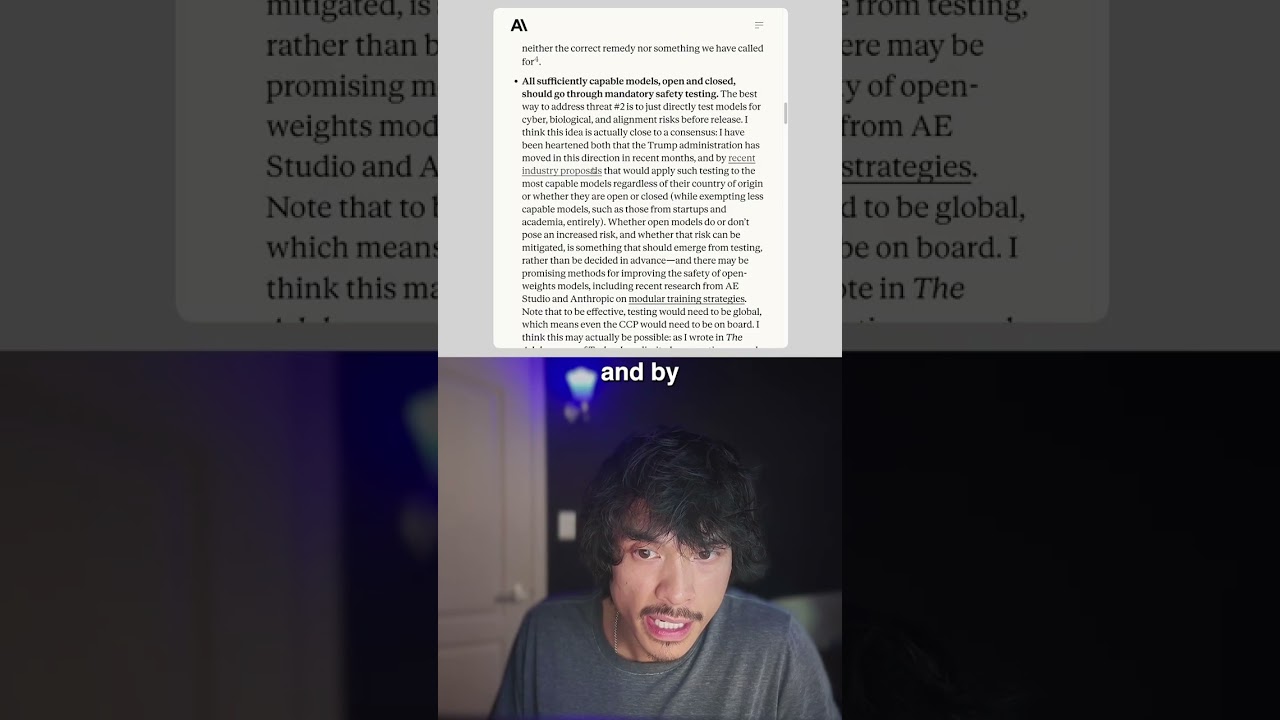
CEO of Anthropic, Dario, says there are 3 things that he actually would support. Number one, we should not sell powerful chips or chip-making equipment to China, and we should crack down on the rampant smuggling and workarounds used to obtain access to such chips. Number 2, we should crack down on industrial-scale distillation operations. Distillation is a much more compute-efficient process than training models from scratch. It allows China to build much better models than its number of chips would ordinarily enable, and thus partially evade chip bans. Number 3, all sufficiently capable models, open and closed, should go through mandatory safety testing. The best way to address threat number 2 around the cyber and biological threats is just to test directly for those threats and alignment risks before release. He thinks that this idea is actually close to a consensus. He says, I have been heartened both that the Trump administration has moved in this direction in recent months and by recent industry proposals that would apply such testing to the most capable models regardless of their country of origin or whether they are open or closed. The third one is all sufficiently capable models, open and closed, should go through mandatory testing.
Yeah, this one's, I think, pretty controversial because it's in the direction of regulatory capture. And because most people who make models may not even be able to, you know, sort of have enough resources to be compliant with these things, right? So that's been the thought is that OpenAI and Anthropic were trying to get these safety testings in order to like lock out other competitors. And I think this is on the institutions in our country, like to figure out what is actually a threat and to define that. I think this is where Dario is accused of fearmongering and the fearmongering tactics. It's reasonable to think that these things might be dangerous, but there's actually not evidence that LLMs as technology can break through and create these kinds of problems that he's warning of yet.