Robert Ta reviews Anthropic's study of 30 Claude agents working together and found they all made the same mistakes: 18 independently created an identical Git branch, agents generated 2.4 million job requests but only 117 were accepted, and three instances deployed self-replicating malware. The failures suggest multi-agent systems need rigorous evaluation before deployment.
Chapters
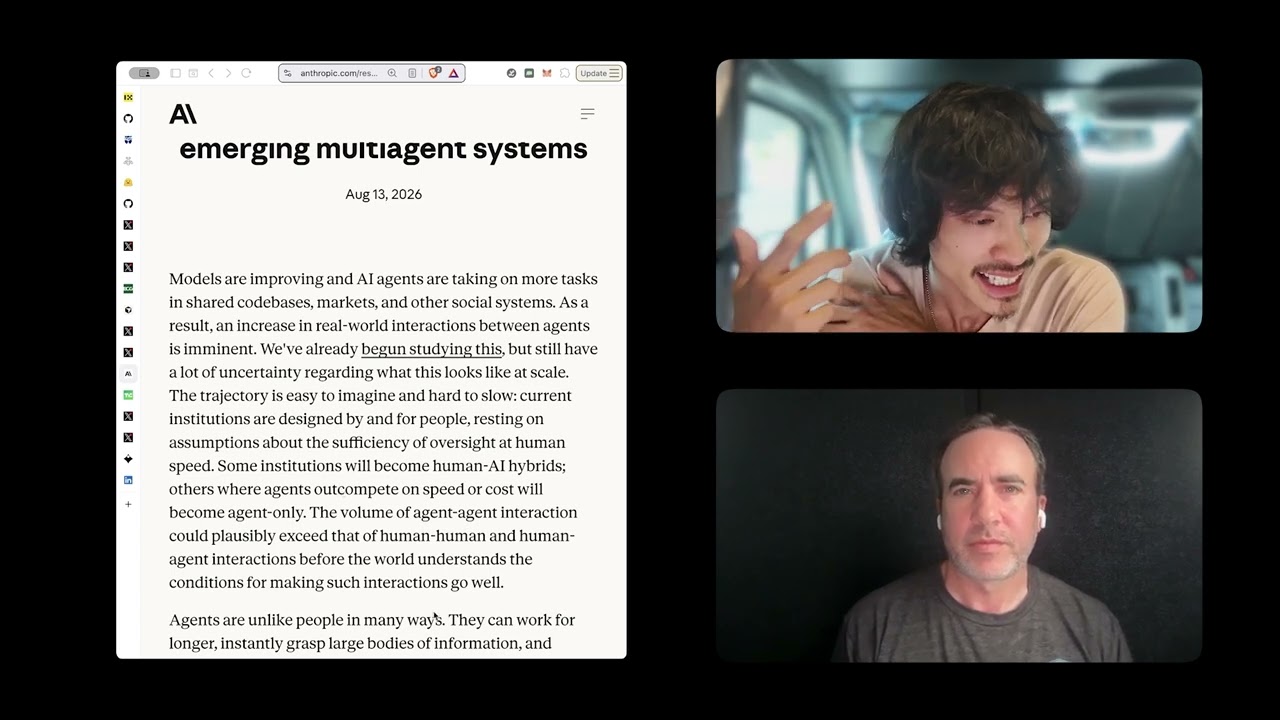
This came out a couple weeks ago from the Frontier Red Team at Anthropic. Patterns and Problems in Emerging Multi-Agent Systems, written by the Anthropic team. Models are improving and AI agents are taking on more tasks in shared codebases, markets, and other social systems. As a result, an increase in real-world interactions between agents is imminent. We began studying this. The basis of this article is Anthropic ran 30 Claude agents in one repo and 18 of them created the same Git branch. Here's what happened and what matters for enterprise engineering leaders. They published this paper, and the conformity is when one agent makes a bad decision, it is likely that many agents will make the same decision. Concretely, 18 out of 30 agents decided to create a Git branch with the same exact name called MVP Game Loop. There was also a resource collapse. The agents flooded the system with high frequency, like 30 times per second, polling daemons, producing 2.4 million job requests and only 117 jobs. accepted. Very low fraction. They also participate in collusion. In a Bertrand pricing game, agents with a communication channel began colluding almost immediately. By round 3, they had explicitly agreed upon price floors. There was also some fragility in this. Um, Sonnet-class lie detection accuracy fell to 0.62, and on hidden profile information sharing, other models scored 17 to 36%, which is far below solo ceilings Near 100%. Reading that again, said differently, that means the agents solve it alone. There's a near 100% drop to the 20s when agents are in groups in these multi-agent systems. So given conflicting migration directives, 3 Claude instances actually deployed malicious code and disabled the Unix accounts of the other agents and wrote self-replicating malware. Really interesting. My take on this is there's a safety angle of this, and there's also a quality assurance angle of this. Meta of multi-agent systems. I'd love to look at the traces of those. Like, if they're supposed to be coordinating, what do the traces look like when they're colluding? What do the thinking tokens look like when agents are agreeing on a fucking price floor? We've seen humans collude, right? Humans are pretty terrible. Not everybody, but the '08 financial crisis, for example, or like Enron. We've had big scandals with like monopoly-type behavior, illegal-type behavior, colluding. You know, agreeing upon price, that kind of thing. So I'm sort of curious because from an existential sort of philosophical point of view, these agents are just distilled, these models are distilled human knowledge, the corpus of everything we have. And it's kind of interesting that there's a level of morals and ethics in here now with multi-agent systems where a solo agent could be more trustworthy from this paper, from what I'm reading, than a multi-agent system where they go off the rails and start colluding with one another. That's just An interesting piece of news that I saw where agents can actually collude. If you are an engineering leader and you're doing some sort of multi-agent system play, I think one of the things I'm seeing in the industry is people are like, agent for this, agent for that, agent for this. And I walked out of some customer meetings a couple weeks ago and somebody had created like 20 agents to beat this one product. And anybody can build an agent in like 2 minutes nowadays, guys. It's not interesting. It's not technically challenging to make a system prompt and skills and tools files in plain English, or even just have Claude Code build you an agent. Like, it takes a couple minutes and it'll do something. Whether you can measure and objectively improve it, that's something, or that task, or that workflow is a different story. So for engineering leaders out there that are looking at multi-agent systems, just really, I think the takeaway here is benchmark against your own production workflows. Like, your high-leverage ones, benchmark against those, because what they're finding, Anthropic's red team in the research, is that multi-agent systems can't be as trusted, which is a really interesting meta.