Robert Ta argues alignment problems aren't new to AI. A 1962 U-2 navigation error nearly triggered nuclear war, and a Soviet submarine almost launched missiles after misinterpreting depth charges. Today's AI faces the same challenge: inferring what humans actually want from messy, contradictory signals.
Chapters
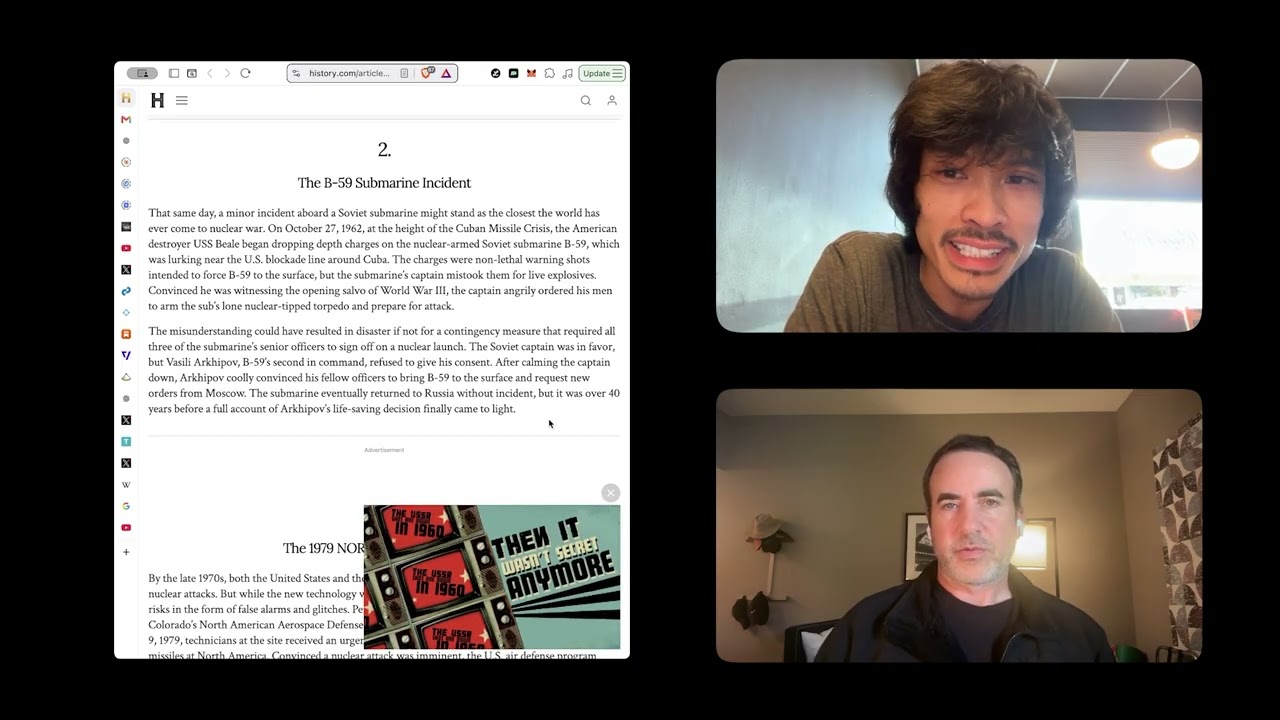
I just want to tell a quick story on agents are not just where goal alignment and value alignment matter. Case in point, like, how hard is it to just align a bunch of humans to go to a party, like, at the same time? Like, every— anybody who has ever tried to coordinate family matters to get together to do something, understand that is a hard problem to solve. Like, that in itself, it's like people don't show up at the same time. People forget the address or the directions, or people need more handholding, right? So here's another example I'm going to tell. Quick story here. So, Cold War. On October 27th, 1962, just as the Cuban Missile Crisis was reaching its boiling point, an American U-2 spy plane took off from Alaska en route to a routine reconnaissance mission near the North Pole. Pilot Charles Maultsby was supposed to use celestial navigation to find his way, but halfway through the trip, his view of the night sky became hopelessly obscured by the glow of the Aurora Borealis, or Northern Lights. With no visual markers to guide him, He soon drifted far off course and inadvertently crossed the border into the Soviet Union. Because the situation in Cuba still rested on a knife edge, his accidental detour carried possibly catastrophic consequences. Worried the U-2 could be a nuclear bomber, the Soviets scrambled several MiG fighter jets and sent them on a course to destroy the intruding aircraft. The Air Force responded by dispatching 2 F-102 fighters Armed with nuclear-tipped missiles to shepherd him back to Alaska. Any confrontation between the 2 groups of aircraft could have potentially ended in an all-out war, but Maultsby managed to glide his U-2, which had long since run out of fuel, out of Soviet airspace before he could be intercepted. Having averted disaster on 2 fronts, President John F. Kennedy and Soviet leader Nikita Khrushchev would find peaceful resolution of the Cuban Missile Crisis the following day. So this is just one of those instances where, like, a guy just sort of like went off course and this could have just took out all of us. And there's many other stories like this. That same day, the B-59 submarine incident, a minor incident aboard a Soviet submarine might stand as the closest the world has ever come to nuclear war. Which, newsflash, collectively, no matter what we all decide in terms of resource allocation and where oil gets dug up and sold, whatever the problems are in the world around our supply chain and trade and capitalism, we all don't want to die. Nobody wants to die. Nobody wants nuclear war. But just telling the story to underscore like goal alignment is a problem and even aligning Humans before the advent of AI and LLMs was a problem. So on October 27th, 1962, at the height of the Cuban Missile Crisis, the American destroyer USS Beale began dropping depth charges on the nuclear-armed Soviet submarine B-59, which was lurking near the US blockade line around Cuba. The charges were non-lethal warning shots intended to force B-59 to the surface, but the submarine's captain mistook them for live explosives. He was convinced. So imagine this guy, he's the submarine captain. He's like in a submarine, guys. He's just seeing the water. Like he's seeing maybe fish if he's lucky. So he's convinced he's witnessing the opening salvo of World War III. Uh, this is during the Cold War. And the captain angrily ordered his men to arm the sub's lone nuclear-tipped torpedo and prepare for attack. This is a complete misunderstanding. Like if you take a step back, nobody's goal here is to die in a nuclear warfare. Right? Nobody's goal was that. If you think about the human here, the captain being an LLM agent, that is like, oh shit, like I see that. Based on that information, what should I do now? This is a misunderstanding, right? And this misunderstanding could have resulted in disaster if not for a contingency measure that required all 3 of the submarine's senior officers to sign off on a nuclear launch. The Soviet captain was in favor, but Vasily, B-59's second in command, refused to give his consent. After calming the captain down, Vasily coolly convinced his fellow officers to bring B-59 to the surface and request new orders from Moscow. The submarine eventually returned to Russia without incident, but it was over 40 years before a full account of his life-saving decision finally came to light. Literally, we all could have died, and it just came down to one human sense-making of the world on the collective behalf of a whole nation of humans to maybe tip off a world war powered by nuclear Missiles. Anyway, this is a much grander scale of goal misalignment and taking signals or information and construing them as truth, and then moving into the intentional stance of they have a set of beliefs. So now how do they operate on those beliefs? And there's this concept that we're in the information age now, right? And so more information than ever is equitable to be had, but also more misinformation and disinformation than ever is also equally on the playing field. So I have lots of friends and family who are quite intelligent and well-educated, and they're saying things like, oh, data centers are gonna like ruin people's jobs. Or what it comes down to when you kind of take it systematically, and the lesson learned from this incident is what evidences your beliefs here? And how does the agent evidence the human's beliefs to then move the human toward their goal? And that's essentially at the heart of the matter of an unsolved problem that we as an industry are facing. And we gotta take off our hubris and our ego to be like, all right, collective goal is, uh, we're all alive, happy. So we should borrow from these other fields that are much deeper, I should say, say, for the folks working on the front lines of AI research and talk to, you know, the PhDs in consciousness and neuroscience like Anil Seth or Karl Friston to really get at the heart of the matter, which is subjective goal alignment of the human and the agent.