Robert Ta argues that U.S. regulations banning data centers and requiring pre-approval of frontier models risk ceding AI dominance to China, which is rapidly commoditizing models like KIMI K3. The conversation explores whether lasting value in AI will be in models, infrastructure, or products as competition accelerates.
Chapters
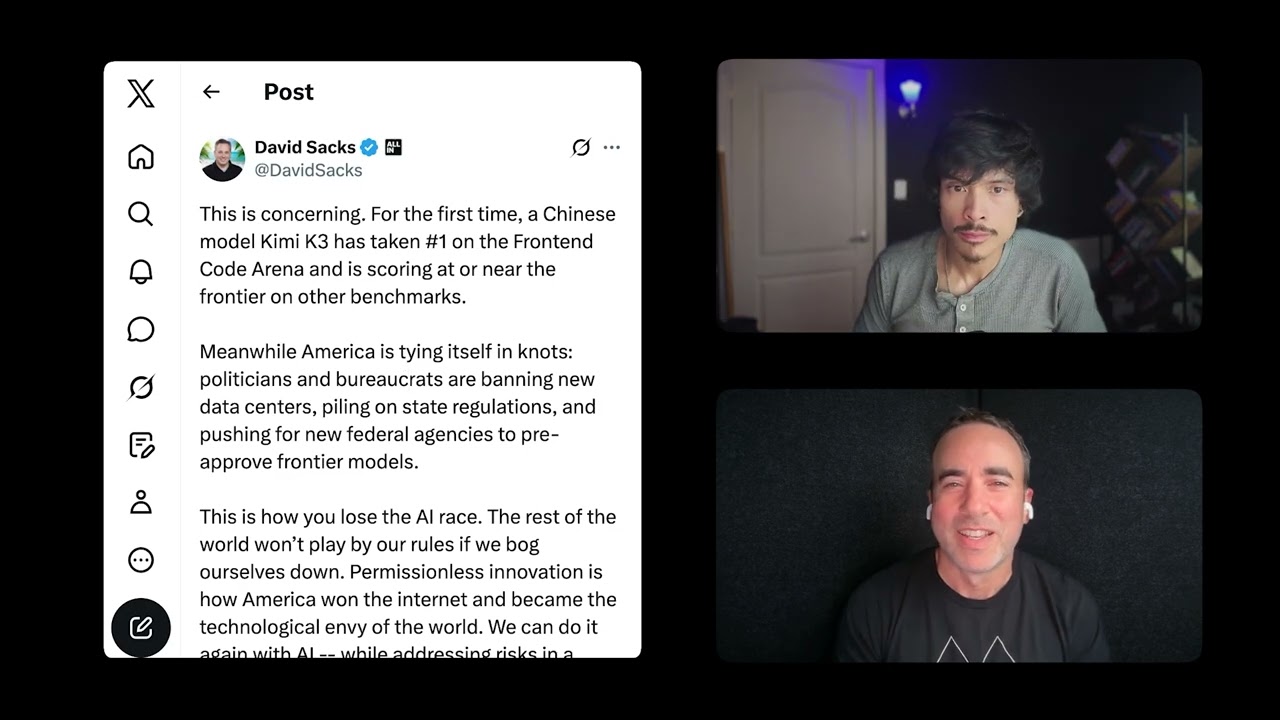
David Sacks says this is concerning. For the first time, a Chinese model, KIMI K3, has taken number 1 on the frontend code arena and is scoring at or near Frontier on other benchmarks. Meanwhile, America is tying itself in knots. Politicians and bureaucrats are banning new data centers, piling on state regulations, and pushing for new federal agencies to pre-approve Frontier models. This is how you lose the AI race. The rest of the world won't play by our rules if we bog ourselves down. Permissionless innovation is how America won the internet and became the technological envy of the world. We can do it again with AI while addressing risks in a targeted way, or we'll watch our lead evaporate. Some people saying here, Chris Costa, what's the finish line for the race? Another person says, sobs, it's too tough because we can never trust there isn't some backdoor for the CCP to review and grab any useful software that gets developed from its use. Abel says, 'Murica. Well, there has been very little patriotism and care for morals. From those American labs doing the LLMs. Let's talk about that open source America versus China narrative. I know you're deep in the geopolitics of everything that's going on right now and how compute is the oasis everybody's wanting and is the, is the constraint essentially that, that we're all seeing on a macro view. Any thoughts on this with the intersection of KIMI coming out?
Yeah, for one, I think David Sacks' position is interesting. He's a former AISR and he's probably not thrilled seeing the administration that he used to work more directly with, kind of holding up models and trying to figure out how to regulate them. You know, I think there's one, there's an aspect of just like him trying to give some thought leadership here across the board and saying we need to let our companies flourish and empower them to do so. Very capitalistic, Sachs is. On the other hand, there's a lot of talk that China might actually be clamping down at some point too. Like as these models get more powerful, they might throttle what they let their companies have the rest of the world access to. The narrative so far has been that the Chinese companies are heavily incentivized to sort of like commoditize the software layer because the country is so strong hardware that they see letting other American companies or European companies get ahead on the software front doesn't like serve their national interest. It's kind of been the narrative so far is that like, you know, they'll release these open source models. And I saw a great meme where like there's like a water skier behind a boat and the boat is the American foundation models and the water skier is Chinese open source versions. So it's like, you're always going to look back. They're always going to be right behind you. Right. Actually, there's a great clip from Chamath talking about how this K3 release proves that AI might be the fastest fastest commoditization cycle in history. What I'm wondering is what protections does Anthropic and OpenAI and to the extent Groq AI have for the research and innovation they're doing? Are these transformer layers really just a commodity that aren't going to have any sort of like protection? Or is there actually like going to be utility at the model layer? Or are we going to see all this at the harness layer and we're going to see products competing for that? A lot going on here. It's cool to see all the discussion around it every time there's one of these model releases.