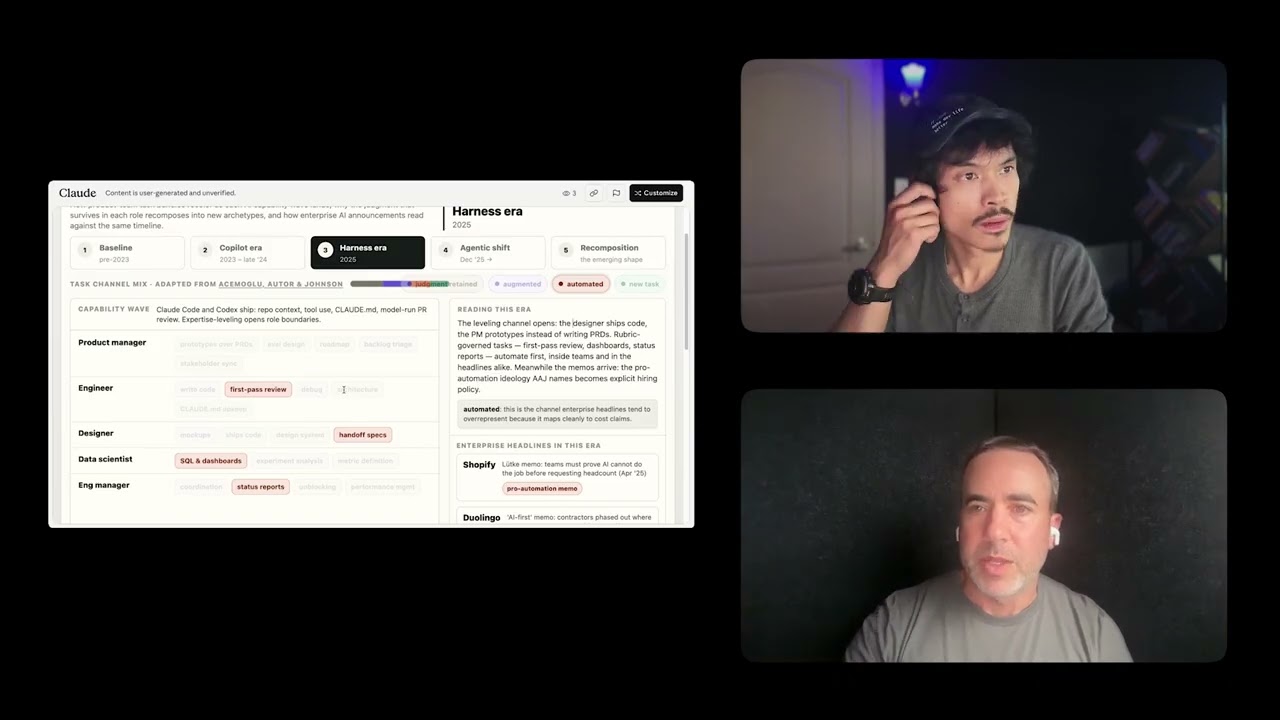
In this discussion, Robert Ta introduces a paper that defines "pro‑worker" artificial intelligence as technology that enhances human skills and expertise, outlining a five‑category taxonomy of technological change: labor‑augmenting, capital‑augmenting, automating, expertise‑leveling, and new‑task‑creating, with only the last being unequivocally pro‑worker. The conversation then applies a task‑level lens to product teams, visualising how AI eras reshape roles. The Copilot era shows a mix of human judgment (gray), AI‑augmented tasks (purple), automated tasks (red), and emerging new tasks (green). The Harness era, driven by tools like Claude Code and early Codex, adds bandwidth for new activities such as product‑manager prototyping and automates first‑pass code reviews. The subsequent agentic shift, exemplified by Claude Code plus Open 4.5, leads to role recomposition where designers can code, junior engineers improve, and product managers can research, prototype, and ship, indicating potential role dissolution. Throughout, the speakers argue for a nuanced view beyond the simplistic "AI takes jobs" narrative, emphasizing how AI can create novel human‑centric tasks and expand capabilities.
Chapters
Building pro-worker artificial intelligence. This paper defines pro-worker technologies, including artificial intelligence, as technologies that make human skills and expertise more valuable by expanding worker capabilities. Our conceptual framework distinguishes amongst 5 categories of technological change: labor augmenting, capital augmenting, automating, expertise leveling, and new task creating. Only the last category is unambiguously pro-worker, generating demand for novel human expertise. Expertise rather than commodifying it. Yeah. Do you want to go over this? That paper at the intersection of this new narrative popping up around the product role.
I heard about this paper earlier this year when it was released, and I thought it was a good lens to look at. Like, let's get some more nuance than just like, is AI going to take our jobs? Is AI going to automate everything? And I think that was actually the hypothesis that OpenAI and Anthropic maybe considered core in what they were doing. Like, that's what AI would do. But I think that the paper gives a more nuanced lens, and it says every technology that comes out has these kind of like different ways that it can augment labor, augment capital, it can create new tasks. Let's take a look at what's actually going on through that lens. And what this artifact does, shows the baseline, like what did product teams look like before AI? And then if you click on the Copilot era, we start to see the ways that AI is impacting the, the tasks that we do in these jobs. And this is by like a task level analysis. So we're saying for each of these roles, what is the task that's being done? The gray is human judgment is retained. There is augmented technology with AI is the purple. Automated is the red. New task is green. So this is a Copilot era. We all remember that. You can see kind of like the different roles in the product organization. The Harness era is the one where we got Claude Code and we got the early versions of Codex. Obviously that's a step function and all of a sudden you're seeing, oh, I've got more time and more capability to do new tasks. And if you look at like the product manager, prototypes over PRDs and eval design, these were things that maybe didn't have to do before we had so much power through the AI tools, but now we can, we can allocate additional bandwidth in our work and this is value adding activity. So what's being automated? The engineer first pass review. I think looking at pull requests and saying, is this code good. Like, nobody has to do that their first time anymore. You can ask Claude Code, is this ready for my review? You know, it can do the first couple reviews itself. So those are the kind of things that you're seeing being automated through this, the Harness era. But then there's the agentic shift. And this was what we all really felt when Claude Code plus Open 4.5 came out in December. This is what the agentic AI built for us. And we start to map here to Boris's framework where it says recomposes towards. So this is actually like, now the AI is so impactful in our job that it's causing job dissolution or role dissolution on the teams. The designers can code, right?
Um, yeah.
The junior engineers can go better.
The product managers could research like, yeah, product managers could prototype, product managers could ship to production. Like it's a different world.
Yeah. And so that empowers like a different shape of the job. And I think this is just an interesting way to look at it, is to take these different task workflow vectors and say, is it still a human, you know, judgment retained? Is it augmented? Is it automated? Is it a new task? You can see the nature of change over time. What you see is a mix of things, right? It's not just things being automated. It's that things get automated and the new tasks arrive that we can add more value. There's no like upper limit on the amount of value that a human could add. With these tasks, given the capacity to do more tasks. I think that's the exciting thing, is that we can augment ability and we can create new tasks. And that's how, like, these product teams are probably going to continue to evolve. And I think we can take a look at the transition here. Okay, so if you're a product manager, now you're recomposing towards a prototyper/grower. Your job augmentation is kind of like making you most fit for those type of roles. The engineer is going towards the builder/sweeper/maintainer. The designer is towards the prototyper/sweeper. Data scientist is towards a grower, and engineering manager towards the maintainer/sweeper. This is kind of like a conjecture or brainstorm, but it's taking the traditional roles, saying how they're changing and how they're going to meet like kind of world Boris is seeing on the front lines of the frontier models. And then the last section is what does the world look like in the way that Boris described it in the recomposition era? Now you get like these different kind of like role divisions and new capabilities people are capable of, augmented capabilities people are capable of doing. We're seeing this in our own work too, right? Like where the role of prototyper and builder are definitely like bifurcating in ways that we need like more nuanced language to say like, which state is our product at? And our latest agents kind of orientate around the artifacts that each of these roles create. You know, as in like, we actually have like a literal, we have an agent that literally shapes requirements, right? And we have an agent that literally shapes story tickets. And those artifact-driven tasks that, that are being performed kind of reshape the, the nature of the work in the product team. And just one more like data point I wanted to show here that this, there's some headlines on the right-hand side if you scroll down. These are a collation of like, how are companies describing their workforce decisions about AI. I think Klarna is a really interesting one because earlier, like in 2024, they said, guys, automation is here. We're laying off all the customer service people. You know, we got this with the 2024 AI, which they, they since have come back a couple of times and like restated their position about like, oh, we actually need customer service people for the more complex tasks. And now they're kind of like even using language of recomposition and new task skills. And you're seeing this across different announcements. So I thought this was cool. And the artifact, as you go through it, it kind of tells us the changing narrative about like announcements that companies are making, given decisions to like, uh, manage talent through these technology adoption. The other end of the bar, like one is like, there's, there's definitely like narratives coming through from Anthropic and OpenAI about product team recomposition. On the other side, there's this debate that is kind of low nuanced. Is AI taking jobs? And I think both of these are converging into like, no, let's just use this task augmentation lens. And let's understand how the roles are changing. Where are we going to see automation? Where are we going to see new task creation? That's the productivity vector that, like, we should be talking about and sort of like, you know, on the All In podcast, they have this like weekly debate about is AI taking jobs or not? And they're sort of like all pulling data points that we just talked about, but using it to support like a yes or no position when the position is actually more nuanced. What is the composition of task skills and how is AI meeting each one of those? And I think that's what we want to be doing in organizations.