Robert Ta argues that cheap code generation is upending product teams. Engineering time is now cheap enough for rapid prototyping to test ideas and align stakeholders. Organizations need to move human judgment away from low-leverage tasks like first-pass code reviews toward higher-impact decisions.
Chapters
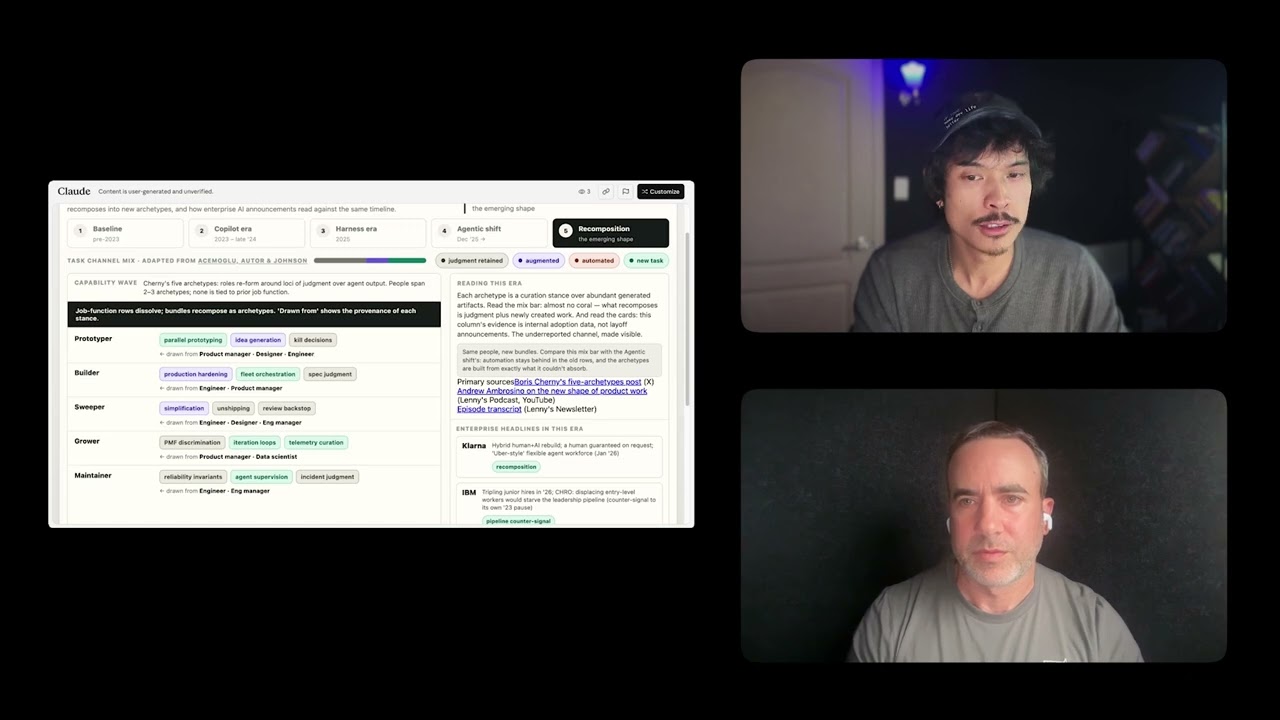
If you're a head of product or a product manager or an engineer, engineering manager, head of engineering, head of design, designer, like if you are in software development, you're on tech team, you're shipping product, you need to be thinking about these things. 'Cause you're probably doing these things like parallel prototyping, idea generation, killing things, like, you know, unshipping, production hardening, fleet orchestrate. You're doing these things and you probably are just sort of doing it and now you've drifted off into exercising skills and capabilities. To meet the new demand of the capacity of work, of being able to serve your roadmap and your customers because you have more capacity, people could do more. And you've probably drifted away from what the career framework looks like at your company, right? Like unless they updated it and are thinking about this new language to describe the capabilities and skill sets, it's not even like roles anymore. Like if we think about the archetypes, it's kind of just expressions of the roles in different scenarios to meet the demand of whatever's needed to keep moving the supply of we are baking the bread that is a better software product. What I mean by that is the whole goal before was built around this fundamental assumption that engineering time is very expensive. So we want to measure many times and cut once. Now code generation is practically free compared to what it was a year and a half ago, 2 years ago, right? 3 years ago. And so code generation we're now finding is a way to prototype. You could codegen something and you're no longer seeing that as like, oh, that was a super expensive thing. You could generate code to build UI that you have no actual commitment to bring to production just to get something out there, to align on an idea, to then get more experimentation and more hypotheses out to get more stakeholder alignment and more learning, right? So the whole job of a product team from product management to designer to engineer is to ship world-class products to capture market share to build products that ultimately you can compound and create value in the world, and, uh, that creates economic value for the business, right? So it's the intersection of those things: customer value, product useful and innovating, creating value in the world. And, and so that should meet your bottom line for the business. That is the goal. What are the things in between that goal? That has shifted. And it's really interesting to see, like, some companies are being like, uh, actually we're totally wrong about this. Like, there's more demand now, and now we could have our people serve higher-level valuable decision-making versus like lower-level things like being a backlog junkie or, you know, doing the code review first time for a pull request. It's like, no, bring me in for the second time, do an adversarial code review, like save the valuable human judgment for further along in the higher leverage areas of baking the bread.