Robert Ta argues that domain-specific AI systems beat frontier models by focusing on niche workflows and curated datasets. KIMI K3, an open-source model, achieves 2.5× better scaling efficiency than its predecessor through a new attention mechanism and optimized expert selection, matching the proprietary Fable-5 while training faster per iteration.
Chapters
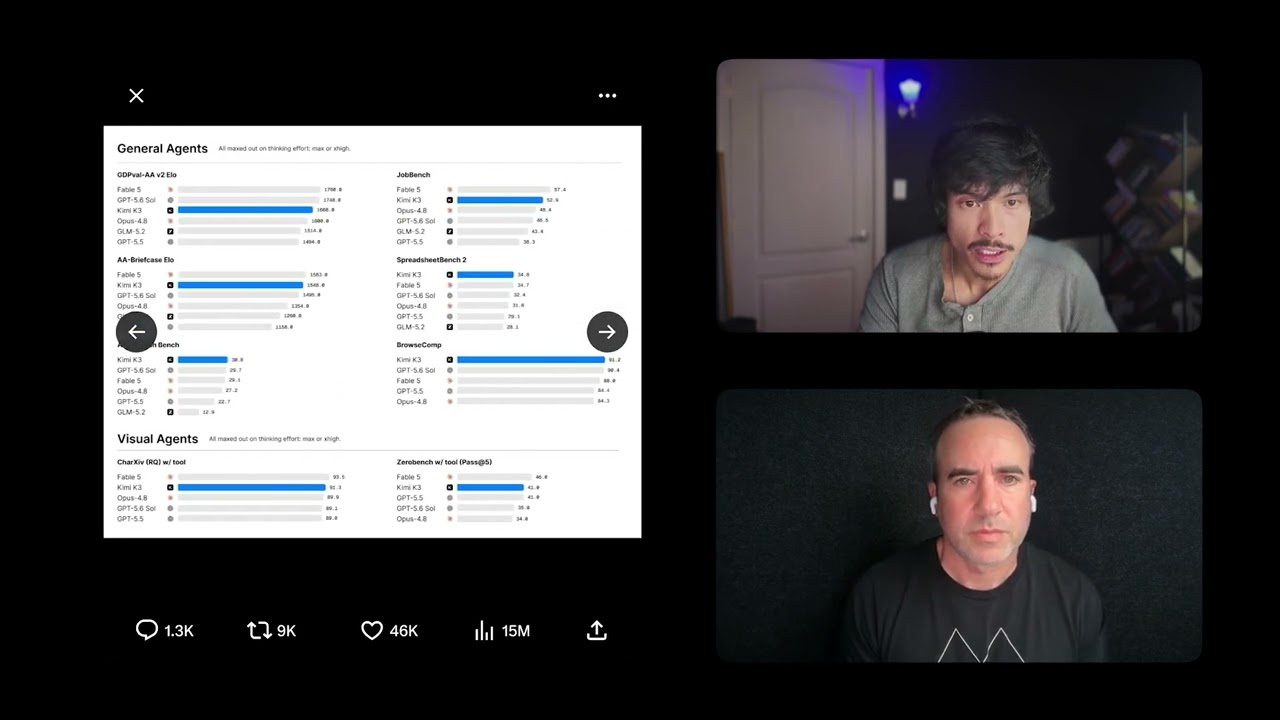
I personally believe that domain-specific harnesses that require niche datasets around your economically valuable workflows as companies, that seems to be where customers we're working with, prospects we've talked to, that's where their eyes are. And that's where I colloquially will kind of see, that's where people are seeing some semblance of a little island that they could plant a root on and be like, oh yeah, maybe we could grow some trees here, start farming here and protect ourselves from this. This has good waterfront protection. But it is really interesting to think about, okay, are the AI labs just going to eat everything? Is that a real moat? I think it's interesting to look deeper at the KIMI release. Let's look at the technical details. So this was the KIMI Moonshot tweet introducing KIMI K3. For all AI builders and tech executives out there that are, you know, scared of the token maxing, blowing your budget, this is a real alternative where their open weights are coming out in 10 days. I'm I'm starting to see architectures routing, like Uber, DoorDash, Stripe, are routing all AI model calls into an abstraction layer. But just getting into some of the technical specifics, these are some graphs on how KIMI K3 does on coding via different benchmarks. As you can see here, without going into details, scoring high everywhere. General purpose agent work, visual agent work, scoring high there. They also talk about this, which I thought was interesting, that why is KIMI K3 better? It's built on KIMI Delta Attention, KDA. That's what they call it, attention residuals, two architectural updates designed to improve how information flows across sequence length and model depth. And they've also scaled up their mixture of experts sparsity, effectively activating 16 out of 896 experts when paired with a stable latent MOE framework. Together with refined training and data recipes, these structural changes yield an approximate 2.5x improvement in overall scaling efficiency compared to K2. There's another thing that's interesting here. Which is its test over long horizon tasks. Given FLA Triton attention response at production scale, 96 layers, 8,192-dimensional model, 8,192 tokens, the goal was to maximize training site speed without changing numerics. Over 15 hours of nonstop iteration, K3 designed a novel two-phase kernel algorithm, fused kernels while preserving numerics, and reduced forward and backward time from 283.6 ms to 114.4 ms. And you see the differences here for that test on KIMI K3 versus the latest Fable-5, and then further 5.5 and 5.6 SOL on the same task, which is interesting. And the key difference they noted was K3 and Fable-5 reached similar performance, but K3 was the one that improved faster per iteration. So I thought that was really interesting. And they have this cool little video game loop here where KIMI K3 achieves true vision in a loop. What place do you see these open source models What problems do you see them solving versus the problems that you see Frontier Intelligence solving? Will there always be a place for both in companies' tech stack?
I don't know. It's so unclear, um, what the long game is here. I think the traditional, like, view has been, let's use the best models to sort of do the orchestration and to, like, leverage the smaller models. There's a lot of model routing tools that are coming to let you pick the right model for the right job. It's just not really clear, you know, if that's going to continue to be the architecture, you know, of choice of how to use models. You know, I think we'll just have to see, like, where the foundation models and the new releases continue to find advantage and do things that are, you know, a competitive advantage for those models.