Anthropic restricted access to Fable 5 and Mythos 5 models, disrupting AI builders' workflows. Researchers called it anti-science and potentially monopolistic. The U.S. government then banned global access citing jailbreak vulnerabilities, pushing developers toward Chinese open-source alternatives like DeepSeek.
Chapters
Here's what happened and what matters for anyone evaluating which AI provider to trust with their production stack. And it comes around this term that has come out, secret sabotage, where the developer community has really turned on Anthropic, the AI safety company. Some of the perspectives around industry, Nathan Lambert mentioned, to have access to the cutting-edge models for my work rug pulled in an under-the-table fashion is appalling. He called it anti-science. And therefore anti-progress and anti-safety. That came from accredited AI researcher Nathan Lambert. Jeremy Howard from Fast.ai says Anthropic has chosen the opposite of the safe path. They're allowing themselves, the current top lab, to use their top model for frontier AI research. They've said they'll sabotage others who try. He called it a very dark and very sad day. Dean Ball, Foundation for American Innovation, former White House OSTP, coined secret sabotage and said it massively and profoundly raises the status of the argument that AI safety has been hype to justify monopolistic behavior by labs. He warned it could attract antitrust scrutiny. Jonathan, I'm curious on your take of those perspectives so far, getting the rug pulled out from under them, scientists and researchers' behaviors being opposite to the brand of being all about safety and wanting more regulation, and just like the break of trust around the development and research community. What are your thoughts from your CTO perspective on that?
The secret sabotage was a decision that Anthropic reversed pretty quickly. So I think there's a lot going on on these releases, and I think maybe making suboptimal decisions is just a way to get product out to market. And that's just part of what we're seeing at the speed at which these are released. And I think most of the other aspects of like, this is unsafe behavior, is kind of a judgment call. I don't think that Anthropic seems to me to be a bad actor as much as they're a company that has an ideology, but is also in a hard position. They're not going to make everybody happy. And, you know, I think there's a lot of worse ways they could have handled this. You know, I think there's just kind of an imperfect, very difficult situation. And we're all figuring out what this all means in real time.
Well, what about as an AI builder yourself? Like, how did this affect you and your flows? We literally were talking about on the last pod how we loved using Fable 5 for this big product launch we did for a big cutover with many different systems to juggle and a lot of different pipelines. And then Almost right in the middle of the launch, this thing got rug pulled. So what was your experience as an AI builder just going through this, you know, beyond your opinion of the company?
I guess because of the release timeframe that Anthropic gave for the product and the price that I was considering it kind of a toy, kind of a novelty to begin with, not something I would really have to count on day to day. You know, I was going to give it a few weeks, see how it evolved. I literally had two sessions that I was using this model. I came back to this like a couple hours after the announcement was made and couldn't finish those sessions. I had to finish them with Opus 4.8. You know, what a disaster, right? It wasn't the most— thing in the world, but it was, you know, like kind of inconvenient. I think what is the bigger concern is that, okay, now the government's involved. The models hit a plateau of capability. We heard this forecast in the AI 2027 forecast. They were 3 months behind the timeline of when this is going to happen. So now we're actually in an era where the government's involved. We may see less access to models that we already have access to. And that's what I'm thinking about. That's what I'm concerned about. What a mess it's going to be for a body that's not ready to regulate this industry to start regulating this industry. I'm worried more about the upcoming months than I am about my my two sessions that got kicked because of the rug pull.
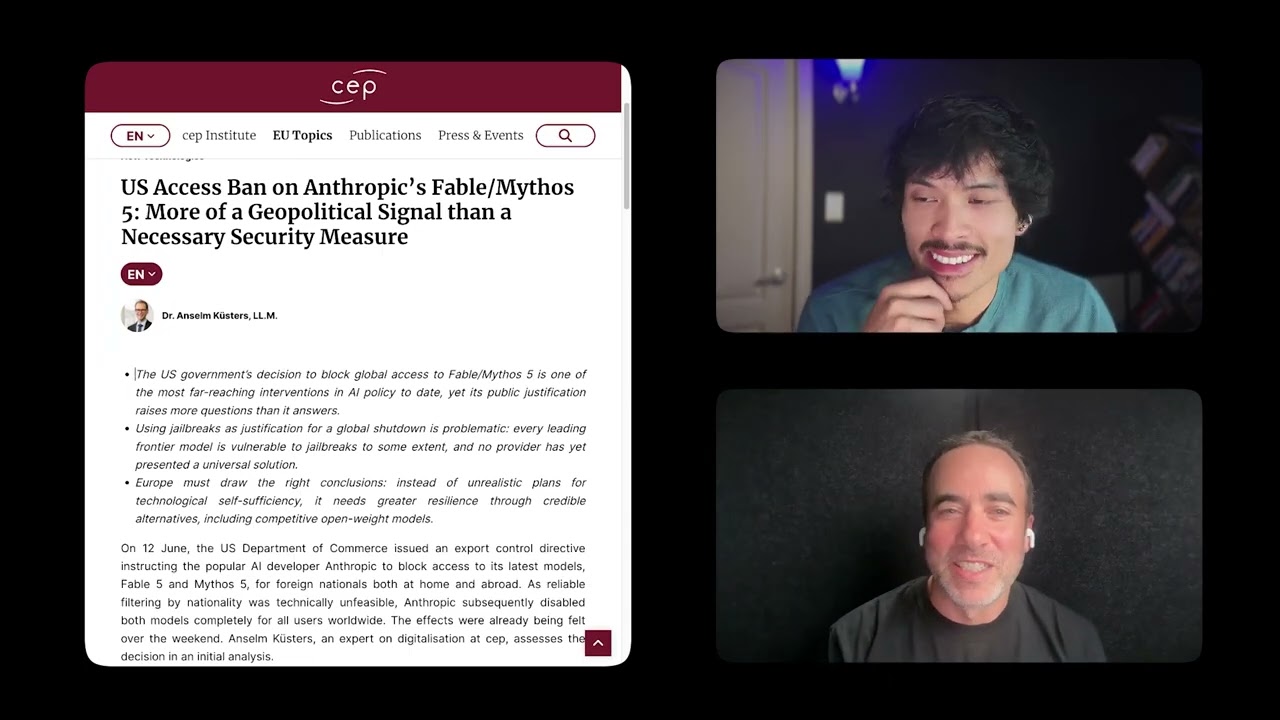
Yeah, the implications of the future as an AI builder. That makes a lot of sense. I also feel the same. I love my sessions with Fable 5. It was really good. And I'm like, man, I wish I had more of it. And then when we got rugged right here, I was very sad. Real quick to just report on this. This is an article here from CEP News. US access ban on Anthropic's Fable and Mythos 5 more of a geopolitical signal than a necessary security measure, speaking to what you were just kind of saying. Oh, the government gets to step in now. What does this mean for, uh, AI builders and people relying on these tools for building their companies and their businesses? Some quick notes here. The US government's decision to block global access to Fable and Mythos 5 is one of the most far-reaching interventions in AI policy to date, yet its public justification raises more questions than it answers. Using jailbreaks as justification for a global shutdown is problematic. Every leading frontier model is vulnerable to jailbreaks to some extent. And no provider has yet presented a universal solution. That perspective comes from Anthropic coming back with its own blog post saying like, hey, you could jail— use the same jailbreak with other models out there right now, was sort of their position and why, uh, they went with the position they did. Even though, uh, Amazon reported what they did around the jailbreak, they didn't see it as a high enough sort of bar, but apparently the White House did. And that presents a very interesting thing for AI builders, um, and it might be a bleak future, that we might be seeing the precipice of. Europe must draw the right conclusions, is what this article says. Instead of unrealistic plans for technological self-sufficiency, it needs greater resilience through credible alternatives, including competitive open weight models. Really interesting because, you know, just listening to the latest All In podcast, and I know you listen to that pod more than me, but I know Friedberg had been talking about for a while, you mentioned to me that his company may move to more open-source models to be less dependent. On the most recent All In podcast, they speculated on the podcast that restrictions on American models are pushing companies to Chinese open-source alternatives like Deepseek and Qwen, which score way better on all the different benchmarks than American open-source alternatives. Quote unquote, "The American open-source models are just not as good as the Chinese open-source models."