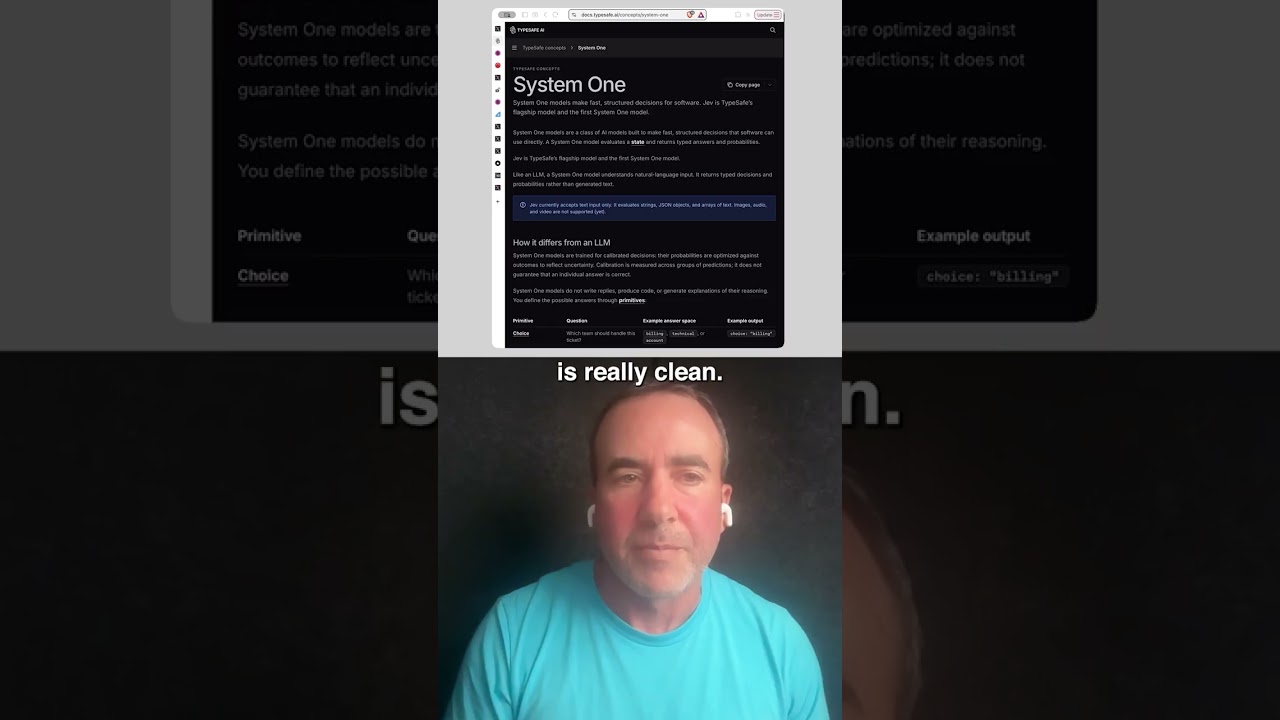
In this segment of the YouTube video, Robert Ta interviews Jonathan about his practical experience using Jev, a retrieval‑augmented generation (RAG) platform, for large transcript corpora and for simulating self‑model decisions within a world‑model. Jonathan explains that Jev lets them pose many parallel, multiple‑choice questions against a JSON‑encoded state (the transcript or model state) and receive probabilistic choice scores. He highlights the type‑safe, clean API, the ease of integrating Codex to auto‑generate the question‑choice structures, and the “art” of crafting effective questions and answer sets. Jonathan notes that the tool works out‑of‑the‑box, is fast and cheap to set up, and that its probability outputs give him insight into where the model excels or struggles, making Jev a powerful addition to their workflow.
Chapters
Jonathan, any initial reactions, takes on using Jev yourself against our use cases?
First, I think this was exactly what I wanted to see in retrieval augmented generation tool. And for me, it's just exciting. Like we deal with a lot of transcripts, right? And we can ask a whole bunch of questions against the transcript corpus in parallel, get answers back and like amazing, like, you know, infrastructure set up so much faster, so much cheaper. So just right off the bat, there's really practical use cases. When I requested early access, I said, hey, we build self-models and we have a probabilistic output for them. I want to see how Jev works in that use case. And so what I've been doing is breaking down our self-model versus world model simulator and having Jev predict like what the self-model will decide in a certain situation, given its belief structures. Basically what I'm doing is translating our self-models to a set of questions that are asked against a world model that is in the, that carried in the state. And when you look at the type-safe docs, I really like just the abstraction that they bring to the API is really clean. When I talked about transcript, that would be in the state variable. You can sort of chunk that up any way you want to as far as like a JSON structure. But then the important thing is like questions. How do you formulate the questions? And of course I'm using Codex to just like interact with their playground and Codex interact with their API. It's able to like just understand everything, just dump the docs into your Codex, point it at the browser, pulls everything together. You have a state structure, you have questions, and then each of the questions has choices. So it's not an open question. You can't ask open questions. You can ask questions that have a set of choices associated with them. And there is some art to both how you structure questions and how you structure choices for each of the questions. I found it like works just as described perfectly out of the gate. And, you know, the probabilities it gives back, I'm getting more of a feel for as I go through the scenarios and like what it's good at and what it's not. But it's a really, really powerful tool.