Robert Ta discusses Zero, Vercel Labs' new agent-native programming language that launched on GitHub with 2,200 stars. It emits structured JSON diagnostics by default, letting the same CLI command work for both human developers and autonomous agents. The language is pre-1 and intentionally unstable, but Vercel sees strategic value in tighter control over deployment and hosting.
Chapters
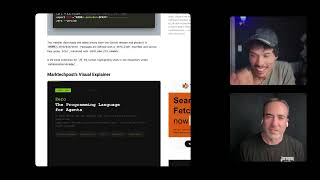
Vercel Labs, they just released agent-native programming language. It's called Zero. This is the GitHub repo. Already has 2,200 stars. Released last week. It is an experiment in building an agent-first programming language. The project is exploring what changes when agents are primary users from day one. A language that can be learned on the fly, tooling that exposes structured facts, for debugging and repair, and a standard library broad enough that most programs do not start with a dependency search. 0 is pre-1 and intentionally unstable. So breaking changes forthcoming for sure if you're using this. But I think this is, this is really cool. Here's like a marketing post by MarkTechPost. This is a cool image where, uh, the CLI emits structured JSON by default. So this is zero-check dash dash JSON, and it'll actually throw out particular structure for the agent to check out, like code, a repair. Uh, and so what they say here is that each diagnostic carries a stable code parameter, a human-readable message parameter, and a repair object with a typed repair ID. Humans can read the message, agents read code and repair. And it's the same CLI command serving both of those personas. I thought that was pretty cool. I don't know where this is going to go, but it makes sense that somebody would try this. And I was surprised. It doesn't surprise me that's Vercel, but when I saw it, I was like, oh wow, this is cool. Why would they try to make this? And then from a business standpoint, it totally makes sense if other people adopted this and, you know, they own sort of the deployment and hosting. Story. That'd be pretty dope. And they could have— and any— and what I imagine is if an application adopted this language and then deployed it, hosted on Vercel, you would probably get better, less erroneous build pipeline over time, right? That's what I imagine would come out of this. What do you think of this zero programming language for agents, Jonathan?
Yeah, it's a really interesting idea. It definitely serves a purpose, I think, just in terms of efficiency. You know, like we've been writing code for years at the, at the human level, but you know, like when we say compile code in our browser, you know, JavaScript gets minified and we can't read that necessarily, nor debug it, uh, but machines can. And then the format, it was kind of interesting because the harness that I'm having Codex build right now, this is what the code looks like because it's, it's building a harness for like an agent description to another agent, right? And so it's kind of curious that, yeah, this is kind of structured JSON-looking blob is like the best way that the agents have to interpret it. It matches my own experience about how my agents are talking to each other. We'll see where it goes. You know, I don't know that it even matters. Like, I don't even know that humans need to define this. I think that agents might just be able to figure out how to talk to themselves more efficiently without us.