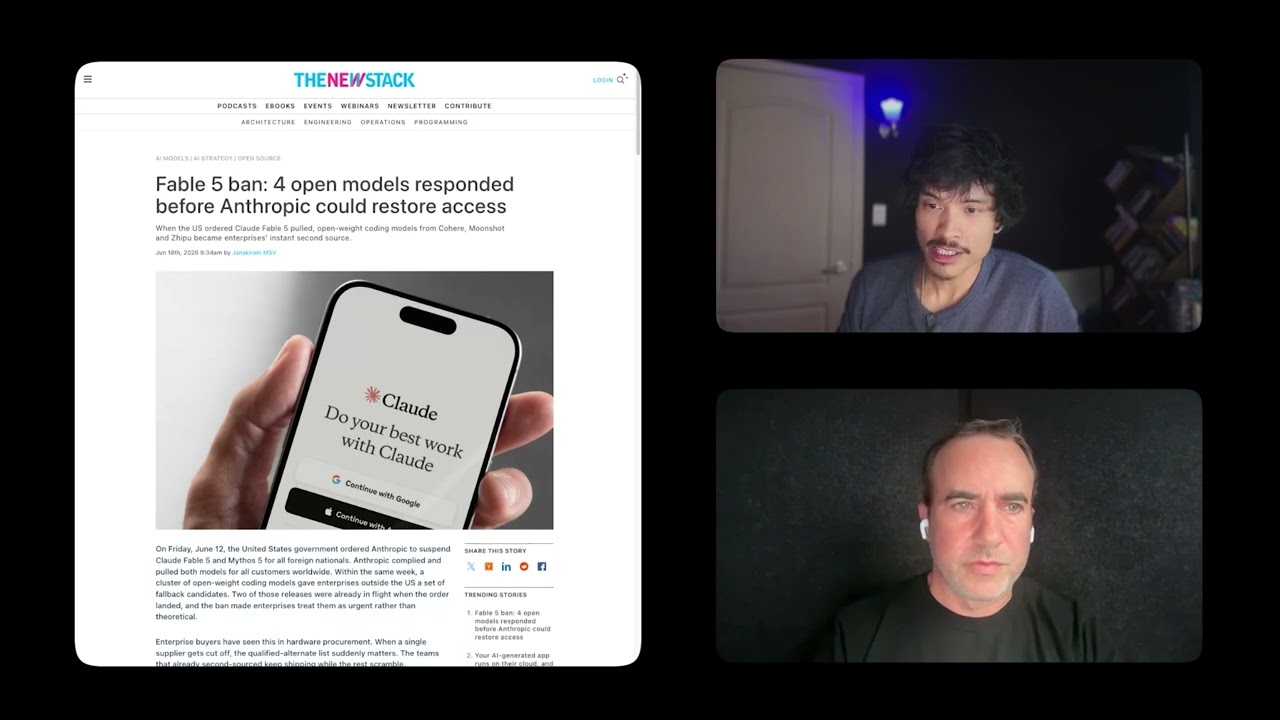
Robert Ta explains how a government ban on the proprietary model Fable 5 revealed the danger of relying on a single AI vendor. Within days, four open-weight coding models filled the gap, showing that engineering leaders need to diversify their AI stacks and reduce dependence on frontier labs.
Chapters
Fable 5 got banned for open models shipped before Anthropic could respond. Here's what happened and what matters for engineering leaders evaluating AI vendor risk. You need to stop building your agent stack on a single provider because they essentially pulled the rug on their zero data retention for enterprise deals already inked from the whole messy aftermath of the government directive to take off Fable 5 from the market. That's actually pushed the industry towards open weight fallbacks. So some facts about the situation. 4 open weight coding models filled the vacuum before Anthropic could restore access. Cohere shipped North mini-code, which arrived 3 days before the order, timing-wise. Moonshot, super popular, made even more popular by Cursor using them as their primary underlying model for their harness. They shipped KIMI 2.7 code, which was the same day as the government ban. Zippoo opened GLM 5.2 the next day. It was actually shipped at 5:21 PM Eastern time as a deliberate echo of the order time.
That's pretty on the nose.
These were already in the pipeline, and the ban exposed that production-quality alternatives already existed. And I think this really speaks to the future of open models and the tension that we see between the frontier labs that obviously want to go make all the money and enterprises moving away from token maxing into, hey, what workloads and inference could we be running with our own infra with open source models? Jonathan, what do you think of all of this? The Fable-5 aftermath and the open source model movement with weights attached as a response.
I've heard a few stories on this juxtaposition of the open weight models filling the gap of Fable-5. From my standpoint, they solve different problems. Like I'm usually using open weight model to like do cheap repetitive tasks, you know, maybe like transcriptions or something like that, or have a smarter model delegate to like some mundane tasks to these models. I've used a KIMI in the past for that with OpenClaw. I think maybe it was KIMI had like really poor performance on coding. Like its model rated like 16th on the coding benchmark on Hugging Face. I don't think there's anything here that says this is the kind of like cool stuff I want to do with Fable and here's some open weight models that fill the gap. I don't think that's actually what's going on. I think it's just more like a coincidental timing of incidents. But I do think, yeah. Yeah, some of the open weight models are really interesting. I thought it was funny, GLM 5.2 thinks it's Claude. So, you know, just a reminder that these are probably distilled models, you know, definitely, definitely the nature of innovation that we're getting right here. Yeah.