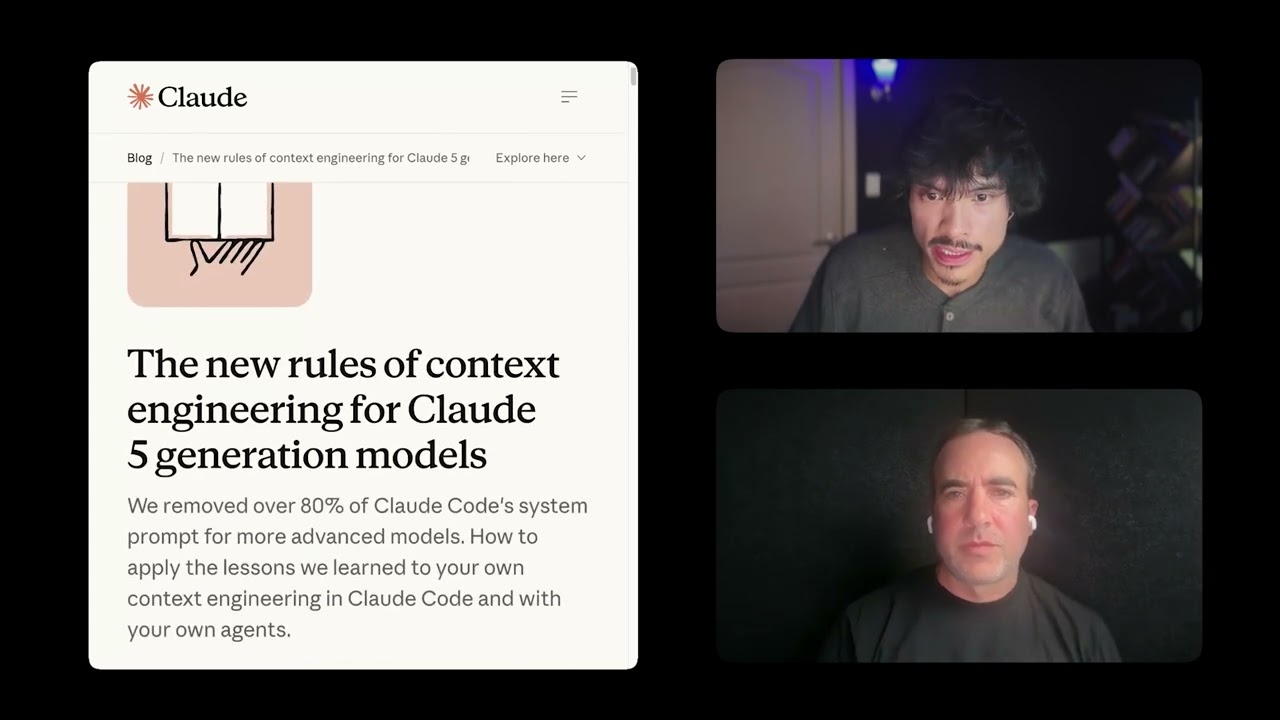
In this video, Robert Ta introduces Anthropic’s newly released rules of context engineering for Claude 5, highlighting a dramatic reduction—over 80%—in the system prompt used for Claude Code models. The new approach replaces rigid rule‑based prompts with judgment‑based guidance, adopts progressive disclosure, simplifies tool descriptions, leverages built‑in auto‑memory (replacing manual Claude.md files), and enriches specifications with portable design‑system references and meta‑HTML files. Robert asks CTO Jonathan for his take. Jonathan notes his surprise at the model’s effectiveness with far less context, discusses the concept of compounding knowledge across model generations, and observes that the previously emphasized Claude.md file offers limited value. He likens the shift to a “spring cleaning” of prompt engineering, emphasizing the need to rethink what information truly needs to be stored in prompts for future models.
Chapters
Anthropic just put out the new rules of context engineering for Claude 5 generation models. Every AI builder, engineer, product manager needs to be reading this. They say we removed over 80% of Claude Code's system prompt for more advanced models. How to apply the lessons we learned to your own context engineering in Claude Code and with your own agents. There's a bunch of sections in here. I'll gloss over a few of them at a high level. One is called unhobbling Claude. So with the new models, they basically say Hey, way to trim a lot of the context. We used to have to say things like, don't do this, leave this documentation as appropriate. And they would assemble the context in this way where the system prompt would literally have things like leave documentation as appropriate. Skills would have certain statements in there like don't add comments or in this way. And that's stuff that Claude had to reconcile and remember all the time. Now the Anthropic team has found that you don't have to do that anymore. Instead of giving it rules, give it judgment. Instead of giving Claude examples, give it design interfaces to understand. It'll figure it out. Instead of putting everything up front in one prompt, use progressive disclosure. Instead of repeating yourself, use simple tool descriptions. Instead of memory in Claude.md files, it has auto memory. And lastly, instead of simple specs, use rich references, including the meta that we've introduced around HTML files as specifications or design systems, lightweight design systems that are portable. How you might apply this? Your prompt references system prompt Claude.md skills memory. They have a Claude Doctor command. Jonathan, I know you deep dived into this article. What are your thoughts from a CTO perspective on the new rules of context engineering for the new Claude 5 generation models?
It was kind of a surprise that the models could be this effective with less context. All of us are thinking like, what does it mean to compound and what's a good investment of what to sort of like store in our prompts and our skills so that the next model that comes out, we can keep the learnings that we have and build on top of them. I think one of the metas that we've seen is people like compounding with within the Claude MD file. And turns out that's not that valuable. And so that's like a pile of learnings that you might have thought would be valuable the next time around that, uh, actually aren't. Pretty interesting, right? At the same time, it feels refreshing. It feels like pressing the reset button a little bit, kind of like cleaning up your hard drive or, you know, just kind of sorting things out. Spring cleaning.
Yeah.
Spring cleaning. Yeah. And the chance to like work with Claude on a new basis. And when I ran Claude Doctor initially, it said, hey, you have all this stuff in your Claude MD that's just like not relevant anymore. And it's, that was true. Yeah, some of the specific modalities, I think when he talks about using trees to work alongside their dynamic workflows is a new meta and the auto memory is a new meta. And so you're thinking about how do I meet those? I think the key is focus on the rubrics, focus on the domain-specific rubrics that you can let Claude code use on your behalf. Everything else, the orchestration level layer is just going to get like acid washed away, you know, by these models as they get better and better. That was my main takeaway.