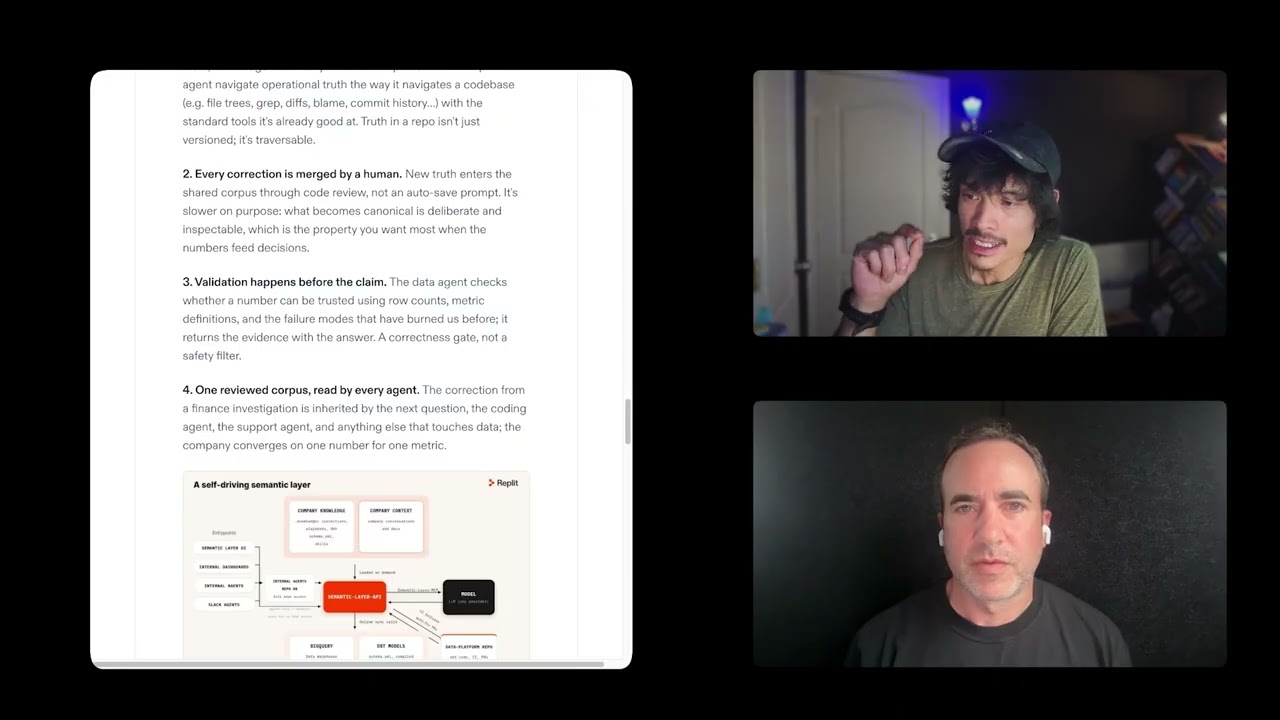
Robert Ta and Jonathan discuss why enterprise AI gets routed around: one confidently wrong answer breaks trust. Replit proposes a Git-based "truth layer" where humans curate and validate knowledge before the AI sees it, then inject that context into every tool, bot, and dashboard.
Chapters
AI adoption starts with truth. Replit, one confidently wrong answer and your whole team will route all the real work around your AI forever. Here's what happened and what matters for any leader trying to get a team to actually trust AI for enterprise AI adoption. At Replit, they argue that AI adoption is capped by trust, not capability. Verbatim, they say a user who gets burned by a confidently wrong answer will double-check the next one, eventually routing consequential work around the system. Entirely. And the fix, they say, starts with a semantic layer. Now, this is not just your ordinary semantic layer. They talk about it in terms of truth. That means telling an agent which tables are sources of truth and how they relate. And this is a line from their article: a semantic layer is not plumbing. It is the first act of governance for an AI-native company. That's the floor. It is necessary, and it isn't sufficient. The real problem is that the data access, that wasn't the real, real problem. It's actually what data can be trusted? What is ground truth at any point in time? And as more truth is discovered at the edges of the enterprises through designers and researchers and customer success and customer support and sales and marketing and product, as we learn more from the field through our employees, our human employees, and now with agents, how do we convert that truth to compounding context for the enterprise? And I think this is one of the most important things in the AI adoption game right now. And model this, benchmark that, that's sort of missing the forest for the trees for at least the customers, prospects we talk to. They're having trouble getting teams to trust the tooling. And that points to what Replit says here, that it starts with truth. What is truth? What context can I put into the context window that is true about what we know at any point in time in our organization? And towards the broader enterprise's objectives. I think this is a really interesting topic. Replit says one confidently wrong answer permanently routes a person's trust away from your AI. That totally impacts the adoption game. And if that's true, your real adoption blocker isn't really the model or anything like that. It's just getting to ground truth. Jonathan, I'd love to hear your CTO perspective on this as it relates to AI adoption. And also, you know, just intersected with what is truth? We've talked a lot about truth philosophically. So that meeting business in terms of compounding context, that's a really interesting This is a really kind of like a welcome take, I think.
And, you know, the pyramid of like the layers that they have with the truth layer on the bottom, it's like, how can the LLM know your company otherwise if you don't kind of feed in these inputs in this context? So I think that's a really welcome point of view. There's been a long history of semantics and knowledge graphs. And so I think there's a question here of what does the how look like? And then how do you store your knowledge in this truth layer? I was just reading the article. I'm not sure I get how they look at like how this truth layer is formed or how the semantic layer is built. Did you get a good read on that? Yeah.
No, I think this is more of a thought leadership-esque thing.
Yeah.
They do have some of these, how the system produces a trustworthy answer. Number 1, the knowledge layer is a Git repository. They're basically just saying truth is something to be versioned and you need to traverse the states of truth or snapshots of truth. That's like one principle that I sort of discern from this. Not that they're saying, hey, use a particular technology. I think they're basically saying, if you concern yourself with the idea of truth, then that's, that's an evolving concept and it's dynamic. And so you need to have snapshots. Number 2, every correction is merged by a human. So another principle for enterprises to consider, which is maybe you don't want AI slop in your truth layer, right? So always have a directly responsible human curating that truth. That's something we've gotten to as a philosophy in our own harness. Number 3, validation happens before the claim. A data agent checks whether a number can be trusted using row counts, metric definitions, and the failure modes that have burned us before. It returns the evidence with the answer. So just like LLM gating, that's like kind of normal. One reviewed corpus read by every agent. Here's the interesting artifact that might help our Architects out there and engineering execs, a self-driving semantic layer. This is around Replit's idea of ground truth so that you're always injecting that into your context window across all your all your workers in the enterprise. Entry points, semantic layer UI, internal dashboards, internal agents, Slack agents. Those talk to a semantic layer API. They have somewhere where they're putting company knowledge. Looks like they put the company knowledge into GitHub, and then somewhere where they're putting company context, probably some level of RAG, and then a semantic layer MCP. BigQuery data warehouse, dbt models. I think it's more just principles. There's nothing they've released here, but I suspect if I had to guess, Replit is trying to move towards, hey, we're dogfooding this, it's working for us, we're using Replit on Replit, and maybe they will release something like a semantic layer for their customers where if they have Replit agents doing stuff across the enterprise, they could share something. I could see that happening. So for any AI enterprise adoption initiative, for any AI executive, any IC that is responsible for AI adoption. Think about this. How do I make sure we're injecting the right context at the right time to hundreds of people, thousands of people, maybe you're a startup, dozens of people? I don't know. But, uh, Replit's take is you always have to start with the truth layer, and that's a semantic layer that makes it legible. Operational truth makes it dependable. So these are 6 things towards self-driving truth. Number 2 is knowledge. So corrections, definitions, playbooks. Number 3, tools, deterministic interfaces to reusable code. Number 4, skills, on-demand procedures, and context. Number 5, workflows, multi-step processes. And number 6, automation, telemetry, autofix.