BoneChat #108 - How small ortho companies can OWN a medical conference.
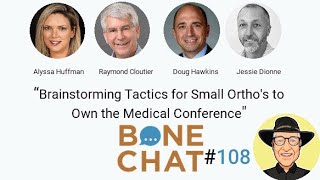
Tiger Buford and small ortho company leaders share how under-resourced firms can dominate medical conferences on a shoestring budget. They cover booth hacks like buying a TV from Best Buy, the "Megatron" concept where startups collaborate, and alternatives like house parties and bus shuttles instead of expensive booths.
Chapters
Uh, Bone Chat 108. We've got, uh, 4 great members who've stepped up to kind of lead this conversation about, uh, brainstorming ways for small companies to own a medical conference. So we have Alyssa, Raymond, Doug, and Jesse. And I'm going to just kick it off with one question and step away. So how do you— what are your goals for attending a conference and how do you pick which conference to go to? And I'm going to step aside.
Well, Tiger, if you'll give some preface, what stage is the company in? Are you talking about growth stage or are you talking about startup, seed, new commercialization?
I don't think it matters. I think it can be any small company that just doesn't have a large presence in the, in the industry. Like, I mean, like Jesse's company, Bone Breeze, they've been around a long time, but they don't have a ton of capital for the US. And then there's startups that are pre-commercial like yours. So let's just assume it's an under-resourced company, which is most small companies. And the good old days, you would make a booth and then people would come by and you'd get leads. And those days are gone. So how do you do this on a, you know, how do you get the most out of a conference with the least amount of spend is probably the better question to ask. And we can go any direction here, guys, so jump in. Tell us what you do.
All right, I'll go first. I mean, with respect to—
oh, go ahead, please.
I say with respect to—
I mean, nothing, feel free.
Okay, thank you. Uh, we're— I mean, I'll speak on our terms because right now we're on the smaller cat side, but we're pre-launch, so we have a relatively decent amount of at least some exposure. So I mean, as I always put my nice big list of all this money I would love to spend on marketing and everything I'd like to do, and I sent it to the CFO and he's like, all right, can you do with about a third of that? And then we try to manage it from that point on. So you really try to— I mean, it really depends on what your focus audience is. And this is— I mean, I'm speaking from the trauma space. If I was sports, if I was joints, I'd be— it'd be a totally different perspective. But I mean, with respect to at least the trauma side, I mean, where is our primary customer going to be? For one, you can't hit every place at the same time or every region. The US is too big. So you got to be very strategic on your regional approach of where you can maximize your presence, where you already have maybe distribution, KOL representation. So that's a big point of it as well. And to be honest, I mean, you've, you've You, you put the nail on the head. I mean, it's the, the good old days of buying a booth and everybody at least coming around. Unfortunately, it doesn't work that way anymore. I mean, from my perspective, the booth is really just somewhere to send people that you've already interacted with to at least show them some of the products. But you're, you're not going to get much useful leads. You'll get probably the person that organized the meeting and 2 or 3 underlings and a couple residents, and that's about it if you're expecting to get booth traffic unless you sent them there specifically. So you have to go in knowing those, and then you, you have to obviously use your marketing, put your big marketing hat on and try to find something to make a splash, something that's gonna resonate with the audience to get people around. And I mean, I can go in more detail, but I wanna hear from everybody else on this topic first before I go too deep.
Go ahead, Alyssa.
Uh, for me, I think it's understanding the ecosystem itself and how we can contribute to the ecosystem. Um, part of it, we have, as small companies and the larger companies, we have a responsibility to evolve the standard of care. And part of evolving the standard of care is understanding what technologies can partner well with your current technologies. Um, who are going to be the people that will help drive that message home without the pay-to-play models? The pay-to-play models are gone. Um, if you're still doing those, um, I'm sorry. Uh, there is great technology out and extremely, extremely, uh, experienced and tenured surgeons out there that do not appreciate that model anymore. Um, we've gone away from that model. So there are genuine people that want to contribute in a meaningful way in the evolution of where we're going with spine and orthopedic care. And finding those people, a lot of times they're at the meetings. And if they're not at, at one meeting, you can find them at the others. The small meetings are very influential. I am very aligned with the North American Spine Society.
There's—
and they took me under their wing because they liked— Eric Muehlbauer, the CEO of NAS, sent a questionnaire about where NAS should go and to a handful of small companies. And he liked my responses and he asked me to be a part of NAS. And so that tells me that they, that they recognize that it's a— it's time to provide meaningful changes within the ecosystem. And so those are the meetings that I personally wanna align with because the people that are staying with it are the people that are going to change the world as we know it right now in orthopedics and spine. So it's like Warren Buffett's theory of get it in while everybody's getting out. What CNS, what NASA's doing, they're really trying to change the, genuine ecosystem. It's not going to be just metal anymore, and it's not just going to be bone void fillers. It's going to be optimization of, A, reimbursement, GPO contracting, um, and within the societies. It's going to be societal influence and funding. It's going to change everything that we know right now, and I love to be a part of it, and I will never stop going to those meetings as long as they encourage the ecosystem change. If that makes sense. So what you might not— what you might find not so valuable now because the ticket prices to get in are, um, are high, what's going on in the scenes, if you can get part of that, that is the influence that will pay itself over a hundredfold in the next 5 years, if that makes sense.
Good.
Good to hear. So what does somebody do this year though? So you've got a small company, you got a, you may be a pre-commercial or you've got 1 or 2 products and you gotta find customers or you gotta find distributors and you know, you don't, you don't have much of a budget.
So A, I always have the surgeons pick out their distributors. I'm not searching for distributors anymore because I've tried too long and 90% of them are terrible distributors. If you have the surgeon, let them choose. And we have two models, two commission models. That's it. We don't do 40%, 60% commissions. That is, that is a long— that is the pay-to-play model. We're not doing that. So that helps save money, right? If you go in, let's say, a week to two weeks before, you call up the organizer and say, hey, do you have any last-minute rates? You may not get into the program, but you can at least get into the apps that will save you at least half of the spend. And then when you get there, you don't need a $7,000 to $10,000 to $50,000 booth. You buy a TV from Best Buy for $500, have a fantastic pitch that's running in the background and that you can explain and walk through. Have— you don't need all of your instrument sets. Sitting out. If they want to see them, then you, then you show them. But simple, something that's transportable, you don't, uh, that you can, you don't have to rent a $2,000, $3,000 TV, um, from the, the event. You just pick it up at Best Buy and bring it. It will bring your budget from a $50,000 budget down to a $5,000 budget. Um, and then these steak dinners, everybody is bored. They are tired of steak dinners. Please, can we get away from steak dinners? Um, uh, do something meaningful, fun. Uh, we went to Red Rock and we talked on the way to Red Rock about the product, and we saw a concert. You know, the concert was $18 a ticket and we had a ball. Um, you don't— you can make it a meaningful experience without overspending, and you don't have to do it the way the big companies do. And in fact, the surgeons appreciate it more.
Well, that's good tips. Interesting. Doug, Raymond?
Yeah, I'm not sure that I'm worthy to be on this because I haven't had all the success that I would like to have at the CCJR, the AAOS, or AUCUS, or the meeting that I've been going to. Yeah, so we have a— Novasource has a primary total knee and total hip, total hip, and we're working on a single-use pre-assembled sterile instrument kit for our knee, which we expect launching in March.
Our—
I'm probably premature to go to these meetings the last couple of years, and probably because we expected to have this process go a lot faster than it has. But I think it's been beneficial to us. We've become more recognizable in the industry and that's been probably worthwhile. But I think, you know, as Lisa said, she has a lot of good points. I think, you know, I think as you go into these meetings, everybody's in a daze. It's exhausting. And if you have to kind of take control of the day, schedule the day, whether that would be bringing surgeons to your, to your booth or have distributors come to your booth with the surgeons, or even, you know, schedule breakfast, schedule lunches, schedule dinners. If you're sitting there waiting on surgeons to come to you in these meetings, they're not going to. So you'll sit there as bored, you know, bored out of your mind. You know, we have as a product that's not been cleared by the FDA, we still have it on our table with the not cleared by the FDA statement next to it. But it's, but that's something that I think that it's interactive to the surgeons. So once the surgeons are able to come to that and they, and they have the, are able to touch things, that's beneficial for them. 'Cause otherwise they look in, they look over at you and may wave or may not and they just walk on by. So I think the make your booth inviting is, is something that's important as well. And then, you know, as you're through 3 or 4 days in these meetings, you're exhausted at the end of them. Take good notes. Make sure that you follow up with these surgeons because, you know, you think you may remember who you met with on the first couple of days, but it's easy to forget. And then you're like, I can't— I I don't remember his name, don't remember how to get a hold of him. I think he lives like in San Antonio, or, you know, so like it's, it's something that I try to do a better job. I'm not perfect at it at all, but so look forward to hearing other people's ideas as well.
Raymond, what are you doing?
Oh my goodness. A lot of really good suggestions. Appreciate you two or all three of you. I went down memory lane. My first Academy was 42 years ago, and I was a startup engineer with resume in hand. And the point I'm trying to make is you never know who might come up to your booth. And how you respond to who comes to your booth sort of solidifies in that person's mind what type of company you are. And so you always have to be on, you know, on the whatever the culture that you want to have. As in some cases there were, I remember people in Atlanta at the Academy who were very kind to me and others that shooed me away, which is probably what I might do if I wasn't careful. Because you could be under a lot of stress. But my one— but to answer your question, Tiger, your direct question was, what do you do? And the answer is, it depends. As a startup, pre-commercial, my view is only attend the conference in order to network or find the surgeons like Alyssa said. I don't think there's any value in showing up pre-commercial unless it's a different type of product than what I'm used to. However, in my general opinion, it's the first year or two at most that you want the splash and really try to tone down how much, how many different conferences you go to. So it's like the big wave in order to create the sufficient demand that you then don't have to go. At least as an exhibitor. Now, I know it's difficult for these societies to fund these wonderful conferences that they do if people just show up and don't sponsor. And so I do have a bit of an issue with that. So I try to sponsor when I can. However, I've also talked to NAS that sadly The surgeon is becoming less of the decision maker and that's who they have attend these conferences. And so if this decision maker isn't even attending, they're gonna have to be concerned about people pulling out. And it, because most people, when I talk to them, they see NAS, I don't know about Academy, haven't been to Academy in a while, is more of a business to business. Opportunity, which is important, certainly with distributors. So the first big question is, it depends where are you in this, in the cycle. But also paying obviously attention to who are you targeting and all the prep work that I think somebody referred to is critical to have those meetings pre-scheduled if you can. So now in the old days, surgeon training was important. I remember the days when Sawbone, you know, labs were really, really seen as valuable. Over the years, I've created different models, a, um, little mini Instron to demonstrate scientific principles. It was more interesting to me, I think, than the people walking by, but, um, that's because I wear an engineering hat. I think I have to be careful that most people who are going to— and recognize that they don't have a whole lot of time. They don't care about the nitty-gritty. They just want some kind of pearl, if anything. And obviously, if you can get a key opinion leader at your booth that they could rub elbows with or chat with, that's pretty important. Showing clinical cases is pretty important. So there's a lot of reasons to do it. But I believe you need to be nimble and continuously reevaluate. For us, this year we may only attend one meeting, whereas in the past we've attended 5 or 6. And it's because I have to deploy the precious capital to meet the demand as opposed to build demand. And I'm not saying that to be arrogant, it's just I don't have a lot of extra capital is really my point. And it's just, I don't get the return.
Boy, a lot of good wisdom there.
I do have some pitfalls if you want to go into pitfalls. And this is, I probably made every single one of these mistakes and you guys are probably already aware of it. One is people steal stuff off your booth. That's kind of annoying. And so you need to be real careful what you put out there. Another is looking at your cell phone, people walking by. If you don't even care, if you don't have any enthusiasm, no, they're not gonna care. Another is arguing with somebody who just wants to pick a fight. I've seen that. Surgeons come up from probably competitive companies and you don't want to get a, have a scene. And then the worst one is riding on the bus back to the hotel and talking about your day with your colleague, and then you discover when you get off the bus that you were talking about the surgeon right in front of you. Okay, that's really embarrassing. So don't ever— be real careful in public places not to, to say anything negative. And then a pet peeve of mine is leaving too early, you know, bailing, because you spend a lot of money on this. You should stay the whole time, in my opinion. So those are my thoughts. Hope they were helpful.
Good. Kyle, did you have a comment or question?
I'll ask it, but if it's better left for later, that's fine. So I was curious, there are sometimes these little innovation consortiums or small group get-togethers that are meant to be kind of a cluster, a showcase of startup companies that are some sort of adjunct to larger meetings. I've been to some of them, been fine. I'm just curious if anybody has had success with those, you know, stay away from them at all costs, they could be done better. I'm curious if that is the sort of thing that has a place somewhere in here specific to, you know, fostering startup ecosystem.
I'll tell you what we're doing at the NASA Innovation Network. We are building a GPO where it's surgeon— mobile devices— surgeon-advocated product. So this is part of the issue, right? Why surgeons aren't showing up to these meetings. A, because they can get their continuing education credits via online. B, everything comes to them now except for the small companies, right? So how do— and the small companies can't get on GPO contracts because You're, you're freezing, Alyssa.
At least we know the answer of what she was about to say because we're all pretty much experts on why. Jesse, do you want to take it, or Patrick? I mean, you can probably finish her, her sentence there for sure.
Oh, I mean, the GPO thing, that's obviously not the nature of this one, but it's a constant headache for everybody that's not a multi-billion-dollar cap company.
Exactly.
Is what it is. I mean, I'll pick it up since she's cut off there.
I'm with you, Tiger.
She's back.
I'm sorry. I'm at the airport. I apologize. We're being part of that GPO. I think if you can get— so what it is, is a GPO that the hospitals can give to the— or the distributors can give to the hospitals through the value analysis and have the seal of approval by the societies. So if you have, let's say, a retina surgeon on the value analysis pathway, now you're not relying on a retina surgeon and a company to get the company's perspective of why this product is valuable and innovative. You're getting a stamp of approval from the society saying this is valuable. We pre-negotiated the pricing and this is where we— and helping streamline that value analysis process instead of relying on the GPO that gets compensated on both sides of the, of the deal. That's one reason why I think an innovation society can be very powerful is what they're trying to build and develop.
What's the— Alyssa, what's the status of that?
It's right now in the beginning. Um, uh, uh, we have to look at the legalities of it. Um, and so I'm hoping by next June we're announcing the GPO, and I think that will really— it will be one step in the right direction. Of giving the power back to the innovation and the surgeon and the patient care.
Excellent.
I think what Kyle was asking are, can 2 or 3 startups get together and do a regional, their own regional meeting? Has anybody seen that work?
Or—
go ahead.
There's there's guidance. You can't share a booth at these regional meetings. You can do your own. Absolutely. And honestly, I think it's very smart to create a megatron of small companies. In fact, I would love to develop a protocol with our aim, uh, with products that are even outside of just hardware and biologics that are patient optimization, nutritional optimization, increasing bone mineral density prior to surgery, um, and then postoperative products to create a protocol that actually reduces the reoperation rate, because not one product is going to be able to do that. It has to be a collaborative effort. And so if a, if a protocol is developed with a handful of companies, then, and it demonstrates it, that it is reducing the reoperation rate or postponing it, um, significantly, there's true value in that for the surgeon. And then you're a trusted and reliable source because it's not only your company that's part of the protocol. I think that's where small companies can align and become a Megatron, so to speak, a force of their own nature.
Boy, I love that idea. So you'd have non-competing complementary product lines that maybe are— they're all in spine or they're all in joints or whatever, and, and you— everybody pitches in You have 10 companies, everybody puts in 10% and somebody markets it.
Correct. And then, and you can, and if you have 5 surgeons that are utilizing the protocol and the protocols are being developed and you can keep track, you can use this as very powerful media opportunities as long as it's HIPAA compliant, you know, and use it as part of Grand Rounds lectures. People love to be educated. They do not like to be sold to. And so if we're, if we're showing here are the preoperative, just like they do grand rounds lectures almost, Alan Daniels, a lot of the, the big spine guys and Russell Bodnar used to do this and Richard Southgate, they'll show complex cases and before and after and then they'll gather opinions from the consensus to see if they did it right, how they can improve it, and make social media the grand rounds lecture for all of the companies. So we all learn together and it's trusted, reliable, and it's a conversation between surgeons instead of conversations, and it's taking the sales process out of it.
Well, so that you— is it you— do you target at night or weekend? And how do you get the surgeons interested?
It's on LinkedIn. You can just— you literally— because remember, and that's a big part of optimizing these shows, right, is utilize— it takes far more points of contact for somebody to be interested in a product now. It used to be 7, then it was 13. Now it's probably closer to 100 times they need to see your company, your product. They need to have a little light bulb flick off in their own head because there's so much marketing out right now and there's so many opinion pieces. So for you to show up at a, at a conference and them not to ever have seen you, or maybe seen once, twice, maybe 10 times, they're not going to be that interested unless you are truly extraordinary. And even then, only 5% of the market are early adopters. So it's really important to educate versus sell and hosting those grand rounds images, a lecture-ish. It's a conversation, right, that they can have on their own time. But they're still educating as, as well as being educated and providing opinions. It's fascinating to watch it grow.
I love that. I love that idea. I remember back in the 2000s, companies started doing live lectures inside their booth. That was a trend. I don't know if that's still going on, but you couldn't help but stop because the surgeon was up there talking about you know, cases and, and it was a, you know, a live mic that, you know, would attract people. But you're talking about doing this on a LinkedIn Live thing?
No, just a post. Okay. Yeah, you could just do a post, the before and after X-rays. Here's what we did. This is what we saw, and here's what we learned from it. And then it's just commentary thereafter.
I love that. What's the— what are the best conferences here? I'll share my screen. I, I created a list of all the conferences this year, uh, chronologically. Stop me if you see a great conference that— and I realize you guys are in different spaces sometimes.
I think the conferences are what you make out of them. I really do.
Doesn't even matter.
I mean, I've been to conferences year after year and sometimes they're a total dud and sometimes they're the best thing we did that year.
So it's, it's—
there's a lot of rationale to what makes a good conference. I mean, it's obviously very specific. I mean, I would say, like I said, we're, I mean, I can, you mentioned earlier about what we're doing. I mean, I'll be ha— I'll, I'll give one because it's already advertised. So it's something we can already talk about. It's, uh, Southeastern Fracture Symposium. It's the only conference we're doing in January. Um, it's regional. It's only specific to trauma. And it's something where, uh, we're, we're participating in, but we went back. I'm going to go back a little bit when you said about what we're doing with respect to and how we market and how we come on brand is How do you want to be perceived by the— you want to maintain or at least project your brand to the industry. If my brand is that like us, we're focused on simplicity, on clinician advancement and education. So I'm going to— when I'm going to participate in one of these, I'm going to focus on those aspects. I'm going to focus on an educational aspect to it and make it worthwhile for them. So Southeastern Fracture, we have a sawbone lab that we're going to sponsor during it. So it's a breakout session where everybody can attend. We have Dr. Mark Mori out of Mayo who's a world-renowned shoulder surgeon that's gonna be attending and he's helping us build our education, our Bonebridge education department. And we're gonna be doing like these innovative new sawbones that he's pretty much developed himself that have soft tissue attachments, allow people to use our products in an environment that's unique that's never been done before. So it hasn't been, it's only coming off in about 2, 3 weeks. It's something we're very excited about, but it's, When we talk about like trying to being a small company, being nimble, I said there's, I'm looking at my list, there's probably about 6 or 7 meetings this month that we could attend. We're only doing one and we're gonna go all in and make a big splash at it.
And where's that, Jesse, where's that located and how and where do you draw surgeons from? How big of a radius?
I mean, now this is a regional one, so it's, it's a Southeast region. It's gonna be in South Carolina. So it's focused on trauma surgeons, orthopedic traumatologists in that market. And that, I mean, That's why we're going more, investing more in it than a regional meeting because it's focused on our core, our core customer, which is a trauma surgeon. I mean, if we, we do something similar with the OTA. I mean, we, we focus on the OTA because that is one of the main, it is the main trauma orthopedic society. If you're in trauma, you probably should be in that market or in that society. There's, I, I don't want, not, I'm not gonna name names 'cause you're flipping through all the list of of society meetings. I mean, no one in marketing wants to admit it, but there is stale marketing out there, and there's some meetings that just aren't worth it anymore.
Yeah, more, more than they are, I think. Well, I think more than they are worth it.
We have to remember also, we are in the sales business, right? So if you have a product that's not in the market— and Tiger, to clarify, we are commercialized as of February We will have our first cases. So yay. Congratulations. Thank you. But what is it going to take for it to pay for itself? Right. For the time, not just the cost of it, but part of the cost of having a company is you show up, period. And, and just be— and not any— and anybody that's been in sales knows if you get— if you're 1 out of 10, that's a good day. You know, you're a good company. So there's going to be 90% nos. But part of it is you show up, you're prepared, you've networked, you've done the pre-work, and you've done everything to optimize your chances of extraordinary value. And, and then you take away from it what you learned. I am— I get frustrated With the cost, yes, they are expensive, but the cost not to show up is far greater. And one surgeon can pay for one— for a meeting. That's it. If you're pre-revenue, this is one thing that I'm pushing very strongly with NAS is there needs to be a budget for if you're under $30 million or you're pre-revenue. If you're pre-revenue, because the surgeons love the new innovation stuff. That's what gets them to go to a new, to a new booth. So, um, for— I put on the table $10,000 is an annual fee, and you can— in a pre-revenue company can show up to any conference within the North American Spine Society, any small regional. And so you can have your distributors, your potential distributors, show up on your behalf. It doesn't always have to be the CEO showing up. It's somebody to represent the company. And because right now this cost per square footage is so high that it's, it's nearly impossible for true innovation to show up to every meeting. So what would you guys think about that as a, as a collective of pre-revenue or early revenue companies or small, low revenue below $30 million? Would that be of value to you to be able to show up to every meeting at an annual price of $10,000 or $15,000? So It's paid, it's done, and you all you do, you show up to whatever, uh, meeting they offer as a society.
I love it. Um, when's it going to happen?
That's— I think— I'm hoping we announce it in June.
Wow.
Yeah.
And then also having an Innovation Row where small companies, um, uh, instead of, um, instead of that back in the back, nobody sees you, nobody comes by you, a true innovation row of companies that have extraordinary talent, extraordinary product that the society has deemed valuable. Not that it's not pay to play. Again, that's a pay to play model is what currently exists in all of these meetings instead of a focus on innovation.
If I could Just kind of springboard off of something that was said, I think, earlier. My experience is that smaller meetings are more valuable to me because they're more personal. The sponsor appreciates the support, or the lead conference lead appreciates the sponsors more, and you get a lot more mileage out of small conferences. We did a cadaver lab pump combined with didactic for Latin American surgeons and they just love it. And so that's a separate kind of expense and, and type of meeting. But these small regional meetings I think are the way to go.
The booth space is so much more equitable at smaller, sort of like, let's call 'em hotel meetings rather than convention center. Meetings. You can't— somebody might be able to have a booth that's twice your size, but it's not like 30x your size like it would be at one of the big meetings that, you know, the big companies have escalators and all that sort of stuff, and the little guys are buried in the— up against the back wall. The small meetings that are sort of like hotel ballroom kind of centered, it's like everybody kind of just around the periphery with maybe a row or two going down the middle, and it just looks much more like the— you know, nobody walks in and they can't— they don't see the sort of differences in, in company size right away that can distort people's sort of perceptions.
Agreed.
Good comment.
Al.
Yeah, so really relevant. I, as you guys were talking, we talked about the, somebody was mentioning about the smaller meeting. Jesse, you're going to like Southeastern Trauma or whatever. So I've been supporting Eastern Orthopedic Meeting for many years. And one of the things, the variables that you have to press now, and it's happened to us 3 times this year, that shame on me for the second time. But, you know, the placement of these tables and the setups of the rooms can literally make or break your return. We just sent some people to MSTS in Mexico City, as annoying as that was, and only to have a report back that they had the worst location possible and like nobody saw us. And so the pressure, like, so Eastern Orthopedic Association meeting happens to be one that I'm close to. And I've told their board like, this has got to stop. This is, this is, I, I, you know, I put two booths in this year, one for my existing and one for my, my startup. And we were behind the food and the, like the whole setup. I'm like, this is just awful. And I mean, I was one squeaky wheel. I'm like, this is terrible. So when we talk about the variables that you have to do with these meetings, you know, getting, getting the attendance list and, and finding out who's going and trying to make the most out of it because it is work. You're not there on vacation. And that's always got to be preached is like, get the job done. But the other thing, the factor now for us is that's like reflexive is where are you putting us? And let me see what that room looks like because I mean, it was— we had a colossal waste of money on 2 meetings this year that are normally what you would fit into that, Patrick, into that category you just mentioned where you think you'd get more out of it.
Are you guys like me where you find— I find the most value in the after hours, and that might be beforehand with a breakfast with another company, your business development team, or it, um, um, having— because at the booth you don't really— you're not really able to have long conversations with people. And so if you get 1 to 2 people after the booth to really have a longer conversation with, that's to me where I find it very valuable. So it doesn't matter how large the meeting is. If I have 1 to 2 people that I can close at the end of the day, that's where I find value. And I can get that at any meeting.
The booth at 10 AM is like an appetizer to like bumping into them conveniently at 6 PM.
Sure.
Yeah, you just need that. You need that initial It depends on what it is, right? So if it's a familiar group like Eastern Ortho, I just navigated my way around. I was a little pissed because my guys weren't very busy and it was just a bad location. But Alyssa, you're right. I mean, we just, you know, you're gonna, you're gonna do what you have to do to make sure you get that value out of that. But I, I do believe that if you are going in cold, especially if it's like MSTS where we really needed to show an innovative product, a truly innovative product, um, and we just didn't get the traffic just because it was the worst possible location you could be in. And we were first-time exhibitors who spent $10,000 on it. So you think they'd want to treat us right to have us come back. So I love the way you're communicating with and trying to lead these societies to think differently because a lot of them are stuck in the old way of just thinking like we are still— it is our privilege to go and spend money and be at these meetings. And that's just not the case. We're too in demand. Our money is too in demand anymore. And I think we appreciate and I applaud your efforts because you're right. I need to take accountability for myself, you know, just listening that I need to be more proactive in that and get more out of these things.
Yeah, actually, I think Al hit it on the head. I mean, at this point, it's really— I mean, I'm not— not to sound arrogant, but we're at the point now where from— I mean, from at least my perspective, that a lot of these meetings need to be courting us. It's not the other way around. It's like the— these meetings, because there's 3 meetings every weekend for the foreseeable future. There's so many of these small regionals all over the place that, they need to convince me that spending my money there is worth our resources and it's gonna get customers in front of us. But like Alicia said too though, it's the money is made after hours. Your booth is really just an entry ticket to have someplace for people to walk around to, to direct them after the fact. But to build, you need to be building those interpersonal relationships, uh, on the back end, which is after 5:00 PM.
Yeah.
Uh, Dr. Maloney.
So great topic today. Uh, and I, I think the reason that this is such a delicious topic is that, um, getting value out of meetings is so hard. Um, Raymond attended his first meeting 42 years ago. I did the math, and my first Academy meeting was 43 years ago. And I just got out of the Army, and I showed up, and I was like a kid in a candy store. And I think one of my dominant personality traits is curiosity. And it was at that meeting that I stole an idea from Dr. Harris out of Boston. On centrifuging methyl methacrylate. He had used a gas, a gas sterilized centrifuge. I went back to Alabama and I made one out of stainless steel that I could autoclave. The next year I sold that. That's my first invention sale to J&J. So, you know, to me, when I go to a meeting, my, like I said, my biggest thing is curiosity. And you've given me an idea here today. Uh, by the way, I love what Alyssa said about early adopters, and I put in the chat because my career has been all about finding early adopters. I'm like a truffle pig in Italy, okay? And I— and they are the secret, uh, to what— whatever success I've had, those early adopters. Uh, and they share certain traits, but that's a whole topic, a whole different topic. But I think, um, the idea that you've given me today is that if, if I'm a surgeon, I'm attending a meeting, um, if somebody handed to me a treasure map, a value map of all of these booths, because I'm only there basically because I've got a couple of industry buddies that I want to go see, or a couple of things, or my favorite rep said, hey, stop by this booth, or whatever. But there's another 400 booths that I'll never see. But if I had a map that said, here are all the new ideas, here are all the innovations, here's the stuff worth talking to, here's the first-time booth you'll never ever see otherwise, and I had that as a guide, I would spend more time in the exhibit hall. And if I were a company And I published that map. Guess whose booth would be, would be pretty prominently noticed? That would be my booth, because I'm— hopefully I have something that's innovative and everything. So many, so many great things said today. I really have enjoyed. I haven't said much because I've just been taking it in. And what we were talking about, the shifting evolution of decision-making in hospitals, and that That VP of supply and logistics that I brought from Piedmont Healthcare, I best, back in November, he totally identifies that he doesn't give a crap what the surgeons say. And he, he's pretty upfront. I mean, he will say, if comfortable, that their power of decision-making is getting less and less and less every day. That's, it's kind of scary really when you, your career is built on building decision maker relationships that you think are doctors. Anyway, great topic.
Wow. Good stuff, Mark. So do we need to create a, a cool startup medical conference in the middle of the country? And just, you have to be game changer stuff and you gotta be small and make it cheap, do it in a hotel room somewhere?
I don't know, brother. There's a lot of people doing it as bolt-ons to their meetings. Anterior Hip Foundation, all these innovation summits. Doug, I'm sure you've been at a few that, that meetings that have pitch decks and Shark Tanks and all these things. So I think, I don't, you know, I, I don't know if it doesn't already exist in a lot of forms. And then in the, uh, Yeah, and even in the investment space, you know, so many life sciences and medtech investment spaces and everything. I don't know, maybe I'm wrong. I actually think it's a crowded space, but I'm open to, you know, the opinions.
I agree with that. It is a crowded space. I think though that they are open to understanding. So if we as a group of small companies come together and develop a protocol, pitch that protocol to the society. I mean, people complain all day long, but very few actually provide solutions. And anytime I talk to my team, okay, we got a problem, what's our solution? And we look at it from every angle. And they are not getting people that will provide solutions. So if you come up with a unique solution and say, as a society, we want your endorsement as a society, as this protocol to reduce revision rates or to solve this X problem or whatever. Um, what would you think about helping us with that trajectory? And maybe they help fund it, maybe they help— they pitch it to the society, maybe, and it gains awareness. You, you can never go wrong with pitching an idea to a society, but I don't think creating our own society is a good idea. I think if we don't have the bandwidth and we don't have the prowess, the deep prowess, the political prowess that they do.
But do you have the criteria, Alyssa, like where you, you kind of maybe set the guardrails for them to evaluate the innovation? You know, solutions are thrown around, you know, like, like a deck of cards, but setting up, you know, what the, the parameters for what is the actual solution, you know? Yeah, yeah, maybe that makes sense. That might, that might help.
They are open. They're very open to new ideas. And in fact, there's some great minds. And a lot of these people that are on these committees are actual innovators. On this call, we are all dot connectors. We are, we're, we're great solutions-driven people. If we can't figure it out and help benefit the ecosystem, then there's something genuinely wrong.
I like the treasure map idea. I'm just wondering if NAS or Academy would let you even do that, have your own subset of innovation treasure map.
Well, they have. We're talking about Innovation Alley. Yeah, we're talking about doing Innovation Alley, and, and it's voted on by the society members. Again, too many decisions are made without the society's input. And so you don't have any buy-in. But if the surgeons deem these are the top 10 companies we see as, as valuable in, in the, in innovation for the ecosystem, who's going to go to those 10 companies, right? Every single one, because they had a place, an opportunity to make a decision for it.
So NAS would handle like a survey, an innovation survey to their membership?
That's what we're—
that's what we're talking— that's, that's a really— that's, yeah, that, that's built-in support. I love that.
And they're talking about funding. We're talking about creating a microfund, or not even a microfund, a big fund.
Wow, I like that.
This is the fun stuff. And I, I welcome anybody to talk to Eric Muehlbauer. He is the greatest guy. He is open to any idea. Really brilliant guy.
Why don't we get him on BoneChat in the future and just give him, you know, drill him with questions about what small companies need? I don't know if he'd be interested or not.
That's a great idea.
What if you don't— what, what can you do at a conference if you don't have a booth? On purpose. So there's pros and cons of having a booth. If you don't have a booth, you're really nimble. Um, can, can somebody talk about, um, what, you know, the advantages and disadvantages of not having a booth?
Patrick, that's your wheelhouse, brother, ain't it?
No.
It is. He's done a great job doing it.
Yeah, I think you go to, like, when you go to meetings, you almost are going in, you're not, you know, if you're not gonna have a booth, you're probably not really there to showcase product as much. You might have some ability to do it on a smaller scale, but like you're really confined physically sometimes by like what you could fit in your jacket pocket or those types of things, or what you can, what you can hold. And that's just not practical for for a lot of people. But that's a place to meet distributors. That's a place to show up at happy hours. I mean, for really small companies, and I've been in this position a couple of times, like if you're just yourself, that is the better way to go sometimes because as soon as you have a booth, you're stuck at the booth like you can't, you literally like can't, you are at that spot almost the entire, almost the entire time. So it is better to be able to, to move around, but that's just as effective if you ask me to. And that's where I, that's where it's better to go to the bigger meetings. Like I, it would be so far, like a company would have to be, have so much revenue before I would like recommend putting a AAOS booth or something like that. But I think it makes a lot of sense for people to just go to AAOS and be around. It's just an efficiency play almost more than anything. You can just see more people in a shorter period of time due to the concentration of of distributors, customers, suppliers, even people like, you know, recruiters go to the bigger meetings or the whole sort of like industry ecosystem. So I have had success finding distributors for sure, meeting customers for sure. We all run into sort of customers that you would never think to meet of on places like LinkedIn and stuff, and they don't care if you have a booth or something if you're at the meeting and you say hi. So that is like a You know, you can't do it for forever, but I, I have found small amounts of success in, in just being around meetings.
So I've done this a few times. It starts with me as a, there has to be a hotel attached to the conference center. I have to be able to get a, a suite. I have to get a half a dozen bottles of nice French wine and a sommelier to serve it. And that's the sort of bait. And then beyond that, there's a direct ratio between the level of preparation and the results. So many people go to these conferences to just kind of show up and throw up. And it's kind of like going into a battle. You know, people fight like they train and they sell like they train, or they get the results like they train. So there's a direct ratio there. But I've done the without a booth a few times, and it has advantages and disadvantages, but it's mostly about cultivating those relationships, those special relationships, those KOL relationships, um, and of course good wine.
10 years ago, 5 of us who worked for the same company, we didn't have a, a booth. AOS was in Vegas one year, and we rented a huge house not too far off the Strip, and we all stayed there, and we had a big like event at the house that night, or one of the nights, where We brought in a chef, we brought in a bartender. And, you know, if you think of like the 20 hotel nights or whatever it would have cost, the whole thing was far cheaper than if we had done the sort of conventional route. We hired a bus, you know, we told the surgeons, like we told, you know, we sent out the flyers and stuff and said the buses, you know, meet at this notable spot, whatever, in one of the hotels. And we had the bus and then we were sending people back and forth. The bus went back and forth afterwards for a certain time. We had surgeons staying there until 3 o'clock in the morning at the at the house, and it was like far, far more economical than if we had gone the conventional, like, let's book 20 nights at, you know, at Caesar's Palace and have this huge steak dinner in one of the steakhouses there and all that sort of stuff.
I think to Alyssa's point, like, having something unusual, it will draw— because people are bored of the same thing. So having something like the Red Rock, like, I was really sorry to miss that. Yeah, yeah, I, I went, um, to NAS for the first time. And obviously for me it's different, right? I have a startup, but it's— I'm there to meet other companies, other tech companies and surgeons who are innovators. But yeah, I did. It took a lot of preparation. So I like, like Mark said, it is a battle and it took a week, almost full time of preparing and reaching out to my contacts who I thought might be going, because NAS does not, does not give out an attendee list, which I wish they would. I think that would make, that would make interaction between attendees much easier. Um, so if I, I did mention it to Eric, I don't know if, if you, you are on board with that, Alyssa, if you can mention it too. Um, and, and then they're just really, it wasn't, it was really, it was harder on the on the floor, but any, any kind of event, like smaller event, happy hours, lunches, evening events, like those were the, the places where I felt like I had more real connections with people. But even on the floor, being nimble. And, and I think if I would have a booth and I would tell someone, come by the booth, like, yeah, they might, they might not, you know, they might forget. But if I'm when I said, you know, where are you, I'll meet you, then they were very open to doing that. So I think it is much more efficient.
I think people forget or underestimate how incredibly boring most surgeons' lives really are. Now, it's fulfilling. I'm not taking anything away from the work they do, but it's extremely predictable. It's very schedule-driven. They don't have a lot of spare time. They work 10, 12 hours a day very often. They go to these meetings and you, I think if you offer them an opportunity to have a little fun, like Patrick was talking about, I bet it's 2:30 in the morning and he's thinking, when is this guy gonna leave? Kill me. Okay. But they're having the time of their life. Okay. Yeah. Good. Those are good points.
I remember back in the day at Sulzer Orthopedics, and we were a medium-sized company, we had a Pebble Beach golf pro in the booth and we were giving 5-minute lessons, swing lessons to surgeons. We had tee times every 5 minutes and we would hand the surgeon their 5-minute lesson on a video disc. And you know, they loved it. They were lined up. But nobody even asked about the natural knee the whole time. It was just a gimmick and we got no leads from that.
But anything you can do creatively these days that, that, that you can, I'll say get away with, cuz that's a phrase that comes to my head, but I think everyone knows what I mean. I don't mean do anything illegal or improper, but the big companies have these huge compliance departments that basically force the Ruth Chris dinner and nothing else but the Ruth Chris dinner. So if you can do anything outside of that, it will probably stand out a little bit just by comparison to like the same, you know, it's not like there's not creative people that work at Stryker. It's the compliance departments that basically force the exact same type of thing down there. You know, they sort of don't let anything else slide except for these things that they've done 10,000 times.
That's a great point. That is a great point. The startups have an advantage over all the big companies, and you always have to remember that.
You guys can try things and we're stronger together.
Yeah, I was just gonna say, like, your idea, Alyssa, about complementary, right? Like, yeah, the startups should get together and they're not direct competitors, right? And create some of these fun events because you want the same surgeons maybe to come there and do something extraordinary. And I think Yes. If they just come and do 5 minutes of something and can leave, that's not, not a good setup. You kind of want to have people hang out, you know, something that whether it's, it's the great French wine or whatever that makes them just kind of stick around for, for at least half an hour, preferably longer.
I wrote an article on LinkedIn called Cowboys versus Ranchers. And, uh, basically last month, because the— I compared cowboys to independent practices and 1099 reps and independent dealers, and the ranchers were the big companies and the hospitals. And you know, the ranchers, they bought the land and they water rights and they put up fences, but who's having all the fun? The cowboys. Now, they didn't last, but as part of our myth And I can tell you that it's fun to be a cowboy, and you give a surgeon a chance to be a cowboy at a meeting, they'll come back, or they'll remember anyway.
Well, and I mean, even in the Red Rocks thing, people that make memories together stay together. You don't make memories a lot of times at dinner. It's after the dinner you make memories together. But we had our manufacturers chip in. On the bus ride out there. We had an Australian manufacturer chip in on the bus ride over. You know, it does— your manufacturers will help chip in and they'll attend and they like to know your surgeons as well. And it becomes so much fun because the surgeons like to know— they get— if you make memories together, now they're a piece of the pie. They're a piece of your own ecosystem. And they want to encourage people to know about you because they believe and they trust and they like you. That's Sales 101.
That's well said.
I'll go on something Patrick said. I mean, about the being— I mean, that's kind of our mantra actually with WeApproach. We try to be obviously very simplified with our stuff, but when we do something, we try to go all in. And I give credit to our marketing people, are phenomenal. But like 2, 3 years ago, we were still very small at the OTA and we wanted to make a big splash. And we, we decided, well, we opted to get the lanyards. So everybody does lanyards. It's, it's a unique, it's, it's common thing. All the big companies do it and they just put their label on it. So we're like, how can we do something that's gonna blow people's socks off? So we actually did this lanyard, which you can see here. Still talked about to this day because what we did is we got up, we found a supplier that would actually get us a lanyard that was a phone charger.
Hmm.
And then everybody, and it got to the point where people were like coming back and getting handfuls of 'em to take back to their offices to give to their staff. I mean, it was, like I said, this is probably, we're, we're still young in the US, but, and like I said, we have good marketing people that are unique and, but, and this was most of our marketing budget for that year, but it was a big splash and still talked about. 3 years later.
You've said big splash a couple times now. I'm just trying to think of like, what can people do to make like a literal big splash or something so they can tell people they want— they're there and they want to make a big splash. Like, I don't think having a dunk tank in your booth would be, you know, would, you know, there's so much electricity flowing around those things. But I'm just, I'm thinking out loud of like, what could be done to like, be like, yeah, we're here to make a big splash.
And I mean, you could be always— there's always ways to be creative. I mean, it's fun to have good marketing people to be lucky to be associated with smart people. But I mean, like, I'll give credit to other companies. I mean, like Paragon, when they first launched, I didn't even see it, but my surgeons still tell me about it. They launched that academy or AOS, and they put up a booth with just curtains, and they had a bouncer there with a red velvet rope. There was nothing in the booth.
There was one guy with an ankle plate.
Yeah, there was just one guy just holding there, and he was like in a nice suit, and he wouldn't let anybody in. And everybody to this day, like, these guys still talk about it. So I give credit to whoever came up with that idea. But there's plenty of ways where you can be memorable. Without having a 40 by 40 booth with a big $100,000 banner above it.
Um, you gotta have fun. We did green lighting that you could see from the ceiling. So we would say, just go to the booth with the green lights that you see on the ceiling, like a Batman, you know? And it cost, uh, I think it cost about $750, and all we did was have a 6-foot-tall version of the Pedicle Screw., and people love to take pictures with it. I can't tell you, we probably had 100 people come by to take a picture with the screw.
Yeah, I've done that too at meetings. Like, you, you find it, and I've got one if anybody needs a resource. You'd like give them your CAD files and just tell them like, we want to— can you make me a 50x model? Or, you know, whatever the appropriate size is model. And it draws people's eyes right away of something that's just enormous, like way out of place enormous. Not bigger— far bigger than you think you need to make it. And there's a lot of ways to get attention. I like the idea that Alyssa had too. I've done this myself of like, like the TVs, like rather than renting them through the conferences and stuff, like there is definitely for anyone who's done this, there's like for sure a trade show union, like, like mafia that if you ask them to like, you know, plug a socket in, it'll cost you $500. You're far better to like go to Target across the street from the conference, buy a TV and literally leave it there. That's far cheaper than it is to like use their rental services that they, that they all provide.
I've donated an 8-foot table to every meeting I think I've been to.
Yeah, exactly. I mean, it's like you are better off showing up with nothing and buying everything there and thinking of it all as disposable than using the services that they provide.
Well, but if you donated it, Jesse, then they're going to rent it out for $5,000 next year.
There's a standing order at Staples for the 8-foot table with my name on it pretty much every conference.
Yeah.
Well, and they have a trade— like all these union guys, they work the circuits. If you give them a free TV, they're going to love— they'll hook you up later on in the back end. If you don't have carpet, your carpet's delivered in 5 minutes. You know, they remember you.
Yeah, I like that. I'd just return the TV the next day. That's what I would do.
Yeah, if you have a— if you have time. Sometimes you don't have time.
Sometimes you don't have time.
Yeah, I just— I buy a used TV. Best Buy has 70-inch used TVs for like $350. Sometimes it's not even worth the $3.50 to drop it off.
That's a good point.
Yeah, it's cheaper than paying the shipping if you own it. Like, it's almost cheaper now to just buy it and, and not really get too concerned about it.
Yeah, well, we've gone a little long, but this is a great topic.
Um, yeah, thank you. This was a bit— that was a big one at the end for me because I'm just literally writing my list for AAOS and you guys just gave me a shit ton of good suggestions because Thank you. So little, little at the cherry on top for me. So thanks, guys.
All right, guys, thanks. See you next week.
Thanks.
More from Tiger


BoneChat #145 - ASC Robots, Direct-to-Patient Marketing & Ortho Startup Reality

BoneChat #144 - Defining the Standard of Care for Orthopedic Tissue Preservation & Restoration

BoneChat #143 - AI-Driven MedTech Sales, Startup Traps, & Orthopedic Commercialization


BoneChat #142 - Fastest-Growing Ortho Segments, Reverse Shoulder & Joint Preservation Rollups

BoneChat #141 - Disrupting Surgical Visualization: Single-Use 4K Scopes with Richard McKillop

BoneChat #140 - Transforming Knee Rehab, Patient Experience, and MedTech Go-to-Market


