BoneChat #115 - Real-Time Gait Analysis with Ceriter’s Smart Insole - Q&A with CEO/Founder Jan Limet
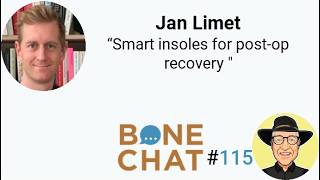
Jan Limet, CEO of Ceriter, discusses StrideOne, a smart insole that monitors gait after foot surgery. The device costs under $100, tracks weight-bearing and step count, and sends data to clinicians. Over 30% of ambulatory orthopedic patients face complications, and Limet is seeking a $450k bridge round to reach Series A funding.
Chapters
This is Bone Chat 115. Today we have Jan Lemaitre, or Lemaitre, with Ceratir, a Belgian startup that's developed a sensor to improve outcomes with real-time gait analysis. Jan's going to be bringing this device to the US. I put this one in the category of, why didn't I think of that? It's so brilliant, so simple. So today we're going to help Jan prepare for a successful US launch, and I'm going to turn the mic over to him.
Welcome aboard.
Are you frozen, Jan? Oh, we lost him. Well, he'll come back.
Mark, what did you say to him?
Stage fright. Bandwidth fright, maybe.
I don't speak any Flemish, but we could say guten Abend or bonsoir.
But Dutch, Dutch will work. There, you're back.
Was it just me or was it Zoom? No, it was my connection, I guess.
Unfortunately, it was only you.
So, okay, sorry for that.
It looked like you ran away, Jan, out of fright.
Uh, no, that was not it. I don't know what happened. I think my Wi-Fi just, uh, died. Put my computer to my phone now. And I'm on my hotspot.
Get things going. You're all right, throw up your slides and, uh, quick, quick study so you don't—
okay, good, go. Let's start. Um, so thanks everyone for, uh, for being here and, and, uh, listening to our story. Um, company is called Seriter. My name is Jan, I'm a co-founder and, uh, and CEO. What we make is a product called StrideOne. It's literally a smart insole. We call it an AI-powered recovery tool for, at this stage, mostly foot and ankle surgery. But over time, that will develop into knee, hip, diabetics, and a lot of other solutions as well. Now, what's the problem we're trying to solve? I'm not going to talk you through all the details on the slide, don't worry. A lot of orthopedic surgeries on the lower limbs, about 8.5 million in the US and Europe each year. More and more happening in a, outside of a clinic, so in an ambulatory surgery setting where the patient goes home immediately after the surgery and then there's just poor follow-up. A few PT sessions, 95% of recovery is happening without somebody there, without somebody to see what's happening with the patient to help them comply with protocol, et cetera. And that leads to poor outcomes, poor outcomes where with certain conditions, especially in foot and ankle, there's more than 30% risk of complications which are expensive for the healthcare system, painful for the patient, et cetera, et cetera. We solve that problem. How do we do that? We do it by, depending on the type of surgery, already before, or if it's trauma, after the surgery, we put a Smart Insole in the patient's shoes and we monitor how the patient walks. So we track activity, gait quality, loading, therapy compliance, etc. On top of that, we're building a system that allows clinicians first by themselves, over time automatically, triggered by the system to identify which patients are at risk of complications, to have targeted interventions for the patients where it really matters. Patients that are doing, doing well don't need to come back for a session. Patients that are not doing well, the clinician can intervene. We offer the possibility to get remote therapy. So you use the device not just to monitor, but also to do your exercises and getting real-time feedback. You see here, At the right bottom of the slide, some visual feedback that we provide, but we also do audio feedback. And to that we also tie automated documentation to make the process simpler for surgery centers, for PTs to bill, um, uh, payers, et cetera. Um, objective of all of this is to get to better outcomes, lower risk of complications, faster recovery, reduced cost of care. What does the product itself look like? So you see here on the left top side what is in the insole, and I'll show it also here. I have it live here, so you see how thin it is. These are printed sensors. We currently have 8, I will soon have 10 to cover the entire foot. It's available in 4 sizes, and we then put some cover material on top of it Then it looks like this. It has electronics here on the side, and that clips on the shoe as you see on the picture with the shoe. This is the current version. The new version will look more modern, will look like this, will have a flexible silicone sleeve for waterproofing. That will be available in 6 to 8 weeks from now. This is the hardware. Hardware connects to the phone. We have our app, app uploads the data to the cloud where we have our own algorithms that run, that process the data to calculate what is the quality of gait, how many steps have you put, how is the left-right balance, et cetera. And then we offer those insights both to the patient and to care teams via our cloud portal. That's a general idea of the product. I'm not going to spend a lot of time talking about the size of the market. I think we all know that there's plenty of patients that could benefit from this. Maybe one number that's interesting here is the, the $300 revenue per patient, which is more or less what you could currently get through remote therapeutic monitoring revenues for a 2 to 3 month episode. Traction and validation. So we started with this product initially as a product that was used in rehab centers where the PT would work with patients and mostly neurological patients. And we did a study with that where we showed that small study, 9 patients, but all patients within a week were walking much better with the device than without. And that was based on objective data, based on subjective data from the PT and from the patient. So every checkmark was green for every patient. It's being actively used in a number of research institutions, hospitals, in, in rehab centers as well. And that was mostly still in the neurological space. Now we're moving towards orthopedics where we're starting a few studies, study with Duke University, Ghent University, and Amsterdam University focusing on ankle fractures, ankle corrections. And bunionectomies. In parallel of that, we're also talking to potential customers or go-to-market partners, as we like to call them. And I'll talk a bit more about that in a few seconds. I think the most interesting thing here is we've been speaking to a lot of surgeons— knee, hip, foot and ankle— and we see most traction with foot and ankle surgeons. And it's It's virtually 100% of foot and ankle surgeons that we talk to that like the product and want to work with it. Sample size is still small. It's between 5 and 10 surgeons at this stage, but they all want to work with us, which we find very good news. Then, and I think this is for me the most interesting discussion or the most interesting topic that I would like to get your feedback on today, and that is business model and go-to-market. So in terms of business model, we actually see the device as a disposable. So we sell it to a patient, we sell it to a PT, whomever. It goes to the patient, then after 3 months of use, they can throw it away. The cost of goods of an insole or a set of insoles when we're at scale should be below $100 and probably even lower. I hope that we can get it below $50. So the cost per patient, it's just to put things in perspective, it's not going to be a $1,000 product. It's a few hundred or even less. And the way we want to bring this to the market, we're currently thinking of 4 ways, 4 type of clients. The first is working with clinics, ASCs, and PTs. They can get new remote monitoring revenue using this device. So RTM revenue, reduced episode cost by being faster when a patient is developing a complication, lowering admin costs, avoiding callbacks by better documentation, etc. So beyond the potential RDM revenue, there's additional benefits for these type of clients in optimizing care, reducing the cost of care, and improving outcomes for their patients. And that works especially in a value-based care setting, obviously. So that's number 2 on the right-hand side at the top, MedTech plays. Implants players, other potential medtech companies that we're talking to that can see this as a tool to collect real-world evidence and differentiate their offer compared to their competitors. So showing with our device, we can prove that X% of patients is recovering faster or have a better outcome than our competitors. And it's proven by STRIDE-1. So that's the idea there. Value-based plan and payers. So better outcomes, faster recovery means lower cost. And so for a payer, especially in a value-based setting, this is a very interesting tool. Lowers the cost of care, so should be able to get some traction there as well. And then the last space that we're thinking about is the employer space. So solving short larger companies to reduce absenteeism, get people faster back to work, and then potentially also work in collaboration with the larger digital MSK providers such as Hinge and SORP. So that's what we're currently thinking of. We are talking today to ASCs, PTs, and a few smaller medtech players. So we've just taken a few months ago the decision that we will focus on the US market. We're currently still, I would say, in an exploration mode where we're talking to potential customers and trying to get pilots. We sold the first device in the US to a patient of one of our key opinion leaders 2 weeks ago. So we have our first success in the US, but obviously we're hoping that that's just the beginning. Good. Very briefly on the team. On the left-hand side, you see the founding team. In the middle, at the top, you see a very smart advisor that we've been able to get on our team. Very happy with that. Familiar face for you. And then on the right-hand side, these are the key opinion leaders that we're currently working on. So two out of Europe, one in the US. Cesar. He's a foot and ankle surgeon at Duke and very enthusiastic about the product. And then the last slide that I'm going to talk about, that's— we're currently also looking for, for investors, looking to do a small $450K bridge round that should enable us to get runway and reach the milestones that we need to reach to do a serious Series A within 12 months. I'd say if you're interested or you know someone who would be interested in this type of business, let's chat. But I guess for now, let's focus more on the business side of things. So I'm happy to take any questions to explain further what we do if some things are not clear. And otherwise, I have a whole list that I would want to get your input on. So, um, uh, maybe first I'll start, uh, with seeing whether there's any questions, anything that you'd like me to, to explain further before, uh, we get into the details.
Well, yeah, I'll ask the first question. So what's the, the business model? As you sell devices, or do you sell the data, or both?
So, um, The business model is we sell devices, software subscription. So it's basically a setup fee and then a monthly subscription. That's the way we would probably structure it. But again, it depends a bit on whether there will be reimbursement or not. We can still change that. But the idea is to get as a combination of a setup fee and a subscription, a revenue of $100 per device per patient. Okay.
Yeah, I'm very curious about your, your patent strategy. I looked it up and it looks like you, you try to patent things, but everything is abandoned except one Belgian patent. Can you, can you tell me how that happened and if you have anything else in the works?
Yeah, so, so that's, that's a historical patent from way back when, um, when, uh, when we started the company, it was actually a solution for Parkinson's patients, and we tried to patent that solution. Um, now, um, in Europe you can't patent a medical methodology. In the US you can. And so, um, we basically kept— we started the Belgian patent because in Belgium you get tax incentives if you have a solution that is patented, but but beyond that, it has no value. So that's why we started it. Then we said, okay, we can also go for the European and the US patent with that solution. But then very quickly it became clear that in Europe it was not patentable. In the US, it might have been patentable, but by the time we were testing the device in the market with Parkinson's patients, we decided that we would not pursue that route. And so the patent also didn't make any sense anymore. And so at this stage, our current view on things is that our defensibility should come from having a very large database of recovery trajectories, which is something very unique that is difficult to build and expensive, especially if there's already someone who has it. Then the algorithms that run on top of that, and then potentially We may also be able to patent some pieces of the hardware going forward, but that's not the core of our defensibility strategy.
Okay. I would just make sure that you have freedom to operate because there might be other companies that do have IP in the United States. And also, I mean, the US application just got abandoned. So if there is anything in there that you can still salvage and transfer it to this you know, new trajectory, it might be worth it, especially if you're ever going to look for investors, or that's one of the questions that people ask, you know, do you have IP? And it's nice to say yes, even though it might not be exactly what you're doing or exactly the product.
Yeah, no, fair point. Fair point.
Yeah.
Yeah, we did have a previous financing round.
Sorry. Yeah, I'd follow on with Andrea on that, that I think particularly doing a patent analysis to see if you would be infringing upon anyone else's is going to be pretty critical at this stage because like there's regardless of the products out there, there's one that I can think of that's fairly similar is called Plantiga and it's a, it's a Vancouver-based company, but it's similar where they have IMUs based and then pressure sensors within insoles. And they're mostly using it for like professional athletes. And so I'm not sure what type of IP they have covered in their space, but that's something that you're going to have to answer, particularly when you go for— when you start talking to investors about this.
Yeah, I agree. I've done it not for shoes, but for some kind of sportswear recently, and I was— a freedom to operate one, an infringement search, and I was blown away by how much IP there is out there. And a lot of it is, is individuals trying to patent and then eventually they abandon it. But, but I would make really sure that, that you're not infringing on someone's patent or just be aware of who it is and what you can do to design around.
Yeah, that's—
yeah.
So with our previous financing round, we had an FDA and FTO analysis done. The amount of patents in the smart insole field, it's huge., but the lawyer didn't find anything that would really— where we were really at risk. So, um, when was that done? But it is true that there's a lot of, um, that was done 2023, I think, or 2024.
A lot could have happened in the meantime. Like, IMUs are getting smaller and they're more and more incorporated in wearables.
Yeah, yeah.
Andrea brings up great points. She, every time she talks, you got to take, you got to write down and follow.
Oh, thank you.
You may not be able to get a strong patent on the device, but it may be on the UI in the US. If you got to figure out kind of what your secret sauce is, is it, is it the UI? Is it the, is it the, the massive amount of data and the ability to parse the data? You just got to figure it out.
Yeah, because I know that that was—
go ahead, sorry. How you're translating the data into outcomes, right? Like, how does that— yeah, what's the relationship there?
Yeah, and even in the United States, that is going to be kind of a haul to get that in terms of the process. It is easier if you have some sort of hardware-based solution. Which, once again, I think that's going to be the biggest challenge, because we've played in that, in that area of the methodological approach in the data place. And it's just, it's a lot of effort to get there. And so it's just, particularly how that is going to be unique is something you'd really have to work on. Because there is a lot of groups that do have these types of stories, like me being one of them at one point. And it's just trying to tell that story, particularly to investors. You really have to have something unique within that process, but also being able to defend it.
Yeah. Yeah. Okay. Thanks.
That's good IP stuff. What, what else? I'm sure people's wheels are turning.
Yeah. And then I think also, because, uh, for example, let, uh, so I had presented on BoneChat, uh, last year and was talking when we were in, uh, our raise phase. And so we were having a lot of these similar questions from particularly VCs or private equity and different level for like a Series A. And it was a lot of those same questions of how are you going to, how are you going to essentially be a business from all of this? And we had hung our hats both on the RTM model as well as the, the VBC. And the RTM is tricky in terms of how much it's actually been adopted in the states. The key things that are happening is that they've made it more accessible this year by making it like lower bars to be able to collect, like the days monitored as well as the amount of minutes you need to monitor the patient. But because a lot of private insurance doesn't take care of that or accept it. A lot of organizations will only do it with Medicare patients. And then you also have to be careful if you're trying to go for an indication where the provider is under a global monitoring period because you can't utilize that RTM within that, within that same window. So area— so but where I think you're— where you have this unique opportunity is particularly for the foot and ankle market. And then, and also in the chronic care management as opposed to looking directly after the surgery because a lot of surgeons just don't have the ability to collect in that window.
Okay.
Oh, we got a question.
Yes, so the—
Oh, go ahead, go ahead.
Yeah, so I was also gonna, Talk about the question there from Mark. So in terms of business model, I think the first one we see with ASCs or PTs to be defined would be that we sell the device to them and they then use that device to monitor the patient typically during 2-3 months. So not just the first period post-surgery. And then either the patient pays out of pocket, either they charge Medicare or whomever is paying for that patient, either they pay for it themselves. So there is a business case to be made. We still need to validate that. But if you're as a provider in a value-based setting, and you're able to reduce your 90-day readmissions, et cetera, that also has a lot of value. Now there's probably gonna, gonna be some water that needs to go to the sea before we can validate that, before we can prove that. But there is quite a bit of research showing that these type of solutions can effectively significantly increase, for example, compliance with weight-bearing protocols for patients. So if you have had an ankle surgery and you can only put 30% of your weight during 4 or 6 weeks, you're very likely to get a complication because you put too much or not enough weight. And with our device, if we can prove that we can increase that compliance, reduce the chances of complication, that has a huge value for ASCs.
Yeah, I think that the key thing is—
Does that clarify the business?
Yeah, I think one of the things to think about in that is do you have to demonstrate that at some level as a pilot study before you start looking for investment? Because there's a lot of technologies that'll make claim— not that specific claim, but something similar to that, like the reduced readmissions or XYZ factors. And that's part of your, your raise strategy is figuring out when that information has to be done. And does it have to be, for example, published in a manuscript Or is a white paper sufficient? Or is the general understanding of that, that this makes sense, will work? Because there's a lot of different standards of evidence for that. But I would also add, with regards to the RTM, if the patient is paying for it, you may not be able to utilize the supply code. You would be able to utilize— the PT would be able to utilize the work codes, but I'm not But you'd have to— but I'm not sure about the supply if it— if the patient purchases it as opposed to the provider.
Yeah. Yeah. Okay. Yeah. Yeah. In terms of what we can prove by when and how that fits in the race strategy, I think realistically we first need the bridge round before we can— we can do anything that comes close to a study. If you just look at the period that you need in order to track sufficient patience. Um, what we're, what we're currently doing for the, for the bridge round is, well, we have existing investors and then we're talking to surgeons that see the product and that believe in it. And so we, we must— one that he hasn't fully committed yet, but he said he's very interested to invest. Um, these surgeons, they see the product, they see the value, um, and, and the intent is to at least do part of the round with, with type of investors. But then Series A, we definitely need validation. We need a first paper or first data that is somehow published. It doesn't have to be a full-blown paper yet, but presented at conferences, whatever. It's— that's why we have key opinion leaders we're working with, but we need to have that by the Series A. That's That's good.
Who makes the buying decision, Rick, for like a physical therapy post-op wearable?
Yeah, so for example, it's, you know, the 3 pathways we're kind of talking about here. One is through the hospital, one is through the ASC, and then the third we'll call it a PT clinic. And the hospital's obviously the hardest. They— but it's actually the easiest to demonstrate a value to the patient as opposed to making the hard economic argument based on our experience, because sometimes they can eat it based off of the value-add or proposed value to the patient. But particularly when you're having the conversations with PTs or ASC owners, you very much have to have the economic story dialed in. And particularly if it's a surgeon you're talking to, they have to be able to understand that there is no additional effort to their clinic for utilizing and promoting the technology. Because any assumed burden, like, so for example, if you're asking the MA to do calibrations for the patients or to spend 15 to 20 minutes in the clinic to set them up, that can be a non-starter for adoption.
Yeah.
So you really—
yeah, needs to be super, super smooth. No, that's the idea. The idea is even that we, we would send it to the patient's home, um, and that, that, that the clinic doesn't have to do anything with it. They can just track, um, track online and that's it.
It, it seems to me with, you know, coming to the US with limited funding, you probably need to pick one of those three customers only. You know, hospital, ASP or PT, and you ought to really have to focus on—
Yeah.
Or some of the others. We also, the discussions we're having with medtech players, I think the challenge with that business model is that before you get any real revenue, you're probably 6 to 12 months out They want to see a lot of pilots, a lot of validation before they actually start using this. That's what I'm afraid of. Maybe some— we're talking to one smaller medtech company, it's a startup, and they're thinking of using our device to track the usage of their device by the patient. So they make some sort of shoe for the patient to practice at home. But they don't know whether the patient is using it. Um, that's, that's never going to be huge for us, but that could be a first few hundred thousand relatively quickly, I think, if it's successful. Yeah, I think that— any, any, any ideas in that sphere?
Yeah, well, I, I like what Tiger's talking about in terms of being very specific for use case, and that's why I was hinting at the focusing on the most specific application where the data is the most relevant, which will likely be something to do either with foot or, foot or ankle or something to do with balance, mobility, or, or some aspect like that. Are you utilizing insoles in both feet or just one?
Yes, both feet. Yeah. Okay.
So then your cost of goods, you're anticipating to have two different sensor arrays And then both those arrays are separately talking to the phone, which has its own processing? Yes. And then your engineering side, are you— is your team engineering it, or are you outsourcing to a third-party engineering firm?
Hardware is external, software we do it all ourselves.
I like that. Yeah. How many people you think customers are going— will there be low-hanging fruit customers that just get it and say, okay, I'm gonna, I'm gonna use this device to track, you know, outcomes and without having to see a bunch of data. And then other customers are gonna want, you know, 10,000 patients. Are there, are there enough low-hanging fruit, you know, foot and ankle surgeons, podiatrists that'll just get it, you think? Or what do you guys think?
That's, that's all I've been thinking about really since we started this is who's going to care the most, who's gonna benefit the most, where is it gonna make a difference, or is it, just more data that would be useful, you know, in a, in a research paper or in the real world. And, and, you know, I'm not sure actually. If it's a, if it's a, if it's a device that you can take into a practice as a foot and ankle practice and say, use this and you will make more money. That's a model. There's no doubt that more information has value and more data may indeed help patients in the long run and reduce readmission. All those things are right. But, you know, probably a lot of us in this call have had enough experience with remote patient monitoring and therapeutic monitoring and CCM to know that you just can't walk in and they'll sign right up. There's a lot going on there. And I think Richard said something about behavioral change is killer, or somebody said if it takes too long to put it on and it disrupts the flow, that's a bad thing. Yeah, I know. I see a lot of people nodding.
Yeah. Yeah.
I mean, my gut feeling is actually to stay away from the ASC to start off with, particularly at the stage you're at. You need a key KOL. That is whatever in that specific field you're looking at and can demonstrate the benefit and talk to what it is to create a pushdown approach for clinic, creating the clinical utility or validation for the purpose of it. But in parallel, you need to look at ultimately how do you scale with the business model? Because one level is people trusting it or something. And then the second part is, as you're trying to raise money, having a proposed business model behind it that makes sense. And even when we were talking to a bunch of VCs and, and IBs, you know, last spring, there was a lot of pushback of saying that RTM was dead. And that's not the case. They've made some modifications there. And there are businesses that are doing it. But it's a harder slope than what originally everyone was hoping about when it was like 3 or 4 years ago.
Interesting. Yeah. Yeah.
So to your point, Richard, it seems like it really is no VC money these days, right?
Go ahead. Say that again, Chance.
I was just going to say, to Richard's point, you know, if you— people's attention spans are so, so small now. And there's really venture capital. You're hearing most of them talking about, well, how much revenue do you have? You know, and I apologize, I got in late on the discussion, but it seems like that You're still early trying to get some proof points that you can put a proverbial stake in the ground around and build a moat around it and then expand it from there. Now, what is the ultimate, you know, who we are, why we exist, what our value proposition is, what clinical problem do we actually solve, what's the patient benefit, and how do we— how are we showing that we prove it? You know, the prescriber, do they, you know, understand and make it easy for them to actually adopt, right? So that you move through this process pretty methodically.
Yeah, yeah, I think that the, the, the value for patients there, we have a pretty solid view, and I think every surgeon we talk to, at least every foot and ankle surgeon, believes us. It's not what I'm believing right now, right? And to be fair, the first test that they do, it always confirms their thinking around this. How we make money from that, there I agree, we need to be very methodological and look at different options. We have that RTM option with ACs, with PTs, but there's other options out there. And I think MedTech is one, but then what are the others? And there, you know, any ideas that you have, you know much more about this than I do. So very happy to continue hearing your ideas.
Yeah, I think that the VBC is something, but it's still really early. I mean, we're doing trials with ourselves right now, really demonstrating how do you work within bundles to generate and create savings. And even those, those are pilot programs that we're running. Like, for example, in combination with like Team Hospitals and other ones that are mandated to participate in these things. So part of your process and due diligence is really going in and understanding how a PT, how a physician, and whoever gets paid and under what different type of payment models— are they fee-for-service versus value-based care? Um, is there an incentive for the, for the position, if they like, do they have gain-sharing opportunities as a result of bringing novel aspects to the system? All of those will drive how hard your KOLs push for you. And if you don't know that part of it, the technology will have a hard time going somewhere, especially being able to communicate that well. To whoever you're trying to raise money from.
Yeah, yeah.
Richard, really good points. Thanks. One question I'd like to put to the panel is around, looking back on my MoveUp experience where we struggled to break into the surgery ASC market for the same reasons you're— and we banked on RTM as well, and that was definitely tough. But when I look at the Swords and the Hinge Health of this world that are some of them billion-dollar valuations, I'm not sure it's justified on the revenue, but when they play in the employer space and they play in the space around avoiding surgery costs, you know, reducing costs and healthcare costs for employers, I'm wondering, is, is that a potentially more fertile place to kind of chase initially, possibly in conjunction with one of these players as a, as a kind of a partnership, or whether, yeah, I mean, in other words, are we maybe too focused on this sort of traditional, um, hospital and healthcare market and maybe looking more— should we be looking more at the, uh, at the sort of employer self-insured market?
Yeah. From what, you know, some of our experience with that has been that— but well, a couple things. So for example, it was interesting because I, I've talked to Sword, and, uh, some of the things that they've said that's interesting is they want the direct employer route because a lot of surgeons and providers don't actually like our technology, which was kind of interesting. And so they— it's because of their side and their strategic partner that their partnership they were able to create with the corporations that ultimately, I'm, I haven't seen any good pay. I haven't really looked well enough yet to see what their actual clinical effectiveness or savings have been to the organizations. Versus is this just a solution that seems to make sense? Like, for example, when I think it was insurance or someone bought like, however, hundreds of millions of Fitbits it was and just gave it the two employees and hope that would work better. I'm not sure how well they quantify that, but I, in terms of the outcomes, if it's effective or has it actually resulted in savings, I'm not sure. But I know that those groups are harder to talk to in terms of like getting those meetings and being able to demonstrate that value. You could have a chance for that saying, you know, we're fitting in this specific niche. But if it's trying to be in everything, I think it's going to be more of a challenge.
Yeah, you got to focus.
You got to focus.
Sorry, go ahead. You're delayed, Jan, so it's— you still have low bandwidth, so we're talking over each other. Keep going.
Yeah, apologies. Yeah, so my question was then, So we need to find a niche that for these players, um, is still sufficiently interesting. So we, we need to be able to provide sufficient value, but it also needs to be big enough for these players to be willing to talk to us. If it's just, you know, a very small subset of, of potential employees that, that would wear the, the system, um, then for them it doesn't make sense. And then I'm wondering, the foot and ankle surgery um, it's, it's in those terms, it's not big, right? Um, I'm wondering whether then diabetics or something would not be a better niche to look at, but I'm not sure that Hinge and Sword are active in—
a lot of, a lot of diabetics are in wheelchairs. Um, I know that not weight-bearing really.
I know that there's been a number of, you know, going back into the patent space, I know that there's a number of things that I was working on in the past, which was the idea of like socks or pressure sensors to be able to identify, to help a neuropathic foot prevent, you know, the injury or those types of detection things. So, you know, going back to Andre's point, the IP, whatever you jump into, you got to be careful of the IP space and making sure you're not infringing upon something that what that would be. The— I mean, I know that, that Sword has been going through a process of acquiring companies to help build their portfolio up. But in terms of who you would talk to and at what point, they would probably say too early. What is— show me what you're like in 2, 3 years from now, would probably be my guess.
Also, you need to build up, I think, more data around the predicting if, you know, based on a person's gait and et cetera, whether a surgery is— where that can give good insights into whether surgery is necessary or not. But I think you're working on maybe working on those things potentially.
So, yeah.
Yeah. And so a lot of— yeah, go ahead, Tiger.
Oh, go ahead. Follow up, Rick.
Go ahead. Yeah, I mean, I think because, you know, I've spent a lot of time in the prediction side as well in trying to figure out how do we extract value from data. And mine is more like proactive based off of recovery. But the idea of like when to go to surgery and, you know, is this a high-risk, low-risk patient, those types of things. There's groups and algorithms that have done pieces of that. And so it's not entirely new. It's how do you create— how do you either demonstrate that this is better than what's currently out there on the market for that, but then also create an incentive for it? And then who is that for? Because the only people that really benefit from delaying surgery to some extent would be insurance, as opposed to a hospital or ASC, which would benefit from actually going to surgery sooner. And in that case, it's more of how risky is this patient And if they're high risk, then they're going to the hospital. So it's, it's just being careful of the trap of we can create this really interesting technology that's really backed by a lot of research and hanging your hat on that without a strong economic case of your, your COGS are super low, the patient usability is high, the clinic's usability is nil. And then from that, there's a pathway to either someone wants to pay for it or it's just, it's low enough that the RTM, that you can use the RTM in some cases. And that, that's a big challenge. And this is not just you guys, this is every single wearable has, has these same problems right now.
It's a great point. Yeah, it's just finding the value proposition. Is— can you prove that there's less follow-up, there's less labor, less readmittance? Can you, can you show that? Because that has a value.
But I think we really focus on, uh, because I really believe that we can, um, and, and we should, we should see that pretty quickly. You don't need massive sample sizes to to be able to prove that. That's actually what we want to do in pilots with ASCs and other types of players. Track that. I mean, if you can see, especially for patients that live far away from the center, you can see that they're walking normally as expected, then they don't need to come back. And so it's costly for the patient, it's costly for the center if you can avoid that by just looking at the data once.
Yeah, that definitely has value.
And it does. So in parallel to that, we've run trials that we're presenting some of this at AOS that actually next week. But it's this idea of, in our case, we're trying to reduce the amount of in-person PT. And so using the technology to demonstrate that instead of going, for example, for a knee replacement, you go anywhere from 6 to 8 weeks following surgery 3 times per week. Now you're saying you're marrying it with the technology to say, okay, maybe it's once a week or once every 2 weeks that you're using— that you come in and the PT is making a decision based off of that data. And that works well in the value-based environment. It doesn't work as well for fee-for-service because in that case you're trying to maximize a little bit more. And so that's why you can use the RTM, but then you have to justify to a PT that that additional— that, that, that income that they would have lost by not having the patient in front of them is made up for with the RTM. And so it's just— it's a, it's a tough value proposition if it's not nailed down.
Yeah, good point. Here, Kyle's been waiting for a while. Let me— he always has great questions.
Well, now you set me up. Jan, you mentioned bunions, ankle fractures. Tell me more about what procedures in the foot and ankle space— I see on your website you've got knees and hips and foot and ankle. Tell me more about the foot and ankle procedures you're focused on and why you selected those.
Yeah, yeah. So the website is still very broad. We've seen more traction with foot and ankle, so we haven't updated the website. But so we see a lot of value in bunionectomies. So forefoot surgery where typically during the first 4 or 5 weeks, you can't put any pressure on your toe or on your forefoot. So you have this bunion shoe and then afterwards you need to gradually build up that pressure again. And that's something where we can, very, very easily monitor, visualize how the patient is doing, compare that to other patients. And that's where we've started to build up the data. And we can even go as far as telling the patient, hey, we just, you know, it's together with the, they look at the lines with the pressure and we have 3 lines, very simple to interpret. And the surgeon tells the patient, you see, this is at this level. I want you next week to be there. Take this home, walk with it, look at the data every day, and just try to get that line a bit higher. And the week after they come back and the patient and the surgeon are happy. So that's the type of use that we see there with forefoot surgery. Then with ankle surgery, the guy we're working with, a trauma surgeon, He's very much interested in just understanding what the patient is doing and when the patient is fully recovered. He does very complex calcaneus fractures but also other ankle fractures. His point of view is that nobody, nobody knows when a patient is fully recovered. There's no definition, there's no data about that. And just visualizing that for the patient and the surgeon, he says will be very valuable. And then another type of surgery that we're looking into is ankle corrections, forefoot, not forefoot, ankle and flatfoot corrections, for example, where what these surgeons tell me is we used to have nothing in terms of visibility, then we had these weight-bearing CT scans, but that's still all, you know, it's Okay, there's a loop, but it's still static. We want to see dynamically, is the landing of the foot, is it more correct than it was before surgery or before surgery even to avoid, you know, we see here that the ankle, you know, it's not the way it should be, but what does it look like when the patient is actually walking outside? So those are the type of use cases there. So that's broadly what we are looking at in, in foot and ankle.
Interesting.
Good. So, one quick— so, one quick thought.
Sorry.
So, one thing you might keep in mind there is sometimes you can have an ankle injury where it's all soft tissue and not bone-related and it actually is worse than if you had broken the bone. And that's probably going to be more likely in high-intensity athletes that are going to be far less price-sensitive. So, you might have an avenue of going the route of speed to recovery monitoring as opposed to post-surgical monitoring, especially with the uptake of some of the soft tissue internal bracing things that are happening with BioBrace and other stuff like that. But it's interesting that you're, that you're tracking it with a variety of different things.
Cool.
Yeah, yeah. And then weight bearing becomes super important with soft tissue.
Yeah.
Yeah, go, go ahead, Mark.
No, there's a, there was a German company that, uh, I stole their motto decades ago called Bauerfeind, and their motto was motion is life. So I don't think there's any doctor you'll talk to anywhere that doesn't agree that this is a good thing. Having, however, having said that, I don't play doctor. I, my motto is work with me and I'll make you money. So I think the first place, if I were Karen, I would start with a, a revenue model that I know makes doctors money, makes practices money. I would start with that. And I would start also with a KOL advisory board cuz doctors sell doctors and that is critical that you have a really heavy, like a Duke. It's very, very good, uh, testimonial site, established site. And that revenue model, you know, will get you business and we know it's gonna work, but the data will follow later. You know, big data will come later. And those studies will come later. And they concurrently with that, I would go after big employers that wanna get people back to work faster and they'll see the logic behind this too. And they'll also be able to immediately find the malingerers, those that are not getting out bed, those that are not walking, those that are not— again, motion is life. And so actually, motion is money.
That's okay.
Yeah, Mark has famously said on BoneChat many times that your sales force is your KOLs. So would you rather have 1 KOL or 10 or 100 KOLs? And That's a, that's a strategy that works in the US.
They are your sales force.
Yeah.
And they, and a lot of guys wanna be first. They wanna be the first one to present at the podium about a new technology. And you gotta find those early adopters and the guys that have, you know, podium power.
Yeah. You've gotta find those young doctors that wanna be fam— that want, that wanna be famous. Nothing is more motivating than a desire for recognition.
That's a good point. And then the data will follow, and then years later they'll, they'll be up at the podium presenting all the, all the analysis just to validate that they were right. I like that.
So then, then the question becomes, how do you, how, how do you, how do you get I mean, KOLs, you can, you, you, you can give incentives, right? But other doctors, what's the incentives for them to, how do they make money? Because as I understand it, in the US you're not allowed to pay a surgeon to, to sell your device to, to patients.
You have to find young doctors. Like, I don't know, 20 years ago I was building an advisory board. One of the doctors I found was Bill Ritchie. And he later on became the president of the academy. And I got several others, guys like Roy Sanders and David Helfand, a special, you know, a special at HSS. At one time they were nobody, but they wanted to be somebody. Those are the doctors you have to try to find and you don't pay 'em. They're not looking for pay, they're looking for recognition. Of course, now later on they want a good stock portfolio. They're not as dumb as they used to be.
Yeah.
Yeah.
We're, we're already talking to the doctors about, about stock options.
So that's, uh, once upon a—
but that's, that's just a few. That's not, that's not—
one of the guys that I know Richard's working with once upon a time was a young ambitious doctor named David Stuhlberg. Very smart, very smart man.
Absolutely. Having dinner with him tonight, actually.
Tell him I said hello. He may remember me. I don't know.
I will.
I certainly remember him.
But I agree with you. The, the, the acquisition of a KOL, it's— there's laws around it, obviously the Stark, but there's, there's different ways that you can have agreements or arrangements and those types of things. But you don't always have to do stock because That's also sometimes that can be a challenge, particularly when you start looking at investment rounds and or if you're looking for an acquisition because based off of how much power they have or what type of say, or if you have like 20 different doctors on your clinical board, that can lead to its own problems. But the something to think about is if you can't get a doctor to use it because you're not paying them in some sort of way, then you have a business problem still.
Yeah, well said. So when you go to Academy, you'll be at Academy, Jan? Sorry, will you be at Academy in New Orleans next week?
Uh, no, I will not.
No.
Okay.
Um, which is— it's not a great meeting nowadays. It's just gotten too big and I would go to the smaller foot and ankle meetings and maybe joint meetings. You'll get more intimate discussions with foot and ankle surgeons. We haven't even talked about podiatrists, but one of the first things that popped into my head was podiatrists are, you know, they're the overlooked orthopedists, the second-class citizens. And they love, I mean, I remember it right when we would go see a podiatrist, they would say, you are the first company that's ever come to talk to me. I mean, they, so they're, they're a little easier to approach. And a lot of times they own their own clinics, right? So is the podiatry angle, does that make sense to everybody?
So if once I had the revenue model, that's actually the first market I'd go to.
Hmm. Yeah, I, I would stay away from the, the global, uh, we can solve everything issue, uh, particularly early on here. Uh, because when you start saying things like we're using a pressure sole for knee, people are like, well, how are you measuring the most relevant metrics for knee as opposed to the cases where you're probably the strongest? You just have to make sure though that the market analysis, because if you looked at, at, by a BC, they're going to do like the rule of 5 or rule of 10 based off of just Excel spreadsheet math in a lot of cases. So you need to be able to have that, that story that in theory can work out well, uh, because they have a lot of just basic formulas they run to make a decision on if they're going to fund you or not.
Okay, maybe so can I ask a final question or are we out of time?
Yeah, yeah, no, go ahead, Jan. We're one more question and we'll wrap up.
Yeah, so one question that came to mind when you were talking about podiatrists, would if we want to approach it, Mark, do we need KOLs that are podiatrists or do they also listen if you have a KOL that's an orthopedic surgeon?
So it's kind of a one-way street. You can, if you have a podiatrist that's a KOL, other podiatrists may listen. If you have an MD or a DO that's a KOL, then podiatrists will probably listen, but it's probably not the opposite. MDs won't listen to podiatrists.
Okay, well, very well said. Yeah, well, this has been great. We're up against the hour, but, uh, I mean, we all get the technology. It's awesome. You just got to figure out the business model. It is. I mean, if I had ankle surgery, I'd want this thing for sure, uh, post-op.
Well, I, I would say I wish you all, uh, foot and ankle surgery in the next few months, and I'm happy to, uh, happy to send you a, a set for free.
We did. We didn't talk about lost leaders, but have you ever thought about real quick giving the first one away for free or the first 5 and then getting a surgery center hooked on it?
Yeah, yes, yes. That's what we said to Cesar at Duke. The first 5 or 10 you can get for free, but the first one he sold already to a patient, so it was paid for. But yes.
Yeah. Cool. Well, all the best of luck and hope to have you back on BoneChat with a lot of clinical data and we'll talk again. Good luck.
Yeah.
Thank you very much for having me. It was a very interesting discussion. So thanks for all the feedback.
Okay.
Good luck, Jan. Great. Thank you. Thanks. Thanks. Have a nice day.
More from Tiger


BoneChat #145 - ASC Robots, Direct-to-Patient Marketing & Ortho Startup Reality

BoneChat #144 - Defining the Standard of Care for Orthopedic Tissue Preservation & Restoration

BoneChat #143 - AI-Driven MedTech Sales, Startup Traps, & Orthopedic Commercialization


BoneChat #142 - Fastest-Growing Ortho Segments, Reverse Shoulder & Joint Preservation Rollups

BoneChat #141 - Disrupting Surgical Visualization: Single-Use 4K Scopes with Richard McKillop

BoneChat #140 - Transforming Knee Rehab, Patient Experience, and MedTech Go-to-Market


