BoneChat #46 - ExplantLab, a genetics-based diagnostic for metal ion issues before & after TJRs.
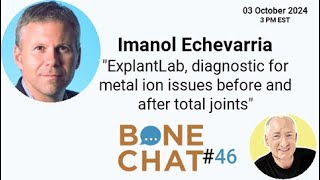
Amin from Explant Lab discusses a genetics test that predicts metal-ion immune reactions before and after joint replacement surgery. The company's Autotype and Orthotype tests combine HLA genotype with metal-ion measurements to identify risk, with plans to expand to knee replacements and launch in the UK, EU, and US.
Questions this video answers
About 620 patients and ~810 hips.
Around 15%.
Approximately 70% of cohort used for development and ~30% for testing/validation.
Autotype = pre‑op genetic risk test; Orthotype = post‑op test combining metal‑ion and genetics; MyOrthotype (direct‑to‑patient) = consumer-facing/light pre‑op version.
Pre‑op: blood or saliva (saliva feasible for DTC). Post‑op: blood draw plus metal‑ion testing (requires spectrometry).
Chapters
Foreign.
Welcome to Bone chat discussion number 46. Eminal is the CEO of a UK startup called Explant Lab and we first met in July. And I love, I love startups like Explant Lab who bring a better solution to orthopedics and really have zero competition. I mean they really are carving out a new diagnostic. So he's going to lead us through a discussion about a new genetic diagnostic that finds metal ion issues both before and after total joint surgery. So handing the mic over to Eminol. Welcome.
Thank you. Appreciate the introduction. Can everyone hear me? Okay. Okay, fantastic. I will just share my screen. Okay, let me go full screen on this. So I just try to arrange my desktop so I can still see everyone. Okay, Is that clear?
Yes.
Great, thank you. So I've just put some slides together to give an intro to the company and a high level overview of the research we've done and the products that we developed. Please feel free to jump in with questions as we go along. Ty, double check. Is there anything else on the agenda today or.
No, it's you. It's 100% you. Typically people raise their hand so if I'll, I'll notice little hands come up and I will let you know if there's a question.
Thank you. So very quickly, company is around 14 years old now, so I always joke that we're the oldest startup in town. Company was founded by my business partner, gentleman called David Langton. Dave is a surgeon who following residency took some time to do a PhD in bioengineering, really looking in depth at the issues with metal on metal hips. So he did his PhD in that area and following that work ended up setting up an independent lab to kind of go deeper into the area and has spent his time subsequently on that. So very much a research funded unit for a period of about 10 or 11 years. And it's only about three years ago that we really started working together to kind of begin the journey for commercialization. Dave is extensively published and we currently provide the NHS in the UK with explant analysis services. We won the national tender to do the explant analysis on failed and revised joints. So we provide that service to surgeons in the uk. The vision for the company is to create a diagnostic platform so to analyze high volumes of large and small joints, implants, fixations and then perform histological and genetic tests from these explanted patients and analyze the data to really identify relationships between the physiology and genetics and implant performance, ultimately leading to the development of diagnostics for complete metabolic and Genetic profiling of patients. We've already got our first product on the market in this space which is focused on cobalt chrome. This came from the work that Dave had originally started with the metal on metal research years ago. And I'll come on to a bit more detail about how the product was developed. But we essentially have two tests. A pre op test to help identify patients who would be at risk of a metal hypersensitivity reaction and then a post op test to identify metal hypersensitivity in situ. September of last year we received a second grant from the UK government to also look into other materials and we're currently recruiting for that trial and that's into titanium and zirconium, so establishing links with those two metals as the next tests. So that's a very kind of high level view in terms of what we're trying to achieve here. The problem as we see it is that these joint replacement surgeries are not universally successful. And we know that there are several causes of failure in hip and knee implants and ankles, shoulders, wrists, et cetera, from loosening right through to local tissue reactions. And this represents a pretty significant challenge. Depending on the research that you read, anywhere between about 7% and 20% of patients return with pain post op or have complications. So these are by no means a kind of a slam dunk in terms of the outcomes. What we found is that an allergic type response to metal, cobalt and chromium in this instance is an under recognized cause of implant failure and because of the symptomology is often confused with infection. Now around 70% of hip implants and over 90% of near plants contain cobalt and or chromium. This is particularly under recognised in knees, I think. More recognised in hips. I think there was something like there are several hundred papers covering this in hips. I think there are maybe nine covering it in knees. So it really is under recognised in that area. It is beginning, I think, to be more recognized. There have been several publications more recently and you know, we are seeing comments from folks like the FDA talking about needing a better understanding of the host response, which is essentially where our company's focused. So if we think about, you know, creation of better devices, improvement in surgical technique, we kind of regard the host response as kind of the third leg of the stool here and one that's not really been had as much time or energy focused on it. So the FDA recently designated two new implant designs as breakthrough devices. We know this is seen as an issue by the FDA and we're looking to launch this product in the US to help identify patients who either are at risk of having a hypersensitivity reaction or are experiencing a current hypersensitivity reaction. So HLA genes determine autoimmune or autoimmune like diseases, whether that's Ms. Or celiac disease. And we now know that that is also the case for alval for lymphocyte dominated responses to poorly performing joints. In extreme cases you see this kind of full albal response where you have this huge lymphocyte buildup. But in less serious cases you do see the swelling, pain, redness, all the kind of hallmarks of an infection, which is why it's often misunderstood, misdiagnosed. But it essentially comes from the release of metal ions from any part of the implant and then the body's immune response to those ions. So we kind of came across this as an issue within Dave's initial research and then we began a full clinical evaluation. So around 620 patients we won. Well two main sites, North Tees Hospital in the UK plus Nuffield Health which was associated with the North Tees Hospital, the Hospital for Special surgery in the US and then Royal Perth Hospital in Australia. So around 620 patients in the trial, around 810 hips. We had patients who were alval resistant despite having high levels of material loss and they did not show a lymphocyte response, they showed only a macrophage response. And then we had patients who, even though they had a very low wear rate in terms of the metal ion concentration, were demonstrating both macrophage and lymphocyte responses. So we could see that we have this immune response going on. So these were the two patient cohorts that we identified. From there we were able to identify the HLA genotypes for being able to predict this response to to cobalt chrome. And around 15% of the population carry this particular gene. So it's a fairly large cohort of patients who are at risk of developing some kind of immune response to a poorly performing device. And it's worth just kind of reinforcing that point where there is no so very little shedding of metal ions. We don't see a huge response as the level of metal ions increases. You see kind of a dose dependent response in kind of the immune response from the body. So just want to clarify that, that this is a dose dependent depending on the metal ion level. So with this data we used about 70% of the cohort to develop an algorithm to be able to predict those folks who are at greater risk and those folks who are having an active response. And then around 30% of the cohort was then used to test the algorithm to ensure its validity and its accuracy. The reason it's an algorithm and not just a kind of on off is there are a number of factors that go into this. So there are factors around the prosthesis, the wear site. There are also factors around age and sex that determine how severe the response can be. And the reports that are produced from this give a risk factor which is compared to background risk. So if your background risk is X, it will then say is your risk as a susceptible individual, you know, 2x, 3x 4x depending on the outputs from the, from the algorithm. The data was published in Nature Communications last year, so we were delighted to have it published in Nature. So we were very comfortable about the fact that it had been fully kind of peer reviewed. And then this. The data from the trial was used to develop two products, essentially a pre op product and a post op product. Now I'll come on to this. We have two versions of the pre op product, but the products can be used to predict the likelihood of an immune response in pre surgical settings and also identify an active immune response. So the three products are autotype, pre op, orthotype, post op. And then we have a direct to patient version of the product. For anyone who say whose surgeon is not prepared to have the product used via the hospital but wishes to kind of have the report run themselves, they can privately contact us and have a direct to patient test done. So let me just take a pause there before we come on to kind of commercialization, just to see if there are any questions. I'm aware I whizzed through this pretty quickly, but Tiger was at pains to point out that this group's a quick study. And so I wanted to kind of get through the top line piece quickly and give you guys a chance to ask any questions.
It makes sense. I mean, I've written articles about how the revision rate every year for knees and HIPS is 15% every single year and nobody, nobody can quantify it. Where are they coming from? You know, there's obviously hips, you got dislocations, early infections, but then, but there's 15% every year. I mean there's 150,000 knees and hip revisions in the US so it's like 300,000 every single year. And I bet you once you guys are on the market in the US you're going to find a percentage of those are metal ion problems.
Yeah, I think there's been a, there's a paper released earlier this year I believe and in around 30% of patients, I think many of whom were culture negative, it was actually Albal that was low grade Al that was responsible for the inflammation and pain, not actually an infection. So it is I think quite often misdiagnosed.
Yeah. I'm not sure a lot of surgeons want to know this actually, but that's a different thing. Any questions from the group so far? It's a blood test I assume.
Yeah. So there's two versions. There's a, there's the, we have a blood test. So the pre op test can be done with either blood or with saliva. The post op test requires metal ion testing as well. So it's a combination of the metal ion testing plus the genetics that kind of gives the, the risk factor in the post op setting. So I should have clarified that. Yeah, yeah.
Mark's got a hand.
So as I recall SQLAB had a. Something called the Gold knee.
Yep.
Which was produced I suppose in Germany that has some kind of coating to protect against maybe the alert, you know, the allergic reaction to chrome cobalt. Is that correct?
That's correct. So there are I think four, five companies that we're kind of aware of that are producing, you know, product here. So Ceramtech, you know, obviously with that with, with their ceramic current ceramic hips and they've applied for knees. Then we have the auxinium stuff from Smith and Nephew, similar coatings, Iconium coating with, from B. Braun or ask your lab. And then I think Link and Merrell also have similar products.
So the one that interests me most is the, the B2C the myorthotype.
Yeah.
Kind of bypass all of the decades of training and so forth from the physicians and go directly to the consumer who would probably want to know why 15% are replaced and what are the barriers to selling it directly to the consumer in the United States, to be.
Honest, there's, there's no real barriers to sell there, you know, very similar to anyone else who's kind of selling the genetic testing. It's just a question of registration and then you know, the relevant kind of sales and marketing. So there's no particular barrier to that.
So you're sell, are you selling it now on a.
No, we're not on the market. So we're, we're approved in the uk. We should get EU approval in the next six to eight weeks then we're going through FDA approval now I think probably Q3 potentially next year for FDA.
What's involved with the FDA for this. What, what class does this fall into as a genetics?
We're not sure at the minute. So. Okay. We're currently going through the pre submission with the FDA to kind of work out whether we can go. Whether we can go 510k or whether we need to go full de novo and what the right classification is. So we're still having that conversation.
Great.
Yeah.
If you need regulatory expertise I can help you with. I know some terrific consultants.
Yeah, thanks Dagger. We have got a company that we're working with on this. We were very fortunate in that the gentleman who did the original EU dossier for us did a fantastic job. So the consults we have working with us, we're pretty pleased they've got some decent substrate to build out the FDA application. Got it.
I'm kind of with Mark. I like the direct to patient is made for the U.S. you know, I, I play golf with a dentist who knows more about alloys than anybody and he had a metal and metal hip with a huge reaction had. I think he's had two. Two. He's only in his 40s. He's had two hip replacements.
Because of that we, we hear some horror stories. So there was, we had one recently in the uk. I'll not name the hospital or the surgeon, but particular lady had a, had to have a revision. Metal ion levels off the chart. Horrible Alvar reaction. She had the hip revision and then the same surgeon put in a knee with cobalt chrome content. So you know, thinking, I mean this idea that the metal on metal piece or the, the hip piece was isolated from the rest of the body and of course she was already massively sensitized and as soon as the other joint, you know, started to wear even a little bit, she had an enormous reaction. So there's just not the, I think the understanding of you know, the presensitization in some of these revision patients.
Yeah, here, carry on. Let's.
Yeah.
So the.
In terms of. Let me jump to the. So we have been working in the UK just to really kind of get a, get post marketing evaluation of the product to be able to demonstrate to customers the kind of applicability and the accuracy of this. So we've had 72 patients so far, 60 in these, but 25 of these revisions and each of these cases it's correctly identified whether there was ARMD or a well functioning joint. And that was compared with histology. So we could tell by the, by histology whether there was an active ARMD taking place. So we're pretty happy that you know, the post marketing analysis there is demonstrating what we saw in development. So in terms of kind of the go to market strategy for us. I've already talked you through the Orthotype piece. We are already having some conversations with some of the manufacturers of non cobalt chrome. So Mark, you know you mentioned esqlap. We've been speaking quite extensively with Bee Braun around their products in both the UK and in Europe and we've spoken on their behalf a couple of times and they're big fans. We did originally have a very productive relationship with Smith and Nephew. I was sharing with Tiger ever since Mark Reed, who was the global product manager for Obsidian, left the organization and then there was a whole bunch of restructuring. I'm just not sure what's going on there. But it went from a very good collaboration to basically tumbleweeds in the past year or so. So we're just waiting to see if they can sort out their leadership structure and whether this is a conversation they want to pick back up with us. Because as a companion diagnostic, this is obviously something that works very, very well for those organizations in being able to identify pre surgery, you know, which patients would most benefit from their ceramic or zirconia products.
Yeah, partnerships that have a non cobalt, cobalt or chrome product would really benefit.
Yeah. So, you know, our intention as stands is not to try and build out, you know, a large infrastructure globally or in the us. You know, we're looking more for a distributor model with, with sales partners. So we'll, we'll begin shortly to actively look for partners in this space that we can work with. I would imagine initially we'll focus in the east coast where, where we're based and there's a good high concentration of, you know, surgeons here that we hope would be interested. I've mentioned the, the timelines already, so I'll not go over that. And I think we're all aware who the customer group is. Our initial focus will be the eu, the USA and then Canada and Australia. We're actually already getting early use in Australia. So product is not licensed there, but it's being used under special authorization by some of the surgeons there. So they are very keen on the, on the test and already kind of, you can always tell how keen someone is when they're prepared to fill in reams of paperwork to actually get access to it. So the fact that that's happening is a good sign. In terms of the testing, we don't, we don't do the testing in house. So, you know, our expertise is very much kind of the Bioengineering and the identification of the genetic links. But in terms of the metal ion blood testing and the genetic testing, we actually work with the NHS blood and transplant labs, which are NHS labs within the NHS that also do third party testing. So they provide both our metal ion testing and our genetic testing at present, which obviously works very well for us. And we'd be looking to find, you know, similar testing partners across Europe and in the US to be able to process those tests for us. Doing the genetic tests in houses is not overly complex. You know, the diagnostic equipment from Thermo, Fisher and the likes of Illumina is pretty straightforward. The metal ion testing not so much. So we really need the special centers to be able to help us out with the spectrometry and what have you for the metal ion testing.
So you need a local test lab in each country where you're selling?
Essentially, yes, yeah, we are doing some cross border stuff at the minute where we've got people testing out the service. But as soon as we get to scale we'll really need to have the lab set up in the individual countries.
And what's the mechanics? So a pre op patient or post op, they do the blood tests.
So mechanics are blood test is done in hospital, test is sent off to the testing center, genes are identified, the lab has access to the cloud based algorithm, they input the HLA genes and the other patient factors, the report's produced and then the report is emailed to the surgeon who can then let the patient know kind of what's been found and therefore what choices need to be made either in terms of implant selection or if this is post op and they've had both the ions and the genetics, you know what the next steps are. So that for the, for the post op, if you imagine it as a four box grid where you have, you know, high, low metal ions and then you have, you know, the risk factor. High, low risk factors. If you are a patient who's got high metal ions and you have high risk factors, you have an active issue and that's a pretty strong signal that you probably need a revision. If you have the genetic risk factors but you have very low metal ion levels, that's much more of a kind of a watch and wait and probably retest ion levels every six months just to make sure they're not creeping up and interventions not needed. So the post op test can be used to kind of inform what treatment's needed and a kind of what point the patient is in terms of the intervention they require.
Got it and what's the cost? What's the cost to the healthcare provider?
So in the UK, the pre op test is 395 pounds and the post op test is 565 pounds. So we've tried to keep this, you know, comparative kind of genetic test. This is six digit resolution genetic testing. Comparative tests for say cancer are around 11, between 11 and 1300 pounds. In the UK we've tried to keep this much closer to the costs of other tests for surgeons. So, you know, how does it compare to an mri, you know, to histology testing in a lab and try to keep it in that ballpark. I think, as many people on this call may know, the NHS is pretty broke at the minute. So trying to come in with any high test, high cost tests, you know, is, is kind of doomed to failure.
It seems like you could push the price in the US a little more, especially the direct to consumer version.
Yeah, I think so. I think there's an opportunity, and I think there's an opportunity for some really interesting health economic analysis in the US as well, you know, in terms of, you know, potential reduction in outcomes at a longer term piece. But one of the areas we're really interested in discussing and seeing if anyone's got any experience in is reimbursement in this space. Another couple of things that have been fascinating is we've generally had two responses from customers. One saying, I've never seen this, it's not a thing. And then when you start to dig in a little bit and say, so you've never seen a patient who's come back, you know, inflamed, sore joint, painful, and then when you've, you know, tested for infection, no infection, and then they go, well, yeah, I've seen plenty of that, but they've not, they've then not made the connection, there's something else going on. And then we have other. And this, this hadn't crossed our mind in the UK because it's a very different environment. We've had other surgeons basically saying, hell, if I don't use the pre op test and a patient then develops a metal hypersensitivity response when I could have used the test, does that leave me in any way exposed? And that wasn't, that had not crossed our minds at all because, you know, litigation is not really a thing in the uk. But that, that kind of risk factor popped up from, I would say probably 30 to 40% of surgeons we've spoken to in the US, which we found really quite interesting. Not a marketing tact, not A marketing tactic we want to use. Pretty negative, but thought it was an interesting response.
Well, I mean, you don't have to tell anybody you're doing that, but you. I would. You could contact, you know, plaintiffs attorneys all across the US and make them aware of this test and they will work.
I was laughing. That's a good idea.
So, you know, in terms of the kind of the next steps for us and the areas where we're really looking for kind of, you know, support advice, if you like, is, you know, how do we kind of navigate the reimbursement and build a case for reimbursement, you know, both kind of Medicare and the insurance companies making sure we find the right lab support. You know, is this, whether it's, you know, Quest or LabCorp or whether we even look at, you know, if we would, if we were to dip a toe in the water by doing direct to patient testing just using saliva, that's how we gathered a lot of our data on the initial trial in the UK and I think we had about 98% usable samples from home saliva test kits. It was very, very high. So we know that that works well and you know, setting up a small lab to directly ourselves in the US would not be a hugely expensive undertaking. So these are kind of some of the questions that we're, that we're asking ourselves. And then obviously the, the broader sales model in terms of finding the right sales partner.
Yeah, I've done 23andMe. I'm sure a lot of people have. That's a saliva test. Yep. Where do they, where does 23andMe process their, your samples?
Do you know, I think they have a number of sites. I think they're quite distributed, a bit like kind of LabCorp. I think they have sites in kind of the major hubs. As I say, that's pretty straightforward. It's when you get to the blood test, the metal ion test is where things get a little more complicated and we need the specialist labs. So very, very quickly. I just want to make, just want to share one last, one last piece. We are running a second trial. We received a million dollar grant from the UK government that's kind of up and running now. I mentioned it briefly in the opening and this study is. Let me just jump down. So there's about a million bills on this slide. Sort of jump through. Here we go. So this is a much larger study. It's around 2,000 patients and we'll be using the same approach where we have the initial investigation and we'll then develop the algorithm this is looking at because, because the original study was done on hips. This is looking at knees to make sure we've got the right data in knees as well. And it's also covering titanium and zirconium. So we can see if there are any kind of biological and genetic links towards zirconium and titanium. So ultimately the idea being that if you have an orthotype test, it will test you against several different metals so that, you know, a surgeon can decide, hey, yes, you're a good candidate for titanium, you're a good candidate for zirconium. And one of the things we found really interesting when we spoke to some of the big manufacturers, they seem to immediately look at this as a threat, the ones that don't have zirconia type products. Whereas when we look at it, all it's saying is actually cobalt chrome products are actually fine for 85% of the population. So it was, it was unusual the way they looked at it. But we want to make sure we're not saying cobalt chrome is a, you know, should not be used. We're saying that any implant should be the right implant for the right patient as opposed to, you know, particular, particular materials being avoided in everybody. So just want to kind of make that point about the follow on trial that we're doing as part of the follow on trial. We are also speaking to some dental surgeons. In speaking to a couple of dental surgeons, they shared with us that they, anywhere between about 1 and 4% of patients, they see issues with titanium implants in the jaw. And so they're also interested and it will be a, a minor update to the protocol to be able to put maybe 100, 150 dental patients in and also be able to include dental patients in the protocol and get some interesting data there. So that could be a, you know, a follow on area for us as well.
Is the, is titanium the alloy that's the problem or is it vanadium or aluminum?
So we don't know. It looks like it's titanium, but that's the purpose of doing the analysis. So we can actually kind of nail that down and find out exactly what it is. I mean, as I'm sure, as you guys know, when patients first started having, when they first started seeing these reactions, everyone was convinced it was nickel. And it's, it's not nickel, it's cobalt chrome. So we're still trying to identify, you know, which part of the alloy is causing the issue. Got it.
So what do they do today, Amino? I mean, obviously I mean I, I've been in orthopedics forever and they used to like tape a little metal disc on the patient's like wrist.
Yeah.
And you know, that was a skin sensitivity. It wasn't very accurate. But what, what are surgeons doing today?
So nothing really. So there are some patients, there are some surgeons who will use ltt, but we know that LTT is notoriously inaccurate in terms of false positives and false negatives. So what is ltt? Lymphocyte tolerance testing. So it's kind of an in vitro test to see if there's a response. It's got a couple of kind of very noisy proponents, but the science really doesn't back it up. For our post op test we have specificity and sensitivity numbers that are higher than troponin. So, you know, we're pretty comfortable with the sensitivity and specificity of the testing. And there's nothing really that compares at present that we've seen in the market. Well, to be honest, that's one of the challenges if you come out with a better version of an existing approach. You know, certainly in my career I'm kind of quite used to going in and trying to grab market share with a better product. But you know, we're developing something that is not particularly well understood which, you know, brings its own challenge in terms of finding the kind of the true believers in this space.
Yeah, I can see the big orthopedic suppliers are going to push back on this even, you know, I can really see that.
It depends again, it depends which one. So yeah, we've been, we've spoken with, with Merrill, with B. Braun, Ceramtech, with Smith and Nephew and they like the science, they like the product, but moving from that to a commitment, you know, we had a brief conversation about this tiger that, you know, if you are a product manager, you are, you know, you're not reimbursed on going out to find entrepreneurial solutions. You're, you're reimbursed to try to get, you know, 5% growth next year by kind of banging the drum harder with the sales team. So trying to get folks to, you know, take a risk. We're finding that speaking with the surgeons and having that surgeon on surgeon conversation is where we're getting the most traction at the moment. It's a very mature, when folks start to see the data now, it's almost like a two step approach. They understand that there's a metal on metal issue with hips. You show them the data with metal ions with knees and they're kind of moving closer to understanding that this is actually a real thing and then from there kind of establishing the testing and letting them know that that's available and it can be used. Yeah.
Wow. Do you have KOLs in Europe or the US that are speaking about this?
No, we haven't just because we are, you know, we're not approved yet. So you know, having spent 25 years in pharma, I'm very nervous about doing anything without approvals. So we don't yet. We've been speaking to a couple of folks and sounding people out. We've got our partners at hss so that, that will begin as we get closer to time. But at the moment we're really focused in the, in the uk. Got it.
You could, you could put, you've got publications, you could certainly push those to Joey. Are you familiar with Joey, the online journal?
Yeah, I had a look from the link that you sent, so. So yeah, I think it'd be a great place just to start to share some info. And when we did the previous research and published it in Nature, we kind of waited for the big reveal. With this next round of research we're kind of sharing interesting info as it comes out. So we just did a paper, or should I say a poster at the BOA meeting in September where we shared information on the first 60 patients that have come through the cohort. So we're kind of drip feeding some of the results in to various meetings now as opposed to kind of waiting for the, for the grand reveal.
Got it. So Mark, how, how should he sell this when I mean he's got basically 10, 12 months to get ready for the US market?
First of all, you know, I love Nature magazine. They have been through the years the first to publish many different things including. That was the first time I ever read about HIV.
Yeah.
In the early 80s they were pre infection control. They just, they moved the market similarly. So they're just a hell of a institution.
Yeah. So.
I'm, I'm really hung up on the B2C because it bypasses reimbursement cash based business. And if I were getting a total joint, which is a huge commitment, which I fortunately don't, that would be. I want to know that very thing and that could be easily marketed. So it seems to me it's a great story. Everything starts with a really good story. A couple of things I, I'm curious about when you as the biggest explantation company in Europe, which is a. I didn't even know that was a thing really? But I guess that that's, that's amazing. How much information do you collect? Because, you know, the reason I asked that is that going all the way back to the cavalry in the army, everything is about information. All information has value.
Yeah.
Today with, you know, with AI and quantitative big data analytics, that data that you have of the who, what, where, when. Yeah, yeah, that could.
Yeah. So we are, we are the biggest independent lab. Unfortunately, in the uk, most implants go straight in the trash, so they're literally taken out the patient and thrown in the trash. So we've got a decent amount of data, but it's not anywhere near the level we'd like because we still struggle. Unless we're managing to get the retrieved implants, because we're doing R and D on them, we still struggle. Even though there's now an NHS service. We've been working with the NHS on that service for a couple of years now. I think there's about 18 hospital trusts have signed up, but, you know, they still kind of still talk, oh, we can't afford it.
And.
Even there's guidance from the MHRA in the uk, there's guidance from the government. These things just will go straight in the trash. Whereas I was up at Yale last year speaking to Lee Rubin and some of the colleagues up there. He was telling me that they have. They have seven years worth of explanted joints in storage, basically in the basement there, because they have to keep them for a certain amount of time. So they do about. They do about 2,000 revisions a year. Thanks, Joe. Appreciate it. They do about 2,000 revisions a year and all of those have to be stored. So they're sitting on a gold mine. They have no idea what to do with it. We try to engage them in a conversation, so we'll come in and analyze these things for you. But the weirdest thing is they have a genetics group, they have a bioengineering group and they have a surgical group. And for whatever reason, they can't make those three things meet. So they must have the better part of 15,000 joints in storage on site that they're doing nothing with, which to my mind is mind boggling.
I'm just curious what data points you collect when you, you know, when you do get a chance to analyze and so forth.
What's interesting is we do have all of the genetic data on file, so if we need to go back retrospectively to try and identify new relationships that come up with subsequent research, we can actually do that because the samples are stored.
So if you send me a kit, what do I need to do? Take blood, Spit on it?
Yeah. It's literally spit into a tube, seal it up into the pack.
And then.
We run the, run the test and send you the results.
A week or two.
In the UK it's about two weeks. Yeah. Obviously small island, easy to get stuff to the lab, get tested, but yeah, it's about two weeks in the uk. So you could order one from the.
Uk.
Officially, no, because we're not registered here. Now registering the, the autotype test that we have in the UK for direct to patient is not the full test. It basically tells you whether you carry an at risk gene or not. It doesn't use the, doesn't utilize the algorithm. We did that on purpose in the UK to separate the two if we want, if we were to go kind of, if we were to launch the full fat version, if you like, we would have to then have the full kind of algorithm response in there. But we just, we kept the two separate in the UK for that reason.
I was just curious, you know, Tiger, you mentioned 23 to me. Did that have to be like FDA classified or approved?
It depends what your testing for. So. And it depends on the risk. So if you are telling someone they carry a risk, you know, if there's a risk of a false positive or false negative and say something like oncology, the risk is far higher than if it's for a joint. So our classification, diagnostic classification drops because of that, because the outcome is not, you know, life or death, it's a painful joint. So the classification is low for this device. I think in the UK we're class two. Okay.
It's kind of like, what are your, you know, it's just like, what are your claims? What can you say? So when, when they, when you ship the patient the results back, you got to be really careful what you say.
I guess you do. So in, in, in Europe, for example, you can't share detailed genetic results with a patient without offering genetic counseling.
Wow.
So you're launching in a market, you have to have people on site, you can offer genetic counseling. So you know that that's a very different, you know, proposition to just being able to kind of, you know, send out a test and then the patient takes it to the, to the surgeon says, hey, look, I think I'm at risk here.
You can't just send them a note and say, bad news, you're fucked.
Yeah. Yeah. Unfortunately not.
Oh. So I'm, I'm kind of with Mark, I think. I mean, I When you start in the US I would have a website direct to consumer. I would, I would, I mean for lack of a better way of saying it, I would scare patients before their surgery and say, you know, you have, you have a percentage of having a reaction to the metal alloys and you, you know, give them all the statistics and I would just scare the heck out of them. And you click right here and in two weeks you're going to know if titanium implants good for you co chrome or which ones to avoid which questions to ask your surgeon. And that's, you know, you, you bypass reimbursement. You don't need sales. Sales is expensive. And then that's the pre op test for post op test man. I would call every attorney in the United States. I would get a database of the 10,000 large plaintiff attorneys in the U. S and I would make them aware of this. If you have a plaintiff that's had a joint revision and you have an, you know, we'll tell you what likely what caused that with this quick you.
Have a, we're running a conference, partnering on the running of a conference in early December and we have a, an attorney coming over from the US to attend at. My business partner has done a fair bit of medical legal work over the years on failing joints and this guy's really interested in the new genetic stuff so he's coming over to listen at the conference. So I think that's, I think that's sound advice. I'm going to get his thoughts on, you know, how do you position this? So you're not coming across as an ambulance chaser but, but you can kind of share with people. This is a real risk. This is a thing.
Yeah, but you don't, you're not an ambulance chaser because your website's not going to talk about that. It's just, you know, you know, an attorney will have a patient that had a revision and they, they're suing their surgeon and hospital and manufacturer and everybody and they need to know about, there's a quick test you can do for a thousand bucks. And yeah, and then, I don't know, it seems like then you kind of in five years or ten years from now you, it would be hard to pick an implant without doing this test.
You know that's the, I mean that's, that's kind of where we're trying to get to is that it just becomes, you know, ultimately becomes standard of care and kind of reimbursed and it's something that is, you know, that is done prior to anyone getting any kind of implant.
Yeah, it's. And there's no. Go ahead, Mark.
What percentage of revisions do you feel like you could tie to the adverse response? The alba?
Yeah, that's a, that's a really interesting question. So about 15% of patients carry the cobalt chrome gene sensitivity. Depending on the research, anywhere from 7% to 44% of patients who post revision or tested at point of revision demonstrate signs of albal. So the last data that came out early 24 was about 30%. The 44% within these kept from some research a guy called Adolph Lombardi, who, you know, is a very kind of, very well respected surgeon in the area. So, yeah, the 7% is low, but yeah, anywhere up to 44% of folks who are coming back show signs of alvalor.
I mean, that's enormous. Basically one out of three have a metal ion sensitivity that they didn't know about.
Yeah, so partly, I mean, what we think's happening is that if you look at the, if you look at the rate of infection across the board, rate of infection, I think in the UK is around 1.4%. No matter what has been done. You know, the UK is obsessed with infection. No matter what has been done in the last 20 years, the rate has stayed at 1.4%. We are pretty convinced that up to half of that may not actually be infection. It may actually be an autoimmune response that's being misdiagnosed. And so the reason that the improvements aren't happening is actually it's being misdiagnosed and we think it's actually an RV response. Now we don't have the, we don't have quite enough data to be able to go out and make that claim. But the more data we gather, the more we're seeing these high numbers of patients coming back with ARMD or Alvol.
So the immune response is almost a diagnosis by exception. They kind of have to rule out infection, you know, loosening everything.
So for us, standard of care should be, especially in the uk. The uk, the waiting lists for, you know, bone scans or for MRIs is horrendous. You're not wait six months, you could have a blood test and within two weeks the surgeon will know. Is the loosening taking place because of the metal ions that's now correlating very, very heavily. So it's quicker and it's cheaper. And so we think, as I said, that, you know, we want it to be standard of care, pre op to select the joint and post op, if Someone's coming in with a, you know, swollen, painful joint and they intend to kind of aspirate to see if there's an infection. They should be testing both at the same time. Test for infection, test for alval. Both results come back, MDT can say it's alval or it's infection and know what the next step should be.
So the pre op test, the direct to consumer test is just you spit in a tube.
That's it.
And the post op test, you take a blood test as well.
Take a blood draw, three, three EDTA 6mm vials. And then you know, one goes to, one goes to be checked for genetics, one goes to be checked metal ions and there's a spare in case something happens to one of the samples.
Yeah. I tell you what, this would be a really fun campaign marketing campaign to run. I can just see the Google Ads, they're extremely effective.
Yeah.
You know, law firms, oh my gosh, it'd be fun. And no insurance required, which reimbursement sucks. So.
Yes, it does, it does. And you know, obviously as a startup, you know, we're looking to get cash positive as soon as possible.
Yeah.
You know, and we'd far prefer to go, we far prefer to be revenue generating while working through reimbursement to expand the market rather than waiting for reimbursement, if that makes sense.
I just ordered a bunch of product called Cyclodextrin from Australia which is not really technically approved by the FDA here in the United States, but they sell it anyway. Yeah, it's just a, a product that they promote as a sort of a calcium eating, plaque eating, material cleansing thing. Which sounds so bogus. But I've talked to a couple of PhD friends and they, what they tell me is that yeah, there, there's a there, there. Yeah, you know, I mean, I know it sounds like a multi level jingoism, but it's really, that there really is science there. And I asked him, I said, well, why, why are we not hearing about it here? And they just say, well, because no one's ever done the work.
And also if you can't patent it, you're creating a market for someone else.
And you can't patent this. Exactly right.
And so that, that's, that's a huge challenge. So if you look at kind of the hormonal market, certainly the hormonal market for males in the US is now starting to explode, you know, with the, the use of kind of testosterone replacement therapy. But there's very little actual work being done in the space because all the products are old. No one can put, you know, no one can actually make a dime on them because you can't protect them. So it's all kind of being done through kind of compounding pharmacies and these kind of esoteric, weird and wonderful approaches because it's not big enough for kind of big pharma or the big companies to get a return on. Fascinating find the whole space. Absolutely fascinating. Wow. So, no, I appreciate the thoughts around the dtc. We hadn't given that enough credence as a. We were, we were planning on launching the light version, same as we did, same as we have in the uk but we hadn't really thought about launching the, the kind of the full fat version. But I guess as long as we, if we made it available directly and also through insurance at the same price, you know, if we introduced it to insurance later, once there was more data accumulated as well, there wouldn't really be an issue there.
So Tiger, if you were getting a total hip or total knee, you're very medically literate, so I'm not sure you're a good candidate. But just say that you're an educated consumer and you read the story and it makes a lot of sense. You knew that between 7 and 44% of revisions had carried this genetic propensity. How much would you spend on the test?
Well, first I would ask my healthcare provider, is this covered? That would be my first question. And they're going to say no. I mean, 500 bucks is a no brainer, you know.
Yeah, I think so too.
A thousand, I think a thousand is a little pricey, but depends on. So, you know, you know, Mark, you know this better than anybody. Fear, Fear sells, you know, people will pay a lot to avoid. If you have a neighbor or relative that's had revision, it's a nightmare, you know, it's.
Yeah.
To avoid avoiding revision is. You'd pay. It's an insurance policy. Right. You're paying. 500 or thousand is an insurance against having a revision? I don't know.
I think it'd be easier to sell consumers and patients than it would be doctors because like Tiger said at the very beginning, they don't want to know.
I don't think they want to know. You're going to hit a wall. You're going to hit.
Unless, as we said, unless there's a downside where they think they'll be left exposed if they don't use the test. That's the, that's. And that's what we're finding in the, in the conversation. But I think that is, that will come, I think further down the line if you turn up and you have your result and the surgeon wants to avoid that shaky ground.
Yeah, that's going to happen over time. But on day one, I mean, let's just say you're launching in October next year.
Yeah.
I mean, you should have the websites, the campaigns, the, all the literature, you should have social media campaigns all lined up well in advance of that and, and you could even create a. You know, it's coming. You know, we, we don't have clearance yet, but it's coming. You could, you could tease people along.
Yeah.
It's a huge patient education campaign.
Yeah. Yeah, we, we think, you know, we think obviously there's a huge opportunity here, especially in the US Especially when you expand it to other joints. But then also if we, if we do the same thing, I mean, if you look at the number of dental implants, once we have the, once the titanium data works out, the number of dental implants is roughly twice the number of orthopedic implants. So again, that's a huge market.
Well, the meeting I was just in in New York City was a large proponent of it. Were dental companies.
Yeah.
And dental MSOs.
Yeah.
The good thing about that industry is that they're extremely technology aggressive. They're much faster adopters than say the medical community.
Yeah. I also think with the, with the, and they're also, to my mind, a little more overtly commercial, so.
Well, they're very entrepreneurial.
Exactly. So through the dental hubs, you know, they would actually sell it themselves as a marked up test as opposed to going dct. I'm speaking to a couple of dentists, dental surgeons in the UK at the minute. And they like the idea of it being a test that they offer the patients and they charge for and so they make an upside on every test. So it's a kind of a reimbursed process for them as well.
I like it. Well, every, every deal gets driven by sex, fear and greed.
Absolutely.
Is the fear sale.
Yes. Now one, one thing I think will be really interesting. I'm not sure, you know, what kind of connections Mark and Tiger, you guys have to agencies with experience in this space. Most of my historical connections in the, in the kind of the agency space in the US or with the kind of larger, you know, publicists and omnichrome agencies from when I was a working at Pfizer. So the kind of smaller agencies, you know, more kind of device experience that's Not a space that I have a lot of connections, other folks within the network that. You guys know that.
Yeah, sure. So you talk about digital marketing.
Yeah, Digital marketing experience. There's.
I would not hire a big agency. I really would.
We. We couldn't afford to if we wanted to.
Right. I would get somebody. I mean, you guys are lean. I love the fact you're not spending a lot of money and you've gotten this far. I would get, I would get somebody right out of school, actually. I would hire an intern and I would, I mean, this would be a dream come true for a fresh graduation.
Yeah.
And I would, I would lay out, Tell them what you're trying to accomplish and have them put together a plan. You know, what are you, are you going to go to LinkedIn, Instagram, Facebook? Where. Where are you going to go? What's the content going to look like? What's it going to cost? Is it organic? Are you paid? Campaigns? You know, I would. And then I would have them, if they're really good, I'd have them execute the campaign and they'll be way cheaper. There'll be a 1099. They won't be an employee.
Yeah.
And they'll be way cheaper than an agency and they'll be on top of it every day.
Yeah, that's good advice. I mean, I spent the last five years learning as much as I can about digital marketing for my regulatory compliance company because we don't have a salesforce. It's all digital, it's all, all remote. And you know, I've got some really great contacts that were, I met them when they were in Ukraine. They're very cheap. They work out of, you know, Eastern Europe. Also have some people here that are very entrepreneurial, that are totally digital marketing. You saw what Treece did, tiger, with their direct to consumer push.
They built, they built a billion dollar company by going direct to patients around. Nobody thought about doing that. Yeah.
Just sold around the, they sold around the doctors.
Yeah, yeah, we have. Mark, Mark insinuated this, but we haven't talked about it. Another thing you don't want to do is sell through the traditional sales network. You don't want to have to go out and find 100 1099s to, to pitch your diagnostic when they've got 100, 200 products in their bag. They're not even going to mention the diagnostics.
My. I have a, I'm a significant shareholder in another business in the uk which is. I'll not bore you with the backstory, but it's Totally unrelated. It's a health and safety business and for the first three years we were totally inbound. It was just Google Ads and it was only when the cost per click started to get too high that actually it made sense for us to then add actual physical SalesPeople the first three years and we did incredibly well just with inbound marketing. So I have seen it work very, very effectively in a, in a non healthcare space but it's always been, I've always kind of worked in the healthcare space where it's been very tightly regulated. But yeah, if we're going to D.C. dTC then that, that gives us a lot more flexibility.
Yeah, I can help you. Let me know when you're ready to do that. I can bring you consultants that can or I mean I know people that can do a really good job.
No, thank you. I'm going to have a chat with, with Dave because obviously we've got kind of two up to it when we're going to the fda. There's obviously the, there's the two different product or two different versions of the product. The metal ion piece is the piece that there's no real predicate for. The combination of a metal line and genetic test combined giving the results for post op. For pre op. It's a pretty straightforward. Yeah. Or a much more straightforward proposition. So I'm going to have a chat with, with Dave when we catch up tomorrow as well to see whether it's worth having a two step process with the FDA here where we try and get to market a little more quickly with the pre op and then we add the post op as a variation as opposed to doing kind of both at the same time.
I think that's really, really smart. You get revenue coming in faster.
Yeah, yeah, I'd have to.
And to be just a little advice, I would have two completely different websites. I would have a consumer website and a healthcare provider website that don't even look the same. The messaging is different, the URL different. Yeah.
If all you got to do is spit in the cup for the pre op, I'd hire that hawk to a girl.
There you go.
Which I don't even know.
I don't even know.
If you guys don't know what that is. I know she's everywhere. Yeah.
Did you, did you run across that in your social media in the, in the uk?
No.
Well, you should look it up.
I will.
It's funny as hell in the tiger.
It's hilarious. She's, she made one comment on a interview in the street and now she's world famous.
Yeah, it's crazy how that stuff can just explode. Yeah. Yeah.
All right, we're. We're. Hit the hour.
Thank you, guys. Really appreciate your time. Really appreciate the conversation. And, yeah, I'll see you on future calls.
Perfect.
Thank you.
Okay, bye.
More from Tiger


BoneChat #145 - ASC Robots, Direct-to-Patient Marketing & Ortho Startup Reality

BoneChat #144 - Defining the Standard of Care for Orthopedic Tissue Preservation & Restoration

BoneChat #143 - AI-Driven MedTech Sales, Startup Traps, & Orthopedic Commercialization


BoneChat #142 - Fastest-Growing Ortho Segments, Reverse Shoulder & Joint Preservation Rollups

BoneChat #141 - Disrupting Surgical Visualization: Single-Use 4K Scopes with Richard McKillop

BoneChat #140 - Transforming Knee Rehab, Patient Experience, and MedTech Go-to-Market


