Andy Tang discusses whether founders should go solo or find a co-founder. He warns that constantly pitching investors makes you a "damaged good," and explains why having at least two co-founders beats going it alone.
Chapters
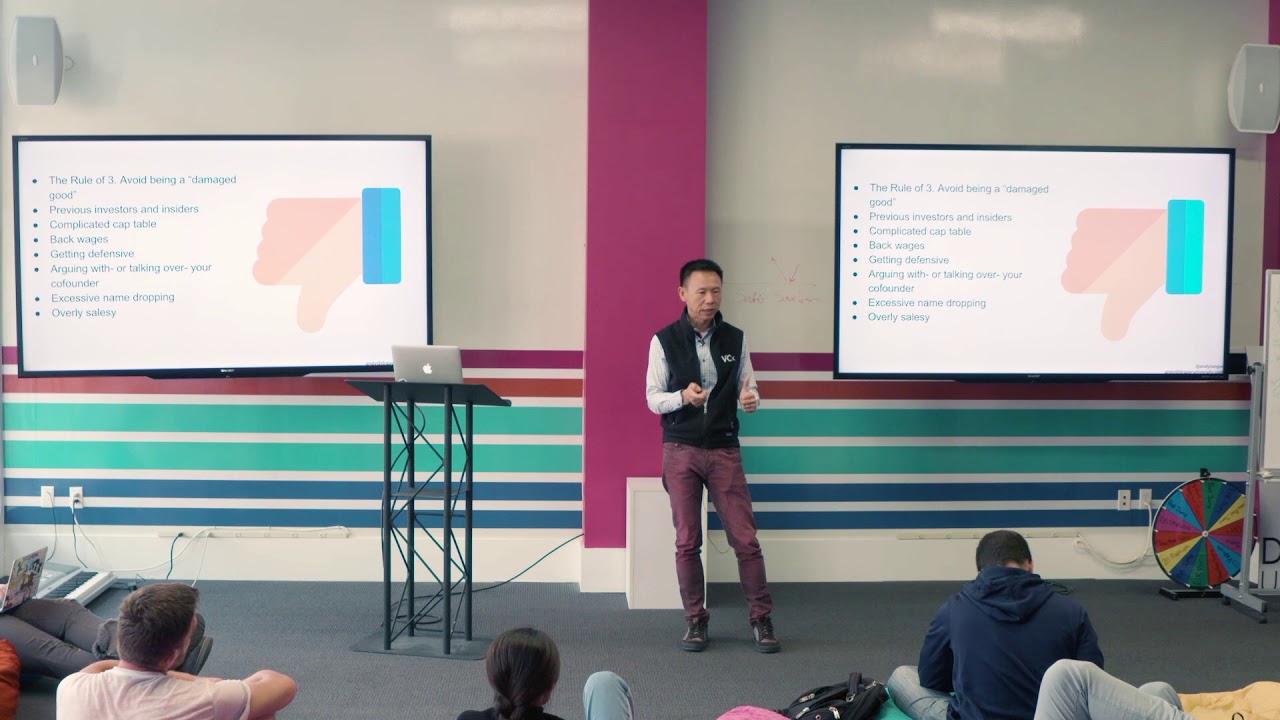
Okay, so I keep emphasizing this, money will come and you don't want to ask too often. Part of it is you don't want to become a damaged good, right? What's a damaged good? You email everybody under the sun, right? So that's why the email marketing technique is important. What you don't want is you email everyone in whole Silicon Valley, everybody knows about it, So there is an investor community, right? We often communicate, so if you sort of blanket email everybody, then I would feel like, oh, this person is just talking to everybody and they haven't been funded, what does that mean? The market must have decided this is not a good investment. Even if it's a good investment, the approach may have accidentally labeled you, caused you to become a damaged good, so you want to avoid that. That's one. 2, for whatever reason, if you fundraise and it's not successful, it's not good to continuously fundraise, right? It's better to shut it down and say we're done fundraising, right, we decided to bootstrap, even if you didn't raise money. And then you come back to the market 6 months later or a year later. Does that make sense? Yes.
Yeah?
And in fact, during that time, it gives you time to build credibility. Getting a job is building credibility, right? Working on the business and reporting back is building credibility. Yeah. We talked about not being— getting defensive, right? This is a good one. I like to back a team of at least 2 people. So one-person team, a lot of times, Has a lot of risks, right? Unless you get the perfect person that knows everything and could double-check yourself, I haven't seen one yet. So having 2 people is typically good. But here's one common thing that trips up 2 people going to a meeting. So you and I go to a meeting, right, and we start talking. I would say the market— is $5 billion and you say, oh, it's actually $4.5 billion, and I say the market is— I said the sky is blue and you said, no, the sky is oftentimes green, that's a little bit confusing for investors, right? If you say sky is green, I'm going to say— at the most I would say is sky could be green, but it may take some serious science experiment that you could probably make it green. That's probably what I would say, the most I would say. You don't want to— there is no need for you to be proven right. Definitely not the expensive— proving your co-founders wrong. You had a question?
So like if you're a single founder but if you have a very strong team of advisory board, then does that help?
Wait, we're talking about co-founders not talking on top of each other, it has nothing to do with advisors.
No, like if you're a single founder, you do not have a technical co-founder, but instead of that you have a very good advisory team, then does that help?
Yeah, it goes back to the necessary but not sufficient condition.
Right?
There's no right or wrong answer. I mean, there are plenty of— I mean, if you're Elon Musk, you don't even need a strong technical advisory team, right? It's just little things that help you increase the odds to survive the random process, right? So yeah, you could have 2 co-founders plus A strong advisory team. That would be even better. So these are orthogonal properties that— orthogonal properties that affect the end probability in independent ways. Make sense?