6 Founders, $1 Million ON THE LINE | Meet the Drapers S9: FINALE
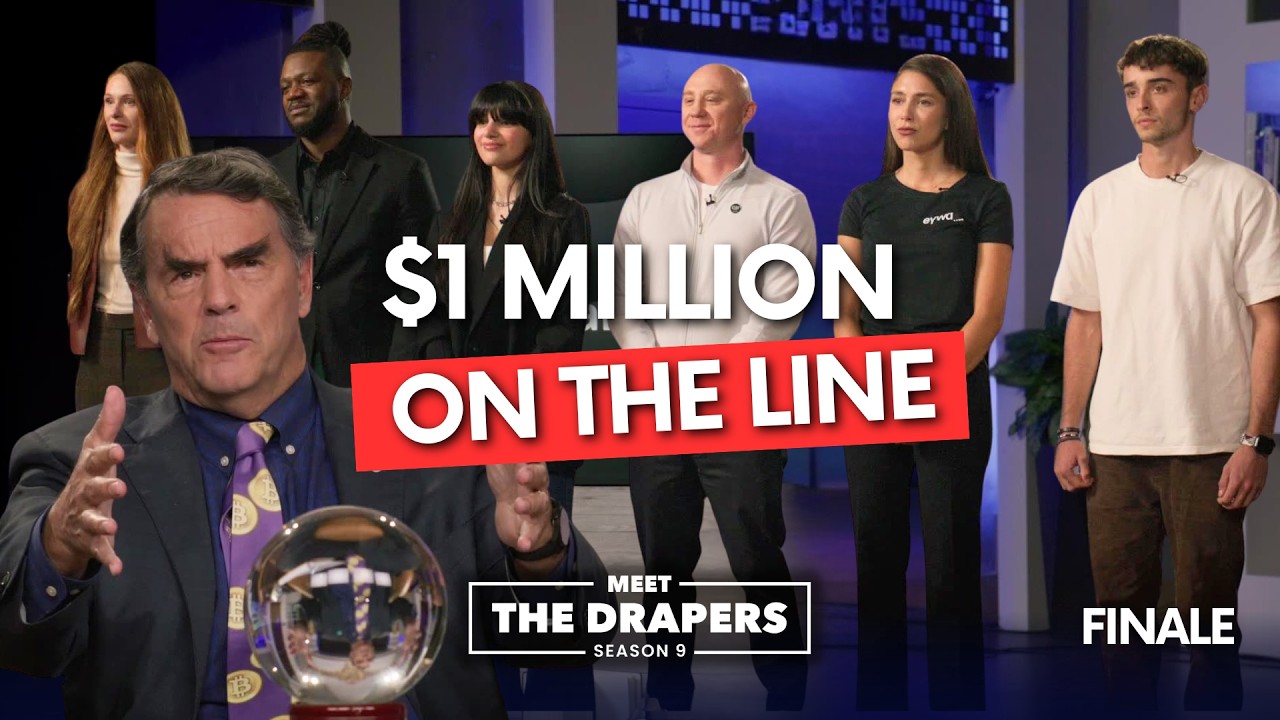
Six founders pitch Tim Draper, Adam Draper, and Rob Solomon for $1 million in this season finale. Juliette pitches menstrual-blood stem cells at Muse Bio, Jayla presents AI diagnostics at Illumicell, and Kevin demos autonomous logistics at Glide. The investors grill each founder on their tech and business model.
Chapters
If you're hugely successful, who is gonna be upset?
Today is the day, and I'll know.
The great finale.
You can tell that it's like whittled to the top.
I knew I had to bring it.
We're gonna take you through a lot of training exercises. I really want to teach you something that you can take back to your company and apply.
What is this?
You learn more in your defeats than you do in your successes.
These are really, really talented founders building really wild things.
I'm Tim Draper. I'm traveling the globe to find game-changing entrepreneurs with world-transforming ideas. Thousands applied, but only top entrepreneurs have made the cut for a chance to win an investment of $1 million. It's a journey packed with unforgettable moments.
Yeah!
Welcome everybody to Meet the Drapers, where we interview entrepreneurs. They come from all over the world and eventually come to a day like today, which is the great finale. We are so excited to be here. Are now down to these 6 entrepreneurs. I'm Tim Draper, venture capitalist. Been doing it a long time. This is Rob Solomon. Rob has been the center of every major internet revolution from Yahoo to Groupon. You were also at EA when you started your career.
Pre-internet even.
And what are you gonna be looking for here?
The best entrepreneurs, they have an unfair advantage. That's one. And then I'm looking for missionaries. In Silicon Valley, there's been a lot of mercenaries who have descended here and then all over the world. Those mercenaries never really make it. It's the missionaries who are going against the grain, who have a belief, who will bust through walls, who will do anything and everything to make it happen.
We've gotta welcome Rob Solomon Draper to the Draper family.
Cool.
Welcome to the Draper family, Rob. Good to have you.
Ah, just, wow. I always wanted a second brother.
A little older.
Just slightly older brother.
Yeah, slightly older brother. On my right, we have Adam Draper, innovator, and he was the first ever Bitcoin accelerator.
Sounds like you've been at it for 50 years almost.
And Booth started out as an accelerator and now it's a Major venture capital.
We've invested in 600 companies. We write $500K checks, and we look for the magical, the mutants, and the historic.
Ooh, I like that.
I like it.
One more thing about Adam, just so you know. He is a Draper, but his eyebrows have drooped down to below his nose. You're still part of the family.
My kids love that my eyebrows never grew in up here and only down here.
Adam, what are you gonna be looking for in these entrepreneurs?
I like they have an unfair advantage. I am always looking for, hey, Are we creating superpowered heroes who really, like, you believe that this is the only thing they could be doing?
Why don't we bring on the first entrepreneur?
Let's do it.
But before we do, let's see what's going on behind the scenes. This is where you do the eyebrows, but he can— I'll do the mustache.
The mustache.
I knew nothing. I knew we had to take, like, sport clothes, and that's it.
I was a little nervous because really outside of my wheelhouse.
Felt a bit carsick in the back.
I knew it was going to be exhausting.
I was just waiting for the fireworks to go off.
Rock rocks.
I love him. They literally work all the year training entrepreneurs.
Welcome to the farm, everyone. What we're going to do today is we're going to take you through a lot of training exercises, which should be fun. But also hard. I really want to teach you something that you can take back to your company and apply. Our expectation is for you to grow to $1 billion or more, right? So if you can't get to $1 billion, you shouldn't be here. Tim will be out here, get that extra little edge on maybe who he should invest in. So you'll be evaluated from all different angles. Work hard today. Give it everything you have. Any questions at all?
You guys have fun.
Let's do it. Let's go. All right.
We're so proud and we're so excited to be here. Lucky we live fairly close so we could pop in. Very excited.
Can't miss a big day like this. And she's kind of like, go get it.
We are Muse Bio. and we use menstrual blood stem cells to make better drugs and therapies. When I was 23, I was immobilized by a severe spine injury, and it's left me with chronic pain that I have to manage daily. But I have some amazing news, which is that between the first pitch of Meet the Drapers and this finale, my team and I have literally built the platform that will allow me to treat myself And millions of others. And let me tell you how we're going to do that. Women release millions of stem cells every month when they menstruate, and these cells are superior to all other stem cell sources. They heal without scarring, and they grow twice as fast as any other stem cell. And that makes them the best fit for regenerative medicine at scale. And that is exactly what we're doing. So the Muse Bio platform. One source, menstrual blood. Many solutions. We've got ingredients, products, and clinical therapies. So we've set up the donor collection sites. We've set up the lab and stem cell bank. We've set up the donor community. And we even have a product that is making money now. The skincare manufacturers want our menstrual rejuvenating powers. And so we are able to fund our R&D while making people look young and beautiful.
How many more stem cells did you say it was than ordinary blood?
So a rough calculation is that there are 300,000 to 600,000 times more stem cells that can be from menstrual blood than from the blood in your veins.
Okay, what business population or politician would be upset by what you do? And what might you be up against?
There's been a whole pushback against stem cells because there's this notion that you need to have an abortion. It comes from fetuses, it comes from, like, embryos, and we don't need to do that anymore. We can get it straight from the source. No ethical barriers.
Women have been having menstrual blood for a long time.
Yeah.
Been around for a while.
And so, like, what kept us from actually using the stem cells in order to make skin?
The world wasn't ready for at-home medicine or this concept that there's so much more to our bodies than, than like what we previously knew. And I think we're really in the right moment where people are ready. Plus, social stigma has changed a lot. In the US, we really have a lot of potential to continue to rewrite that narrative because it's a topic that's not spoken about often.
And when you think about your business, you're really building 2 companies, the aesthetics and the therapeutics. How do you think about running both? 2 companies at the same time? And which do you really want to pursue in the biggest way? Is it aesthetics or is it therapeutics, or do you really think you can do both?
When this aesthetics explodes, we're going to hire someone who's going to lead that, that that's their passion. This will continue to feed into the therapeutics, and that is where our team is hyper-focused. And it looks like within the next couple of years, we can have a therapeutic on the market in people, and it opens doors to everything else.
All right, Juliette, thanks so much for coming to Meet the Drapers. Thank you.
Thank you. Great to see you.
Well done.
I think nailing a 2-minute pitch is a huge challenge. You want to include all the details that feel important, but you can only include, like, 1% of them. I don't know.
I felt like a lot of progress has been made. Focus is starting to be had, and they're gonna gather up all these stem cells, and then you don't know where they're gonna be used. They're just gonna be used to create new amazing possibilities. And that's exciting.
Yeah.
Can she actually do therapeutics and aesthetics? Should she choose one and then sequence it to go to the other? I'd be a little bit skeptical of doing both simultaneously because startups are so hard. Everything's stacked up against you. Trying to do 2 startups at once is challenging. But if one feeds the other and you sequence it properly, it's, it's kind of brilliant.
All right. With that, let's bring on the next entrepreneur. But before we do, let's see what's going on behind the scenes.
Today, our first activity is going to be paintball. Our lead instructor is Ryan, getting you trained up. He's been national champion, world champion.
And when we get into these situations that are very high pressure and very high paced, you can step back and be like, what were you thinking at this moment? Why'd you do this? A lot of times in business, it takes a long time to figure that out. And that's what's great about paintball. It's kind of like high-speed chess with guns. So just like any game, there's a board. We're gonna take the red team inside now. My shooters, listen up. This is your bomb, so you guys cannot touch it or move it, but you have to defend it. They don't know where the bomb is. They only have a general idea of what it even looks like, and we'll see how well they communicate that.
We know where they're coming out from.
Someone's gonna be like here. I will stand it.
I will. If they come from inside, cuckoo. If they come from outside, caca.
You think we should do the whole circle the thing? We go from different sides.
I think so.
So we send Nick first.
Circle the wagon.
And we're gonna send the bait, so we're gonna check if that hiding spot is still working.
I like it. Goggles on, barrel covers off. Kevin, come with me real quick. Inside is a terrorist group. They have a small bomb in there. You gotta find it. Once you grab it, we'll deactivate it. It looks like this, and it's blue.
3, 2, 1, go, go, go, go, go!
8 minutes!
So if you see a blue, a blue bomb, we have to grab it and take it out. Oh, thank you.
Go around.
There goes the bait.
I don't think it should come from here.
Yeah, there's someone inside.
Careful.
Yo, you hit on your loader.
Come on out.
I got me, man.
We got Jayla and Kevin.
It is inside.
Sorry.
Camera van.
Fuck! All right, now they're both dead. That's game over.
I mean, major adrenaline rush for sure.
You lost very convincingly.
Yes.
You guys tried to at least kind of like break out a little bit, but the defense was significantly better in the aspect where they're like, well, we know they have to go to these areas.
You learn more in your defeats than you do in your successes.
We gave Kevin a vital piece of information, that there's a blue bomb. Did you stop everything?
No.
And collect? Okay, so you had 8 minutes. As you're walking down, he's telling you all, blue bomb, blue bomb, and they're getting distracted.
Yeah.
And they're about to go into a firefight.
Yeah.
You can stop, collect everyone, make sure everyone knows about it. You can change your plan.
Having the time to re-strategize when you learn something new is really important.
Planning ahead, but also being adaptable and be able to understand which is the best team play.
Anytime that I'm on a stage, of course you're a competitor, you want to compete, but when you're in a crowd with People that you love and adore for, you know, them being brave enough to take on something as hard and as audacious as being a founder in a startup, you know, you're rooting for them as well. We're Glide. We're the world's first autonomous road-to-rail solution. I've been in logistics for about 25 years. I started my career off in the US Army, and then one thing that I saw across the entire line was logistics was broken. We had road that is extremely congested, rail severely underutilized, and the process that bridges the gap It's broken. On top of it, it takes about 2 to 6 weeks for a fully loaded train to depart from its point of embarkation, and they charge you for it. The first-mile logistics costs for about 75% of total landed costs, and we're here to fix it today. What we've come up with is a core technology where we have one vehicle, one move, one person, no people at all. We've developed a gliderverse, what we call it, where we have the vehicle at the top is called Raiden. is our fully autonomous vehicle with remote capabilities for human-in-the-loop for defense as well as industrial parks where compliance isn't really a big deal. You're low on staff, you're low on people, but you want to get the job done, and I'll show you exactly what it looks like. What you see on the screen here is Azure 1Six. This is our AI orchestration tool, and it— you're able to input your logistical load and then control the vehicle from the safety of where you are. Raiden has the ability to get underneath any road-based trailer. Any rail-based cart with little to no modification. We utilize infrastructure that is there in place today, so no new infrastructure needed. And then we have the only patent in the world. One of the things about rail is there's a lot of derailments, so we're able to look and do inspection while it's on it. But as you see, we're able to get it, get underneath a 20-foot container, pick it up ourselves.
Once they see this up and operating and it's starting to make money, they're going to compete and they'll be like Big businesses with big money. How do you feel like you can compete with them? And is it just the patent, or are you feeling like, hey, just this first mover advantage might be something else?
Yeah, I feel it's a combination of both. The patent gets you across the line so you can have some, uh, some, some technical, uh, moat on it. But the next one is we're the first ones to actually do it.
Where is it best used, and how are you thinking about developing the Absolutely.
So my answer to that is everywhere, always, all the time.
Okay.
Everywhere, always, all the time.
It sounds like this is something that is so obvious that should have happened 20, 30 years ago, 40 years ago, 50 years ago, because I think I get a sense of who you're helping, but who's going to really be pissed off when you're doing this everywhere?
Yeah, I didn't finish my whole pitch. I got past the video and then to the You know, dual-use slide, and it was like a stop. We will get some pushback in the beginning from unionized ports or unionized railroads, but the great thing about it, there's part union and then there's part non-union.
Why is it so much cheaper to go by rail than to go by the roads? Is it more friction?
When you're on the road, you're dealing with disparate materials, so you have a rubber road to a rock or asphalt or dirt. So you have to generate a lot more force to move that mass. Whereas on rails, you propel based on metal to metal. So you have no friction in between it.
Terrific. Thank you, Kevin, the MOAB for the ride. Thank you, Kevin.
That was great.
I appreciate you, Kevin.
Some folks, you have to demonstrate to them that the new way of doing things is better for your longevity because that's the way the world has evolved.
The unions are hard to bust. If they don't want to use this system, they will not use this system. So he has to figure out a way to play nice with the with the unions at the ports and everywhere else that they exist.
Everything Everywhere All at Once always makes me think, okay, let's just get one thing from one place to another place. This is like if you had $1 trillion and you actually wanted to upend the entire system and rebuild it from the ground up. I love it. I think it's an incredible vision.
I think one of the big issues is radical prioritization. You know, they all are—
Yes.
They all are trying to either boil the ocean or build a space shuttle or solve everywhere, always, all the time. And if they don't focus, they'll die. Big vision is important, but then bringing it down to saying no to everything except the— to your point, you know, what should they choose and how should they execute and how should they prove it?
Dude, radical prioritization. Rob, he's got the— this is— I'm taking notes, man.
Let's bring on our next entrepreneur. But before we do, let's see what's going on behind the scenes.
Welcome to the next exercise, guns. How to shoot a gun safely. We'll start you off on rifles, which is what I consider the safest way to learn how to shoot. And then after that, we'll go to pistols. I love bringing you out to the range. When you're shooting a firearm, you got to control your breathing. You have to control all these different biomechanics.
I've never shot a paintball gun or shot a regular gun.
I've shot before. I've never shot pistol.
First time I ever learned how to meditate was when I was shooting a long rifle, and I didn't know it at the time, but they were teaching me, hey, control your breath.
In Canada, we're allowed to shoot large firearms, so I did shoot a .22 before, but I've never been able to shoot a handgun. That was pretty sweet.
You just need to pause and set it.
Being focused and being aware of our breathing.
They're small devices that can hurt people very badly and kill people. That's a lot of power to wield casually.
The instructor said something really important that it kept resonating in my mind. Fast is slow. As low as fast.
So you're low again.
There it is.
I see what you mean.
Good hit.
Whoa.
That's what I'm talking about.
We're gonna go head-to-head in a shooting competition and figure out who the top shooter is. The rules are simple. One side will be red, the other side will be white. If you flip all the targets over, the competition's over. You have 10 rounds. Once you get done with your 10 rounds, You're done.
When we saw boys versus girls, okay, easy.
Shooters, stand by. Shoot! Victoria was amazing.
That we went to handguns, I was like, we're out. Is that my strong suit?
Score is girls one, boys zero.
Woo!
Woo!
Woo!
The fuck?
No!
Come on, Juliette! Go down.
Oh shit!
Yes, yes girl! Yes girl!
I wasn't a bad shot, apparently.
The ladies, they catch on to things fast. Someone gives you a configuration or a blueprint, you read it and you digest it and you apply it. That's what I saw from Vicki and Juliette.
I'm normally keen to doing things fast, fast, fast, but sometimes actually like going a little bit slower and you will hit the target.
So I was pretty confident about the pitch. Definitely nervous, but also excited compared to last time when I was like, it could go any way. In the last 200 years, we've relied on microscopes for medical diagnostics. But here's the thing, microscopes were designed for the human eye. But to this day, lab testing is manual, subjective, and represents massive inefficiencies in the healthcare system. Illumicell AI transforms imaging into machine-readable data. Our holographic system captures cells in 3D, and our AI transfers those scans into machine-readable data and biological signals. We collect 60 times more data points, we do it 50 times faster and 20 times cheaper than a standard microscope. And we've already validated this in our first application in semen analysis. We've trained our AI on 400,000 data points over clinical trials and pilots, and we're achieving 99.6% accuracy in testing. At its core, Illumicell AI can analyze cells in any fluids. That's semen, urine, that's blood for immuno-oncology and autoimmune diseases. We're even discussing menstrual blood with Juliette right now. And each scan we do represents new data, and over time, that data compounds into a massive dataset, a platform that can power new diagnostics, new devices, new research, drug discovery and development platforms, and so much more.
If you're hugely successful, who is going to be upset?
As we started traveling, going to conferences, and actually speaking to doctors and investors in those countries like Saudi Arabia, Morocco, We discovered that it's a huge problem that they also want to solve. And, you know, the taboo is kind of going away. More and more people are talking about male health and what fertility means for male health. Most go into business thinking, I'll have the best tech, I'll make people's lives better. And they don't realize that there's actually so much more to it. Fertility issue overall, it's an economic issue and you don't want to let that happen. Are you selling equipment?
Are you selling data? Are you selling services? Are you doing all of it?
So what we're selling at first, we're selling to clinics, doctors, labs. We will be selling the equipment itself. So that's our imaging module that is capturing the data. There will be subscription to our AI and there will also be consumables. So we have to put the fluid in a consumable and put it into our machine for analysis.
What's your first customer and what are they doing with it?
We have a waitlist of urologists and clinics that have actually filled out our round. It was 70% our future customers. They would buy our imaging module, they would subscribe to our software and get our consumables.
Do they get the microscope too?
Yeah. So it's a, it's kind of like an espresso machine. It's really tiny. We've already installed it in several medical centers in the United States. And people love that it's so small that they don't need to really think about extra space.
This is a razor and blade model then. You are getting the machine installed and then your annuity is forever as long as that machine is there.
Yeah, exactly. And there is also the software subscription and we get the data and data is eventually our moat.
Well, Jayla, thanks so much for coming.
Thank you.
Being on the show, making it through survival.
Terrific.
Good job.
I like the razor and blades. That's yeah, it's the ultimate model if you get if you can really deliver on it. Yeah, big annuity forever.
Yeah, I mean all I wrote down was does it work? And then can you make ten of them? And then can you sell a hundred of them? And like she made it sound like they have these in a couple places. I didn't quite yeah, the LOIs are interesting.
Just converting them is the big. The big opportunity, the big challenge.
Yeah. This is the move. Like, this is what medicine's coming to you, right? Like, that's gonna start happening and that's exciting.
Isn't it amazing?
Oh man, these are fantastic.
Hey, meet the Drapers, baby. This thing's working.
You can tell that it's like whittled to the top. These are really, really talented founders building really wild things. It's great.
Living in the future.
Great.
Okay, with that, let's bring on our next entrepreneur. But before we do, let's see what's going on behind the scenes.
Is that him?
Oh my God, it's him! I was worried about the cold plunge, like literally thinking about the cold plunge the whole morning.
When Tim shows up, he always brings this energy, and then we went straight to the cold bath.
I think what saved me from panicking was that I had never done that before.
Found you now!
Can you dance?
Okay.
Wait, your name?
My name is Victoria Costa Paz.
Victoria, so nice to meet you.
Nice to meet you too.
Welcome. Tell me what you do.
Clinical-grade psychedelics for mental health, for depression.
Before you got in here?
I wish, I wish.
Once I was in there talking, it was like I forgot that I was in the ice water. And then when it was— when I was done, I was like, oh man, I'm still in the ice water.
Am I going slowly enough? Okay, you're shooting.
Give me your—
it's my first time.
So I went, just hang in there, just hang in there.
And what saved me was literally when it was my turn to pitch.
It is really nice of you to come by my office. Heads down, 1, 2, 3.
I wasn't as afraid as the girls. I suppose it's because I didn't know how that feels.
Like Tim sitting in there just like chilling, you know, like he was sitting In the sauna, puts you in a warm mood.
Tell me about your business. I might ask a few questions. We'll see how it goes.
So yeah, I'm Franco.
Franco.
It was like, what the fuck is this? Algorithms that are detecting fires hours faster than NASA.
Do it, Frank.
Tim's ability to withstand a cold bath, impressive at his age. He didn't seem to have any problem in his office. We are the world's first company to develop a high-throughput drug miniaturized and automated laboratory.
My body hit that water, man, it was cold. But once I was in it, this is where I'm supposed to be at.
You've been in here long enough? Have you been— you doing fine?
Yeah.
Okay.
Let's just sit here for a while. Yeah, it feels pretty good.
I think it opened up something new for me.
It was a mind game, like Victoria versus Victoria. I experienced a lot of emotions. I don't know how many minutes it was, but I think the conclusion is everything is in your mind, and you can definitely control your mind. Oof.
My time to shine and my time to show what my team has done was today, and that's where I knew I had to bring it. My name is Kyle Escherno, and our mission at ExoBiosphere is to extend and improve health on Earth and also in space. And we do that by finding cures in space. Brain cancer, blood cancer, breast cancer, Colon cancer, metastatic cancer, ALS, Parkinson's, Alzheimer's, heart disease, the most debilitating and destructive diseases on Earth can be cured in space. In space, cells form into 3D structures, which are much more physiologically accurate ways to study disease progression and therapeutic response. Currently, the technology is stuck in the past. On the International Space Station, astronauts are pivoting by hand or using static systems which can only conduct dozens of tests. And that was the genesis of ExoBiosphere. We started with 3 fundamental constraints: the size, the functionality, and we had to ensure that it would be standardized. And for the first time today, gentlemen, I'm happy to show you that our prototype is ready. Here you see the system where you insert the cells into our laboratory. Inside of the laboratory, you have robotic arms that are removing these standardized well plates and putting them inside of our microfluidics dispenser. The robotic arm takes the, uh, well plates and puts it back into the system. You can see we have 6 plates, which allows us to do up to 2,000 tests. This is 100 times more than what has ever been possible before. And finally, while we do intend to allow other people to use the platform, our intention is to do our own longevity-based missions so we can develop our own AI-based space models and bring more cures to people on Earth and eventually in space.
If you can grow a cancer super fast in space, then how is that going to help us Solve cancer.
What our customers are paying us for is for the entire turnkey service. So they provide us with their cells and the drugs they want to test. We ship it up to space, we conduct the tests, and then we bring back that data and their cells and give it back to them.
Like, we don't have this on Earth, so like, why do space?
It's a great question. And in fact, as we were advertising this platform in space, One of our potential customers asked to buy the terrestrial unit, and we made a sale. You know, this microfluidic system does exist. We bought it off the shelf, but never has anyone miniaturized this and put it into a system about the size of a microwave. So we have terrestrial sales already.
How do you compare to other people fighting to get on the spaceships to get up there into the space stations? You have to have a very valuable Payloaded in order to get the spot.
Rob was awesome.
It was clear that he was really interested in our technology. I felt like he was going to approach it maybe with a bit of a more commercial hat on. There is no system like this that can conduct the throughput. We're talking about thousands of tests that are being conducted. This is just the beginning of something extremely exciting.
Kyle, thanks so much for being on the show.
Thanks a lot, Tim.
Great to see you.
Thanks for coming.
We as a species know very, very little about what is happening biologically in our bodies.
Wow, I'm blown away. The 100 times thing is remarkable, but the 3D, the cells converting to 3D, I never knew that. And that, I think, creates incredible opportunities to understand and study them at a much deeper level. So he's onto something that makes a lot of sense.
Pharma is trying to do experiments in space. That is true. And we haven't been able to do many because you have to go up to the ISS.
You—
they do have to pipette, which is like a ridiculous thing in space, man. Imagine being a scientist and just being like, okay, this thing is— there's a little fluid and then it just like floats off.
That's right.
That's basically their job is just like, I'm a scientist doing— well, not again, you know? And Like, they're trying to digitize. We're trying to get closer to digitization of all this, and we need, we need data to be able to digitize. So.
With that, let's bring on our next entrepreneur. But before we do, let's see what's going on behind the scenes. Finalists, this is your next challenge. We're breaking you into 2 teams. Your goal is to build a boat and get all 3 of you across To the other side of the lake, you've got to get out of the boat, get back on the boat, and come back. You will get points for being dry and first one back. Go to it!
So I've done Build-A-Boat before. The best strategy is like one arrives totally dry, the other ones are going to swim super fast.
The guys, you know, they look to me to lead. The mechanical engineer on the team, the person that built vehicles. I never built boats.
We had a plan of putting like 3 barrels and attach them with ropes and with tape.
A passenger in the middle and then 2 paddlers. Yeah.
Kevin could tie super good knots. I thought we were building a pretty solid boat.
We were very quick and dirty about it.
Sweating, like building, and I was pulling ropes and tying knots.
I loved our boat. It was amazing.
Okay, bring it up.
Okay, I need all 6 of you here. Never done this before. You 3, You 3 get that boat. And you 3 get that boat.
The nail in the coffin.
It felt very Tim.
No fucking way we are gonna do this.
I was instantly alarmed because the boat is so small.
No idea of their vision of how this was gonna work, and it was not apparent.
We didn't understand how they planned to row that boat.
The oars were too short.
You got 5 minutes.
It was not that easy to be on the same page, you know?
Good entertainment here.
Collectively, we probably weigh over 300 kilograms. It was going to be a lot to put on that little stumpy boat.
We had the great idea of doing the boat again, and I think that was the worst decision.
Plan B.
Two, one, the race begins!
Okay, now.
You know, the guys went into the water. We panicked a bit, and that panic really reflected on the team. dynamic. Victoria was suddenly like, we have to go! Juliette was like, no, we just have to have good design before we go in.
Yeah, we're a struggle bus. We look like 3 big elephants trying to get on a— in a clown car, man.
The 3 of us will sink the boat.
The good thing was that Franco is very light.
I do surfing. It wasn't as hard as for my teammates.
Get on, the rest of us, we're gonna power through it.
If we didn't have more tape, we We were in a rush. When we tried to put the boat inside the water, the pipes started filling with water, the ropes started getting too loose, the parts were not well attached. We didn't have any boat.
You need to just like simplify, simplify, simplify.
We have 2 challenges here. One is to cross the lake, and the second one was staying dry.
We need to focus on the real goal, which is get to the other side, get back.
We have speed as our advantage.
Like, the swim, like, halfway was like, okay, no problem. And then when you reach the other side, you're like, you know, I gotta swim back.
This is a long lake.
The swim itself was, was pretty terrible. Not only did we have to stabilize the entire boat, we also had to pull it.
I was like, I really want to help my team. Definitely I cannot It is further than it looks.
Thank you. Thank you. We made it.
Some water earlier. Man, I think it was a valuable lesson. Being an entrepreneur, you depend a lot on third parties.
Sometimes science doesn't go as We took on the challenge super quickly. It was like, okay, let's do this, do the best out of it.
It's just important to understand what you're willing to give up and what for.
Expect the unexpected. Sometimes your environment changes, sometimes the tools you have change. You have to be prepared to adapt quickly.
Be okay to let go of parts that maybe you were attached to initially.
We have to be able to pivot under duress. We have to be able to Shift the mission and still execute. We had to get across, right, with at least a dry person, and it was a mission fulfilled, I feel.
Viewers, usually I'm pretty easy to reach. I mean, there are only 300 million of you. I'm making it a lot easier for you to contact me. I have downloaded my brain into this digital twin, and you can scan this QR code. You can pitch me your idea. You can talk about your business, anything, and I'll answer it 24/7. Enjoy it. It's great. It's a new feature of Meet the Drapers and Draper TV. I think you're gonna have some fun.
I enjoyed a lot giving the pitch. I practiced it so much. I was super nervous. It's really difficult to explain what a psychedelic experience is if you haven't been through one, right? Psilocybin is here to change the game in one dose, generating neuroplasticity and generating that deep reset on your brain. We're not just manufacturing a drug. We are engineering microorganisms with biotech in order to produce high-scale psilocybin at precise doses and cost efficiency. But just a molecule won't change the system, right? That's why we created Wisellio, our dual-sided platform for therapists, psychiatrists, and patients to track the treatment throughout all the year. This is how we generate data. This is our digital sales representations, and this is how we generate better treatments for the future. Today, Big Pharma is winning with capital. Tomorrow, we are winning with biotech, with data, and with AI in our favor. In the semifinals, we just had lab-scale psilocybin. Now we have 2 industrial batches of psilocybin, purified psilocybin, our own process patent, and we also have a clear pathway in Australia with a clear client. The only thing we need is to have pharmaceutical-grade industrial psilocybin. And to go from industrial to pharmaceutical-grade psilocybin, we need $1.5 million. That is getting us to traction. That's why at Eiwa, we don't replicate the world as it is today. We are designing the world as it will be. Thank you.
If someone's investing in you, they're betting on psilocybin. They're not necessarily— your application of it is definitely for mental health, but are there other use cases of psilocybin?
We're not just producing psilocybin, we're also producing 5-MeO-DMT, DMT, and bufotenin. The difference is how much time do they last in the person and their plasticity profile. We're also seeing different indications, for example, eating disorders, addiction to alcohol, tobacco, opioids. I think that this is just the tip of the iceberg. By the moment of the questions, I got I was super nervous. I was like, I want this to end. I want this to end. Like, just gimme the million and let me go home.
It sounds like you have a much more efficacious product. What are you doing differently than everyone else in terms of getting to that purity, to that pharmaceutical grade that is different than the others who are out there peddling something that might not be pure or might be even dangerous and not understood well?
So basically what you can get today in the different states where this is decriminalized Psilocybin is mushroom, but when you have 3 grams of mushroom, for example, you don't know exactly how much psilocybin that has in. And that is what is making it difficult to get to a market and to do clinical trials because you need the doses to be the same. You need replicability. And that's where we're fixing with biotechnology. That's our differential.
What does the trip feel like and how long does it last before you can be human again?
Okay, so a normal treatment with a macrodose, which is 25 milligrams of psilocybin for treatment-resistant depression, let's say, would be like 6 months long. So first you have preparation. You start having your sessions with your therapist and psychiatrist. He tries to understand you. They get you ready for the day of the dose. Then the day of the dose, you're around 4 to 8 hours with a professional. that is guiding you throughout your psychedelic trip. And afterwards, you have around 3 months of integration where you're talking about what happened in the trip, what's next for me, how are— how I'm going to improve.
Magic mushrooms.
Magic mushrooms. This is fantastic.
Perfect. All right, Victoria, great to have you on the show.
Thank you.
You're terrific.
Now having industrial-scale psilocybin, it's like a huge milestone.
One great thing about this season of Meet the Drapers is like being able to track the progress. Her progress is insane. That was way farther along than I thought she would've been at this point. Yeah.
And I think the mental health crisis doesn't go away. I think it just changes. And the medicinal approaches in the past have been very debilitating. This new frontier is so exciting.
Yeah, from what I've heard, this is like a cure for PTSD.
And anxiety and many things.
No, I hear it makes you better looking also.
Well, it makes you think you're better looking. It makes you think you're better looking.
Confidence boosting.
It's like they used to call that beer goggles. All right, with that, let's bring on our next entrepreneur. But before we do, let's see what's going on. Behind the scenes. It's over there. Entrepreneurs, are you ready for your next challenge?
Yeah!
This is 27 Stones. This is an exhibition from Burning Man that somehow teleported to this place right here where you can go around the 27 stones. My recommendation, go fast. Who wants to go first?
I can go.
Leaders go first. Alright, Victoria.
Why is it 27?
It's a magic number.
It always looks easy when you see it from the first stone. When you get to the middle, you're like, hmm, okay, let's continue. Oh my gosh.
Oh no.
Nice.
She makes it look easy.
Yeah, I've never seen anything like it. You feel like you're levitating.
Go for the record, Franco!
I am usually afraid of heights. We as entrepreneurs have some willingness to overcome fears.
That was pretty good.
Seeing it in real life, it did make me feel something.
The view from the top is incredible, and you can feel the wind.
It goes against nature, like rocks floating in the air. And at the end, like climbing up with everyone else, and then I got to be at the top. I mean, it's just awe-inspiring.
Our thinking in 27 Stones was one of overcome whatever fear Fears you have. Fear is the mind killer, Frank Herbert. And if you can overcome, like if heights are your fear, if water is your fear, cold water, you gotta be able to overcome all your fears so that you can charge up the hill no matter what. As an entrepreneur, there are gonna be times where you feel like you were up there, like there's nothing below me, but I'm just gonna go.
I had my pitch nailed better than in the semifinal. I had practiced it much more in that time, so I was pretty confident that the pitch would go smooth. So in 2020, I had family friends lost their homes to wildfires. I learned that the organizations responsible for protecting the land Only found out because people called 911 in remote areas. So we built a platform that analyzes more than 10 satellites every 5 minutes with our proprietary AI algorithms that are detecting fires hours faster than NASA, alerting response teams immediately, and showing them how the fire will spread. Today, we operate in 21 countries, maintain 100% retention rate, 9.6 of NPS across. 33 paying customers, have supported the response for more than 600 wildfires last year, and we are the main partners for Aon, the world's largest insurer. And every competitor in the industry is hardware-based. They rely on their own satellite sensors or cameras, which is of course slow, expensive, and hard to scale. And that's why we built the first software-based platform where we enhance all of those technologies through our AI So we detect fires faster than companies launching satellites for the same purpose while scaling globally with extremely low operational costs. And we are funded by MIT, the United Nations, Cornell, Techstars, the founder of Reddit, Alexis Ohanian, and Draper Cygnus VC. We will evolve from a fire alert system to the leading fire intelligence platform of Latin America while expanding into the US market within 18 months. We plan to reach $3.5 million in ARR, positioning us for a Series A focused on integrating drones to put out fires immediately so we can solve this problem globally. Thank you.
Terrific. You've raised $2.7 to date, right?
Yeah.
And what have you done with that?
So 1.5 years ago, we raised $900K. We were just 3 technical co-founders of 19 years old, and now we have validated the commercial model. With 85% of gross margin, 1.5x of return on investment per sales representative, and 8 of LTV CAC.
So who's your biggest customer and what are they using it for?
Now, for example, we have a timber company in Argentina that basically relies on ground patrolling, people like going over the area and looking for wildfires, literally. And they basically now receive early alerts through satellites to their WhatsApp channels. So they can act in time and save losses. And they have reduced to 50% their force in the field.
How much real-time is it? Every 5 minutes, 10 minutes?
We have every 5 minutes new information. For example, in San Bernardino County, they do the monitoring of the fires every 2 hours with drones. With our system, they can have every 5 minutes information on the fire's evolution.
Do you have a pricing opportunity or pricing challenge? So I see that you have 33 customers. But the revenue is only $230,000. What's the opportunity here? It seems like you might be undercharging. Is that true?
Our strategy is starting low with the satellite detection system because it's plug and play, it's low cost, and it has high impact. But then keep increasing the ticket by selling them the monitoring product, then integrating their cameras, integrating their drones. And once we have all their fire protection in our platform, we have huge entry barriers, and also personalized reports to optimize their fire protection strategies. So this, every stage is an upselling for us.
Can you still do a backflip? You don't need to do it.
It's my second time with Adam. I think he's great. I knew he was gonna ask for a backflip. I have been practicing, but my legs are dead after survival.
Sore, man.
I am really super sorry. I practiced in the room. But that didn't went well after survival.
That is a great answer.
Isn't that great? Okay, Franco, thanks so much for coming, being on the show.
Thanks, Tim.
Good to see you.
You're a true survivor.
Good job.
The main point of having Tim is having his name and his advice and his contacts, not just the money itself.
The insurance companies have to love this, and they'll love it more and more as he gets better and better at detecting early.
Yeah, they might start insuring houses again.
Absolutely. Yeah.
All the insurers left California. Like, if he figures out how to insure fires, like, for— you start at high-end houses or commercial and you go down. I think that it works. I think it's a business. I think it's a great business. I think it's more like figure out what— like, Franco's got unlimited potential. This guy is a monster. Get upside in Franco is a good model of like a fund.
Hiking with Tim was super special.
The whole setting, it was gorgeous.
Besides getting to be in nature, we got to like talk with Tim and like have more than a few moments with him.
Along the way, Tim stopped to share some pieces of advice. The fact that he's taking this time and share some of the things that he's learned in his life and with his companies, I was just really moved by that.
He gave a story about a tree. He said the tree fell down and then it shot up and came back a certain way. Life says, hey, go ahead and lay down, but it's our job to find another way to reach the light to continue on growing.
Like how entrepreneurs should adapt to life.
It sparked in my mind like what It's nature for me, what feels natural to me.
And having beautiful terrain, it's about how we feel and what we do. That is real wealth.
We do meditation and yoga because as an entrepreneur, you get very— you're placed in stressful positions. 2 ways you can combat that stress very quickly, one is yoga and the other is meditation. I do this every morning. I do it 3 times. We're just going to do it one.
There's a couple of tribes in North America that say breathing through the mouth is like poison and breathing through the nose will make you beautiful.
Put the mind, the body at a place of peace.
Not being mindful, not being focused, it really, really takes a toll. And it's an asset that is worth protecting.
Well, at the beginning of the day, I said I'm out here evaluating and Tim's out here evaluating. There's gonna be a third evaluation. What we're gonna ask each one of you to do, write down 1, 2, 3, 4, 5, the founder you would want to create a company with.
Uh-huh.
We're gonna rank everyone here 1 to 5. The one that everyone says, hey, this is an awesome co-founder.
This is crazy. Almost all of you were a first pick for somebody.
Oh my gosh.
The variability was very small, from 11 to 17. That was the range. But our winner is Franco.
All right.
Did you think you were gonna win? No.
No.
Where?
So proud of him. Franco is one of those entrepreneurs I know and I'm friends with. I wasn't surprised. Go Argentinians!
A lot of gratitude for all of them.
Every contestant from this season, I really adore.
It filled me with gratitude and confidence in myself.
It's time to dance, baby!
Woo!
Come on, Franco, you can dance better than that. So, I have a couple of questions for all of you, and these are more specific to your deal.
Ooh.
MuseBio, you're trying to raise $6 million. How does that look?
Maybe $4 million is soft circled at this moment. You know, it's pretty good moment for anyone else to join in.
Hypothetically, with the money, what would you be able to accomplish?
This would get us through phase one clinical trials in Australia. That means faster efficacy data and safety data. We could self-fund ourselves slowly, but with six million, we can get this done fast.
Kevin with Glide. We've already come in twice, right?
Yes.
Your hurdle is higher. I've seen the thing, but I sort of feel like by now it should be working. What's the holdup?
It's working. We're deploying. We have active pilots. For the GlideRM, our biggest thing is to ensure that the technology works to plan because, you know, one miss, 80,000-pound load, and that's a big problem.
Glide or tranq?
Ah, yeah, I know, I know. You know, we're gliders, AKA Trinx. Maybe we'll do a product called the Trinx.
How about Glanks?
I don't know, that's maybe the worst of both.
Or Tribe.
And Jayla, you've raised $2 million on $35 already.
Oh, we're raising it right now as a bridge round. We've already raised $3.2 million. On the fertility side, we started discussions with a major laboratory in the United States for a volume of $300,000.
Kyle, I thought you had $30 million non-equity money. Now I'm seeing it's $5 million.
So we have grants and contracts. Collectively, it's $8 million, and we've raised $3 million.
The last round was at $20 million?
That's correct.
Cedar Sinai?
Yes, sir.
Iowa, we're in, in your deal. You've taken in $4 million. What was the last round?
The last valuation was $12 million.
You need to get to $1.5.
Just $1.5.
If you don't get to $1.5, then what happens?
I'll be slower. We don't want to be slow.
So, so everyone thinks money means speed.
It doesn't work that way. There is a natural pace to an entrepreneur. Piles and piles of money only speed it up incrementally, and they actually create more problems.
Raise it and pretend you only have half is what my dad's saying.
But I like at least they're dedicated to do it whether they get the money or not. Satellites, you've taken in how much so far?
$2.7 now. It was $900K the pre-seed and $1.8 now.
Oh, you already have it?
No, it's in the bank. This would be the second close potentially with you and with other US investors.
Speed round. When will you get to $25 million in revenue? Left to right.
Great question.
In the next couple of years.
By Q2 next year.
2029.
2027.
4 years.
2028.
When will you get to 20?
Who's number 1? Who's number 2? Who's number 3?
First off, you're all really impressive. I think upside, just broadly, you guys are all going to have pretty good upside. You guys should Swap equity or something. Juliet, you're my number 1. We did invest, but whatever my dad ends up negotiating with you, we'll put in another $250K.
I just dropped mine by $250K.
I'm so excited over the last year, what you've been able to accomplish. My number 2, Exo Biosphere. Dude, we need more science in space, and if you're gonna get us there, it's gonna be My number 3 is Iowa, Victoria. Your progress for refining and developing over the course of the year, I actually think from last year to this year, like, that was the most growth of anyone. But I didn't think you were gonna make that much progress towards actual, like, clinical-grade refining. Oh, also, I'm gonna do $250K on the other 2 too, so.
I kind of want to change the rules, if permissible. I think there should be a 4-way tie for 3rd, but, uh, I like that one even better, but I don't think I can cheat that much. I think MuseBio is just incredible, right? 4 billion-ish women on the planet. There's something magical about that if you can harness that. Number 2 is I think we should be screwing around in space. Exobiosphere would be my number 2, and then it just gets hard. Ultimately, let's do a 4-way tie for 3rd.
This has been a tough one, and I got to I know all of you on Survival.
Yeah, it's interesting because you all know each other really well now.
I'm really pleased with all of you. This is really amazing. But here's the good news. I don't have to do anything. We just go to the crystal ball. Magic words, vibes. Let's send a vibe, all right? We're gonna have 2 third places. 2 second places and 2 first places.
Wow.
Third place, Glide, we're going to commit $250,000 to your next round. Ideally, it'll be much, much more.
Thank you.
Satellites on Fire, I am so thrilled to get involved with your business. I don't know how big the marketplace is, but I know you're awesome.
My whole, like, conversation was like, I'm not sure about the thing, but I want upside on Frank.
Yeah.
$250,000 in this round. Okay. In second place, we have Immunicell. My commitment is half a million at the $15 million cap. Iowa, also in second place. We will do $500K of your $1.5 million. Subject to negotiation, we might go higher to push you, or at least bring other people in to push you to your $1.5 million. We really— I really want that.
That's great.
Now we have 2 first-place teams. MuseBio, I mean, we're gonna put $1 million into your round, but that million might go at the last round or the new round depending on whether you're I'm gonna raise $6 million so that if you only raise $3 million, then the valuation slides back down. Perfect.
Okay?
Exo Biosphere. You know what is weird? Look, I've spent a lot of time with you. I wasn't thinking you were gonna win here until here, until now. So we'll do $1 million at your $20 million valuation.
Thank you, Tim.
Big group hug.
I felt like success for my entire team. I felt proud that I could represent my team properly, fulfilling that other people recognized the importance of the work.
This show was a stepping stone that made Muse possible. You're literally making me cry. I feel like there's a lot of signs of like, this is what you should be doing, and I just I just feel incredibly grateful, and yeah, the fireworks are foreshadowing.
It's been a hell of a journey. Anytime that I'm on a stage, of course you're a competitor, you want to compete, but when you're in a crowd with people that you love and adore, you know, you're rooting for them as well.
It meant a lot. There's someone here that's believing that psychedelics can treat mental health in a much more efficient way.
More learning about myself as a person, as a founder, and every time we did a talk, Every challenge, I learned something new about myself.
I'm super happy to have had those experiences. All the great anecdotes that came with them— backflip, having a robot kick me. It's awesome for me to leave this way with the investment that I was looking for.
See you next time on Meet the Drapers!
More from Tim


He Sold His Car to Build This Startup, Then Pitched It for $1M 😳 #Startups #AI

This Startup Moves Your Crypto BEFORE Hackers Can Steal It 😳 #Crypto #Cybersecurity




15 Months Without Refrigeration?! This Startup Thinks It Can Go Global 🥥 #FoodTech #Startups



