A Brief Bio of a Veteran Tech Journalist | Bloomberg Radio & TV Anchor Cory Johnson
Bloomberg anchor Cory Johnson built a framework for spotting fraudulent companies by applying journalistic skepticism. He found a Minnesota bulldozer maker inflating revenue through accounting tricks and inventory hoarding, shorted the stock, and watched it collapse 57%. His method: read like a cynic, trace where information comes from, and do ground-level due diligence.
Chapters
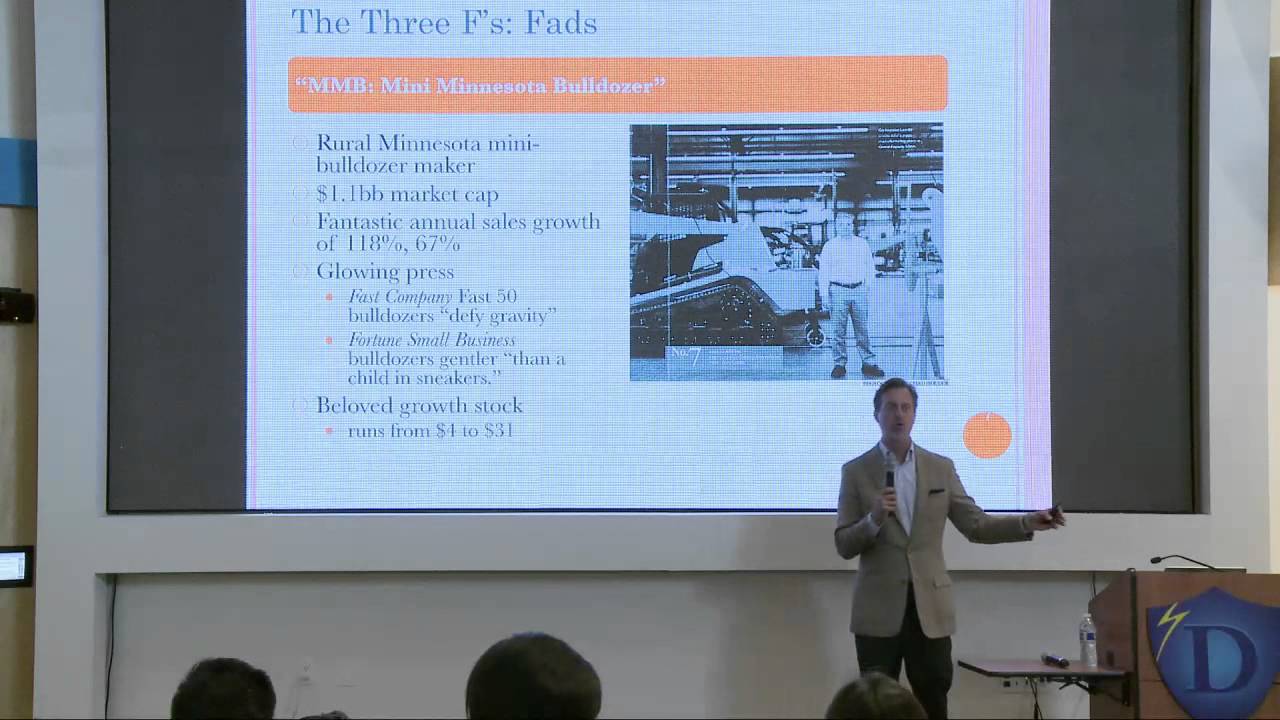
And I could bore you and tell you about journalism or wearing makeup for a living, which is what I do on TV, or trying to have a radio voice and talk on the radio, which I do every day on Bloomberg Radio. But the basic— what I do all day, and I mention it just to give you some background as to what I've learned in the course of my career, is I've been a journalist for most of my life. And I worked initially, as she mentioned, covering culture and media, principally as a sportswriter and a crime writer. And then I went to cover business, helping to launch something called TheStreet.com with a guy, a shy retiring guy named Jim Cramer, who's on CNBC. He's since off his lithium and is much more entertaining. And I, after launching TheStreet.com, I became really fascinated with writing about business and finding untold stories in business. I went to CNBC and I got a job offer from a longtime source to go work at his hedge fund as an analyst. So I walk in as a fully formed adult human being, recently married, with a mortgage and things that grown-ups do, realizing I didn't know the first fucking thing about managing money, which is kind of a problem because I was tasked with doing high-level business analysis for a hedge fund. And what I realized is that I had some particular set of skills that weren't typical of, let's say, the Harvard MBA that was sitting Literally started the same day as me, sat next to me, competing for the same bonus pool that I was competing for, and developed a specialty around finding really crummy companies, companies that I like to call fads, fakes, and distinguishing them from the fabulous companies, the companies that might look like you want to be suspicious of them. I also suspect that what you guys get to study here is stuff that looks great or stuff that's really cool or stuff that's always possible. And what I want to prove to you is that there's also a bunch of liars and exaggerators and bullshit artists and people who are trying to steal money from investors, trying to pretend to be the creative and inventive and powerful companies that I think that you guys probably all want to join or create. And so I'm going to talk to you about how I found those kinds of companies. As an analyst and as an investor, as I mentioned, I worked as an analyst for a while at one hedge fund, then I went to another one as a portfolio manager where I was running about $250 million of straight equity money, unlevered, trying to find companies that were lying and failing. So I'm going to take you around how I found these crummy companies and how I did the work kind of like an investigative journalist would do. As an investor, found those companies that were either looked really good and were bad, or looked really bad and were good, and then uses those same techniques as a journalist. And I will recommend those techniques to you as you pursue your careers and try to do the analysis of whether it's a company you're going to work for, a company you're going to invest in, or maybe even better, a company you don't want to invest in. And so, as I mentioned, I work in Bloomberg TV and radio. I was a sports and crime reporter. I was a hedge fund manager. I don't have a license. I don't have an accreditation. I don't have a Draper University degree. I don't have an MBA. I have no credentials whatsoever. I barely finished NYU. It took me 5 years. I have very little experience in these things. If you want to take this as investment advice, you're an idiot and it's your fault. And we'll see if my video is working here. And if half the time it works and half the time it doesn't, today is a not. So I'm going to identify— so I'll spare you the video evidence of these things. But I'm going to identify for you a few companies. So fads, these are companies that are attached to bubbles or fashion, something that's of the moment, right? They're often pitched to retail investors and they're often growth stocks. Anyone want to suggest to me a fad out there right now? Beanie Babies. Beanie Babies are a fad of the old days. Maybe a fad that's more current. Shake Shack. Shake Shack, that's an interesting idea. So fast casual, right? I think that's a good one. It's one of those things that's kind of— everyone wants to find the next Chipotle, right? Is Shake Shack the next Chipotle? It's certainly valued like it's going to become the next Chipotle. I would argue that it's unlikely. What was it? Snapchat. Yeah, I think— so what are we going to call Snapchat? Like social instant messaging— what's that? Mobile apps. Mobile apps, even more broadly. So yeah, that's the kind of right thing. Now, fads. So those are fads. Some of those are going to be real. Some of those are going to be great. Some are going to fail. Some will intentionally fail, right? Somewhere out there, there's someone thinking, I can get a lot of money from investors and buy myself a Ferrari and go to the beach because everyone wants to be in the next Snapchat or the next Facebook. I mean, no one wants to be in Snapchat, right? They wanted to be in Facebook, so they're investing in Snapchat because they're hoping that that's the next thing. And maybe, I don't know. Fakes. These are companies with problems that they know exist, And they're trying to hide those problems. They're often accounting scams. They often look like growth stocks. Stock goes— chart goes up and to the right. And we would also look for busted momentum plays. So a company that was doing really well, they hit an air pocket in their growth and they don't want to admit it. So they're going to fake it until they make it. And if they don't make it, they're going to get their money out. And this happens all the time and I guarantee it's happening right now in the public markets. And then finally, FAB, the fabulous companies, the game-changing companies, expensive companies. The stocks have high PE ratios, high price-to-sales ratios. They're also growth stocks and they can often be mistaken for the fads and the fakes and it's really hard to tell because those stocks will be expensive and because there'll be promises on the come and we'll see how they're growing. So let us move on here. I'm gonna try to use these clickers today. I never have any success with this. That was good. Very successful already. And like all clickers and me, maybe— look at that. Okay. So I'm going to show you 3 growth stocks. They all fooled Wall Street. And I think that— I really do think they're all templates for looking at new, exciting tech growth companies. Exciting not always being a good thing. So approaches. I'm going to— and these— there's a lot of ways to skin a cat. I think that these are 3 very effective approaches for doing business analysis or doing investigative journalism. And I do kind of both at the same time now. One is to read, but read with a cynic's eye. Read like you know the person writing the thing is lying to you. Read like they're trying to convince you of something that probably or might not be true. Progeny. Who are these people that wrote the words that you're reading? Who's telling you this is a great company? Why are they saying it? What have they done before? It's like if you really— did you read any of the good stories in the last 24 hours about Chris Christie written by people in New Jersey? I don't know Chris Christie, and I'm not political in any particular way. But if you talk to people in New Jersey about Chris Christie, they'll say he's so convincing. He will look you straight in the face and convincingly and honestly tell you something that is a total and complete lie. Now if you just listen to what he says, you believe him, but if you know his progeny, know who he is, what he's done in the past, you might have a different view. Now I don't know if that's true about Chris Christie or not, but I know that that's true about some people on Wall Street and people who run businesses. And finally, shoe leather. Do the work. Go see the business. Go see the business a couple times, a dozen times, 100 times, or more than that. See how it works for yourself. Don't talk to people who've seen it work. Go do the work yourself. All right, so here's one. Change the names of the guilty so they don't sue me. So the company's not actually called Mini Minnesota Bulldozer. It was called something else. This is an actual picture from Fortune magazine. I'm sorry, it was number 7 in the best companies, best new exciting companies in Fortune Small Business. It was a rural Minnesota mini bulldozer maker. They made these bulldozers the size of— A pickup truck. I don't know, like a Honda Civic, right? Or even smaller. And they were meant to be able to move around stuff with a special technique. It had a rubber tread. It was a technology that would— they said that it would drive across a golf course. It was a billion-dollar market cap, so not small but not huge. Fantastic annual sales growth of 118% one year, 67% the next year. That's fantastic sales growth. It is going down, and that's something to look for. Glowing press. Fast Company, Fast 50, these bulldozers defy gravity. Does anyone think that any bulldozer defies gravity? No. Just checking, okay. But this writer wrote that, and that editor approved it, and it sounded pretty cool. Fortune Small Business, bulldozers gentler than a child in sneakers. Also not true, even if the child's a boy, 'cause boys are stupid and run into things and stomp on things. A beloved growth stock that went from 4 to 31 and has a great story. It's like a manufacturing story in America. It's this charming guy, Gary Lemke is the name of the CEO. This is the stock chart. If you're really clever, you'd figure out what the real name of the company was, but that's a stock chart. That you're not going to find a lot of people suspicious of. Indeed, if you were watching CNBC, they say, like my banks, like the— I don't know about gold, commodities are great. Look at this bulldozer company going up, up, up. Looks really good. Great company. It's a buy, strong buy, super buy. Buy, buy, buy. Um, I was reading the annual report and it was actually kind of a mistake. I was reading— it was this— it was a 10-Q and I closed my screen and went back to it and I'd opened a different one. I was reading revenue recognitions. Anyone know what revenue recognition is? Oh, come on. Like auditing? It's how you count the money that you take in the door. Revenue recognition is when is a sale a sale. So you're right. It's the audit rules that apply when is a sale a sale. Is a sale something where I say, will you give me $10 for this and I give this to you? It might be, depending on the company, or it might be when I actually get the $10. And there are actually varying rules. So is it a sale if I ship it to you and you promise me payment? Maybe. In some companies, they'll count that as a sale. Other companies will say, if you promise me payment and I have a contract saying you're gonna pay me. So these little things make a really big difference. But they make a— to me, they make a really big difference when a company changes it. So I want you to read carefully with a cynic's eye, imagining these guys are trying to lie to you, 'cause they all are. Company, uh, they used to consider a sale if it was the company generally obtains oral and written purchase authorization from customers for a specified amount. Kind of important, how much do we sell the freaking thing for? At a specified price. So that's pretty specific, right? Uh, they changed that. They don't put out a press release to announce they changed it. They don't mention the conference call. They just change the language in their 100-page quarterly filing. Just one sentence. They changed it to instead of when they have oral or written purchase, they said at the time of shipment, the most appropriate point— appropriate point to whom? To the person that wants to recognize the sale so they can get the sales commission or make their quarterly earnings number? At the time of shipment to appropriately recognize the revenue. So wait a minute. So you make a bulldozer way the hell up in northern Minnesota. You sell the bulldozer to a customer in Fort Lauderdale or Phoenix or Chicago or upstate New York, and you count it as a sale when? Anyone? When? When you push the freaking thing out of the garage that you made it in? That's a sale? Before you put it on the tractor-trailer to carry it to the train to put it on the train to take it down the train to the dealer where the dealer's gonna try to sell it to a customer who's gonna put it out in their lot? At the time of shipment, that's the change you made? That's not getting conservative, I'll tell you that. And I'll also tell you that one CFO told me once, says, no CFO ever goes to sleep at night worrying about the revenue recognition policy. You only make that change if you're trying to make the numbers look better when the business isn't getting any better. So the revenue recognition changed. This company was— I'm 6'5. I don't think I can do this. So the company— see Minneapolis there, right there? God, I used to be able to get up there. Maybe with a running jump, I could get all the way up to the town where this thing was, way up in Grand Rapids, Minnesota, not to be confused with Grand Rapids, Michigan. But way the hell up there, 60 miles from the Canadian border. Ouch, I hit my funny bone. So the backlog was shrinking. I looked at this all in accounting forms. The CEO suddenly announces his resignation. He's gonna retire even though he's 64 years old and he's in Fortune Magazine and all that. And so I go, I fly there. I fly to Minneapolis. I drive 5 hours north. I don't know what I'm gonna find. I go to the local city hall, courthouse, whatever. I look up the records for any company that does shipping, that's registered to do rail shipping. 'Cause I knew that's how they did their shipping. And I go visit them. I just drive out to their offices. And I drive to one and I find it kind of empty. And I go to this other one and I can't find another address. And I walk into this 7-Eleven— it wasn't 7-Eleven— this town even off to the upper left there, Deer River, I think it was called, Minnesota. And I can't find this address. And this woman walks out of the back with kind of her 2 front teeth somehow pointed in different directions, both of them well outside of her lower lip. And she's got tattoos on her neck and she's got a cigarette dangling even though she's inside the store where they're selling hot dogs that have been spinning for like the last 6 months. And she says, oh, you looking for them bulldozers? I can take you there. Okay, I might not survive this one, but I get in my rental car and I follow her and she takes me down this main road where the stoplight was and then down this dirt road and over this berm. You could see it from the main road, but you had to go over this thing. And I walk out and I see this row upon row upon row upon row of bulldozers sold because they've been shipped, sitting out in this field. $38 million in inventory because I counted them all and I wrote down their serial numbers and I figured out which models they were and I went onto the website to figure out what they charge for each one of these things and I created a little spreadsheet just because I didn't know what the hell to do with this. The first thing I did after I stood there in the total quiet, I could hear the wind whipping across the field, I call up my trader, sell 35,000 ASV before the close of the market. I got 35,000 more behind it tomorrow morning. Do not move the market. Because I knew this was a problem. And the stock, they never announced the problem, but about 3 months later the stock collapsed down 57%. You can see there, 58%. So, Tim, you're a trader.
More from Tim


He Sold His Car to Build This Startup, Then Pitched It for $1M 😳 #Startups #AI

This Startup Moves Your Crypto BEFORE Hackers Can Steal It 😳 #Crypto #Cybersecurity




15 Months Without Refrigeration?! This Startup Thinks It Can Go Global 🥥 #FoodTech #Startups



