AI for Molecules | Meet the Drapers S9: Las Vegas
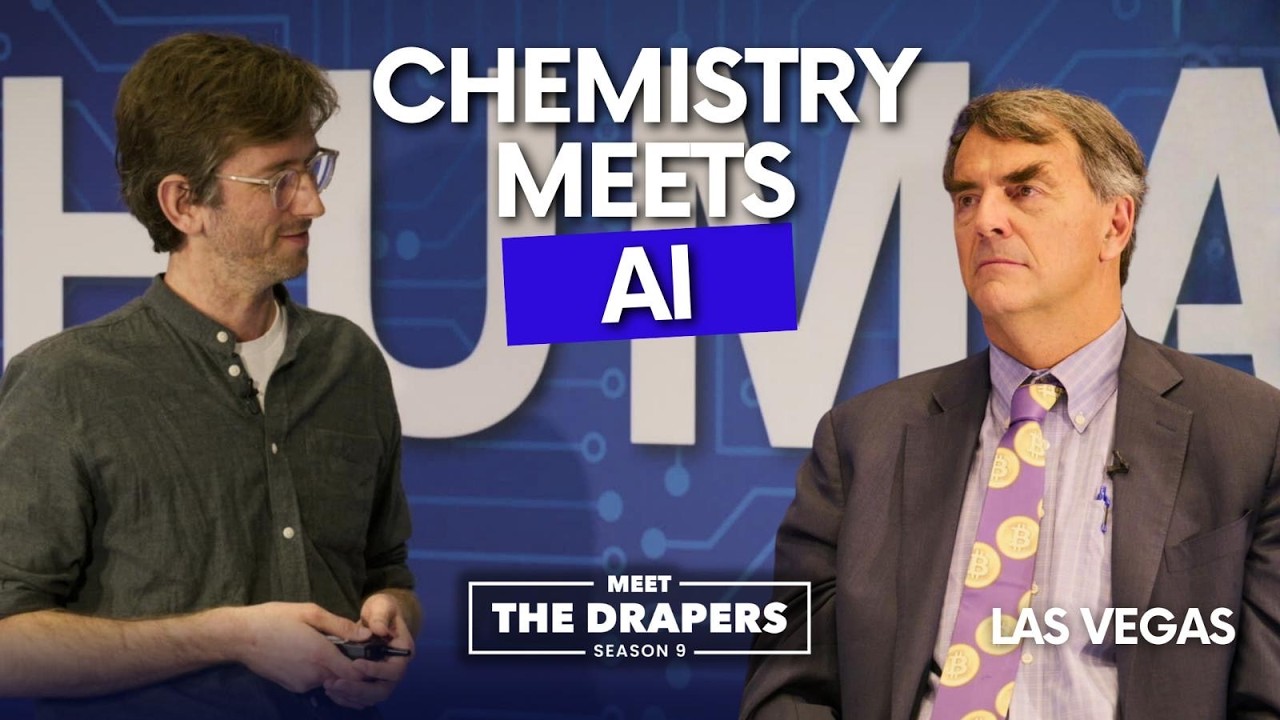
Tim Draper hosts investor pitches at HumanX in Las Vegas. Founders present startups including DeepMirror, an AI platform for drug discovery, and Illumicell AI, which uses sperm-based diagnostics and machine learning for cell visualization. The pitches cover product moats, go-to-market strategy, and regulatory challenges in AI, biotech, and healthtech.
Chapters
Those are the main categories I have.
The company you worked for before, did the investors make money?
That question early on, I was like, oh God.
This is Las Vegas, baby! HumanX is putting on an enormous conference.
I built up this crazy drive playing hockey, and that drive doesn't go away.
Scientific research can turn out really well or really bad, and you have very little control over that.
We're going to do something we've never done.
I set a high bar for myself.
You need to bring this to the market. You need to solve this.
I'm Tim Draper. I'm traveling the globe to find game-changing entrepreneurs with world-transforming ideas. Thousands applied, but only top entrepreneurs have made the cut for a chance to win an investment of $1 million. It's a journey packed with unforgettable moments.
Yeah!
A million dollars.
A million dollars.
A million dollars.
If we had a million dollars, this would really expand the number of categories that we'd be able to work with. We'd be able to hire out parts of the team to be able to focus on certain verticals.
Money is available in Silicon Valley. For me, it's more about all the relationships and the opportunities that it would bring.
Constrained with the number of features we can deliver to some of our largest customers. Get a few more engineers in to deliver on some of these problems.
We can grow much faster. Collecting the data and building the models is not super cheap, but we can go to the next steps.
Welcome to Meet the Drapers.
Hooray!
We have 4 great entrepreneurs here. We're at the HumanX Conference. It's all about AI. It's gonna be fantastic. And the A's are moving to Las Vegas. Tell us a little bit about the A's.
Well, you know, the A's are a 124-year-old franchise. that actually started in Philadelphia. Leaving Oakland was a very difficult decision. We, we will move into a new stadium on Las Vegas Boulevard and Tropicana Boulevard.
We're hoping there are 4 really good entrepreneurs that have come from here.
I'm going to be looking for somebody that is— that thinks long term. Most businesses tend to think very short term. But if you can have somebody that's looking at the long term, you can have a very successful business.
And on my right, we have Shalini Pai, who is the VP of Television at Google. Really extraordinary job. Welcome to the family.
Thank you.
It's so good to have you here. What are you looking for, and what— do different lengths of show make a difference to you?
Really, it is up to the person who's watching it. what they actually want to watch, whether it's a 2-minute clip, whether it's a 5-hour show. And really the job of a platform is to ensure that we can actually recommend the content. You know, just being able to experience, for example, your home videos in amazing 3D experiences, that's what a lot of these solutions are going to enable us to do.
3D?
Yeah, that's something we're working on.
Oh, wow. Very exciting. Okay, what are we going to see here? What are you looking for?
I think what I'm looking for is what is the moat that helps one company succeed over another.
All right, let's get this show on the road, shall we? Let's bring on our first entrepreneur. But before we do, let's see what's going on behind the scenes.
My name is Amritha Basain. My company is called Satira, and we are workflow and compliance automation powered by AI. Growing up, I was a very entrepreneurial person. I mean, like the typical American, Suburban person. I had a lemonade stand as a kid. I spent a lot of time doing side hustles in school. I got in trouble with the teacher multiple times because they said that the rates at which I was selling were not fair. And I was like, well, if people are willing to pay something, then you're creating a market out of something. So I've always been having my own businesses, whether it was e-com or whether it was like selling physical items growing up as a kid. It's always been a passion of mine. I see a lot of these big companies. I want to build something big like that. I didn't have to leave or go anywhere super far away to be able to do that. The place that I grew up and the people I was around, I feel like I got a bit of a jump start on learning about technology and learning about the industry. Early on, I reneged on an offer at a well-known FAANG company that I will not name because I got in a lot of trouble for reneging. My university actually contacted me. They blocked me from the graduation portal until I called the recruiter to apologize. Now a lot of people understand. They see the passion. They see what we've built. Like, we now have numbers behind what we've built. The impact of the number of customers, how much money we've saved, like the environmental impact, the partnerships we have with environmental organizations. So I think now people are more supportive, but early on you have to make those decisions even if people aren't supportive. The younger version of me would definitely think that this is inevitable and would probably be impressed by what I've done to this point. Right now where I'm currently at, I'm like, there's so much more to do. I set a high bar for myself. I've been attending 3 conferences in 3 days, which is crazy. This conference specifically, I think you really have to be prepared, which means like you have to be ready to be walking a lot during the day. Some of the badges like for HumanX are super cool. You tap the badges together, you automatically share information. Last time I was here, I saw a bunch of shows. Like Cirque du Soleil was great. There's a couple other shows that they do in the hotels. So I think there's a lot to do even if you like don't drink or even if you don't party a lot. Food here is amazing. I had really good Thai food yesterday. I think that was like some of the best red curry I've ever had before. You have all diversity of cuisines out here. It's kind of like New York in that sense, especially if you're willing to drive a little bit off the Strip and go to like the hole-in-the-wall restaurants. There's really good food. This pitch was different from the other pitches I've done for more logistics technical audiences.
All right, Amrita, give us your pitch.
My name is Amrita Basin. I'm the co-founder and CEO of Satira. We're workflow and compliance automation software for the $800 billion overstock and surplus industry. My co-founder Gary and I built liquidation businesses in the food and beverage and health wellness and beauty space, and we realized that this is a huge industry where people. Are essentially procuring overstocks, we've built together a platform. So the compliance part of it is when you are figuring out how to offload and monetize your overstock, there is state compliance in terms of how you handle that. So you can no longer dump or waste overstocks. And then there's a lot of compliance in the corporate sphere around like expiration dates of the items. There is $800 billion worth of overstock just in the US, and we see that the vast majority of that ends up in landfills. Retailers, corporations, businesses, delivery companies, distributors, manufacturers— we work with all those kinds of customers. They don't have a solution for how they get rid of their overstock, and now they're getting fined by state governments, they're getting fined by national governments. Many of these companies are B Corp companies, they're trying to achieve status. There's a couple categories that we work with specifically. We work with food and beverage, that's a big category for us. We work with HBA, which is health, wellness, and beauty aids. Those industries have huge overstock problems. We also do Apparel, and then we do furniture and home goods. Those are the main categories right now.
The company you worked for before, what happened to it? Did the investors make money?
That question early on, I was like, oh God. I was like, I had an order and now this has tripped up the order. So that was a business that we were running where we were doing liquidation. We made a lot of money just brokering transactions. But the thing about brokering is that you don't have software to automate it. So we built a platform that now automates that. Again, this is fully end-to-end. So the companies that we work with, They sync their WMS systems. WMS systems are warehouse management systems. We get access to their inventory data directly within our platform. We're able to share it, and then we're able to figure out what is the best solution for that inventory.
Why did you start this business?
Because I was very fascinated by the liquidation space. Again, there's so much money flowing through this. You can make a lot of money just brokering. So technology in an industry like reverse logistics is super valuable. Right now, it takes you 3 weeks on average to get something liquidated. On our platform, it's happening within the week. The fastest transactions—
Do you guys have this problem?
Yeah, you know, actually with, with Tim also involved in an equestrian boot company, do you require that, that there be government regulation to make this happen?
We don't. The government regulation is a big selling point. The state of California has given us grant funding in addition to the VC that we've raised from venture capitalists. We know which companies are being fined for unsustainable inventory practices, and so we're able to go out and market to them. But a lot of our customers that we work with have not been fined yet. So like Gap is a good example, right? Maybe it doesn't make sense to hold those items till next winter. Maybe it makes sense to liquidate it, right? You're able to unlock cash, invest into your business.
But the margins end up being so small, it's easier for them just to give it to a liquidator and say, you solve the problem, because there's not enough money to be made by, by going after that part of the business.
For a lot of customers we work with, they're getting back 50 to 75% of the cost, which Which is huge. We know what your overstock data is. We've created the best solution to get it to a buyer in the overstock space.
What is going to keep you in the business if you have competition?
We started building this with the private buyers that we'd already done business with, right? We didn't need to vet them as much because we'd literally done business with them. We'd been in their warehouses. We'd met these people in person, right? We do have competition. I mean, this is a huge industry. Every, like, few months there's a company popping up that's trying to, like, innovate the way that discounting is working. There's a ton of companies in the returns space. Our unique value proposition is the fact that we're focused on items that have expiration dates.
Well, Amrita, thank you so much for being on Meet the Drapers.
Thank you.
Terrific.
I think the pitch went well. The questions in the middle were great 'cause I was able to like really dig deep and do a deep dive.
She identified it's a big problem. I thought the question about what is the moat points out the real issue that everybody's gonna go into this space, they're gonna drive down the cost. A lot of times people are sending their merchandise Overseas.
What did you think?
It was interesting, John, that you faced the same problems at Gap. Food angle is so humanitarian as well, especially given all the tariffs that are coming our way. I think this is a phenomenal space to be investing in. I think to your point, the differentiator was not really clear to me.
All right, let's move on to our next entrepreneur. But before we do, let's see what's going on behind I'm the same.
My name is Alex Holt. I'm the co-founder CEO of Ayo, the world's first all-in-one AI platform for restaurants. So I followed first my dad, he was a hockey player, followed his footsteps, and then changed gear into my mom's footsteps, who have been working in restaurants all their life. So grew up in Sweden, was ranked number 2 in the country, drafted by the Sharks, played for the Swedish national team, and then I hurt my knee and kind of had to pivot and change from what I thought was going to be my career playing hockey to, uh, actually restaurants. I think I was always an entrepreneur first, not a restaurateur. Opened 10 locations within 10 years. Um, I knew I wanted to do something big, and I think I found that. The fact that it ended up being in restaurants and AI probably Very surprised, but I think I always knew I was gonna do something big in life. I built up this crazy drive as a young boy, you know, wanted to be the best in the world playing hockey, and that drive doesn't go away. So I knew something big was gonna happen, just not what. My wife was thinking it can't get worse because I was never home, I was always working. And the bad thing about restaurants is that you're working when everyone else is off. On the holidays, on the special occasions, those are your biggest nights, and that's when you want to spend time with family. So I think she was excited to be together more on the holidays. But yeah, she's getting used to it, I think. The only reason why we have built this all-in-one system that we have is because I was not technical enough to know how hard it was. If I would have known how hard it was and how much time it would have taken and all the problems that we faced, probably would not have done it. I would've just like focused on one thing. That was the advice we got from all the VCs in the beginning. Just focus on one thing and do it really well. And I was like, well, our name of the company is AIO, all in one. We can't just do one thing. We need to solve this problem. My co-founder is crazy enough to believe in this vision and push through. And it's been hard. We've been working around the clock for 2 years. It's a wonderful experience. There's always people coming to Vegas having a good time, and we try to provide just that. We call it the triple the fun Vegas experience because of everything being served in flights of 3. I think Vegas is a really cool city. A lot of people obviously come here to have a good time. There's great conferences. It's very easy to get to, get around. Formula 1 is here now, Raiders have a team here. A lot of sports events are coming to town, which is really cool for the area. There's so many good restaurants. The best restaurants in the world is right here on the Strip in Las Vegas. Vegas is a very business-friendly city, so more and more companies are coming here. The housing is still reasonably priced, so there's a lot of opportunities in Las Vegas. I'm pretty used to TV. Yeah, I was a pro hockey player for many years. I did a lot of interviews.
Okay, give us your pitch.
Let me tell you, restaurants are not easy. You work all the time. The costs have gone crazy, super expensive. So many problems you're facing. You need literally 10 systems to run a restaurant, one for POS, one for payroll, one for accounting, and so on. I set out on this journey to solve this problem, and I got really lucky and met my co-founder Zia, who was head of product then at Nvidia. He built iconic products for Motorola. What we set out to do is building AIO, all-in-one system for restaurants. So imagine everything you need to run one restaurant— payroll, accounting, marketing, website builder— everything in one system. And on top of that, we have 33 AI agents automating all these redundant tasks, saving restaurants so much time and money. You give your managers of the restaurant one In that system, they can do literally everything from hiring, paying the employee, doing the marketing campaigns, watching the report, improving the product. Everything you need, one-stop shop. And then those agents are automating all those workflows like laying a schedule, paying the bills, doing the books, running the reports, sending you the analytics on how to improve the business and whatnot. P&Ls.
How's your business going so far?
Lucky that I wasn't first because it would have thrown me off. a lot more if I wasn't prepared for it. We launched 6 weeks ago on January 29th, was our pre-launch. We hit $1 million in annual revenue in 12 days. We are on track to hit $2 million now, and we're aiming to hit $10 million by the end of this year.
So who are the big customers?
We're focusing on the independent restaurants first because it's a faster sales cycle.
So you gotta sell each one individually?
They actually come to us quite a lot, to be honest. This is a huge need in the space. And restaurant owners are really struggling with all of the products that they're using today. And we drive their cost literally down by 75%. On top of that, we make the business more efficient. We drive them more traffic.
There are lots of workflow vendors, including Salesforce, for example. Why wouldn't they get into this space and compete with you? You've also briefly touched on driving more traffic. In this day and world, that's the biggest thing. So we'd love to understand a little bit more on that.
I think it's a very specific niche market. There's a million restaurants in the US. 60% of them are small business owners. Toast, they only have 15% of the market. And the challenge for Toast is that they have purchased all these different companies. So it's really hard to build AI on top of all these segmented databases. So like if we dig into the product here, tableside assistance, so you can order with voice right at the table. AI marketing with a couple of clicks. Can generate an entire marketing campaign for the restaurant owner, which typically you need a full salaried position to do. Responding to reviews, like a lot of restaurants don't have time to sit and respond to all these reviews. Now it can be done completely automated. And then the biggest piece is IO Intelligence. You can literally query your own database and ChatGPT style spits out the answer. So that's super powerful. So no more running reports, no more like trying to figure out where you're at. You can actually have AI What's going to differentiate you?
Why are you going to be awesome?
One of the best things we did right away, we brought in advisors, 15 restaurant owners, managers, chefs, that every Wednesday morning for 2 hours we sit and go through the products before we even write one line of code. So by the time the product comes out, it's like, this is what we want. And that's what we're seeing why there's such a pull to come to the restaurant.
Very impressive, raising $7 million, the group you put together. When you're making your pitch or they're coming to you and saying, help us with all this, what are you charging them and what are they saving as a result of it?
The only real use case we have is, is my own restaurant here in Vegas. We went from having 5 salaried positions down to 2. We have increased our sales by 30%, and that's just one restaurant.
You wanna run some restaurants in a stadium?
Yeah.
Let's just make a deal today.
Yeah.
All right, Alex, thanks so much for being on Meet the Drapers. Appreciate it.
Thank you so much.
Terrific.
Thank you.
I feel great. It was super fun. Tim interrupts perfectly, so you just have to kind of be on your toes.
What did each of you think?
I like the fact that he's going after a niche. You know, he talked about his moat being the fact that he understands restaurants from end to end. I think how much money he can make from it is the question. I do personally think cost savings is great, but if you can increase the sales, I think that's a larger—
John, what do you think?
You raised Toast, you have OpenTable, but they've got 180 people, programmers mostly, raised $7 million trying to solve these problems quickly. It might be a significant first mover advantage. And there are a lot of mom-and-pop restaurants out there that operate very inefficiently. I think it's pretty interesting.
You almost made a deal right there.
Oh yeah, well, there might be other people in my organization.
Okay, so let's bring on our next entrepreneur here in Las Vegas. But before we do, let's see what's going on behind the scenes.
I'm Max Jacobs, CEO and co-founder of DeepMirror. We help chemists get drug molecules from an idea into patients. Much, much faster than ever before. The academics, like, they often work mainly for themselves, for their own prestige. So it is actually quite isolating and quite lonely. So you don't actually work often as a team. The last one is the professor, the first one who did all the work. Everyone in between doesn't really get much of the recognition. So teamwork is actively discouraged in a way. Whereas now in a company, it feels like everybody Has a specific responsibility and works as a team. It feels like you have some sort of perpetuum mobile that kind of moves by itself, and everybody does their stuff for the greater good, which is very different to academia. I mean, I'm still a scientist by heart, even though I left academia. Initially, you think, oh, you just do it for the chemist. Da da da. But then, as soon as you feel it touching other people and see what it will mean in the grand scheme of things. Then you know actually the really addictive thing is the patient impact, not so much the steps in between. But you have to kind of do it the whole way. Being on that track, you don't feel like you're absolutely in control of your own life most of the time, because in the end, scientific research can turn out really well or really bad, and you have very little control over that. That's why I kind of shifted as well. So it was a bit of a gradual thing, but it came from the idea initially that It was all about trying to translate technology into something that people actually use every day in their work and not something that they don't really understand how to use or is too complex to use.
Viewers. Usually I'm pretty easy to reach. I mean, there are only 300 million of you. I'm making it a lot easier for you to contact me. I have downloaded my brain into this digital twin, and you can scan this QR code, you can pitch me your idea, you can talk about your business, anything, and I'll answer it 24/7. Enjoy it, it's great. It's a new feature of Meet the Drapers and Draper TV. I think you're going to have some fun.
We're on the Strip in Las Vegas. Everything that Europe often is not— big, flashy, exciting, great. This trip is definitely great, but also yesterday we had a networking reception where they took us on a racetrack down south in Las Vegas. to drive supercars, which was also cool. Normally we go more to chemistry-focused conferences, so it was quite an exciting opportunity to give the company pitch to a more general audience. I really enjoyed that. I love the States. I actually almost grew up in the States because my dad almost took a job in Boulder. Yeah, sometimes I wonder how it would have been if I wouldn't have grown up in Germany, but here, like, a really exciting place. Normally when we pitch, it's like on phone calls with potential customers, and then it very much becomes more like a demo. So yeah, nervous until the lead-up, but as soon as you're on stage, I think things start flowing.
All right.
Hi everyone, I'm Mike Jacobs, CEO, co-founder at DeepMirror. Each and every one of us here in this room will have 20,000 ways in which you can catch cancer that all need to be treated by different treatments. However, over the last century, humanity has only approved around 1,000 drug molecules for treatment, and we need to do much more. It takes a really long time to translate drugs from the lab into the clinic, an average of around 4 years or so. And we at DeepMirror bring that down to 6 months with our interactive co-ideation platform, which essentially is a tool that helps chemists and researchers in general to collaborate with AI and their colleagues To design safe and effective drugs faster by helping them suggest the next best molecule to make.
I guess you need the human there too, but—
Yes, very important.
But the— how does the AI know if something is safe?
You can always solve for one thing, such as kills bugs really effectively, but while you're doing that, you might lose out on other things and it doesn't treat anything. You also need to make sure it doesn't hit any other targets. It might kill cancer, might lead to drugs starting to interact with each other. There's all kinds of off-effects that might happen. And that was also where the kind of the idea for the whole company came from, which was all about making technology accessible to people that actually make the decisions in the lab. So we are putting a lot of effort into the design of the interface to make sure that technical chemists, non-technical chemists alike can use the interface.
Is the big breakthrough here that you're using a neural network?
So the way the product works is Chemists come with a few drug molecules that they have tested for different assays in the lab. They upload these to the app. We have pre-trained on a lot of chemical data, which includes data that only we have access to through our customers who sometimes give us access to their data. So there's a bit of the data moat angle there. And then these models are on the fly fine-tuned on the uploaded user data, and then they become really good scoring functions which can evaluate new designs. And that's where the second part comes in. It's about generating molecules that may be interesting to chemists, which is actually quite difficult. They're quite opinionated when it comes to what designs they like and which ones they don't, because many of these people have 30 years' experience in the industry and have seen all kinds of different things.
Curious how you compare it with AlphaFold. A lot of the research that has gone in through DeepMind and Isomorphic Labs.
So we're mainly a subscription service that we just sell directly to the biopharma companies, and we tend to aggregate algorithms that we know work well. We keep also doing our own research on top, but first we test.
John, do you have questions for him?
Is the FDA fully on board, or does it not even touch them because, you know, you're, you're all kind of pre-FDA work?
I don't think we have any regulatory issues because in the end, for FDA approval, you would still need to do all the relevant Rat, mouse, and other animal experiments. So that's, of course, super important.
You're paid just for the service, or do you get a piece of the drugs that get designed on your platform?
It's like the crux of like where we are different. Many investors either go on one side or on the other side. As soon as we would take a piece of the drug, then it becomes a bit competitive because then suddenly we take a piece of one drug and then suddenly we become a biotech company ourselves. And then the whole like data sharing part doesn't really work that well anymore. Because people might not trust us as a data arbiter. So it's a subscription service primarily.
As you get these customers and they are feeding in their research into your systems, are you isolating those data?
It's a multi-tenant cloud, but of course there can be no cross-contamination. So we're actually ISO certified and also in the process of getting SOC 2. I mean, that is super serious, right? None of these molecules can ever go into the public domain because each of them could become a billion-dollar drug. So there's a lot of a trust element involved. We're taking a lot of efforts to protect the IP.
Max, thanks so much for being on Meet the Drapers.
Thanks for having me. Good job.
Well done.
Thank you.
Bye-bye.
It was a bit different than I thought it would be, but then they interjected and it became more of a conversation. That was great.
What did you think?
It did seem like there was a moat here that I got, especially based on the data that they're getting from their customers. I think it's a great space. Like, who doesn't want drug delivery to be delivered faster and to cure malaria?
What'd you think?
We didn't get enough into what the subscription model looks like. I thought he made a good comment about wanting to make sure that they don't favor one company over another or they don't have a business. But, you know, I, I don't know how big a business this can be.
Let's move on. Let's bring on our next entrepreneur. We're here in Las Vegas, but before we do, let's see what's going on behind the scenes.
I'm Johannes Kraus, co-founder of Youth HealthTech, and we do smartphone-based health screenings. Working day to day in the healthcare system will always give you this a bit of annoying feeling because you're working on something where you know you should not work on it. Because it's— you're treating diseases instead of trying to prevent them for others. So that was always this moment where I was like, why are you here? Why are you doing this? If just I could have told this person, hey, you should have done a check before. Hey, you should have worked out before to avoid this, what I'm treating here right now. From my background, I grew up in this Automobile environment, everyone becoming an engineer at BMW. So it's this German career thing you do, very stable, stay 35 years in the same company, taking responsibility. And I think that's what you do as an entrepreneur every day. You take it for the company, for the people you employ, which have families at home, which You need to pay a salary. I think that's one part of it. And you are responsible for your own success. To solve a problem, you believe in a product and you need to solve this. You need to bring this to the market. You need to sell this. And I like this responsibility a lot. So I'm excited, obviously, about the journey. I heard there's a racetrack where I want to go to race some cars. I think that's good fun. And then, yeah, obviously you have to visit the casinos, the big fountain. So the thing to do in Vegas, right? As I think for the conferences, it's amazing. They are very big. Everything is in one place. You can meet great people from all over the country just here. So I think that's very cool. There's one thing thing I would love to do in Vegas. It did not happen yet, but I would love to come for the Formula 1 race because this is a bit my, my hobby passion. So I would love to come to a conference when there's the Formula 1 race as well. I think HumanX is a great conference. It was very big and all the AI leaders were there. It's always good to see where the trends are going, obviously of the big players, but also what other startups are doing. Made some great connections already, so It was profitable already.
Yeah.
It was my first time really on television. It's difficult for me to see, okay, where do I look? When you schedule a doctor appointment in the US, it's usually more than 3 weeks to get it, and it's more than 5 visits to get this holistic, comprehensive picture of your health. That leads to 75% of the people facing late diagnosis. That's why we have decided to bring preventative screenings to the smartphone. So how does this work? You just take your phone and take a 2-minute checkup. You do a face video, an audio recording, and pictures of your eyes. And with just that, we screen for 7 health areas and more than 50 biomarkers. We have decided to build a platform where we integrate existing health screenings which are validated, and we extend it with our own IP to get to this holistic picture. This enables us to become a universal entry point for all health and wellness services because everything starts with this check, and then you can collaborate with insurance to bring down their costs, with longevity clinics and supplement companies to increase their engagement through that checks and increase the retention for them.
So the selling process is at the moment through the clinics So you can have that end-user connection later.
Yes, and we also have.
And you keep the data on each person.
Exactly.
Give them a feedback loop and everything else.
Exactly.
Do you co-brand or brand or is it?
We co-brand.
Yeah.
We co-brand.
That's correct.
I liked how he interacted with us. We didn't do the complete pitch. He interrupted, but in a non-negative way.
You're taking data from all these sources, which. I guess anyone could, but you're putting some IP on top of it. Can you talk a little bit about what that IP is?
The companies we are seeing out there are using one single data input. We combine different data inputs and bring that all as a multimodal AI in one model. That's, I think, where the future of AI is going.
How often does your mother use your test?
So my mother didn't use it at all. My mother is not in this world anymore. It was one motivation for me to build this. My father uses it almost every day.
Does he really?
Yeah.
Do you make it really easy? You just push a button?
It needs to be super, super easy and accessible, so it can only take 2 minutes of your time. If it takes 15 minutes and you have to order something, send something, no one will do it. We need to make this accessible.
How do doctors And the AMA feel about this? Because, you know, there's another company out there that spit in a cup and it would tell you what you were predisposed to.
Yeah.
And the doctors and the AMA came, you know, after that business out of the view that only doctors can really tell you what's wrong for you.
We do not replace a doctor and we do not want to. But I think we can all agree here that the healthcare system takes a lot of money with not so good outcomes. So when you see, okay, my blood pressure trend, my heart rate trend is going out of hand, then I might see a cardiologist. It's much more efficient than go to some other doctor before and then have this journey of multiple doctors.
Johannes, thanks so much for being on Meet the Drapers.
Thank you so much. Thank you.
Thank you.
Thank you. Thank you. It was fun up there. I felt a little bit nervous because my first time really to be on TV.
What do you think, John?
I need to learn a lot more to understand how they sort of can distinguish themselves from, you know, all the other health providers that are in the same business.
How easy would it be for Apple to do something like this? I know he talked a little bit about multimodal AI, but everyone's doing multimodal AI right now. So yes, what makes them unique?
Okay, we're gonna do something we've never done here on the show. In this conference, I met 2 great entrepreneurs. Come on up onto the stage and give us your pitch.
I saw Tim Draper and I was like— me and my co-founder Michelle went to talk to him, introduce ourselves, quick elevator pitch. He said, you know what, this is what I'll do. I'll call out your name and you quickly talk about what you do. But instead, he just asked us to go on stage. So that was a very pleasant surprise, but also kind of serendipitous.
My name is Michel Bielecki. I'm one of the co-founders and CEO of Illumicell AI. We combine a proprietary cell visualization technology and use machine learning algorithms to quantify the observations we make with that. When you start off a medical career, you have all those expectations about what you're going to be doing in 10 years. You go through your rotations in residency and that kind of pops your bubble. You're like, wait, do I really want that? And to me, the answer was no. Like, I think that the system has a lot of flaws and I'd rather work on the system for future generations as well. What we're doing is hard and the pay sucks, but we're in an industry where what we do actually matters. And medical startups that influence patients' lives and people's lives ultimately change outcomes on a population scale, which goes directly into public health. And medicine is one of the most under-digitalized industries across everything we have. We have the tools, we have the technology, but it's not being applied. And I am very passionate also because of personal reasons to change that status quo or to be part of the change that drives technology into medicine in the 21st century.
What are your names? What's the name of your company?
Tell us about it.
I'm Sheila, one of the co-founders of Illumicell AI.
And hi, I'm Michel. I'm also one of the co-founders of Illumicell.
What's it called?
Illumicell AI.
Illumicell.
Yes.
Okay.
You guys have heard a lot about just now prevention, different fluids, blood, urine. We're also in a fluid that I think on average half this room could procure in under 5 minutes, and that's sperm.
We're using sperm as a biomarker for overall health, some types of cancer, diabetes, cardiovascular diseases. It's directly linked to longevity, and it predicts pregnancy outcomes. Right now, that sperm data is being gathered but not used at all, and we We have fantastic technology, as Shalini said, moat, 2 moats actually, to make sure we collect that data efficiently and we use AI to expand on it and create new products that will be a new leap for personalized medicine.
We have 2 core technologies. One is a proprietary cell visualization system, which is a tiny little box that actually works, not like Theranos, that allows you to visualize cells in 3D, and we couple that with proprietary machine learning algorithms to quantify all the observations that we see, as well as other cells except for semen that is in that seminal fluid.
Is there something you get out of sperm that you don't get out of blood?
Sperm has a cycle of 3 months, so it is very sensitive to both environmental factors and metabolic factors. Testing it and correlating it with different conditions Semen is an excellent warning system for something that might be going on compared to blood.
There's millions of people looking for fertility treatments, but only 500 clinics in the United States. So you usually make arrangements to travel to another state just to give in your sperm sample. What we're saying is we bring in completely new distribution system. Every doctor that needs to measure sperm, they can now do it close to your home. So either you Go to their office, or your wife can help you take that sample to her OB-GYN, and you would have diagnostics within minutes instead of having to travel somewhere. And that means not just better patient outcomes, but also extra money for those practitioners that have the device. This is also much better for insurers when you have more targeted treatments for infertility.
John, you got some questions here.
You stumped me.
Shalini, what do you think?
So you mentioned taking it to the OB-GYN who would have diagnostics. Is that something special that they need to have?
You have to have a lab space, you have to have trained technicians, and they take about 45 minutes per test to manually count sperm, analyze its movements, etc. We are basically bringing the power We put the power of all of that into a small box that does it in under a minute. And in our early clinical trials, we actually outperformed the standard of care. So that box will be available to any practitioner who wants to buy it. You don't have to own a lab or a clinic to do it. You just have to have that and obviously the sample.
Terrific. Well, I think you did very well having this cold call.
Thank you.
Thank you so much. It's been a pleasure. Thank you for being on Meet the Drapers.
It was very exciting to talk about what we do, especially with judges like that.
Very interesting. Something that I've never thought about. It wasn't clear if the product actually works. I know they're getting the product ready. And is it as simple as they were describing it?
What keeps anybody from getting into this type of testing and evaluation business? At least it's not going to go away in this case, right?
Yeah, this will probably continue as long as we procreate.
Exactly.
We now have the hardest part of our show— figure out which entrepreneur moves on to the semifinals. Meet the Drapers has now come to Las Vegas. To find entrepreneurs. This guy looks like an entrepreneur. Jailhouse Rock, baby!
Smile already.
It could be worse.
You could be doing the Jailhouse Rock. Oh yeah. I think we're going to get better AI in the conference. We're looking everywhere, even in places where people are gambling. HumanX is putting on an enormous conference, bringing crypto and AI Here to Las Vegas. This is going to be amazing. Let's see if there are any entrepreneurs in Las Vegas. You guys starting a company, or are you just here to blow money?
Both.
You're an entrepreneur, right?
Yes.
Hey, Olin.
Just hanging out with your partner. Nice meeting you. I'm Tim Draper.
Oh.
Are you going to gamble while you're here? Keep up the good work. He created my digital twin. There you go. Hey, what do you guys do? Hi, how are you? Great. Series D company? You guys all do the same thing all the way up and down.
Good.
This is going to help me with my book. Eventually we'll get that book out. We think that extraordinary things are happening here. And this is Las Vegas, baby! Come on up. Amrita for Sotera. What is special about you and what's the AI application?
We've signed the biggest instant commerce company in the US. The way that our competitors operate is not scalable, so that's why we've used software to be able to do this. AI enables us to be faster, and speed is money in this industry.
Max with DeepMirror. If you're not taking Taking a piece of the drugs. I mean, that's what the real business is. How do you beat that?
One of the obvious things to do at some point would be to hook up a lab behind the platform and then over time become really like the main platform which everyone in the industry develops drugs. And frankly, nobody has ever done that before. Maybe the closest comparison would be something like BenchLink. It's a company that is now $6 billion.
Way back, that one. When it was 2 guys and a dog.
Yeah, they're awesome.
Terrific. Okay, and Alex, you ran a restaurant, you had to watch every penny. Would you have bought something like this and why?
That's why I built it. You need exactly this. You are already paying for 10 different systems, and now by consolidating it into one, you're saving a ton of money right there. And then the efficiencies that AI creates There's so much power, and I think taking a company from zero to one is hard, but taking it from zero to a hundred is really hard, and it takes a lot of different characteristics to do that. And I think we have all the puzzle pieces to really make it happen.
Terrific. And Johannes, is it going to be just on an Apple Watch, and it's just another feature, another app? Why you? Why this?
Why would you? You download 17 apps to check for your brain, for your mental health, another for lungs, another for heart. This is cumbersome. We need to make this easy. We need to make this accessible in a one-stop shop. And I think that's how we differentiate from all the others.
Terrific. And Jayla, tell me about the backlash, the, oh, this is about sperm and people are going to be uncomfortable doing There's already logistics startups out there doing that specific thing, making it comfortable for you to procure the sample.
With us, they're not only going to be able to talk to their patients, but actually measure and diagnose and say what kind of fertility treatments they might need.
Judges, Shalini.
Okay, first of all, I feel all of you have amazing companies. Kudos to all of you. So the 2 that I was looking at was Satira and the company AIO. I do think small businesses and restaurants need a hand. I think they're the backbone of our economy, and if we can cut costs for them, really help them market themselves and be discovered, I think that would be phenomenal. And I think it's a— it's going to be a great space. I will go with AIO.
Thank you.
John, what's your I would say the same thing. I think you guys did an incredible job up here. Healthcare businesses are hard for me. You know, I think you solve an incredible need in the restaurant business, but you're sort of at this point doing it one restaurant at a time. On that basis, I would, I would go with Amrita.
Thank you. So, Tara, you had extraordinary passion. I am concerned that I think that there are a lot of people going after this kind of thing. Deep Mirror, yes, we're really interested in computational biochemistry. Not sure about your business model. Alex, concerned about selling to restaurants. There have not been many really great businesses built on selling to restaurants. Youth, if it is, It is indeed the easiest to use. You will rise to the top and it will be something extraordinary. And then Illumicell, you were a great surprise. I have made my biggest wins on funding the rebels. All of you have a little bit of rebel in you, but I'm going to ask the crystal ball to figure out where the real rebels are here. I'm going to need All of you to give the crystal ball as much power and clout as you possibly can. Yeah, yeah, yeah, yeah, yeah, yeah.
Woo!
It's a little bit of a split decision. I'm seeing two things, and the winner is Deep Mirror and Illumina to the semifinals. Congratulations.
It was a very, very pleasant surprise.
Just the chill.
on top of just going there and talking. It felt surreal.
Very happy because we had another pitch competition a few days ago. We didn't move on to the next stage. It's nice to get that validation.
Vote for me and what we're building at Satira because we are very focused on sustainability. We're focused on the environment.
I would love for you guys to vote for us because I want redemption. I really know that we can help restaurant owners change their lives.
I think the points Tim had were really valuable, and I would love if you vote for us and bring us back on the show.
Thank you all!
Good to meet you all!
See you next time on Meet the Drapers!
More from Tim


He Sold His Car to Build This Startup, Then Pitched It for $1M 😳 #Startups #AI

This Startup Moves Your Crypto BEFORE Hackers Can Steal It 😳 #Crypto #Cybersecurity




15 Months Without Refrigeration?! This Startup Thinks It Can Go Global 🥥 #FoodTech #Startups



