AI Technologies | Abhas Gupta
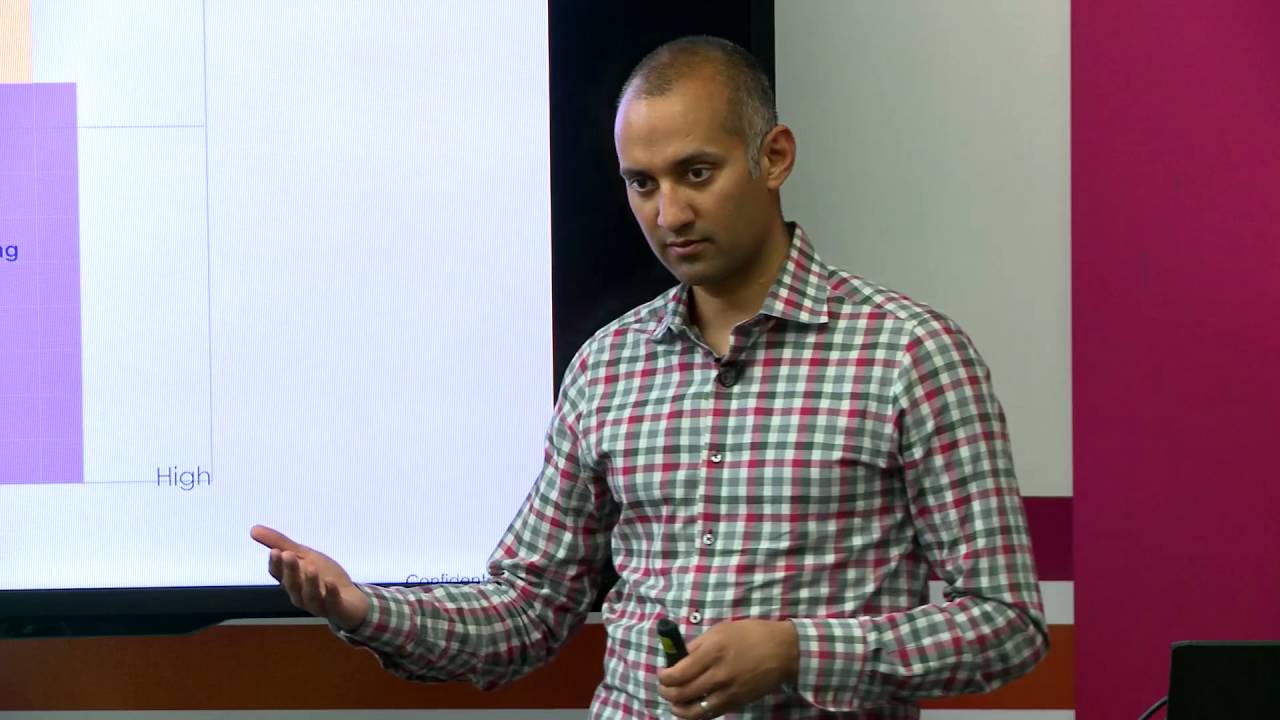
Abhas Gupta maps automation technologies on a 2-by-2 grid of routine versus complexity. Conventional programming handles simple routine tasks, machine learning tackles complex non-routine work, and deep learning solves complex routine problems like AlphaGo and Tesla Autopilot. The remaining gap—complex, non-routine work requiring trust and strategy—still needs humans.
Chapters
This now is looking at how have different technologies over the course of the last few decades started to allow machines to do tasks that fit within this 2 by 2 matrix. So things that were in this lower level, like let's say sweeping the floor. How many of you guys are familiar with the Roomba? The iRobot Roomba?
Yeah.
Yeah, so it's a little thing. You kind of just turn it on. I don't know if anyone's used one. You turn it on, and it just goes, hits a wall, turns like a random direction, goes again, hits another wall, turns a random direction, and just keeps doing that, right? There's no special AI to how it's doing that. It literally is just following a set of sequence of functions, and it'll just keep doing that. Anytime it hits a wall, it triggers the other function, it turns, hits another wall, trigger, turns, and it just keeps doing that over and over. So things that are in this lower level, Things that are basically low complexity and routine things, a lot of high-level programming has been sufficient to address those kinds of needs. Like a cashier. I mean, you can write a program to do that. Most entry-level computer scientists, or I'd say intro class programmers, can do that without a problem, right? When you start getting into things that are more unique or non-routine and things that are also more complex, that's where a lot of machine learning has now been able to kind of access those types of things. So let's think of some examples. Like, you got— who uses Gmail's inbox app? Right? You guys notice the auto-responds? Right? So it kind of looks at the text and says— like, that's a complex thing for you to program. If you were to just, without using machine learning, you would basically like, yes, no, you'd kind of look for those kinds of cues. Yes, no, I'll get back to you later. It's kind of these canned responses, and you would just hope that you were picking the right one, right? And it wouldn't be very effective. And what they've done is said, OK, well, let's take— let's actually not even look at canned responses. Let's look at what people have said as responses to different emails. And let's try to draw relationships between them. And that's essentially just massive machine learning on that. And so that's why it's pretty accurate. You know, you're like, you get it and you're— most of the time my responses fit within those 3 categories, right? And that's how— that's because emails are, you know, tend to be— there's a whole distribution of emails and some are unique and some are less unique. But for the most part, you're kind of entering this territory and they're also complex. That's slightly more complex than sweeping the floor. You've got to think through what you want to say and how does it fit. You have to understand the context of what someone's saying. So that's where conventional machine learning has happened. And now in the last essentially 5 years— I think not even 5 years. In the last 3 years, we're really starting to see things spin up here is in the deep learning world. And in deep learning, that's where you've been able to really access these kind of higher complexity and more routine things. So a lot of great work in computer vision. So computer vision was just kind of off boundaries until a lot of this deep learning stuff has come up. And so we'll talk through some examples there. And then how many of you guys are familiar with the AlphaGo, the game recently? So it's this game. Essentially, it's a game. There's only— the game in terms of what you can do is not that complex. But in terms of— so it's kind of— you can only do so many moves. So it's relatively routine in that sense. But it's highly complex in that all these moves trigger like 20 million or 20— I don't know. It's actually like— I think it's 10 to the 10 million different combinations of different moves that can trigger. So it's a highly complex but relatively routine type application. And so they're able to do that by using massive deep learning resources. deployed against that problem. Questions about this? I have one. Do you have any reason for that, you know, draw that deep brown failure in that stair-like— Yeah. It's kind of more illustrative, right? But generally, it's as you kind of move into this territory— so the rationale is that as you move further to the x-axis, things become— they're not as routine or repetitive. And deep learning, machine learning, they all rely on training sets that they ultimately push forward. So as the frequency of repetitive events decreases within your training set, your ability to predict becomes lower as well. And that's sort of where deep learning starts to hit a wall. In this direction. And then in terms of complexity, it's not— it's certainly possible that fast forward 10 years and we have real AI that you can start to access these higher levels of complexity, but I don't think we're anywhere there today. So this is sort of a— again, this is more illustrative of kind of what the limitations are of deep learning today.
OK. Yeah?
What about the white part? Right. So that's— so good question. We're going to go there now. So again, back to the 2 by 2 framework. Things that are unique, things that are high in complexity. This is where technology is able to do the things, the tasks that fit into these areas. This white sliver is kind of the technology pieces that— or the tasks where technology today can't easily do. So these are things that are purely human tasks, essentially. If you're doing something that sits here, you're safe. Computers are not coming after you for now, for now.
Yeah.
OK. So that kind of is a good transition to the next point. So we talked about all those different tasks. Which we walk through in each of the categories. And what you see is virtually 60% to 80% of those tasks are now covered by some type of technology that exists today. You can certainly dispense cash. You can certainly pick fruits off of trees. You can certainly sweep the floor. You can certainly transcribe text. Highway driving, Tesla's already doing that now. Building regression models, our company WorkFusion It's kind of amazing. They're basically— they went into these number of large companies that have teams of data scientists, and they basically had these data scientists create models for different steps in these workflows. And what they found very quickly is that WorkFusion's AI is able to build the models faster and better than their existing data scientists. So now they're actually tapering back on the data scientists working on that and sort of shifting them over to other tasks. So even data scientists are kind of on the chopping block for technology, to think of it that way. Underwriting loans. One of our portfolio companies, Earnest, and Cabbage, both of them have basically realized a lot of people would want to go and get a loan, but your bank takes 3 weeks to process that loan, just because a lot of humans have to look at it. the workflow process. These guys do it in about 10 seconds. They look at all your data sets. They look at 100,000 data points from your checking accounts, your investment accounts, across everything to make a prediction very quickly. And they do that through a combination of deep learning, of basically huge data sets, and they're able to do that really quickly. All right. So what still isn't— Things like building trust, so us having a conversation and you feeling like I am invested in what you wanna do and I'm helping you get to where you wanna get, that sort of building trust thing is still very much a human endeavor. I think, I guess, what's that movie, Her? You guys seen that movie?
Her, yeah.
Yeah, that's kind of, it's still fantasy, right? We'll get there, but we're not there yet, right? So that sort of building trust is a big part of it. Back to the crafting brand strategy, there's just no way for even deep learning to get anywhere near that kind of world right now.
Yeah.
Go ahead.
Have you heard of the trust machine?
Yeah.
The blockchain.
Yeah.
It's not like that kind of personal resonance between 2 people that's that mutual trust. You're talking about like— well, I guess it is 2 people mutually working for the good of each other, just not humans, Yeah, yeah, so I think you're—
you know, there's trust in security, in cybersecurity, which is like— and privacy, which is a whole different— it's a very specific term to that world. I'm talking about trust in like 2 humans connecting with each other. So an example, what was that movie, Ex Machina? Oh, Ex Machina. Right? It's like, can this machine Become your best friend? Like, can you trust it? Is this really a machine or is it really a human? And trying to— that's like an age-old test, but that movie kind of takes it to that level. So that's what I mean by building trust between 2. I have to watch that. Oh, it's a great movie. It's on Amazon Prime. Yeah, check it out. OK, so right off the bat, you see that a lot of these tasks fall into existing technologies, right? All right, so the point that I was going to make here is that we're already starting to see companies now take these technologies, automate the steps, and put them out in the market. So iRobot, that's the vacuuming machine, right? Like the Roomba. The Roomba, exactly. So they sweep the floor for you. That thing is amazing, by the way. It's like a lifesaver. Rethink Robotics, how many people are familiar with them? OK, so they work in the industrial space. And it's interesting, like, they're— I mean, it's a big robot. It does all— you can program it to do different things. But what has been kind of their recent innovation is that it watches a human do steps, and then it starts doing those steps over time. And so that used a combination of kind of conventional machine learning and kind of deep learning techniques to start following the human steps and doing what the human's doing. So essentially, you can go and park a Rethink robot right beside a human being, just have them monitor it, and after a little while, they'll start taking over. That is very similar to what our company WorkFusion does. They take a body— let's say— so they work— one of their first customers in the financial information space. So these companies will generate like A 10-page document on every company in the world. And they'll get paid, let's say, like $3. And it takes someone— it takes them about 3 months to— OK, sorry. Let me backtrack. They've got this document. They will send it to a BPO. You guys know what a business process outsourcing unit is?
No.
So it's like an organization in maybe India or Malaysia or wherever. They'll sort of hire all these people, do all this work, and then send the results back. And it costs typically like— $3 a record, and takes 3 months to complete all this stuff. This is all like very rote, like go find out what the name of the company is, who's on the board, what products do they have, where's the website, that kind of stuff. Very general information. These guys at Workfusion are like, OK, well, let's put that workflow onto our platform, and let's split the work up between your internal experts, crowds— so they have 30 million workers all over the world now who can just plug in, do like a very specific task, Submit the result. And then the third category, which is machines. Like, this is stuff that's so simple that a machine should do. Like, what's the price of the stock on this date, right? They take this workflow. When they start the project, it's typically like 90% humans that are doing the work and 10% machines. And when they end the project, it's usually about 15% humans and 85% machines. So they go from— as the humans are doing work, the AI is watching it and says, OK, well, I think we can take over that step. And so they'll just route those steps to the AI instead of to humans. And piece by piece, they start taking over. And that's similar to what Rethink Robotics is doing on the manufacturing line. These guys are doing it with knowledge process outsourcing work. Super cool. So what took 3 months and $3 a record, they do at $0.02 a record in 8 hours. So it's pretty incredible. On one of their projects, they can have 8 million people— or sorry, 2 million people consecutively are working on a project at the exact same moment. That's kind of insane in terms of the scale that it can achieve. All right. Tesla. You guys are familiar with the Autopilot in the Tesla, right?
Yeah.
They're already starting to launch that. Gmail, we talked about earlier. The auto responses on Gmail, it sort of falls in this conventional machine learning world. And then AlphaGo, you guys are familiar with that too? That's the sort of deep learning on-the-go game. So this is sort of where different technologies are now being commercialized for different tasks. So
More from Tim


He Sold His Car to Build This Startup, Then Pitched It for $1M 😳 #Startups #AI

This Startup Moves Your Crypto BEFORE Hackers Can Steal It 😳 #Crypto #Cybersecurity




15 Months Without Refrigeration?! This Startup Thinks It Can Go Global 🥥 #FoodTech #Startups



