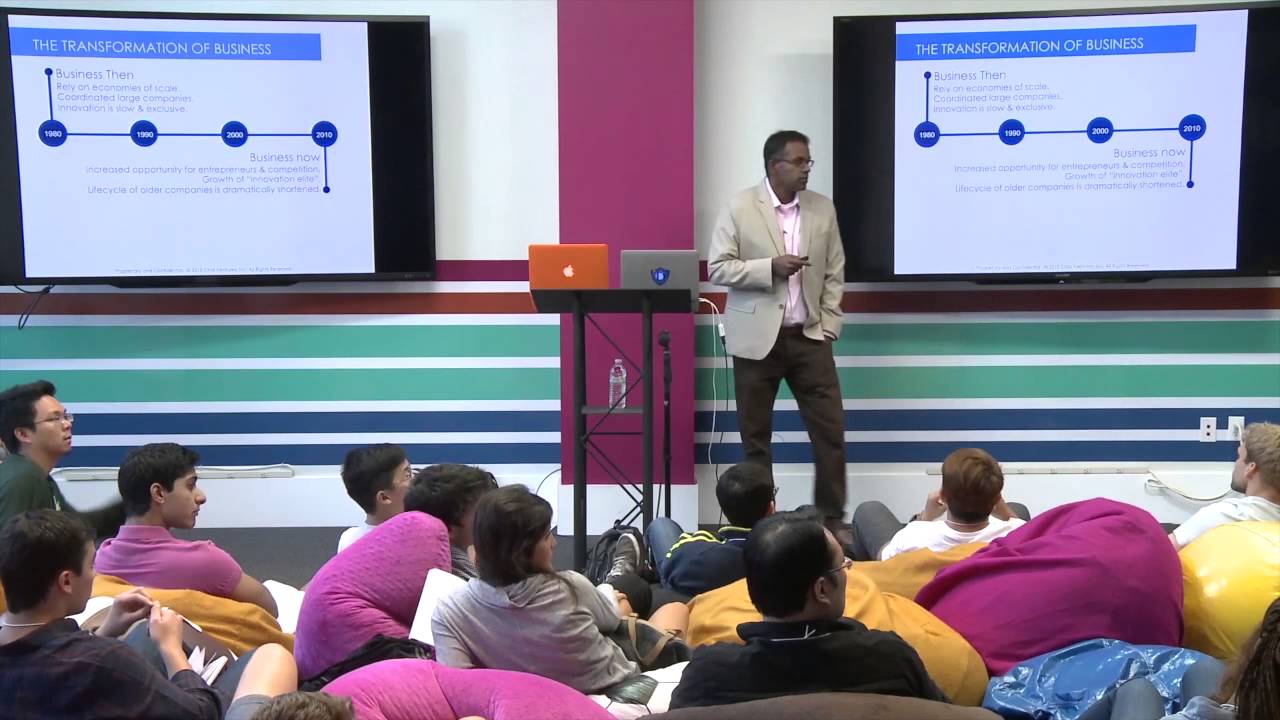
In this talk, Sodan Selvarettnam shares his international, multi‑career background—from a Sri Lankan farm to Wall Street, music, Disney, and venture capital—to illustrate how personal adaptability mirrors the rapid transformation of business over the past five decades. He outlines the shift from 1960s scale‑focused, hierarchical firms to today’s digital, flat, and diverse organizations, emphasizing the exponential acceleration of business cycles, the shortening of S&P 500 company lifespans from 61 to 18 years, and the emergence of an "innovation elite" that captures value through competence, tenacity, and mindset. Selvarettnam presents simple frameworks for visioning, leveraging data, creativity, and execution, and urges the audience to align their work with a deeper personal purpose, asking them to imagine what they would truly want to be doing if today were their last day. The talk blends personal narrative, historical context, data‑driven insights, and motivational calls to action for aspiring entrepreneurs.
Chapters
So let me tell you a little bit about myself and this. I'm a pretty international guy myself. My name is Sodan Selvarettnam. Thank you for the introduction. I'm an entrepreneur, musician. I'm a family man. And I have a track record of being a rebel. Woo! Not only from the island that I was born on, but just from a mindset perspective. I was born on a small island, living on a farm for the first few years of my life. My grandfather was a farmer. My father left familiar soil that our family lived on for several generations to study in the UK and eventually to work as an expat in countries in Asia. This accelerated the trajectory of change and necessity to adopt quickly in my life. By the time I was 17, I had lived in 3 countries, from a farm to metropolitan cities, and little did I know at that time that my journey of intense exploration would continue throughout my life. I have since worked as was said— yeah? Crystal. Crystal was saying, since I worked on Wall Street as an investment banker, Made some savings there. I had a passion for music, and so I left Wall Street to tour as a musician in New York City chasing a record deal before record companies could ever be ready to accept a frontman who was South Asian in descent in New York City. But it led me to become the accidental entrepreneur, including intrapreneurial stints at companies like Disney. Okay, I recently founded and developed a venture capital fund within a publicly listed company, and I have now come back to my roots shortly afterwards to build my next company. But it feels very different this time for me. I'm more heavily invested now in creating a great future than ever before because I have 2 children that will enter the work world in the next decade or so. And I have committed to set an example for them and to create a workplace that I would feel comfortable for them to work in. I also believe that we're at a time where it's the perfect storm to make these changes happen. I also happen to believe that you're the next great generation to make these changes happen. So that's what this presentation is about. It's about Building the businesses of the future, including some contacts and a couple of relatively simple frameworks and mindsets to get you started. So I hope you enjoy it, and most importantly, I hope it provides you some insights about your own journey during your relatively short time on this planet. Any questions so far? Which island were you? Which what? Which island? I was born in Sri Lanka. Yeah, it's a small island below India. Looks like a mango. Beautiful island that was destroyed by a civil war due to nothing that probably had to do with the people, right? Oftentimes civil wars happen that way. Any other questions before we move right into the presentation? Okay, so we're gonna cover these things today. We're gonna start with some context behind the transformation of business, your place in this new world, and some key pillars for building the future. How many of you are here because you want to be a participant, a front row player in creating the— in the future world rather than being a spectator. I imagine most of you have come to this program to learn more about that, right? So we're going to talk about that. There's a section on visioning the future, and we'll go through a couple of simple frameworks there you may choose to apply. Is there a whiteboard or anything that Yes. Okay, perfect. Okay, and then from there we'll move to some practicals on making your vision a reality, including the use of data, creativity, and execution. The reason I wanted to give my bio a little bit more extensively is, you know, when I look at my family's background, I would think that my father had to have a good amount of vision and imagination to leave farmlands in the north of Sri Lanka, to become an expat diplomat in Asia and whatnot. And so I look at his story and I say, it's all possible, everything is possible, but there are some tenets to make it happen, right? And it's a very human phenomenon that moves well past Silicon Valley. It's a DNA of creativity that resides within all of us. Right, and the time is now, and so that's what this is all about. So let's dive right into it. The transformation of business, what's going on today? Can someone tell me some of the ways business has changed from the 1960s to today? What did a business operate like in the 1960s? Paper. Yeah. Well, I was talking about what changed. Everything's digital now. Yeah, everything's digital. Okay. So it's like flatter structures. That's right. Okay. People breathe technology. People breathe technology. Okay. More debt in businesses. There's more debt. Okay. Okay. I don't know that's for sure, but I think being informal is becoming more. Big and? Like being casual in the workplace, wearing jeans. Okay, okay, got it. Okay, a lot more casual. Okay. Integration of, let's say, power minorities, more females, more diversity generally speaking. Diversity, okay. Less algorithmic jobs, like we have a lot of machines doing those algorithmic jobs, so a lot more creativity happening. Okay, okay, perfect. So yes. Open source information is more readily available. Got it. Okay. Good answer. Artificial intelligence replaced human resource. Okay. We can have a philosophical discussion about that one all day. Yeah. We got the liberalization of all the economies across the world. Okay. Flatter world. I guess the function of business in the past was to push products onto the market. Yeah. The crowd could taste the product. Okay, perfect. Okay, so those are really very good answers and very plugged into what's going on, right? So summarize, right? '60s was an economies of scale. There were some coordinated large companies, right? The world of business was radically different. Your father, your grandfather's generation may have worked for one company their whole life. waited for that gold watch, pension plans, all that, that doesn't exist anymore really, right? What changed? Okay, there's this thing called the Cold War. I assume all of you are familiar. You know, there was a lot of technologies that were developed within this government during the Cold War, and over time as we enter the '80s, some of these technologies got commercialized, right? Gentlemen like Bill Gates and Steve Jobs, who are icons today, put the PCs out in the market, right? And that started a revolution itself. Everybody had a computer in front of them. And then shortly after the Cold War ends, the internet revolution starts to percolate. It starts to bubble, and then it grabs hold of what's going on in the world. Right? So what does this do? You guys all pointed it out, you guys and girls and women and men in the room all pointed it out, right? That it's a flat world, it's cheaper and faster ways to launch businesses, and the speed of business starts to accelerate exponentially. Okay? Which means it's tremendous opportunity for entrepreneurs. There is a growth of an innovation elite, and we'll talk about that in a second. Yeah. Those who have the competence and the know-how and the tenacity and the desire end up capturing the value in today's market. And the life cycle of older companies has dramatically shortened. Okay? So opportunities are everywhere, right? The resources to do it are cheap and all around you. There are no barriers. Technology has become the great enabler, like you guys pointed out. You can take initiative with everything that it offers. You have the power at your fingertips to change the world. Change is not an exception, it is the paradigm today. It's not the outlier, it is the status quo if you are to survive, okay? And there's also a rise of the innovation elite. There's know-how, mindset, right? And you're here to pick up some of those know-hows and mindsets as you move into the world to change the world. I hear Tim Draper talking about changing the world a lot, right? And you have those tools. Let's look at what's happened in companies, and this is pretty amazing. In 1958, right, The average life cycle of a company was 61 years. 61 years, and by 2011, it moved to 18 years. The life cycle of a company on the S&P 500 moved from 61 to 18 years. That's a third. Okay? In about 15 years, 75% of the companies in the S&P index will be replaced. That's pretty amazing. 75% of the companies that are on the S&P 500 today will no longer be on the S&P 500. That's an amazing opportunity for every single one of you who have vision and ambition to create the game— great companies in the future. You don't have to wait 60-something years, right? You can create great companies That replace what's there today. It's an amazing point in time that we live in. Any questions so far? No. Okay. So your world, right? Your place in the world. How do you play in this world? What's going on? And this matters a lot, right? We know that the rate of business is accelerating, right? We've all agreed to that. And it's a rising tsunami, right? It's happening. It's not just happening in Silicon Valley. I was in Berlin for a few years, was part of scaling a company there internationally. It's happening around Asia. It's happening in Africa. The tsunami is rising, right? Mm-hm. So you may already be aware of it, and you may be thinking fast through it, but take a moment to reflect that you're in the midst of it. Okay? Remember this guy? Okay. Well, he had a few really great insights to learn from, right? So I want your answers to this question that he's asking, right? If today were the last day of your life, what would you want— what would you want to do— what would you want to do— what? Would you want to do what you're about to do today? Okay, and let me reframe it a little bit. If today were the last day of your life, what would you want to have been doing up till now? Right, because you're in the process of creating, right? What are the things you would focus on? Okay, and I want you to forget for a second what you hear in your society, what the herds are telling you, whether in Silicon Valley or anywhere, anywhere else. I truly want you to think and feel from your deepest core. What would you want to do? I think