Assorted Q&A about Udemy | Udemy Director of Product Management, Stephen McCurry
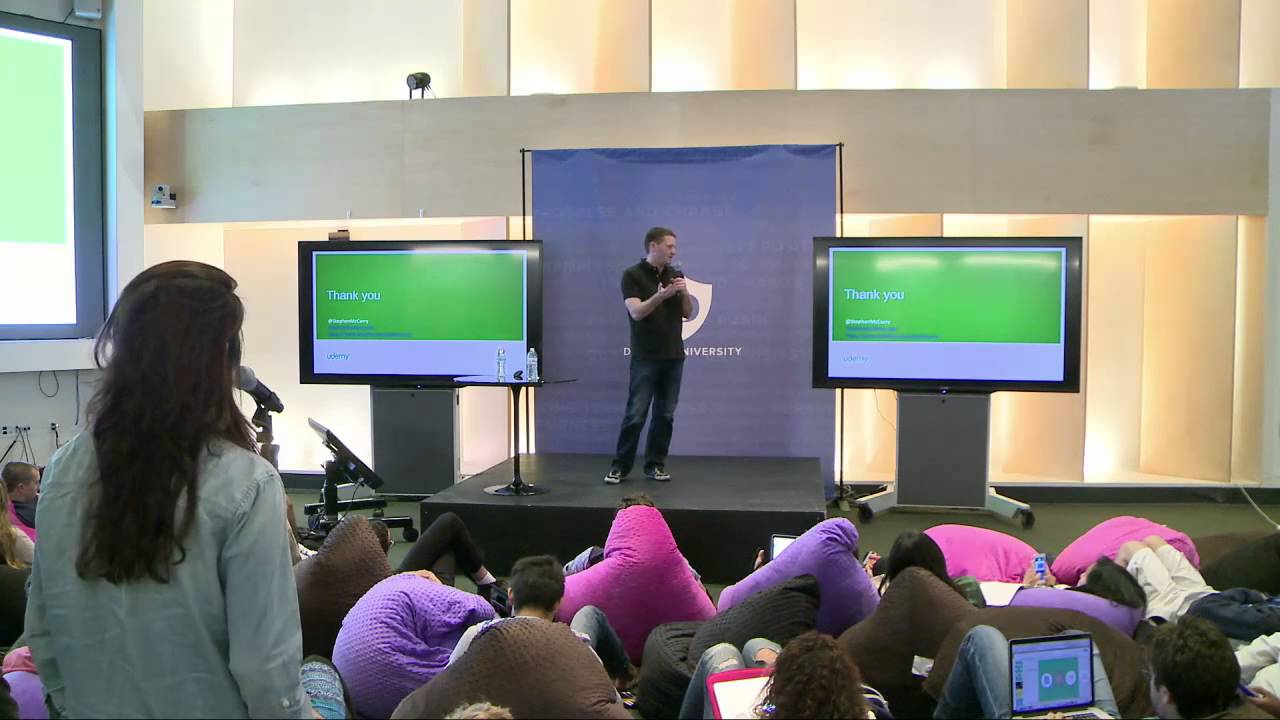
In this live Q&A, Stephen McCurry, Udemy’s Director of Product Management, discusses the challenges and strategic choices shaping Udemy’s online education platform. He explains how learner motivation and low completion rates drive a shift from passive video‑only content toward interactive, in‑browser coding exercises that blend video with hands‑on practice. He addresses the role of assessments and certifications, noting their importance in Asian markets and B2B corporate clients, while acknowledging Udemy has not yet built a dedicated testing product. Quality control for instructors is covered, emphasizing basic production values, engaging delivery, and content relevance. McCurry outlines why Udemy initially focused on development, IT, and entrepreneurship courses, describing the marketplace as still in an early‑adopter phase despite 7 million users worldwide. He contrasts Udemy’s pure C2C model with hybrid C2C + B2C approaches, arguing that not creating content in‑house keeps costs low and preserves scalability. Funding history, recent $65 M Series D round, and the prospect of an IPO are discussed, highlighting network effects and valuation considerations. Growth tactics such as SEO, content marketing, pricing‑friction reduction via site‑wide coupons, and cautious paid‑acquisition are detailed. Finally, McCurry shares his view on partnerships, advising startups to see large platforms as collaborators rather than competitors, and confirms Udemy will remain a fully digital, impulse‑purchase‑friendly marketplace without an offline classroom component.
Chapters
Yeah, so the first part is around motivation. It's definitely true. A lot of people enroll in courses. They don't even start the course. I mean, that's true. Very few people complete courses. That's true across all online education. So motivation is definitely an issue. And we can segment our customers in terms of a sliding scale of motivation. There are probably things that we can do in the product, and we could definitely do a better job of motivating people. But ultimately, this is like a personal thing. Are you motivated? Like, how badly do you want to learn this skill? And then, you know, if you look at the website today, it's primarily video delivery, right? So kind of a sit-back experience, watch the video, kind of like TV. We serve about 300,000 hours of video a month. So we are like one of the biggest video streamers out there. But online education goes much, much further than video, right? It's much more interactive. And you can see a lot of startups now working on pieces of the interactive experience. Duolingo is one that's been very successful. So recently I launched a product that is an in-browser coding experience. And we're blending it with the video. So in the video, if we're teaching HTML, the next lecture is an actual practical exercise. And I think the future of online education is much more interactive, and it's blending video learning with more practical learn-by-doing.
So what do you think about tests at the end of the course to see whether or not— to show proficiency?
Sure. It's a controversial issue, right? So does passing the test indicate learning? Well, it's one of the only tools we have today to assess learning. But is it really assessing learning, or is it assessing your ability to pass a test? And that's a very controversial issue. We haven't focused it on testing at Udemy.
Okay.
I think we will build an assessment product because in certain markets, Asian markets for example, assessment and certification are actually really strong kind of business drivers and reasons for people to enroll in a paid course. But we haven't focused on it yet. Another market where assessment is important is our B2B market. So we package the platform, we sell it to big corporations, And they want to know what is the ROI of this platform. And assessment is one way of doing that because we can say, look, people started here and then they took our courses and then they ended up here. So they increased their learning by using our platform. So that's another area where assessment is important.
Okay, thank you very much.
Hi, Steven. So my question will be more about the quality. So what are the quality assessment metrics that you have?
Because you mentioned you have a process Yeah, so, and this is a constant iteration, right? So, you know, the criteria looked very different last year than it does this year. But we did a lot of customer research, and the biggest thing that people complained about was boring instructor. I mean, it makes sense, right? If you're watching a video, can you understand the instructor? Is the instructor boring? And this isn't traditional education where, you know, you kind of sit in this—
You have to bear with a boring instructor.
Yeah, exactly. You're sat in the lecture hall and you don't really have a choice, or you kind of do, but nobody walks out of the lectures, right? But on online education, this question of motivation, like, people have short attention spans, and if they hear this boring instructor, they just switch off and walk away. So a lot of the issues are very, very basic, like audiovisual, You know, did they have the right recording equipment? Hopefully this microphone is working well for this presentation.
Hello, hello.
Right, it's like, it's very, very basic stuff, and we spend a lot of time educating instructors how to buy the right equipment, how to use the right equipment, how to light the room properly. And then we go on to, you know, is the content, you know, at the right level? Like, is it interesting? Is it actually teaching people something? And that's harder to measure, but we're starting to move into that area now.
Okay, so another question is like, so what do you think are the categories to start content creation best for this marketplace? Like, because I think there must be some. So it's probably harder to start from like all the yoga courses than coding courses, for example.
So completely, yeah. And, you know, I attribute a lot of the success and the early traction So the focus on development courses like IT, software development, programming, and entrepreneurship/business. And if you think about the early adopter market, especially in Silicon Valley, those are the topics that resonate with the people in this peninsula, right?
Yeah.
And those were the early customers of Udemy. And even now, we have 7 million students from 190 countries. We're still at the early adopter phase. The market for this product is big. billions and billions of people. So 7 million people is actually not a big number. It's a very small number. And I would argue that in all the countries that we're in, we're still at the early adopter phase in all of those markets— Germany, Spain, France. These are people that are digital natives. They go and search for learning in Google, and they find— they found Udemy.
Thank you.
Hey, Stephen. So between like pure C2C business model and the C2C plus B2C business model for marketplace, which one do you think is better? Especially in the context of the home rental market, especially like in China, there are some like Airbnb. Airbnb is not doing well in China, so some competitors competitors in China, they kind of introduced that kind of B2C plus C2C business model in China. Do you think that's a good choice?
Can you give me an example of how they're different in that context?
Okay, so in China, they are not doing a pure C2C marketplace. Some of them, they just use, for example, I take your apartment, And I just rent this out to others. So I take charge of that.
Yeah, and this is my point on defining the marketplace. The rules that you set and the things that you take on as a marketplace versus your suppliers or your customers completely changes the dynamic of the marketplace. And in our case, we chose not to create content. And that's critically important to our success. Because if you look at companies, one of our competitors, Lynda, got acquired by LinkedIn recently. They create all of their content, and it's a huge operation, it's a huge expense, and it makes it so that it's very hard to make education accessible because you have this burden that you've got to pay back or continue to operate. So you really have to think about what are the pros and cons, like in this particular context, What are the pros and cons? Perhaps in this context, you can better control the quality and safety and trust is a big issue maybe in China. And because of Airbnb's model, they're gonna struggle to overcome that key point in that market. I don't know, I'm kind of guessing. But you have to evaluate. There are definitely pros and cons with each rule or each thing that you decide to do. and what is most applicable in that context, in that market.
Okay, thank you. Hi, you mentioned that you're still in the early adopter stage, but I'm just curious as to what's your plans for the expansion? Like more specifically, are you planning on going to like K-12 and the higher education?
If not, why not?
The answer to the last point is no, not at this point. So I feel that lifelong learning is a $100 billion market. We're just scraping the surface in terms of that market, even though we have customers in every country. The key thing, one of the key things for our success is focus. Really focusing on the core market and just keep iterating on the core market. We could have gone off and created an assessment product. We could have gone and focused on different markets or different, you know, K-12, for example, is a huge market. We chose not to, and I think that's made us more successful. And I still think there's a huge opportunity in lifelong learning. Markets are all— it's all relative. We've got 7 million customers. When we have 100 million, maybe then we'll start thinking about other markets.
Got it. Thank you.
Hi.
So seeing that Udemy is encouraging creativity through course development, How do you see this model translating into disrupting education inside the classroom?
It's an interesting question. So, you know, I think following on from the point that we're not planning anything in the K-12 market, you know, our focus is really that segment of people who want to stay current in their jobs. They're adults. They want to improve their skill set, stay relevant, or get new jobs. And a lot of our customers are just, they're just, you know, we call them knowledge seekers. They just want to learn. And I'm sure like a lot of us would kind of associate with that segment. You know, typically when you speak to them, they're people where their families value education and they've told them from an early age, hey, you've gotta keep learning. And they tell us things like, you know, learn until you die, right? If you stop learning, you're dead. You know, it's like these kind of very strong words That's a reasonable segment of our market. We're not planning to address the schools market, and I think we'll leave it to other players in the marketplace like Khan Academy to do that.
Thank you. Hello, Stephen. When I came here first time, I was I was about to ask you, like, how did you manage to raise the $1 million with 500 Startups in the seed money? But then I was realizing, like, okay, I think it was because of the competition, Codecademy and Coursera. And then I realized that they actually appeared way after you. So then I started realizing that the brand, maybe it's not so hard right now. And I saw that Last month you raised $65 million also in a D round. So is the objective of Udemy right now putting more branding outside and putting the people think more about Udemy and less about Codecademy and Coursera, or more about like maybe launching an IPO or something like that?
Yeah, I think it's an interesting question. So I think in the early days, and it was a real struggle, I heard that the round B you know, Aaron presented the idea to 30+ VCs and got rejected. I mean, it was really like nobody was interested. And then when we did our round D a few weeks ago, everybody wanted to give us money. I mean, literally like everybody was throwing term sheets down. So, you know, things change over time. And what changed? Well, you know, it's that network effect. You know, starting a marketplace is extremely difficult. But once you get to a certain velocity in the marketplace, they're almost impossible to stop. And that's what the investor sees. The investor sees that, okay, 2, 3 years ago, if I had $50 million, I could create a competing marketplace and beat your marketplace.
Right.
That can't happen today. At least the investors believe that. And to your point about IPO, you know, it was stated by our investor at round D that one of their reasons for investing was that we were going IPO. That's in one of the FT articles about our round of funding. So I definitely believe, and one of the problems with funding is when you fund to $65 million, it makes it very difficult for anybody to acquire you.
Yeah.
Because the valuation, our competitor was acquired by Lynda for Lynda was acquired by LinkedIn for $1.5 billion, which was 10x their gross revenue for that financial year. So multiples and everything, there were very few people who could pay that kind of money to acquire a company of that size.
Can you say the value of the company?
I can't actually, but I think there's a good comparable there. We raised $65 million and Lynda sold for $1.5 billion. on $150 million revenue.
Thank you.
Hi, Steven. My name is Tunde. And I'm also like— I like your presentation. I'm thinking of— I'm going to create a startup targeting lifelong learning as well. And I would like to know what would need to happen for, let's say, for you to partner up with my company in such a way that I get your content, but I deliver them in a different way to my users.
Okay. I mean, we should talk after this, but the content, I'm not too sure. What I will say, I speak more generally, there are problems that I want to solve as a product manager, things that are missing from our product set. And, you know, I have a limited resource in the engineering groups, and we're focused on our core product. When people come to me and say, hey, I've got this complementary product and it makes sense for your customers, do you want to partner? That makes complete sense from my perspective. And I think that's good advice for anybody thinking about startups. You shouldn't look at bigger companies as competition. You should look at them as potential partners. And if I can throw some money at it and partner with somebody who's who's got a working product, that's easier for me than building it. So definitely think about it. I'm not sure about this specific product, whether it makes sense. We'll have to talk about it. But definitely think about bigger companies as an opportunity, not a competitor.
Thank you. And my second question is about competitive advantage. So also, I'm doing my MBA, and it's targeted towards education. And I was doing some research, and I met with the CEO of Edureka. They do something a bit similar to you, but they just target professionals. So they get professionals from Google and stuff, Microsoft, and they get to teach courses. So how do you view competition in this landscape, and how do you differentiate yourself?
Yeah, I think to me, online education is a very nascent market. It's like we're very, very early, despite some of the vanity numbers that you see thrown out there. We're still really early. And I'll tie this back to the marketing question that was asked earlier. We are thinking about mass marketing like TV ads and radio ads and growing the brand, especially with our funding now. But it's a really early market, and I don't see Udemy competing head-to-head with Lynda. I think if you look at it from an individual customer's perspective, they're not trying to decide, will I go Lynda or Udemy? Firstly, do they know online education exists? Did they know they could learn things online? And probably 90% plus of this country don't know that online education exists. And that's what I'm talking about around early adopter market. The people that we're attracting are people that are doing Google searches. That's not the mass market. So when you get to TV advertising, I heard Curious advertising on NPR Radio this morning. Once you get to mass market, then you start tapping into beyond the early adopter.
Hi, Stephen, me again, sorry. I'm wondering, so very interesting, does Udemy consider providing an environment that is similar to offline classroom environment? Because I think like the biggest difference between online and offline is offline is a total package. So you have the You have your course, you have your classmates, you have discussions. And one of the challenges for online education is people are interested, they are taking courses, but during the period they just drop off.
Yeah, I think it— I mean, the answer for Udemy is no. We won't go offline. We'll let other people tackle that market. So General Assembly is one of those offline education providers. To me, I'm a digital guy. I worked in e-commerce for a while with a physical product, and I had to visit warehouses and all that stuff. No, no, no. For me, it's gotta be pure digital, and there's so little friction in a pure digital product. People, when they're assessing an offline product and say it's $1,000 for a 10-week course, That's a real decision. It's a life decision. Maybe you'll speak to your wife or whatever, make a decision. When a course is $10 and it's going to teach you how to code iOS development, that's an impulse purchase. And it works really well in the digital world. So, are those people who pay $10 motivated to then go on and complete that?
Mostly not.
Unfortunately. But from a business perspective and a product perspective, it works extremely well.
Hello.
Can I—
Last question, guys.
Awesome. I would love to know more about the— are there periods for Udemy that is stagnant? Like the users are not growing and things like that, right? I wanna know a little bit more about how did the breakthrough happen?
Yeah, so definitely yes. I mean, that happened. And fortunately, when I came in, my job was to scale the business, and that's what I've done previously. So by the time I arrived, things were much more rosy. But even, you know, there was a period last year where things kind of looked a little soft and we had to refocus our efforts around growth. But in the early days, I'll give you an example of one of the breakthroughs. Um, you know, was in our promotion strategy. And we have a lot of courses at different prices. And it, it's this idea that in a marketplace, what you're trying to do is reduce friction, right? And, and the same is true for many digital products as well. Um, price is one of those friction points. And one of the things we did is we had a widespread scale, like we had a sale, sorry, we had a coupon that was applicable to many of the courses on the site. And last year we created a product for a site-wide promotion and had a specific fixed price point for most of our courses across the marketplace. And what that's doing is reducing friction. So again, if you're on our marketplace and you're looking at a course that's $300, and you're comparing it to a course that's $50, how do you make a choice? It's a process of thinking about it, researching it. But if everything's $15, it doesn't matter. Like, you've taken one piece of friction out of the equation.
Okay. Are there— what other ways did Udemy use to market itself? Like social media or whatever?
Yeah. Channels are important for us. SEO is reasonably important. Recently, we were doing more on the paid acquisition side. But I would definitely caution against doing too much on the paid acquisition side without really being on top of the numbers. Paid acquisition can be this bottomless pit where all your funding goes into paid acquisition. And actually, what you're doing is pushing people to the leaky bucket where people arrive at your site and disappear. And you've wasted your paid acquisition. So a lot of startups can go the wrong direction by putting too much money into paid channels. But really it's about how do you, in your idea, your concept, how do you find the channels that are lowest cost of acquisition and how do you maximize on that? And when you see things working, double down, double down, double down. So at one point, I'll give you an example. Half our traffic comes from our blog. And at one point we had 50 copywriters writing blog content. So we doubled down, doubled down, doubled down. We were writing a huge amount of original content. But what we realized is that most of it wasn't that good and we didn't want to get penalized by Google for looking like we were just creating a lot of content. We changed focus and now we focus on quality. And as we cut away the 80% of our content, actually our traffic went up because the rest of the content ranked higher in SEO. So those are some of the growth channels. We've really tried to leverage all of the growth channels. But when you see something working, you know, double down, double down.
Thank you.
More from Tim


He Sold His Car to Build This Startup, Then Pitched It for $1M 😳 #Startups #AI

This Startup Moves Your Crypto BEFORE Hackers Can Steal It 😳 #Crypto #Cybersecurity




15 Months Without Refrigeration?! This Startup Thinks It Can Go Global 🥥 #FoodTech #Startups



