Assorted Q&A Session | Bloomberg Radio & TV Anchor Cory Johnson
Bloomberg's Cory Johnson answers questions on due diligence, IPO honesty, and tech valuations. He warns that any pre-IPO falsification leads to fraud charges, compares current tech valuations to the 2000 dot-com bubble, and describes his investigative method: raw SEC filings and government documents, visual network diagrams, and tracking inconsistencies like Tesla's Model 3 timeline.
Chapters
It's an issue that I have. Most of my time at Bloomberg, I've been faced focusing on the technology arena and not on Fed policy. Now that I'm doing this radio show every day, I spend a lot of time talking about Fed policy, but I haven't. I've spent a lot of time doing work on what's going on with the economy. I haven't looked for conspiracies among the Fed governors about why they might not be raising rates or indeed why they're.
Hi, thank you for coming.
But I'm open to if you have some reasons I don't know about.
Hi, thank you for coming. I'm a filmmaker in New York. We have lots of things, similar cases like this in film industry because people don't sign contracts. So I'm curious about how you advise on doing due diligence on people. Because I think oftentimes you could find their profile online or all kinds of things. from your friend, but could still be a FOB. And that happens a lot in my industry. I just got a message from my friend who just, they ran off with some money and they don't know what to do. And usually artists have no idea how legal system works at all.
So there's an— I'll tell a brief story. There's a stock that I was short some of, and the stock was going against me, and one of the partners— I worked at a firm that had, we were running about $2 billion, and I had sort of the smallest amount of money at the firm. And one of the names was going against me, and one of the partners at the firm said, give me a write-up about this company. And so I gave him a write-up, and I was talking about the precursors to the company. One was called ABC Group, and one was called ABC Corp. And I wrote a 10-page thing, and on page 2 I called it ABC Group, and on page 9 I called it ABC Corp. And my boss comes back to me, the partner of the firm, he comes back and says, On page 2, you said it's ABC Group, and page 9, you said it's ABC Corp. Which is it? Why are you wrong? I think they changed the name. I'm going to look it up. I'm going to check. I'm going to find out. It was different in different places, and I couldn't figure it out. I went to him. We go to work at 4 in the morning, so this is like 6 o'clock at night, and I'm just pulling my hair out. I'm scared to death and not sleeping. I said, look, I'm just confused.
I'm—
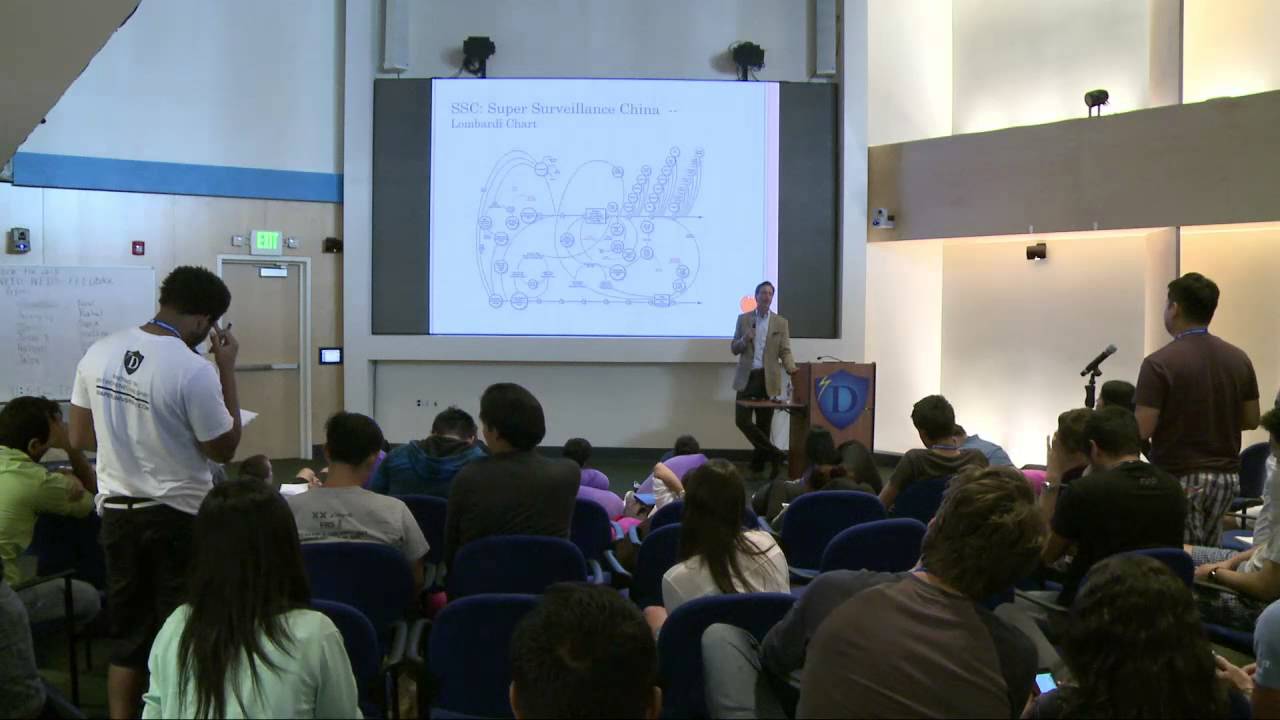
and he yelled at me this line that I gave you guys before. He said, I know you're confused. You're confused because they're trying to confuse you, and it's fucking working. Figure out what's going on. And I turned around. I thought, I'm fired. My wife's pregnant. I've got a mortgage. I don't have any money. And as I'm walking out, I look at this piece of art on his wall by an artist named Mark Lombardi, and it was a drawing that looked a lot like this. But it was nearly this size. And I went back to my desk and I was thinking about the drawing. And I go back to my desk and I'm going, what am I going to do? So I go to the photocopier and I pull out a big piece of paper and I draw ABC Group and I put a circle around it. And I write ABC Corp and I put a circle around it. And I write everything I know about ABC Group from the documents I can find and everything I knew about ABC Corp. And lo and behold, Everything in ABC Group tied to the chairman, and everything in ABC Corp tied to the CEO and his brother and his wife's brother, and the other one, one of the chairman's son-in-law, and this firm they were moving money through, if not laundering. I suddenly realized that this is a partnership that was set up to look similar, to give similar control over this corporation. That's when I started doing these kinds of drawings to figure out how these companies work. So it's a long answer to your question about how do you find out who your investors are and what their connections are. Take a little piece of data and just take a note. Figure out where it goes. You don't have to organize it this way, but do the work. Find out what you know. Put it down on paper. Divorce your sort of— don't make connections where there aren't connections, but see where the things land.
Thank you. I'm interested from a founder's point of view. Let's say we're in the position where we are going to go IPO, pre-IPO. There's a fine line between making your accounting and things look good and misrepresenting what you're doing. So from your perspective, as advice to us, what would you recommend? You know, how much do you fudge the numbers, and then how much is too far? Like, because brutal honesty probably wouldn't be the best policy.
I completely disagree. You want to be honest to a fault because, because it's, it's gonna bite you in the ass. It's gonna— it's— if your numbers aren't right, You're going to be gone, and you're going to have nothing to show for it. The first time an investor finds a number that's false, they're going to have a big problem. The second they find a number that's false and that you knew about it, you'll just be out. That's fraud. Furthermore, if you start telling lies about your own business, you're not going to know when you have problems that you've got to fix. You're going to start to believe those lies. You've just got to be brutally honest about this stuff. If you're at a pre-IPO stage and you're fudging numbers, you go to jail. Or you certainly run that risk. Or you ought to. The law would suggest that you would. People probably aren't jailed for all the things they should be, but that's the consequence of that kind of thing.
That's exactly the answer I wanted to hear. That matches my morals in life as well. It's just the concern— everyone's laughing because I'm so moral in that area. But it's the business marketplace. People are screwing each other over. So it's more like you have to fight to a certain level. So you feel that in the market, if you are taking that approach, the honesty and the actual moral with investors does pay off, and that is the best approach?
I mean, I don't know how a human has a choice. Like, you have to tell the truth. Like, that's—
You see so many of those phenomenally successful companies like Groupon, et cetera, and you're like, really? It's like, it's quite a surprise that they were so fraudulent.
You know, I'm not saying it was fraudulent. I'm just saying that the numbers didn't— it didn't prove to be the— you know, they were afforded the trust as if they were someone who was brutally honest or the company was really trying to do things. They were valued like Facebook when they were pushing every limit, every line that they could to make things look better than they were. That's the fault of the investors as much as it's their fault.
Okay, thanks very much.
Hello, nice to meet you. I just wonder, do you mind sharing your perception if we are approaching another tech bubble, and if so, how does it differentiate from the year 2000 bubble?
So the question, are we in a bubble? Probably. I mean, there's some valuations that don't make any sense, and there's a lot of them. And there's a big, you know, the knee-jerk reaction is every time they say it's different this time, it's not different. Well, it is different every time. There was a bubble in profit-free internet stocks and the IPO offerings of young companies in 1999, 2000. There was a bubble in new home construction and the securities instruments that were created to fund those new home constructions so that people were buying, taking out 3 and 4 subprime loans for 3 and 4 houses, and that was a completely different bubble.
Yeah.
Right? So now we're in a bubble where we've got some companies that have— that are pre-revenue with multi-billion-dollar valuations. You know, and there isn't one, right? There's, by some counts, over 100 companies in the private markets that are venture-backed and valued over $1 billion right now. Surely some of them, if not many of them, are not worth it. And a big part of our economy here in Silicon Valley and San Francisco is fueled by the investor money going to these companies that don't have any revenues and certainly don't have any profits. And so that's not just going to affect those companies when that money goes away or they blow through that money. That's going to affect their landlords. It's going to affect the restaurants they shop in. It's going to affect the Uber drivers who are driving them around from meeting to meeting to try to raise money from the investors. That's going to affect the— that's going to affect the Coffee shops everywhere because the traffic in Silicon Valley is greater than it's ever been, just like it was back in '99, setting records. So when or how will it end?
I don't know.
This is the advantage of being a journalist. I'll make a lot less money, but I don't have to figure out exactly when it's going to change. There are a lot of reasons why things are different right now. And I don't know if it's even real estate that's going to change. I found something yesterday that 60% of all new car loans are an extended period. So they'll take a car loan— this is back to our how long is a tractor good for, right? Car loans are usually 60 months long. 60% of all car loans in the US in the last year were 72 months, which is effectively subprime. The automotive industry is creating as many jobs, more jobs than the technology industry right now in America. And yet 60% of the loans are being driven by these subprime unsustainable ways where the cars— what's going to happen when these cars are 60 months old and they've got a 72-month loan on them? That doesn't end well. So who knows what's going to cause this bubble to burst? But there's a lot of things that are overvalued, and it's affecting the broad economy. I think that's true and hard to argue. Last question, then we'll— What do you got?
Come on.
Thanks, Tunde. This better not suck.
That's too much pressure. I don't want it. No, no, come on.
What do you got?
I'm just kidding. So you talked to her a little bit about like putting in the work and doing the investigating yourself, but you said yourself that a lot of it is not publicly acknowledged and they kind of shirk over it in reports. So where do you do a lot of your digging? Is it public records? Is it government filings?
Raw data. So this is the thing that makes me— so I had a woman that worked with me for the last 2 and a half years. She actually just left this week. And I trained her how to be an analyst. She was a really good patent analyst when I hired her. She had an interest in journalism as well. I took some of it. And when I would ask any of the reporters around me or the producers in TV to help me with some research, they would bring me reporters' stories other reporters had already written.
Right.
Where they had summarized things, often summarizing summaries. Like one reporter reads the press release and writes a short version of that press release as a story, and then gets a quote from someone to respond to the press release. And then some— then my producer would give me the distilled press release, which is already a distillation and even a lie often, or at least trying to steer me towards something, and then give me a summarized version of that. And I go back to where's the raw document? Where's the SEC filing? Where's the government report? What are the numbers? I build elaborate financial models of most of the big companies that I cover. How— what do the numbers look like? You know, the reason Elon Musk hates me is because I can count. And I do all the work on how poorly his company is doing or how much money his company loses or how they keep missing estimates. When they come out and say, It's really exciting. Our Tesla Model 3 is going to be released at the end of 2017. I'm the one that says, hey, wait a minute. I've got a document here. The last time you spoke about this, you said in the second half of 2017. You didn't say December 31st. And they say, well, we said second half. Well, before that, you said it was 2017. You didn't say it was second half. And so then when the CTO goes to give a speech and I can find the slides on a website, of a US government office that he gave a speech at, and it shows Tesla Model 3, 2018. And I call the company and say, what the heck, Shrek? You said 2017, and then you said second half, and then you said late, and now I got a slide that says 2018? Well, where do I have all this? Because I've got a copy of the magazine article where Elon did an interview in England when he said 2017, and I've got a copy of the transcript from the conference call when he said second half. And I got the other conference call where he said end of 2017. And then I've got this, this PDF file of a presentation that they did of this, this, this Energy Department speech in, in, in DC that the company didn't release. It shows us 2018. So the company says, oh, well, we're still on schedule for full production in 2018. And then I can go on TV and say they're pushing the schedule out. And that's by finding the original documents That's by finding stuff that's in different places online. Sometimes it's a PDF file, sometimes it's a magazine article, and sometimes it's an SEC filing, and sometimes it's a company press release. But it's my job, it's your job to pull information together from disparate places. If someone was going to hand it to you already finished, it's already been done.
Right.
That's where your opportunity is in business. That's where your opportunity is in journalism. That's where your opportunity is as a financial analyst, is to pull together different pieces of raw information. And understand things in a better way.
Awesome.
More from Tim


He Sold His Car to Build This Startup, Then Pitched It for $1M 😳 #Startups #AI

This Startup Moves Your Crypto BEFORE Hackers Can Steal It 😳 #Crypto #Cybersecurity




15 Months Without Refrigeration?! This Startup Thinks It Can Go Global 🥥 #FoodTech #Startups



