Backing up your Hard drive via DNA Sequencing | Founder of Cambrian Genomics Austen Heinz
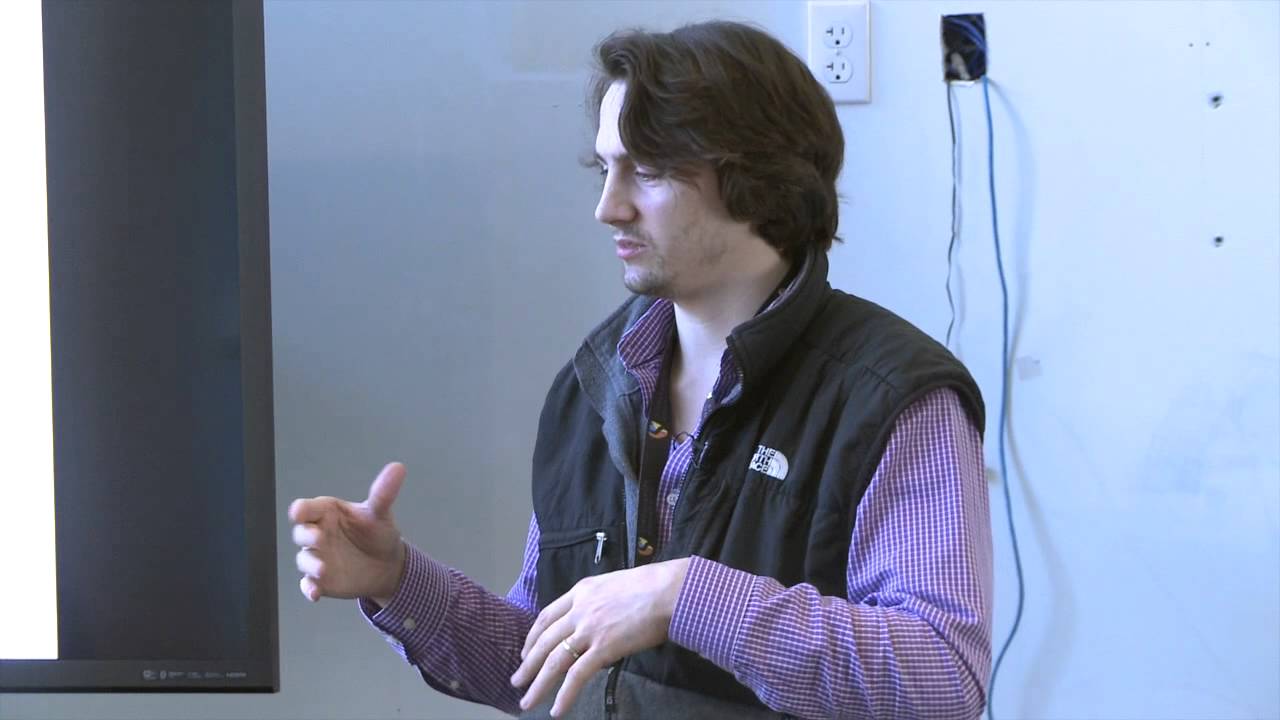
Austen Heinz, founder of Cambrian Genomics, demonstrates storing digital data in DNA. He encodes an AngelList page into genetic material and explains how DNA offers extreme information density and can preserve data for thousands of years, trading speed for permanence.
Chapters
So this is the first gene that we made. This is called mCherry. Do you know why it's called mCherry? Because it looks like a cherry. I'll give you guys some free samples. If you want your poop to turn red, just eat it. Actually?
Yeah.
And actually, I have Tim Draper's actual— his AngelList page. stored in DNA here. So I took the HTML website, converted it to 1s and 0s, then took those 1s and 0s and converted it into, well, A, T, C, and G, right? So you can take any bit of information and can store it in DNA. Why would you— why the hell would you want to do this?
Well, because—
This hard drive here, or this USB drive, how long does it last? Who knows? How long does the information that's stored on that— if I just close it right now and I don't open it up again, how long will it stay?
5 years.
Yeah, 5, 10 years at most. So all your Facebook photos, you better hope that they stay in business and that they can afford to keep redoing and reloading their servers, and rewriting to memory. Because if they don't, the electrons escape and all your information is lost. So maybe it's a good idea, in case Facebook servers get hit by an asteroid, to put all your Facebook photos in a vial like this, and it'll last a million years. And anytime you want it, you just sequence it, yeah.
Yeah, so how do you go from DNA back to digital photos?
Yeah, so you read the DNA on a sequencer, and you just have— you convert that back to 1s and 0s, and then those 1s and 0s can be, just like a computer does now, converted into text. Does that make sense? You just read it back.
Like a fairly simple process?
Oh yeah, yeah, yeah. I mean, it's a simple Python script.
Yeah?
How much could you store? In this, I could store the entire internet in a tube this size. Because DNA is the most information-dense medium. Why? Why would that be the case? Well, it's one-dimensional. It's a strand of DNA, so you can pack it extremely tight. And yeah, so the amount of info— I mean, you could store basically the entire internet in something about this size. I have 2 questions that— I'll throw this out. Anyone wants to pass it around? Will I really turn red if I eat this? I wouldn't eat that one because I poisoned it. There's some preservative stuff. So it might make you a little bit sick, so you probably wouldn't want to eat that one. But yeah, actually, and that's maybe the next application, making your poop change from purple to red to green depending on if you have a certain condition or you're sick, right? But yeah, I mean, those are the same microbes that exist in your gut right now. Those are E. coli. You already have E. coli in your gut. Okay, the second question is— If they survive your digestive system— Then yeah. So you may have to go the other way with it.
Yeah, yeah.
I met with SanDisk last month, who's the largest memory company, I guess, in the world right now. The issue is latency and bandwidth. So even though it lasts forever, the bandwidth is too slow because it takes several days to write the information, and in a couple days— well, actually, sequencers are so fast it takes, you know, a day. But if it's a lot of information, it could, you know, it could take more time. So really, you know, computers, it's almost instant that you can write to memory and read from memory. With DNA, currently, it's a few-day process both ways.
Is that something, that process, that's being speeded up?
I think, I think so.
Theoretically, can it get to the speed of computers?
I don't think it can get to the speed of computers because you're talking about the difference between electrons and atoms. And so that's difficult. But I think, yeah, I think it could become a lot faster if we have—
So in certain applications that you don't need instant transfer.
It definitely could be read much faster. There's even electronic sequencing, which is orders of magnitude faster than the sequencing that we use, which is optical. So you could— I think you'll be able to read it very fast. It's just a question of whether you'll be able to build those molecules, how quickly you'll be able to build them. Currently, it's difficult to do it in less than a day. And unless you were to go to some biological system for making these molecules, which I think is probably far off. Yeah, you're always gonna— I think you're gonna deal with some bandwidth issues of trying to get information written to the DNA and then getting it back out. And I just can't see that ever being as fast as moving electrons around.
Fair enough.
So, but if you wanna store your information for the long term, I think it's really the only way to go. So this is the Genome Compiler. This is the gene here in yellow. And this other junk, who cares? Basically, it's DNA code. And what is life? Life is nanomachines working together in a symphony. So this controls its expression, or how many of these— this particular instrument player are produced. And this is the actual instrument. Or the instrument player. I don't want to mess up my analogy. This is the electronic synthesizer we use to manufacture the DNA. And so I don't know if you can see it, but these cartridges, they hold silicon wafers like this one. So I just open this up. Ah, it's the same size. Fits right in. And my A, T, C's, and G's flow over this wafer and build my DNA strands, produce trillions of molecules on that machine. On this machine, about a million unique electrodes, so a million unique strands. So that's about 100 million base pairs since each one of those strands is about 100 base pairs long.
Yeah?
So what was 100% of that thing that you just moved over there? silicon chip, it's made of electrodes, and so say I want to add an A to 23,000 places, or 23,000 electrodes on this chip, I turn the electrode on in those 23,000 places, and I flow A over the whole chip, but they only incorporate in those 23,000 places. Like the particular color of a printer? No, no, no, this hasn't— there's no colors involved. That's the next step with the sequencing. So I don't want to get into too much detail, but the way all making of DNA works is through applying an acid to remove a blocker, or a cap, or a hat, or whatever you want to call it. So I have a DNA strand. I want to add an A to, say, 23,000 places on my chip. So I create a localized acidic environment, removes that capper, removes that blocker in those areas so that the As can incorporate. But guess what? Those As also have a blocker, right? So only one will get incorporated, right? Then I wanna add a T in all these different places, so I apply the electrode and I flow T everywhere, but they only stick to where I activate. And so by doing this one at a time, you can stack your A, T, C's, and G's on top of each other. Like I said, the problem is, is that 70% of these strands are incorrect. I'm sure anything that you could possibly imagine in your brain, you can make that real. I'm absolutely sure. If it doesn't defy the laws of physics, like, you know, from an energy point of view, anything is possible. There's nothing off-limits. So this is sequencing. This is actual images. It looks basically like colored blinking Christmas lights. This is without showing you the filters. If I put the filters on there, you'll see the blue, green, orange, yellow for the 4 different colors. This is the actual laser printing. So here we're laser catapulting DNA into a bottom collector plate for amplification and subsequent assembly. So it's blasting DNA off of that glass surface. You'll see a video I loop a couple times, but you'll see a laser blast. Basically, this is a bead that has a 100-base pair sequence. There's millions of copies on that bead. Laser blast hits it. It's ejected into a collector. So keep in mind, there's billions of beads on that piece of glass. On a single piece of glass, we can take everything that's ever been made, ever thought of in human history, and attach that DNA to a bead. And have access to anything ever made in 2 hours, which is pretty cool. This is a DNA robot— assembly robot. I won't show you this, but basically it's taking a plate of DNA where we've ejected different DNAs in different wells, assembling them into larger pieces. Here is showing you the speed of how fast we can do this laser ejection. We use the same lasers that do iPhone engraving. So you can hit 50,000 spots in a single second. That sounds like impossible, but that's physics, and it's actually developed for a different industry, but we apply it here for DNA laser printing.
How small is that?
So these are— these are actually 1-micron features. The beads are 1 micron each. We had a first gene party recently to make where we made our first genes, and our next event is going to be a commercial event. I think these are some of the people involved. Let's see if there's anything else interesting in here. You know, you can see this is— you can see the colors a bit more clearly. This is what it looks like during the sequencing. Here's what the flow cell looks like that we take a picture of. Here's actually the physical beads with the ID and Cartesian coordinate. of where they are. And basically, we're hitting these yellow dots with the laser, catapulting them, collecting them, and assembling them to make the customer's order. And of course, we've automated this process as well, so human doesn't have to sit there clicking all day. We turn the machines on, they get to work.
More from Tim


He Sold His Car to Build This Startup, Then Pitched It for $1M 😳 #Startups #AI

This Startup Moves Your Crypto BEFORE Hackers Can Steal It 😳 #Crypto #Cybersecurity




15 Months Without Refrigeration?! This Startup Thinks It Can Go Global 🥥 #FoodTech #Startups



