Be Anywhere, Anytime with Anybots | Board Member of Anybots, Tim Lenihan
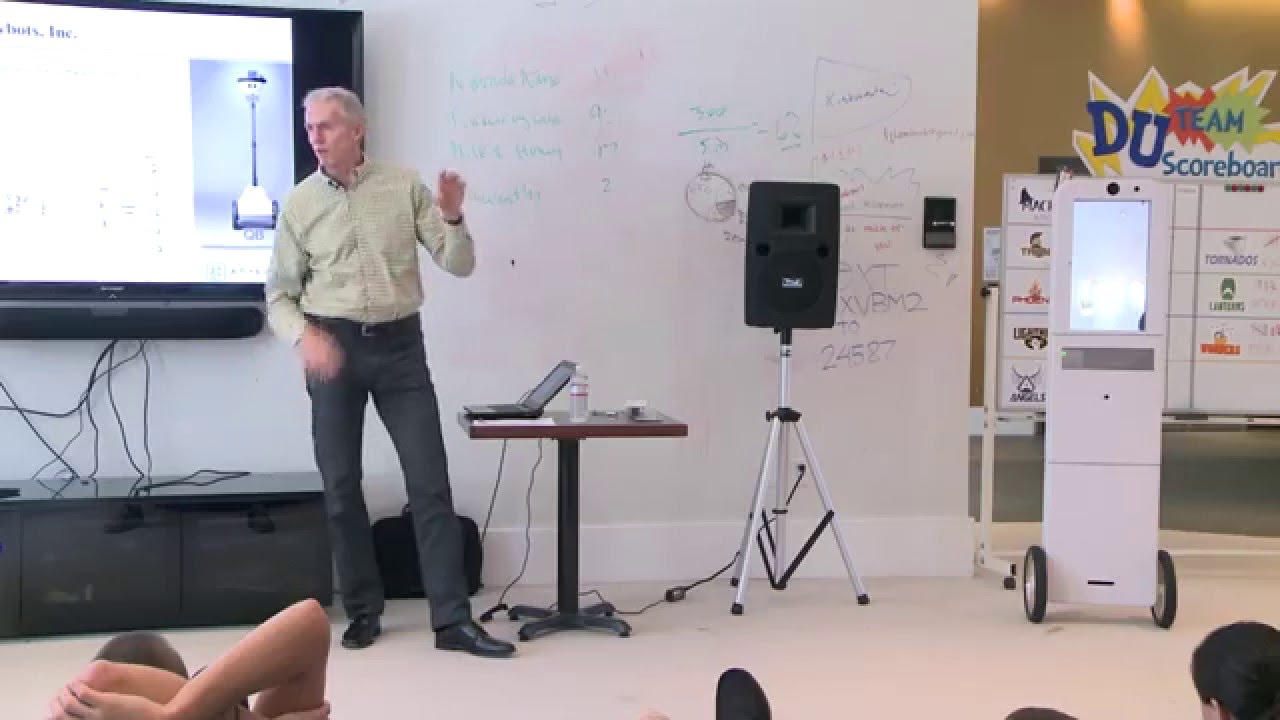
Tim Lenihan demonstrates Anybots' telepresence robots, two-wheeled self-balancing machines that let you control a physical presence remotely. The QX and QB models cost around $7,500, run on 4G, and need wireless latency under one-eighth of a second. Real uses include letting hospitalized children attend school and retail acceptability studies with Microsoft.
Chapters
We'll start with some introductions. My background is I probably started when all you guys were figuring out what a pacifier was. I started working at a robotics company back in Massachusetts and it's called PRI Robotics. It was Precision Robots at the time and we focused on automating the manufacturing of semiconductor devices. All the devices, all your RAM chips and your microprocessors is what we focused on automating. And so that business grew tremendously. When I started there, we were $7 million and the company grew and we went public in '93 and we did a secondary offering in like '97. The company grew to about $500 million in sales and we sold the company to another competitor called Brooks Automation in 2002. So, and then I went off and did a similar thing at another company and another company after that. And I was kind of, I don't know, somewhat done working, and then some friends of mine got involved with this company, and it looks very interesting, so I got involved and I helped those guys with their business strategy and figuring out how to add some value. So Nolan, can you bring out one of the guests of honor? Okay. So you guys saw these 2 robots when you came in. So these— this is what Anybots makes. And these are called telepresence robots. And you think of them really as kind of like— it's a video conferencing system, a telepresence system, and it's mounted on wheels. So you can, from anywhere in the world, you have a browser, you open up your browser, and you can control the motion of that robot in a remote location. So you can decide what you look at, decide who you talk to, where you go. Joe, you wanna drive QX over here? Yeah. The thing that's kinda unique about the 2-wheeled self-driving device is traditionally, when you think about it, you guys all have seen pictures of robots and whatever. Traditionally in robots in industry and whatnot, you have robots over here, you have a fence, and you have people over here. I don't know if you guys noticed when you came in, There was no fence between you and the robot. You guys were all gathered around the robot. The robot kind of has, because of the 2-wheeled self-balancing, it's able to be at head height. And yet, it's not going to cause a problem. If I push it away and it kind of runs back and I don't want it to be near me, I just— it acts kind of like a person. It can take about as much abuse as a person. People come up to me and they say, well, can I knock it over? And I'm like, well, if you could knock over a person, you could knock over this. So the idea that the 2-wheeled self-balancing provides really the safety system. Traditionally, what you had to do is you had to have, in order to have a robot this high and this big, you had to have a big heavy base, right? 'Cause that would keep it from tipping over. But when you have a big heavy base and you're a room full of people like this, or when you're in the lobby out there, people come in, they can, you know, the base causes a safety problem. You can trip on it. If it's moving around, it's heavy, and if it bumps into you, it might hurt you. So people like us, we don't need a big heavy base in order to be head height, right? So because we can self-balance. So the real key technology on this thing that makes it unique and makes it really kind of interesting is its self-balancing. So now you can take robots and you can put them in places where you couldn't ever put a robot before. You could put a robot Like here, we're in a classroom. You could put it in a retail environment. You could put it in a medical environment. You could put it out on the street. You could put it anywhere you like because there's not a safety issue anymore. We've had this thing on the dance floor at parties. We've had it on the playground. So that's really kind of what we make. Robotic telepresence device. And like I said, you can control it from anywhere in the world with just a browser. So theoretically, what we were going to do, but didn't have time to set it up, is Tim Draper was going to log in from his office and be on the robot, which is a perfectly acceptable thing to do. What we run in this thing is actually a Cisco telepresence system. So there's a Cisco codec in here and then a Cisco camera up top. So what's the next step? So some of the ways that these things are used, I kind of have a diagram up here. You can either, you can be at home and your robot can be your avatar in the office. One of the ways that it gets used is like for example in healthcare. We had this kid at Stanford Hospital, this 9-year-old kid named Grady Hoffman. He was going in for a bone marrow transplant. And so when you have a bone marrow transplant, you have to stay in this little room 'Cause they suppress your immune system, so you can't go out and wander around. You're in this little room, you're in there for like 8 weeks. And so he had 2 older— he was 9 years old, he had like a 10-year-old and a 12-year-old brother at their house in Los Altos. So Stanford came to us and they said, well, what if we take one of these robots and we put it in Grady Hoffman's home? And then anytime that the kid who's in the hospital wants to visit his home or go find his mom or dad or go find his brother, or whatever he wants to do. He can log into the robot anytime he wants. He's in complete control of when he turns it on. He doesn't need anybody there to answer the phone like a Skype call or anything like that. He fires it up anytime he wants and can wander around his house. So he would say goodnight to his brother who— they'd read a story together and they'd play hide and go seek and he— the robot would be the guy who had to go find his brothers who were hidden in the house. So they did that for about 8 weeks just to help keep the kid in the hospital connected with his family. And eventually they moved the robot from the house to the school so that the kid could keep up with his schoolwork and interact with his friends at school. What about stairs? It can see stairs, but they can't go up or down stairs. So it's only on the ground? It's a single floor. So it can go up, down, anything that's ADA compliant. You know, the Americans with Disabilities Act, so you have your ramps and your wheelchair ramps and that kind of thing. And if you have a place that's got multiple levels, either you have to have somebody help it with the elevator or you put one on each level. The devices are not that expensive. That other one that's roaming around here somewhere sells for about $7,500. So, you got a question? What if it falls down? Is there any mechanism that kind of automatically can stand up? No, it cannot stand up on its own, but It has a lot of technology in it to keep it from falling down. If someone comes along and picks it up and throws it down, there's nothing you can do about it. In fact, someone could come along and steal the thing. I don't know what you'd do with it, right? But so it has in it a whole bunch of technologies. It's got a set of batteries, obviously, that runs it. Then it's got a set of ultracapacitors that store extra energy. And if there's ever kind of a failure in the system, it uses those batteries to self-lead— put itself in a park position. So the problems have not been with it falling down. We haven't had any problems with that. The biggest issue with this, you guys, and you think about this, it's kind of— I mean, we run into it all the time with our laptops and our devices. It's the wireless. So this guy runs on wireless or 4G. So if you lose wireless, then you lose your avatar. Disappears, goes blank. Yeah. So as you said earlier about the balance, is the purpose actually to make it as human as possible for sort of social acceptability of robots within society? It's not so much to make it socially acceptable, but it's to make it safe so that it can be among people. And so there is some work that we've done to study how people react to these robots. And you notice the first one that's far over there has a little tiny screen. And so that was the first one that we came out with. And people get sometimes uncomfortable with a robot with 2 eyes and a little tiny screen wandering around. 'Cause you can't really tell who it is that's watching you, right? And when you do look at them, they're on a little tiny screen. So we did an experiment actually with Microsoft up in Redmond. And we took a— we used one of their tablets. as the screen, and it was at a retail event. And they first put the pilot, the person who drives, was in a dimly lit, with a big fluorescent light behind his head, in kind of like a closet driving. Kind of looked creepy, you know? I mean, it's like this some guy on the internet spying on you, right? And so that guy went out that way into the crowd of people, and the reaction was, This is creepy, right? So then they said, okay, let's try the other extreme, and they took the same person in the exact same clothes and they front-lit the guy, and then they put behind him a step-and-repeat pattern of Skype and Microsoft, so he looks like a newscaster. So then the reaction is completely different when he goes out on the retail floor. Everyone's like, hey, hi, how are you? So it's— we have studied kind of What does it— what is the kind of reaction amongst the people where you put the robot? And how you present the person who's occupying the robot and interacting with you, how that person is presented is the most important element, right? So it has to be safe, and then you have to get the feeling that this is an individual who I can recognize, I can see their face, I can see their facial expressions, right? Oh, we have the clowns arrived. Thanks for coming. All right, good. So I mean, that's really kind of the story with 2-wheeled self-balancing and the fact that you can make things safe and then the ability to control it over the internet. One comment on that, the ability to control it over the internet, there is some technology in that because it has to be super low latency. I mean, you think about it, you can't, Have this delay of a second or 2 before you see what happened to your drive command. It's the Mars rover problem. They had a 12-second delay between when they sent a command and between when they know what the command did. So you have to make that latency really low. It has to be under an 8th of a second in order to safely drive a robot. All right? So this is called QX and that's called QB. So, and I won't get anybody's attention until we get rid of them. So if you guys can, can you guys move them off the stage, I guess, or whatever? Can they talk though? Yeah, they have a speaker and they have microphones, so they speak and The reason why we're not speaking here is because you have a person speaking there and the microphone would be here, and then the person's microphone would hear its own voice. There's a slight delay, you have this big feedback loop. So typically the usual scenario is the person who's driving that thing is in New York and they wanted to be at an event in San Francisco and they couldn't attend, so they use the robot to attend. What's the future of the robot?
More from Tim


He Sold His Car to Build This Startup, Then Pitched It for $1M 😳 #Startups #AI

This Startup Moves Your Crypto BEFORE Hackers Can Steal It 😳 #Crypto #Cybersecurity




15 Months Without Refrigeration?! This Startup Thinks It Can Go Global 🥥 #FoodTech #Startups



