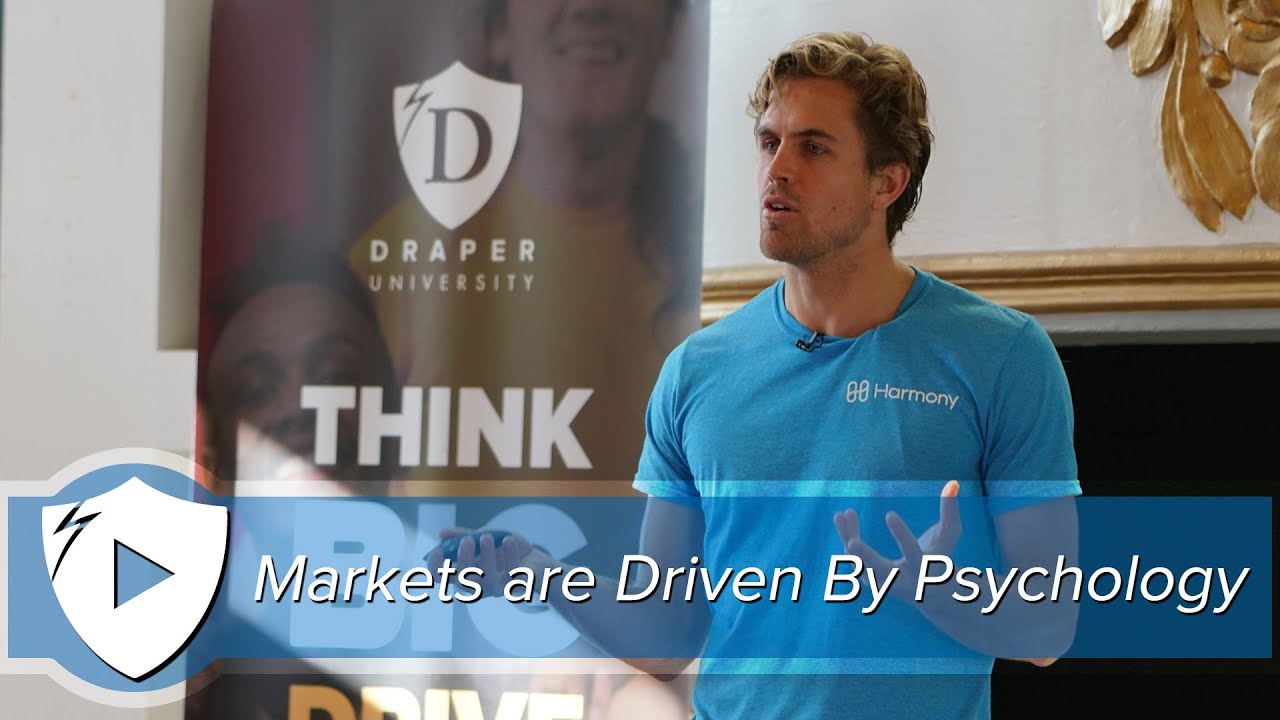
This content was created by Tim Draper. This content was uploaded by Tim Draper. This is a YouTube video titled "Bitcoin Philosophy | Harmony Founder Nick White" (created 2020-02-18) featuring Harmony founder Nick White delivering a talk on Bitcoin philosophy. The excerpt is a monologue covering market psychology and reflexivity (citing George Soros), the Bitcoin scarcity model (21 million cap and halving schedule), the "digital gold" thesis, the Bitcoin pizza anecdote, and technical/social properties of Bitcoin (borderless, fungible, censorship-resistant) along with remarks on bank control and monetary sovereignty.
Chapters
Marketplaces are very driven by psychology. They're all about what each other person believes the other people are doing, right? Like, if I see someone else buying Bitcoin because they think it's digital gold, that impacts me and influences me and makes me think, hey, maybe I should do the same thing. And we all start to think like, hey, well, if everyone's starting to think that Bitcoin is digital gold, then, you know, maybe it will become digital gold. And then it's sort of like a self-fulfilling prophecy. And, um, the— this sort of important note on Bitcoin philosophy, um, there's only 21 Bitcoin will ever exist. So, it, uh, it started out by, you know, do— having 50 Bitcoin printed every block, and every 4 years that will be cut in half. So, in half, in half, in half, until basically it, uh, it, it maximize— it maxes out at 21 million Bitcoin. So, it's really interesting that you have this kind of mathematical guarantee that Bitcoin will remain scarce, like there's actually a finite supply. Even something like gold, they're constantly finding new, you know, mines of gold, so it's hard to guarantee. No one knows what the— there should be a finite supply on Earth, obviously everything on Earth is finite, but you don't really know, you can't mathematically guarantee what the supply is. Whereas in Bitcoin, you can have kind of this perfect mathematical guarantee. There were Louis Vuitton bags like everywhere in this room, like, I don't think they would be, like, as cool or as valuable, because everyone would have them. It's sort of like leaves on a tree. Like, why aren't leaves on a tree valuable? Because, like, they're everywhere. Like, no one— they're not rare. And something like gold is a good example of something that's valuable because of its rarity, as well as some other properties which we'll talk about. But this is why people call Bitcoin digital gold, is because it's finite. And so, it's kind of like a— this rare thing that you want to own and hold and store. At least that's kind of the thesis that a lot of people who are Bitcoin investors have, including myself. And there's this other concept, which is like, how is it that something that has no intrinsic value, pretty much, how can it all of a sudden be worth like $8,000 a coin? Or even back in 2017, in December, at the very peak, it was like $20,000 per Bitcoin. When, let's say, like when Bitcoin first started, it actually had no price. I mean, it was like less than a dollar, it was like maybe a few cents. In fact, I think maybe you guys are aware of the whole like Bitcoin pizza thing, where this, like one of the first transactions of Bitcoin was actually just between 2 dudes, and the guy was like, hey, why don't you buy me a pizza, and like, you know, call up like Domino's or whatever, tell them to send me a pizza. You know, I want like a large pepperoni and I want a, you know, supreme, I don't know. And then, and so the guy bought him 2 pizzas or something like that. Obviously you can like just call, and they were in like totally different cities. I think they were both in the US, or who knows where they were. And the guy's like, yep, I verified that like, yeah, the pizza is like delivered. And so the guy's like, sweet, I'll send you the Bitcoin. And they agreed on some price for that Bitcoin. I don't remember the exact number, but now in today's value, that Bitcoin would be worth like over $100 million, so like maybe $200 million or something. So that's pretty crazy. And in fact now, as part of like Bitcoin culture, people celebrate like Pizza Day. So that's kind of funny. But the reason that something that has no intrinsic value can have value is this concept called reflexivity, which is a really cool idea that was invented by this guy George Soros. And he's a very like famous investor actually in Wall Street. And one of the things that he's famous for is he broke the Bank of England. He saw that there was sort of a vulnerability, or that the, the, the pound was like kind of in an unstable position. And he single-handedly shorted the pound and basically caused it to crash. And he made like billions of dollars. So he's this like pretty genius legendary investor guy. And one of the things he's most famous for is he sort of was the first person to start talking about this concept of reflexivity, which is the fact that marketplaces are very driven by psychology. They're all about, like, you know, what each other person believes the other people are doing, right? Like, if I see someone else buying Bitcoin because they think it's digital gold, that impacts me and influences me and makes me think, hey, maybe I should do the same thing. And we all start to think like, hey, well, if everyone's starting to think that Bitcoin is digital gold, then, you know, maybe it will become digital gold. And then the— it's sort of like a self-fulfilling prophecy. And so, and it can have the same, same effect in the, in the, in a negative way where people are like, oh, like the price is going down, this is all like, you know, BS, like I don't believe in Bitcoin anymore. And then more and more people sell, sell, sell, sell, sell. So, there's kind of a, like a double— it's a double-edged sword, but the point is that markets are like, things that, things have value because other people believe other people believe it has value. If that makes sense. It's sort of like multiple layers. And this is a big part of his own investment philosophy, and what allowed him to be like one of the most successful investors of the last like 20, 30 years. And so, some of the properties that Bitcoin has are, it's borderless, like it exists on the internet basically, or You can, you can interact with it anywhere you have an internet connection. It's fungible, each Bitcoin is exactly the same as another. It's censorship-resistant, meaning that like no one can stop me from sending a Bitcoin transaction. Because there's no one, there's no way for the miners to all decide like, hey, this one guy, he can't send money. He's not part of the network. It's very hard for them to collude in that sense. So that means that I really own my money. And it can't be seized from me. Like, you may not be aware of this, but actually the money that you own in your bank account, you don't own at all, actually. The FBI or, you know, CIA or whoever can just basically freeze it. The same thing in a lot of other countries. Like, you know, for example, I feel like— I don't know if this is in China or whatever, but like sometimes they'll just basically be like, hey, you can't withdraw more than like $100 a day. Because they're afraid of people starting to, like, cash out of banks. So basically, like, the money that you own in your bank account, you don't really own in terms of it's not really yours. That people can kind of step in and interfere with it. So, I'm going to ask you a question.