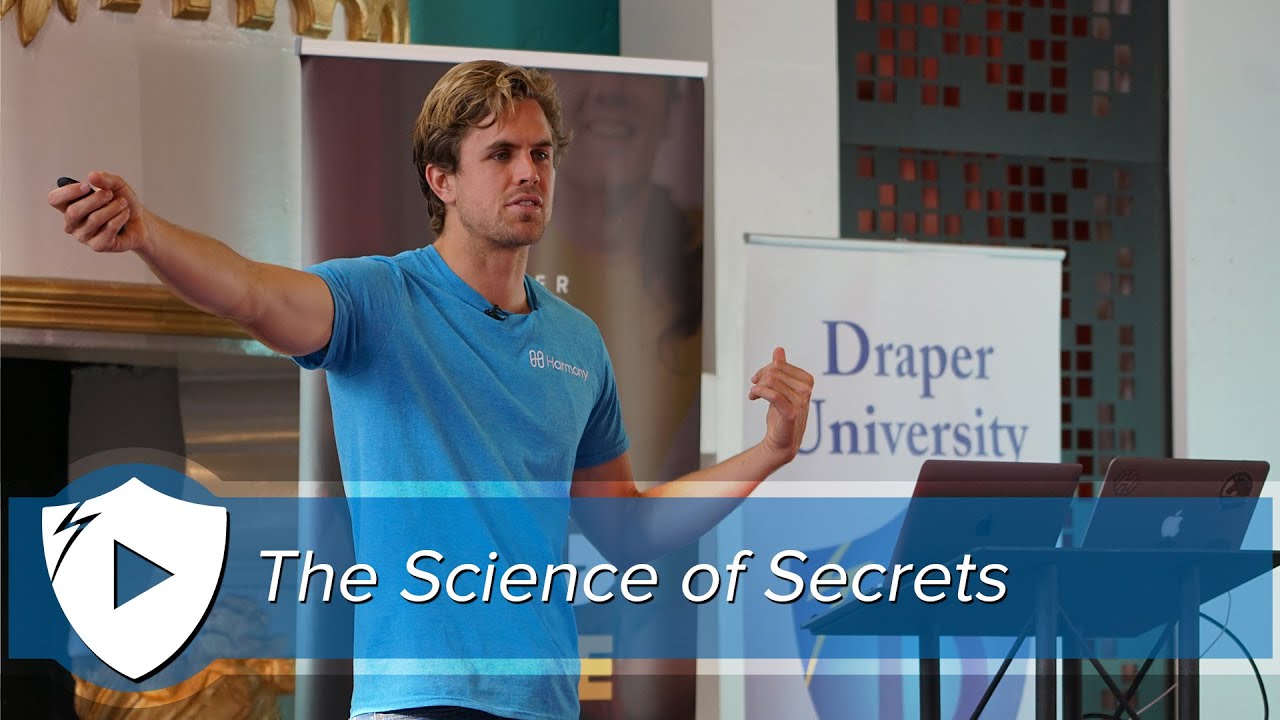
Nick White, Harmony founder, explains how blockchain cryptography works: public and private keys, hashing functions like SHA-256, and why quantum computers pose a threat. He covers RSA, Diffie-Hellman, and emerging post-quantum signatures to keep systems tamper-resistant.
Chapters
But basically, what asymmetric cryptography allows you to do, you can prove to someone that you own this private key, that you are this person at this public address, by doing something called a signature. It's sort of similar to like your own handwritten signature. You say like, I am Nick White. In order to imitate it, they either either you gave them your private key or they were able to reverse this mathematical property. So the first thing you need to know if you're talking about blockchain. Is cryptography. I'm sure you guys heard the term, like, crypto. It's often synonymous with blockchain. People just call it crypto, which is short both for cryptography as well as cryptocurrencies. But cryptography is the science of secrets. It's basically like, how can I keep a secret? That's how it started. It started all the time, all the way back, like, in Julius Caesar's time when he was sending messages to his generals. And obviously if you send a message via some courier, he could be intercepted and the message could be read, and then all of a sudden, you know, they know your military's plan and they can, like, you know, fight you and preempt your attack or whatever. And so cryptography sort of started this way, as a way of keeping secrets from other people. And it evolved actually to do a lot more than that. But another, like, example is that it played a deciding role in the outcome of World War II. So I don't know if you guys are aware of this, but you've probably maybe seen the movie about Alan Turing. I can't remember what it's called now, but it came out maybe a couple years ago. And it was all about Alan Turing creating the world's first computer, actually, in Britain, and they used that to crack the Nazis' code and also the Japanese code. And by cracking the code, they were, like I was able to— like I said earlier in the Julius Caesar context, they were able to basically know the movements of German troops ahead of time and basically sink their boats and, and all of that. So cryptography is actually really important. And in fact, like, to take it a step further, I think even the public internet right now wouldn't work if we didn't have some very fundamental cryptography. If we didn't have ways of keeping secrets from each other, then, you know, all of my texts anyone could read and intercept. Like, we wouldn't want that world, right? Crypto is very fundamental. to the digital age. And these guys over here are Diffie and Hellman. And I put them there because they're kind of considered to some degree as like the founding fathers of cryptography. They invented the first scheme for asymmetric cryptography, which is what we'll talk about in a second. And this, of course, is the first— world's first computer, built by Alan Turing. And you can kind of think of cryptography as mathematical magic. It really is. And it's just getting more and more interesting every year. Things like zero-knowledge proofs, verifiable delay functions, there's all these really cool new schemes that are being come up. So I feel like there's still a lot of potential for cryptography to grow and deepen. Um, so asymmetric cryptography is a really important, uh, piece of, uh, cryptography in general and also of blockchain. So what asymmetric cryptography is, is there used to be— so it started with symmetric cryptography, which is that like I would have something called a one-time pad, which is basically like a code that I agree on ahead of time, and I give it to my friend, and then when he goes anywhere, he can— we're kind of agreeing on this, using the same scheme to encode and decode our messages. But the problem is that I can only do that over a secure channel. I can only give him a shared secret over a secure channel. But, you know, obviously in the digital age, we don't have secure channels to begin with. We need to establish a secure channel. And that's why asymmetric cryptography was so powerful. I don't know if you guys know about RSA or— a lot of these, like, security standards on the internet, but this is a major, major part of it. But basically what asymmetric cryptography allows you to do, it allows you to create a public address and a corresponding private key. And essentially the private key and the public address have this mathematical relationship such that the private key can do some very cool things. Like, you can prove to someone that you own this private key, that you are this person at this public address, by doing something called a signature. It's sort of similar to, like, your own handwritten signature. You say, like, I am Nick White, and no one else can imitate that. Or at least, in order to imitate it, they either— either you gave them your private key, or they somehow somehow, which is against all odds, we're able to reverse this mathematical property. And this is really important for, for blockchain. Because it's sort of like a way of— it's like, it's like creating your own little like mailbox or your own bank account, your private key becomes something that is like your, your identity in some sense on the blockchain. So cryptographic signatures. It also, it relies on a really, really difficult mathematical factoring problem that is very, very hard to reverse. And how hard is it to reverse? It's only, it'll only take you 0.65 billion billion years to crack like your average strength public-private key pair, or at least, at least in Bitcoin's case, which is actually more secure. But the point is, this is like an astronomical number. This is like, like longer than the lifespan of the universe up to this point. The caveat is that there's also things called now called quantum computers. And they allow for different kinds of algorithms that allow us to kind of shortcut a lot of these factoring problems. So in some sense, perhaps this difficulty will be outdated in years to come as people like Google continue to develop quantum computing. But there's other signature schemes that will— like lattice signatures— that allow us to continue doing this, and they're not— and they're quantum secure. But the point is, it's really, really— it's crazy that I can just create a number and then have something that's this secure that no one else can crack. And this is very, very powerful. Because it means that, for example, in Bitcoin, if I'm holding my Bitcoin with my private key, I know that it's almost impossible for anyone to just like steal it from me. They can't just like wake up one day and be like, hey, I'm going to take that from you. They would have to spend more resources than any person has in the universe to get to do that. And the next cryptographic primitive that's really important is hashing functions. So, hashing function, you can think of it as something that takes any, like, an arbitrary length of data and then compresses it into a fixed length of data. So, for example, in Bitcoin's case, Bitcoin uses SHA-256, Secure Hashing Algorithm 256. 256 basically means that it creates a 256-bit output. So, everything is essentially— anything you feed into a hashing algorithm, turns into some pseudo-random string of bits that is 256 bits long. Maybe that computer science is like a little bit too confusing, but the point is that it's kind of like a— oh, and I should say that those 256 bits are very unique. And so the point is that— and it's very hard to reverse. And it's like a digital fingerprint. It's like if I took a photo of my face, and I hashed it, then if I wanted to— and I could give you the hash, and you wouldn't see the photo. And if I ever wanted to prove to you that this is the photo that I used to create that hash, you could— I could give you that photo, you could hash it yourself, and verify that, yes, this is the photo that you hashed to begin with. So it's sort of like a digital fingerprint. If that photo were modified even a small amount, the hash output would be completely different. So, he would know that that wasn't the original input, that that had been tampered with in some way. So, hashing is used for a lot of other things besides this, but the— at least in blockchain, the most important feature is the fact that it's like a digital fingerprint. And this is what kind of allows us to have this concept of tamper— tamper resistance. So, Tim,