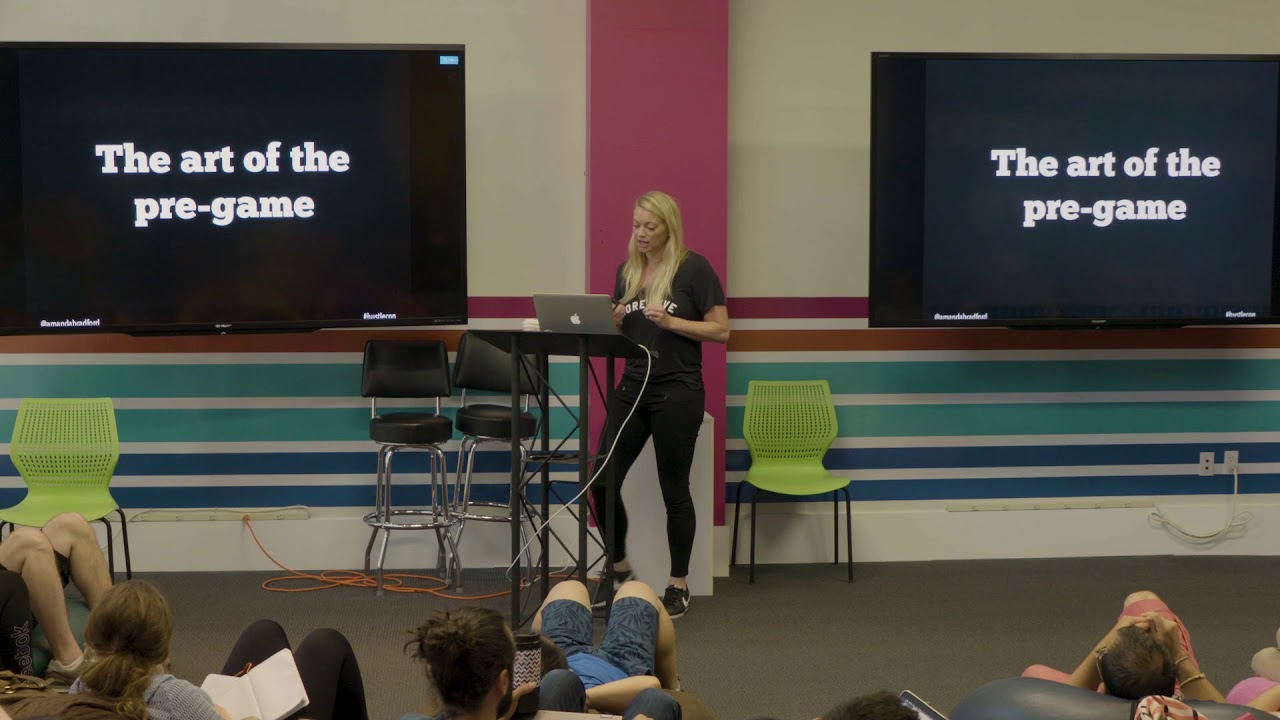
This content was created by Tim Draper. This content was uploaded by Tim Draper. This is a YouTube talk titled "Building the Invite List | Amanda Bradford" (posted 2017-09-05) featuring Amanda Bradford giving a single-speaker presentation on product launch and event-invite strategy. She defines what makes a good launch (daily actives, engagement, retention, K-factor), recommends hosting a smaller "pregame" to cultivate VIP ambassadors, and details how to build and target an invite list (identifying influencers, VIP outreach, networking, door-to-door contact, email/social blasts and paid ads) with examples from a consumer dating/product launch context.
Chapters
So what is a product launch? So you guys know this. You turn your product live, and you hope that people show up and check it out. So that's a big day. It's opening day. You put flags out. You hope people come, whether it's offline or online. That day one number of people that walk in your door is a big deal. Same with a party. You're going to have a big party. You rented out Alcatraz Island. You better really hope that people show up. So— And what defines a good launch? So I think it's the same things that you think about whenever you're kind of wondering how a product or a mobile app you're using is doing, right? You're wondering how many daily actives do they have? What is their engagement? Are users interacting and staying for longer than 10 seconds? What's the retention? Do they actually come back multiple days afterwards? And then what's your K-factor, which is kind of a measure of virality? Are your users telling friends? Are they bringing friends in? Are they doing kind of sales for you? If they're doing sales for you without you even really asking for them, that is a really good indicator of a strong product. And same with a party, right? So imagine when you have a party, you've put a lot of blood, sweat, and tears into it, and then your friends are being annoying because they don't know if they want to come, and they ask you annoying questions like, how many people are there? Is it fun? How much longer are people staying? And who else is there, right? So they're trying to assess whether or not that party is valuable enough for them to kind of get off the couch and go. And so it's the same It's actually exactly the same type of kind of a product if you think about it. And so I think about parties are an investment. So the same type of things you would do to ensure a party is gonna be a really good time and that your friends end up working to bring more people into the party, it's the same kind of thing you would wanna do for your product launch. So the benefits of pre-gaming. So I think about pre-gaming as a couple different things. One, it's a way to get people kind of in your inner circle before you have this massive, let's say, 300-person event. So when you think about a pregame, go back to university, let's say it's 5 people having drinks in someone's room before a big New Year's Eve party or something. What is the value of that? You get free booze. You get to have input on the playlist and games. You get to have real conversations with the 5 or 6 people there. You get to arrive at the party with a group. You get to charge your phone and go to the bathroom. It's a very nice vibe, right? And so then you go to this kind of crazy party and And you're there with a group of people that are really kind of already committed and bought in, right? And so that's sort of the way I think about, like, that's a good pregame is if you can kind of do all these things and then you bring those people into the actual game, the actual event, and those are the people that really kind of carry the team, if you will. And so why should you host a pregame? So I like to think about this as a way to de-risk the actual product launch or the party that you're having. So worst-case scenario, you have a you have a small pregame of 10 people and nobody else shows up, at least you kind of had those 10 people and you got your message across to those 10 people and you hopefully gave them enough value that they can go and tell the other people. So if you think about it, it's like at least you've nurtured the sort of most valuable section of your users, and that's sort of the most priority thing. It's not about if you got 1,000 people and you touched 1,000 people briefly. It's like if you had a really good conversation with these 20 or 30 people. And it ensures that then they come to the event and sort of become ambassadors for it. People feel special when they've gotten special perks or they've sort of been on the inside. They're gonna pay you back by helping you get awareness. And that's the hardest thing with any of this stuff, right? Especially if you're in consumer. So you wanna host an awesome party? I always say have an awesome pregame. And what is the pregame? So this is the hard part, right? So then it sounds easy in theory, but you actually have to build an invite list, right? And that is, I think, the hardest part on this list because you wanna be really strategic about that. You wanna think about if you're doing a free event or a non-free event, how many— what the capacity of the venue is, who you want on that invite list. I always say I had a person pitch me about— they were doing an app about hiking, and I asked them who the most influential hiker was on Instagram, Twitter, and Facebook, and they didn't know that in the region that they were launching. And to me, that's a fail. That means you haven't thought enough about your entire launch strategy because that's probably who you wanna build. Maybe they don't have any Instagram followers, but all the hikers are Facebook users. Then you may wanna double down on Facebook and ignore Instagram. So it's a lot about understanding who is gonna move the needle for your business model. For us, it was obviously singles, eligible singles. So the more eligible, the more I guess, kind of high visibility, the better. So that's kind of where we were targeting. So we made sure we had a lot of doctors, a lot of lawyers, a lot of people that kind of have clearly kind of done— really invested in themselves in education and really had a pretty acute need to— a lot of them were really looking to kind of seriously date. And that was an acute pain point that gets people to show up. So that comes to number 2, is like, how are you getting people to show up? What is their pain point that this is sort of solving? So I'll click into the invite list a little bit more. So what we did was I did a lot of the VIP approach. So this is not scalable, or is it something that goes quick, fast at all. So this took months. I mean, we started in, what, June? We didn't launch the product till November. So I was probably doing this from June through November. And I created target lists. I looked at people I wanted to make sure I got this type of, made sure I had bloggers and made sure I had creatives and people that were in the journalism industry and people that were in the Broadway industry. So we wanted to build a really diverse community of different industries. And so that was really us kind of creating these target lists, finding out different people in those networks. I always say lurk or socialite. I went to a lot of events, little events like you guys are hosting, and you just meet and exchange contact info and you find out what other people are working on. And you don't really have to pitch them there, but I think it's just really collecting information and collecting their cards and starting to get them in kind of your phone, your, I guess, whether it's your LinkedIn network, your Facebook network, wherever you're kind of keeping track of everything. And then I always say door-to-door sales. Like, you can always be doing that. You have to be, you know, I always say be very careful about that. I always say pitch a party, not a product, because no one wants to be pitched a product when you're at a party, but, or really anytime. It's not the best thing to do. So I always say like, I know you wanna pitch your product, but pitch something else correlated to your product and have them come and then let them experience it without giving them the hard sales pitch, 'cause I think that's the way to get people interested without feeling like you're selling them something, right? And nobody wants to go to a sales pitch party. They wanna go to a real party. So there's also the network approach, which is email blasts to anyone you've ever gotten their email address from, Facebook posts. I think these are less effective, but I still think you should should be done when launching a product. I always call this the I have no friends approach, which is the least effective, but I have colleagues who've done it, which is Google Ads, Facebook Ads, Craigslist postings. I think, again, it depends on what you're selling and what you're marketing, so this has worked for a lot of people. For us, it didn't work. That wasn't a strategy we wanted to employ, but I have friends that use Google Ads to even get their first user base, and they've done that. very successfully. So that's— again, it depends on the industry and the market. Thank you.