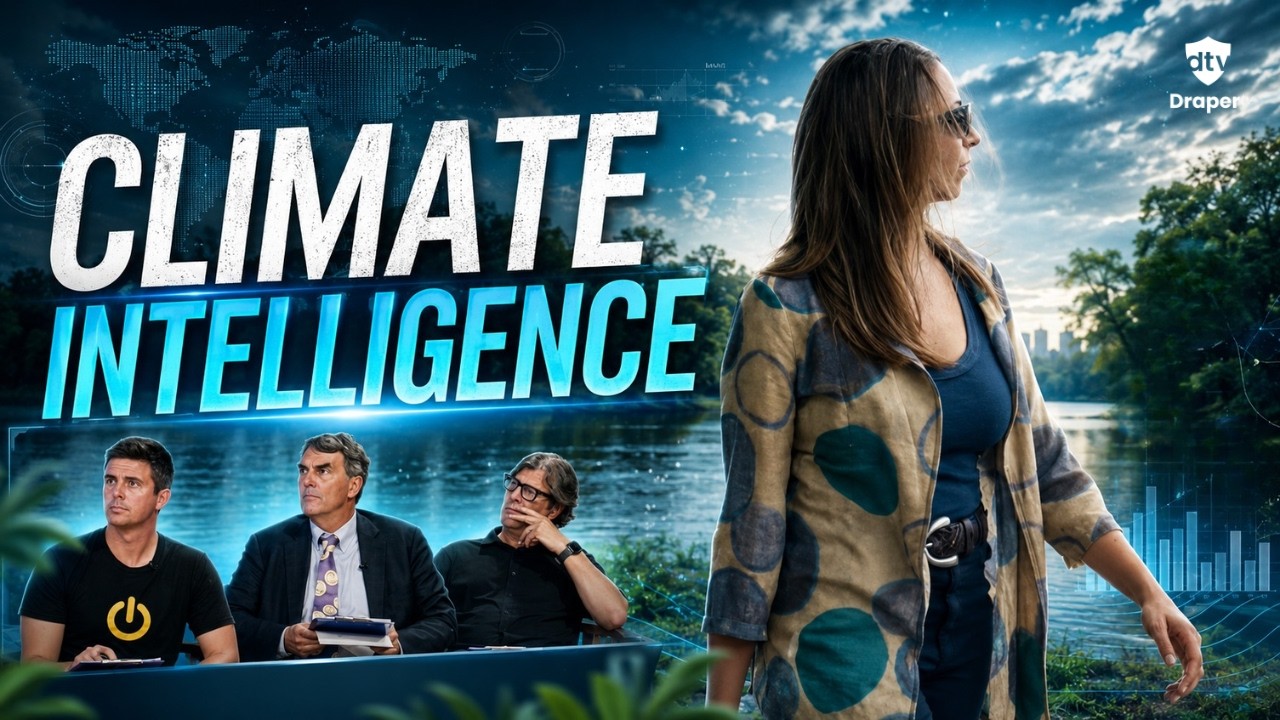
Julia, CEO of Nunatak Biotech, harvests microbes from Antarctica to fix degraded soil. One-third of global agricultural land is degraded, and up to 50% of irrigated land has salinity problems. Her company decoded how native grasses survive harsh conditions and built a synthetic microbiome that boosted yields in saline soils within six months.
Chapters
I love nature. I believe it has superpowers. Life on Earth has billions of years of experience and adaptations. What if we could find the answers to our biggest challenges by learning from nature?
I am Julia, the CEO of Nunatak Biotech. Nunatak is a mountain surrounded by ice. There are a lot of Nunataks around the world, but there is one Nunatak in Carlini Antarctic Island where our team spent 20 years doing science there. We are developing microbial solutions for soil and plant health inspired by in nature from Antarctica and other extreme places. When I was studying international relations, I realized that I wanted to address environmental challenges, and I thought that institutions or global international— yeah, international organizations was the way to do that. And with time, I realized that it was not enough. You need another type of organization such as startups, VCs, like, I mean, the ecosystem is huge. But then I realized that to solve the problems that I want to solve, I need science, technology, and business money investment. So I put all my efforts to start working with companies, leading tech teams, and then I changed my career and I become an entrepreneur because I want it. And what I found beautiful being an entrepreneur is like you have liberty, like you have freedom to act. to do, to make choices. Maybe you have mistakes, but then you can, I don't know, okay, you keep going. And then I think that this journey is like, it helps you to develop as a person, but also as a professional solving something that is complex with others. I don't need a title to do something. Like, oh, it's what I believe. So I want to put like nature in the center of the scene, not me. I mean, I am just a vehicle to be as a CEO, but in my case at Nunatak, microbes are the, I don't know, the main actors or the main, yeah. Some weeks ago I was in a summit where they put the question is, what if the global leaders of today were friends 20 years ago? Like how the world looks like. So like, and I found that question beautiful because when I see other entrepreneurs that are doing cool things and I'm friend of them and all of us us, we are building great things. I think that we are shaping the world in the way we want.
We are in Lago Regatas in Palermo. I love the water.
It's a calm place. Of being here, it's like just Have a walk to the lake. Actually, it's very humid in Buenos Aires, so that's why we have so many trees and plants. I work for nature, actually. Like, my startup is related to nature, so I have to be in contact with nature to be inspired. You have a lot of trees and huge trees. You can find different types and, yeah, spend some time like in nature in the middle of this huge city.
I was nervous, but at the same time confident. I believe what we are building and, and I use this experience to learn. I love nature. I believe it has superpowers. Life on Earth has billions of years of experience and adaptations. What if we could find the answers to our biggest challenges by learning from nature? Well, this is Nunatak. We are building the extreme bioinput powerhouse inspired by resilient nature from Antarctica. The first problem that we are addressing is soil degradation. 1/3 of agricultural land is degraded, and up to 50% of irrigated land is salt-affected and growing. Current solutions are limited because they are not addressing microbiome complexity. That's why comes Nunatak. With 20 years of scientific experience in Antarctica, we decode how this grass could survive in very harsh conditions because of the help of its microbiome. We are building a symbiosis platform focusing on the plant-soil microbiome interactions. In only 6 months, we launched our first product, a biofertilizer that increases yield performance and helps plants to establish better in salinity conditions. We got extraordinary results, and diverse companies will be testing this product this year. But this is just the beginning. Nunatak has built a unique bank of extremophiles, transforming microbes into business with speed to market. We are enhancing current portfolio companies with building microbial teams, enhancing the best functionalities, pushing the limits to reach our visions, create synthetic microbiomes that will create a new paradigm in soil and plant health.
So who pays? Is the farmer buying this?
No, but in our case—
Is it carbon credits?
We are charging fertilizer, chemicals, and biological companies with royalty fees and with royalties.
Adam has come up with this concept of funding the rebels. You seem to be working with the empire. Basically just licensing it out to the empire, you're not challenging them.
Yeah.
I'm concerned that if it's a licensed product, that over time the importance of it will go down relative to whatever the empire invents.
Next time I'm going to explain in another way, and I use this experience to learn. We want to achieve this goal of build synthetic microbiomes at the same time making money, monetizing the whole— the different bioinputs that we can produce.
What's the grand vision?
It's put nature in the center of the scene. If we understand how microbes and the microbiome functions, we can really, like, restore the soils. But the focus is learn from resilience in nature. And I think that is a very powerful thing.