Canton Network: Wall Street's $100 Trillion Blockchain Move | Crypto Megan Podcast
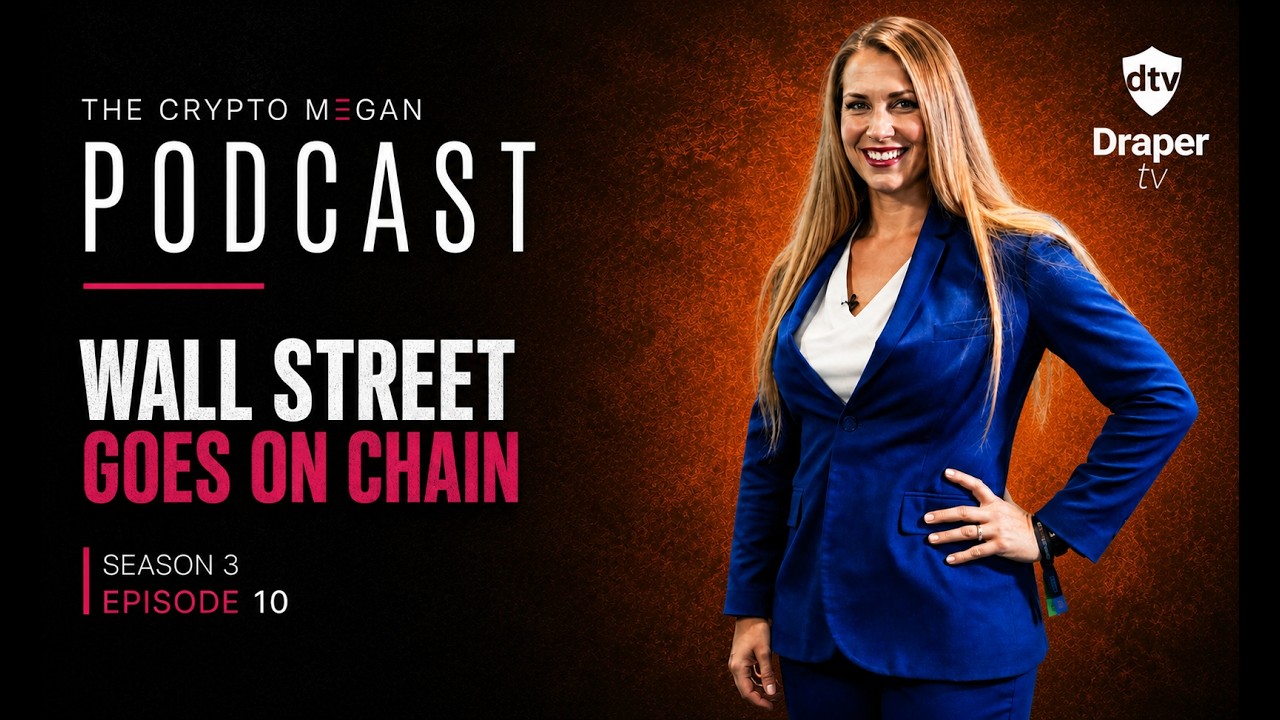
Kelly Matheson from Digital Asset explains why the DTCC, which safeguards over $100 trillion in securities, chose Canton Network to tokenize assets like Treasuries and equities. The system enables 24/7 trading and instant settlement. A July 2026 test with Virtu, Franklin Templeton, and Tradeweb proved it works.
Chapters
My name is Megan Nielsen, aka Crypto Megan, coming to you from the Crypto Megan podcast on Tim Draper's Draper TV. And today we have a very special guest with us today, Kelly Matheson, who is the Chief Business Development Officer at Digital Asset, the creators of Canton Network. And we have some very important news to dig into today regarding the DTCC and their announcement of what's happening with Canton. It is really, really exciting. And Kelly, it's great to have you on the show today.
It is wonderful to be here, wonderful to talk about this topic. I'm very excited, and thank you so much for having me.
Yeah, so first off, I mean, before we dig into this news and why it's so significant, I mean, the DTCC is the backbone for US security settlement. It's absolutely massive. Maybe we can get a bit of a background as to what Canton actually is.
Sure. So Digital Asset, we are the creators of the DAML smart contract language, and as you've asked, the Canton public layer 1 blockchain. And so that is the way to think of us. But I might say it since I come more from the financial services side of the world, the way I describe it is that Canton is the infrastructure that's being used to support the new digital capital markets and more broadly digital financial services ecosystem. It is the technology that's being leveraged that supports interoperability, the ability to compose products and services across applications, and to importantly maintain the privacy that's critical for financial services transactions. So layer 1 public blockchain, but one that is very oriented towards systemically important market infrastructures like the DTCC that we'll talk about in a few minutes.
Right, absolutely. And that privacy element that you mentioned is crucial and critical. It's actually at the forefront of the conversation now as all assets are being tokenized, right? Like Larry Fink, the CEO of BlackRock, said, You know, this is a very important milestone and pivotal point in the industry, and really, really exciting news to hear. The DTCC, just for some stats for those who are listening, safeguards more than $100 trillion in securities and processes around $4.7 quadrillion in security transactions annually, I believe, from the past year. It's the backbone of settlements for US stocks, bonds, and ETFs. So we're going to dig into the news now about the fact that we are now seeing this important inflection point actually happen, and that is the rollout of its tokenization service, as well as, you know, choosing Canton to be one of those blockchains where the settlements happen. Explain to us a little bit about the announcement and the significance of this.
Yeah, maybe I'll start a little bit by just adding on to one of the points that you've said. In being that large of a market, that $100 trillion market, also the place in the world where the highest amount of high-quality liquid assets are available. It's $100 trillion in high-quality liquid assets that are part of the global asset landscape. And what that means is US Treasuries, US equities, ETFs really in demand for use across the capital markets and more broadly financial services ecosystem to use those securities in purchase and sale transactions, as margin in different hedging and investing and trading transactions, as collateral and repo and financing transactions. They are just the most in-demand forms of assets. And notwithstanding that, the high amount of demand, they are not fully accessible on a global and 24/7 market model. That is just true of all of the TradFi financial markets around the globe, but it is most acute in the US market because you marry it up against that demand. So what is significant about this is what What DTCC is doing using Canton is to offer a service to all of its members, the thousands of banks and broker-dealers and global custodians that are members of DTCC, to offer those services so that when those assets are being held for themselves or on behalf of their clients, you can have them in the TradFi form off-chain, or you can now convert them to hold those assets on-chain in the Canton ecosystem. And that enables them— why is that significant? And we can go into this a little bit more. That enables those assets to now be used in real-time purchase and sale or financing transactions, to be used in more of a 24/7 market model, and for them to not only transfer but to settle with immediately. And so to really have a much more Much greater asset utility and an ability for those transactions to be happening with far less risk from a settlement perspective. So it's really, you know, it's as monumental as you're suggesting. It's a real watershed moment for the financial markets and capital markets systems.
Absolutely. It's very exciting for us to hear from the blockchain industry as we see, you know, Wall Street sort of adopting this technology. You know, DTCC has been the backbone, like I said, of traditional finance for decades. What do you think changed that convinced an institution Yeah, it's a good question.
You know, I think there's been a lot of POCs and there have been a lot of test transactions that have quite necessarily given the confidence for organizations like a DTCC and its many market participants to get into building something that's actually for production. But I think that there were probably 3 main reasons for why this occurred now. Like, why did this become that moment in time where they were able to embrace the idea of doing something doing it for production? Well, first, um, there was market demand. You know, the, the crypto markets had advanced, the increasing demand just even in the TradFi markets for getting those assets and getting that asset utility where I can be able to get access to more of my assets to be able to use around the globe. The demand was increasing, was clear, and was well communicated by the market participants to the, the leadership at DTCC. So they had a really good reason. They knew they were going to have their clients as partners to be able to do it. The second thing is that they had the regulatory support. You might have read about the SEC no-action letter that was granted to DTCC.
Yes.
Big moment, right, to be able to have had the market model that DTCC is envisioning discussed with the SEC and supported by a no-action letter. That gives regulatory and to some degree legal structure confidence not only to DTCC but to the market participants who are going to be acting in that ecosystem. And then I think ultimately the third thing is that DTCC had been an early investor in DA and sort of had the opportunity to see how this technology had grown over the course of a decade or more. And so they had a high degree of confidence in the technical readiness at this point to be able to support something that's the size and scale of the largest market around the globe. So it was those 3 things coming together at this right time.
Yeah, it's the perfect storm. And you've also got the backings of—
Or whatever is a positive way of saying a perfect storm, right? I know, right?
The perfect storm in the most positive way possible.
In the most positive way possible, yeah.
The perfect mix of elements to come together, shall we say, and the backings of major financial institutions like BlackRock, like Franklin Templeton. I just did an interview with Jenny Johnson, the CEO of Franklin Templeton. And it's just astounding to hear where we're at now. It felt so far away just a few years ago.
Yeah, and Franklin and Virtu had done actually a trade even before July 15th. They did— Virtu Financial and Franklin Templeton did a trade, US Treasuries, as an iBENJI activity that occurred I think even just a couple of weeks before July. So there's a lot of this going on, not only by DTCC but by the market participants as they get ready for it.
Right. And there was a lot of anticipation leading to this moment and people wondering what blockchains they may choose for this. So why Canton? Speak to us a little bit about that choice.
You know, it's an interesting thing. You made a really good point early on when you were asking the question and underscoring the point about privacy. It's sort of curious to me that, you know, because I grew up on the TradFi side of the organization, spent 30 years at JPMorgan before coming to— nearly 30 years at JPMorgan before coming to DA. And, you know, when I think about the financial markets, you probably see this across your podcast, you think of financial markets as being— having their safeness, soundness, and stability by the notion that my transactions are known to only me and the parties I choose to hire to support them, that there's a level of not transparency, that there's a level of privacy. And I know that I am— my trading decisions, my hedging decisions, my financing decisions, my investing decisions are known only to me and those parties that I choose to share them with. And so to me, the financial markets have their safety and soundness, their stability, their reliability because people know that you can't be traded against by a nefarious party, or you can't—
Right.
I won't disclose my weaknesses from a financing perspective or where I am under stress from a market perspective, right? I have those pieces of information known to me and my party. So the notion in the crypto market that transparency makes something safer or more ability to scale and grow is a little bit weird to me because I, I'm not going to give that information to people who can trade against me or move the market against me or front-run my clients. I'm relying on that privacy. And so I think that, that Canton was the first, um, and arguably, uh, the strongest ledger to, to be created that not only gave that same public sense, that ability to reach a broader set of clients, to have the distribution opportunities of a public network while preserving that safety and soundness of, but only my transactions are only known to me and the parties I choose to hire to support them or my counterparties. I'm keeping that right to know to be aligned to the way the transaction has been done legally and contractually. And I think it's the marriage of those 2 things that made it be the network that financial market participants could relate to and could rely on to be able to grow a digital business.
That makes a lot of sense, especially because privacy is associated in the crypto world with secrecy. And it's actually not like that. It's a fundamental right that people need and want in the traditional financial world. And it should make— it should not be any different with blockchain, right? You can disclose things as needed, but that is not to be mistaken for privacy, which should be a right on-chain as well. And really, it's not scalable without it.
And I think what you've said is exactly the case. So I'm going to give you credit from it after today. You've hit on that point exactly. that it's in the TradFi markets right now, you have privacy almost as a necessity of the separate duplicative operating systems that support the activity. You get privacy, but you get it as a consequence of everything being separate and siloed. When you shift to a market model that leverages Canton and that technology, you want to be able to have the option. So it might be that I have a legitimate business that is going to be more publicly disclosed and the transactions be known, but at least now I have the choice. And I think many of the early layer 1s that came out, other blockchain solutions, just didn't give that choice. It overrode that choice. And so you go from separate and siloed to everything is known to everyone. Well, but that's just not practical when you're thinking about massive global financial markets and the safety and soundness of them.
Right. No, absolutely. And it makes a lot of sense. And it's very, I think, impactful for the crypto world to see this being put into practice. In these massive markets.
Yeah. And if you want to run a business that, that is, is more transparent than others, go right ahead and do that. You have the ability to be able to do that. But the important thing now is that you've put that as a choice to the application and the service provider rather than to the infrastructure entity or the technology that's supporting it, which actually doesn't even have a role in the transaction. So it shouldn't have that right. Now it's more properly aligned. to the application provider, in this case DTCC and its market participants who chose to have those transactions supported by the regulatory environment in the US.
Right. Now, very interesting indeed. And so if tokenized treasuries are successful, what asset classes do you think come next? Will it be stocks, corporate bonds, money market funds? Just how big is this?
Yeah, you know, it's interesting. When we started this, and it was only just, it wasn't even a year ago. The fact that this has moved so quickly is, I think, a real testament to the market participants, DTCC, and the demand. But when we first started this, we thought that the first use case would be US Treasuries, and you're quite right to point out that it is. But over the course of the last several months, as we were working with DTCC to enable this solution, the market demand for equities became very real and very very passionate, to be, to be honest with you, very vibrant.
Yes.
So, um, I think that's why it's meaningful that the July test not only included U.S. Treasuries but included a handful of U.S. equities and U.S. ETFs as well. And the launch in October will now not— it will now not only include all U.S. Treasuries, so you'll be able to use any of them, but I think the goal is to get to the Russell 1000 for equities and a broader range of ETFs. So Um, now is when it started to happen. I think that means in the US we still also have corporate bonds, agencies, munis, and there's also the private market as well. And I suspect that you'll start to see that come on-chain rather rapidly after October, but driven by transactions and market demand, as any good market activity should be.
Absolutely. Yeah, it's, uh, it's moving at the speed of lightning. I mean, so this, this, uh, launch now in July was sort of a test run leading up to the actual bigger launch in October.
That's right. So it was, it was a live production test. They were real transactions by real market participants doing real financing, real purchase and sale, real securities lending activity. But it was contained within a day. All of the transactions opened and closed within a few minutes, which is probably what is less real about that. I think that that will be unless orchestrated that way. Come October, it is just any market participant that is a member of DTCC and onboards to this new service, as you would any DTCC service, can, can just use it to conduct the transactions that they do. I think what's important too is that also means that there's sort of a bit of network ecosystem activity that's starting to happen because DTCC's application is bringing those assets into the ecosystem. Other apps such as stablecoin providers and tokenized deposit, tokenized money market fund— you mentioned Franklin Templeton earlier, BlackRock earlier— are bringing liquidity into the ecosystem. And then applications like Tradeweb, Temple, and Telos that were part of the July event are bringing their applications into the ecosystem to do something with those, those assets that are on-chain. So all of that creates— this is why it's so exciting— it creates like a real feel for secondary market activity on-chain. And that, that is just wonderful to see.
And this is just the tip of the iceberg here in July as we're coming into October. All expectations and excitement of that is real. I had a question about the infrastructure. So could retail investors eventually benefit from this, or is this mainly strictly institutional?
No, you know, I actually think it's, it's, it's, it's both because the retail investors by and large go through an institutional, or I might say more generally an enterprise type of organization that is a member of DTCC and provides those services. I said a moment ago that most of the DTCC members are banks and broker-dealers and custodians. They're providing those services on behalf of other institutions or individuals who are making trading, hedging, and investing decisions. So in many cases, the retail investor is the client of the member of DTCC, And is getting to have the direct benefit of an on-chain asset that can move around 24/7, settle instantaneously, move seamlessly. I think we will very quickly not— and I do mean by October and then continuing after that— see the reshaping of products and services among those enterprise organizations to be able to make those assets available, not only to their underlying institutional clients like pension plans, trusts, endowments, foundations, but the individuals. who are also trading, investing, and hedging for their own accounts. So it's kind of— I know it's kind of like not the greatest answer to like sort of say it's all or both, but it really is. It really is about getting that ecosystem going of you go out to the providers of those services and they then roll those benefits on forward to the ultimate— I'll say the ultimate beneficial owner, which could be another institution or it could be an individual.
Right. Okay, and what then would you say— I have just a few more questions before we wrap this up— would be the biggest misconception people have when they hear Wall Street is putting securities on the blockchain?
Ah, the biggest misconception, um, I would think is that it, um, is, is sort of that it's perpetuating this notion of Wall Street providing some sort of gating, um, uh, function or, or providing a walled garden around it. I think that, you know, in fairness, every market participant that has worked with DTCC so far, and there's a large working group of 60 or 70 of their most active market participants that are working through them, are really genuinely trying to open up the financial ecosystem. So I think this notion that Wall Street is somehow gating this function, I think Wall Street is just the incumbent who happens to offer products and services for the trading, investing, hedging, as we've talked about, and now they're going to advance those services to be on-chain. But there's nothing about what DTCC is offering that doesn't make it available and possible for new entrants to become members and to be able to offer these assets to their clients and their products or services as well. In fact, I think one of the things that's been really nice about the initiative so far and DTCC having this working group is it's really opened it up to new market participants to become members of that working group and to consider becoming members of DTCC to be able to access it directly. Plus you see names like Telos and, and, and Temple Digital getting the opportunity to offer their product services out of the gate alongside an established incumbent like Tradeweb. So I, I really just think the misconception is that it's Wall Street only. I, I keep using the term capital markets and financial services, and I don't mean TradFi when I say that. I mean all fi.
All fi. I like that. I like that a lot. I think you're absolutely right about the perception from the blockchain industry that it's been gated and sort of closed, but coming from that perspective, it actually does sort of— it makes it understandable to see that actually this is opening up newer, greater possibilities.
I hope so. And frankly, you know, it's like anything, right? I think that we have a technology innovation here. It seems like you would have experienced it across your career as well. I don't even think we can fathom what the new products and services will be, right? It's— the technology is going to unlock and we're going to see market participants start to use it. And there'll be products and services, frankly, we aren't even contemplating right now.
Right. And the fact is that the technology is ready. It's now time to implement and put that out there into the world, revolutionize these traditional systems and sort of open them up to these new possibilities. And that being said, the final thought here is that we're calling it crypto and blockchain and referring to it as sort of a separate industry right now, but the thought is that within 5 to 10 years, this is all just going to be the underlying infrastructure like the internet.
I do really think, and I would suggest, is exactly the point you make. People should look at those organizations that are part of the July event and those that are becoming part of the October event and those that are part of initiatives in other high-quality liquid markets, other major markets around the globe. You see this blend, as you would of anything in financial services over the course of decades. of new entrants that can move nimble and quick and have access to the newer technology and can create new products and services with that technology, as well as established market players who have the depth of balance sheet and client relationships established who are embracing that technology and adding it on to the services. DTCC is a perfect example of that, probably the most established of central securities depositories around the globe embracing a technology and adding it on. So I think It, you know, I used all-fi a moment ago, which is how we say it at DA and Canton, but it really is this perfect Venn diagram that's starting to overlap more and more and more. Not crypto, not TradFi, but this new space of digital capital markets and digital financial services. Whatever you call it, it's where the activity will be.
It's been a very impactful interview indeed today as we went over the July launch for DTCC and Canton, and we're so, so excited. for the bigger launch in October here and just exactly what this technology is capable of. We can't wait to follow up with you again soon after that launch. And Kelly, thank you so much for all your insights today. It's been amazing. We hope to catch up with you again soon.
Thank you so much. I look forward to speaking again.
More from Tim


He Sold His Car to Build This Startup, Then Pitched It for $1M 😳 #Startups #AI

This Startup Moves Your Crypto BEFORE Hackers Can Steal It 😳 #Crypto #Cybersecurity




15 Months Without Refrigeration?! This Startup Thinks It Can Go Global 🥥 #FoodTech #Startups



