Capitalize Upon Your Strengths, Assorted Q&A Part 2 | AirBnB Founder Nate Blecharczyk
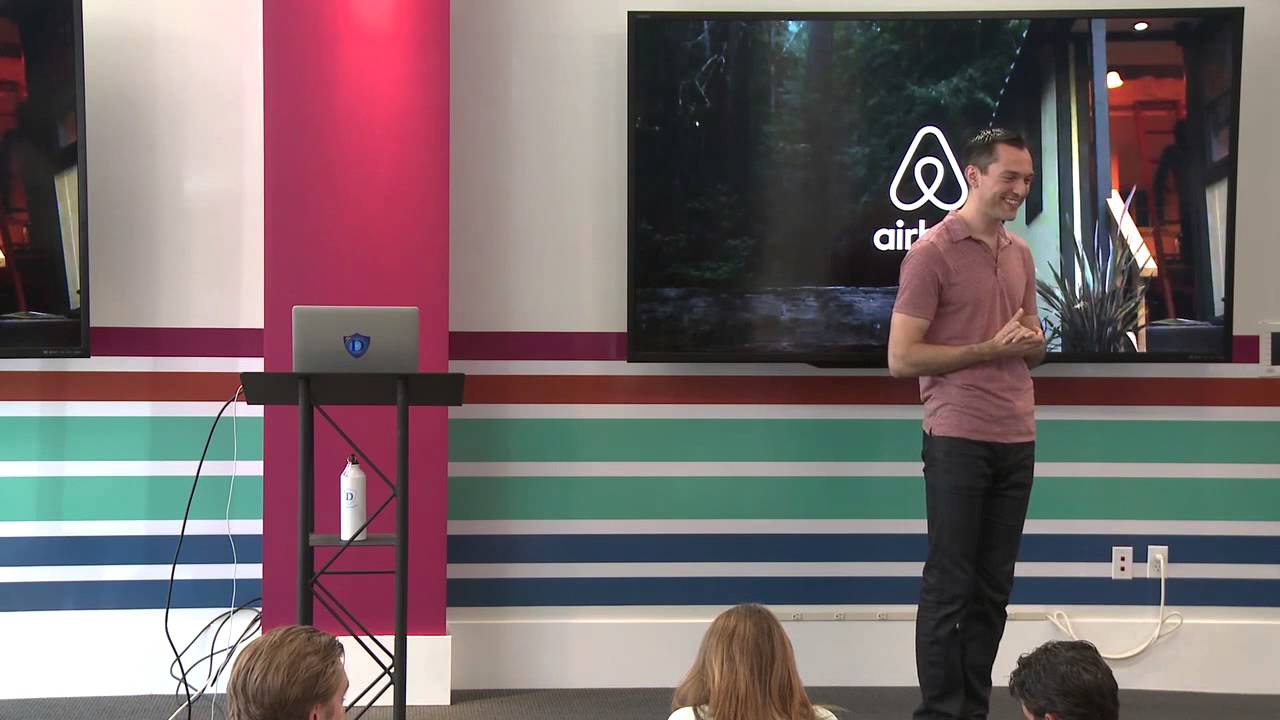
Airbnb co-founder Nate Blecharczyk answers questions about early founder finances, co-founder dynamics, the company's relationship with hotels and regulators, and international expansion. He discusses the mobile app's role in retention and Airbnb's five-year goals.
Chapters
Joe and Brian were paying for things off their credit cards and were actually accruing quite a lot of debt. So that was stressful. I heard a story that you had like an entire map full of credit cards. Joe had a binder like you would have for like baseball cards, you slide the baseball cards in. He had a binder like that for credit cards. And so he would just keep getting more credit cards and maxing them out. And so they each had about $15,000 in credit card debt. by the end of the first year. Not something I necessarily recommend, but that was their personal financial situation. And for me, I was doing a little bit of consulting here and there. I could do a little bit of work and get paid a fair amount of money, and so I would squeeze that in to kind of get by and make my finances work. So we each kind of found our own way. I want to follow up on the question. How many times do you want to kill your co-founders? Well, that's a strong word. But yeah, I mean, maybe that's— It's not good in China. Oh, is there something we need to talk about, guys? What about the co-founders? It's totally normal. It's totally normal. Listen, let me go into a little bit more detail about my relationship with Joe and Brian. Part of what makes our relationship work but also can create some stress is the fact that we come at things with very different perspectives. I mean, not only am I an engineer and they're designers, which is like 2 different sides of the brain working, but we're each very different. And we even did a personality study in the later years where they put your personality graphed on a circle, and each of our personalities was exactly 120 degrees apart from one another. So if you connect the dots, that creates an equilateral triangle, meaning there's— we couldn't have been more different without being more similar. And I had felt that for a long time, and yet we learned very early on that our differences in opinions and perspective actually made us stronger, meaning that if we took the time to work through those differences of opinion, we could arrive at a compromise that was the best of both worlds. Or the best of 3 worlds, and that we saw a pattern that when we took the time to do that, we landed in the best place. And so we respected that process, and it's something that still happens today. Like, I'll think it's obvious we should do one thing, someone else will think it's obvious we should do something else, and Brian will think a 3rd thing, and we'll spend a lot of time talking it through and eventually settling on what is that right compromise. So I think it's totally normal. Especially when you add all the stress of maybe not getting paid, going into debt, things like that. It's heavy stuff. Really appreciate you coming in to speak to us today. How are you handling the disruption in the hotel industry and as well as the legal issues you're having? So I think we are in some ways complementary to the hotel industry. So there are things that hotels are really good at that we'll never be as good at. And there are things that we are really good at that hotels will never be as good at. So for example, what we specialize in is providing you a local differentiated experience, connecting you with a person. Hotels can specialize in having a front desk that has 24/7 services. They have infrastructure pools. They have a certain level of consistency that we can never replicate. And so I think we should each play to our strengths. I think we're ultimately making the pie bigger. Of course, there is some overlap. But I think ultimately the pie is getting bigger, and I'm not aware of any hotels that have gone out of business as a result of Airbnb. And let me give you even a more specific example. We have found that 40% of all travel in the US is with friends and family. So these are people you visit, your friends, you stay at their place, you don't pay anything. Actually, it's one of the biggest single use cases for Airbnb. So socially, it's not particularly acceptable or sensible to make your in-laws stay downtown in a hotel. But if you could put them up in an Airbnb within walking distance of your home at a reasonable price, that might be a good trade-off. You have your space, but they're close, and we see a lot of that happening. And so we're monetizing a part of the market that was previously not monetized, and that us making the pie bigger. And your second question was about regulation?
Yeah.
So we're a very new idea, right? We went from not existing and people thinking this would never happen to 7 years later having gone mainstream, having 35 million guests. And so this has taken a lot of people by surprise. And there are a bunch of existing rules around providing accommodation or more specifically short-term rentals. These rules date back 30, 50 years ago. They were made never imagining that this kind of model was possible. And so although these rules exist and they affect us, they weren't made specifically to address us. And so that's the conversation we need to have, all parties as a society, is to realize that we're in the 21st century. There's now new technology, new ways of doing things. And what are the sensible policies to balance the benefit of this with any concerns? And so we try to reach out to cities as proactively as possible, explain who we are, what are the benefits, also listen to them about what are the concerns, and come up with new policies. Of course, that's easier said than done. And the reality is when you're just starting out that no one wants to take your meeting because you're not important enough. And then by the time they want to take your meeting, it's only because you're so big enough that they're now afraid and they feel that they need to take action. So it's a tough needle to thread. But we have now in 7 different cities and countries passed new home-sharing policies. And for example, UK, France, Portugal have all passed national laws. Cities like Amsterdam, San Francisco, Portland, Nashville, San Jose, have all passed city laws, and we expect many more to come.
Great.
2 more questions. In 5 years' time, what does Airbnb look like? Good question. Yeah, there's a lot of things that we're working on. I think maybe thinking really long term, say 5 years from now, we're thinking about the entire trip experience. So every one of our customers, every one of our guests, They're using Airbnb for accommodation, but we know they're on a trip. We know there's other things they're doing, and we think we're in a good position to provide value during the rest of their trip by leveraging some of our unfair advantages or things that we uniquely have, things like our host community. How can we use our host community to make people's trips better, whether that's connecting them with local knowledge, local insight? How can we use our scale, all these hosts and all these travelers we have on any given night in a city, how can we use that to create special memorable experiences for guests? We think if we're successful, this could be just as innovative and new as our original idea. So just like we created a whole new class of accommodation that didn't exist before, we think it might be possible to create a whole new class of trip experience that doesn't exist today that you can't buy. So that's our kind of 5-year aspiration. All right, last one.
Thank you. I love Airbnb. I've lived in really random treehouses and on top of volcanoes because of you guys.
So that's awesome. Right on.
So my question is more towards your mobile transition. So from a web service to a mobile app, because it's not something that's People would use every day, but then— so how did that transition work? What were some of the things that helped, didn't help? And if you could speak towards mobile growth and where you guys are going with that.
So just tell me more about that. Sure. Well, one challenge you mentioned is not specific to mobile, which is the nature of travel is it's not something people do every single day. And it's very different than say a business like YouTube or Facebook where people, once they get hooked, they come back faster and faster and you can really take off overnight. And that's just not true of travel. People only take a few trips a year. And so when you think about our app, what's a realistic expectation for how often people are going to open it? I mean, the important thing is that when they travel, they think to open the app. Now, in terms of the migration from web to mobile, mobile actually uniquely enables our business in some ways, particularly on the host side, for example. It allows our hosts to respond faster. And when hosts respond faster, that makes the experience better for all of our guests, whether they're on mobile or not. So it actually makes the marketplace much more efficient. And our hosts are power users. They are actually using the website or the app almost every single day. And so it's been very easy to get a large percentage of them onto mobile. And on the guest side, similarly, when you're traveling and you need access to your Airbnb information, you don't want to run home to the computer. Or your laptop, you want to be able to pull it out of your pocket. And it's amazing that increasingly when you travel abroad, you can get data roaming at more affordable rates, and I expect that trend to continue. So I think the importance of mobile and travel is really going to increase as the cost of data goes down.
Is there anything in particular that you guys do to create that stickiness in mobile? Because I have your app, and I don't travel every day, but I still have it. I don't delete it even though I don't— And then at times I would just browse through it to see what other industry coffee shops are nearby, kind of thing. So is there anything in particular from a design or experience perspective you guys looked at specifically to do that?
Well, one thing that we spent a lot of time thinking about is how to get people to sign up on the mobile app. Because you're not required to, and a lot of people— we would drive them to the mobile app, and If they don't sign up though, we have no hook into them. We have no way of following up a year later. And so we've thought a lot about how can we incentivize, increase the conversion on mobile for signups. That's one thing we've thought about specifically. There's a whole bunch of considerations depending on the specifics of your market though. For example, right now in places like India, people's phones don't necessarily have a lot of space. space on them. And so if your app is really big, people are more likely to delete it to make room for other apps. And so that's not something I was really thinking about from my US-centric perspective. But as we focus more on different countries, you go there and you learn about these kind of unique issues. So there's a lot to consider. There's a lot to consider.
Great.
So I want to close up by asking one question. This is probably for you. So 60% of our loans are international. And many of them are actually watching you from livestream. So a common question we have from our international alums is, for instance, as Airbnb goes international, what are some of the challenges you've encountered and some of the lessons learned? Yeah, really good question. So actually only 1/3 of our business is in the US at this point. Europe is over half of our business and Asia is Asia is our fastest growing region. And in the early days I wondered would our business ever work even outside of New York? And then it was like will it work outside of the U.S.? And then it was like will it work in Asia? And what about China? And I've been amazed to see that the answer is yes to all these. And it's indeed some of our fastest growing regions and the majority of our business. Now what have we had to do to do that? Well, one is we did have this global cross-pollination early on, so that's a bit of an unfair advantage. Other things though was certainly localization, so translation, acceptance of local payments, the ability to pay out hosts in their own currency. In Asia, we've had to take extra steps. So in like China specifically, integrating with local app stores, they have different app stores. stores in China, they have different payment mechanisms, different social networks. These are all things that we integrate with in the U.S. And in other countries they have different default providers that if you want to be as good a user experience and as relevant you need to do that extra work. And it's a lot of extra work. And frankly technology probably solves a lot of these problems that weren't easily solvable 10 years ago. Yeah, there are frameworks for how to scale your website internationally. And if you think you're going to go international, which I encourage you to do if it makes sense, the earlier you put those frameworks into place, the better. Because it is pretty hard to outfit your website such that it can be translated in a scalable means. So if you can get that in there early on and build it right from the beginning, that transition is going to be more smooth. than if you try to do that 3 years in. I mean, you might be forced to make a whole separate website at that point, which might not be the ideal thing.
More from Tim


He Sold His Car to Build This Startup, Then Pitched It for $1M 😳 #Startups #AI

This Startup Moves Your Crypto BEFORE Hackers Can Steal It 😳 #Crypto #Cybersecurity




15 Months Without Refrigeration?! This Startup Thinks It Can Go Global 🥥 #FoodTech #Startups



