Charles Hoskinson: The $10 Trillion Bitcoin DeFi Opportunity
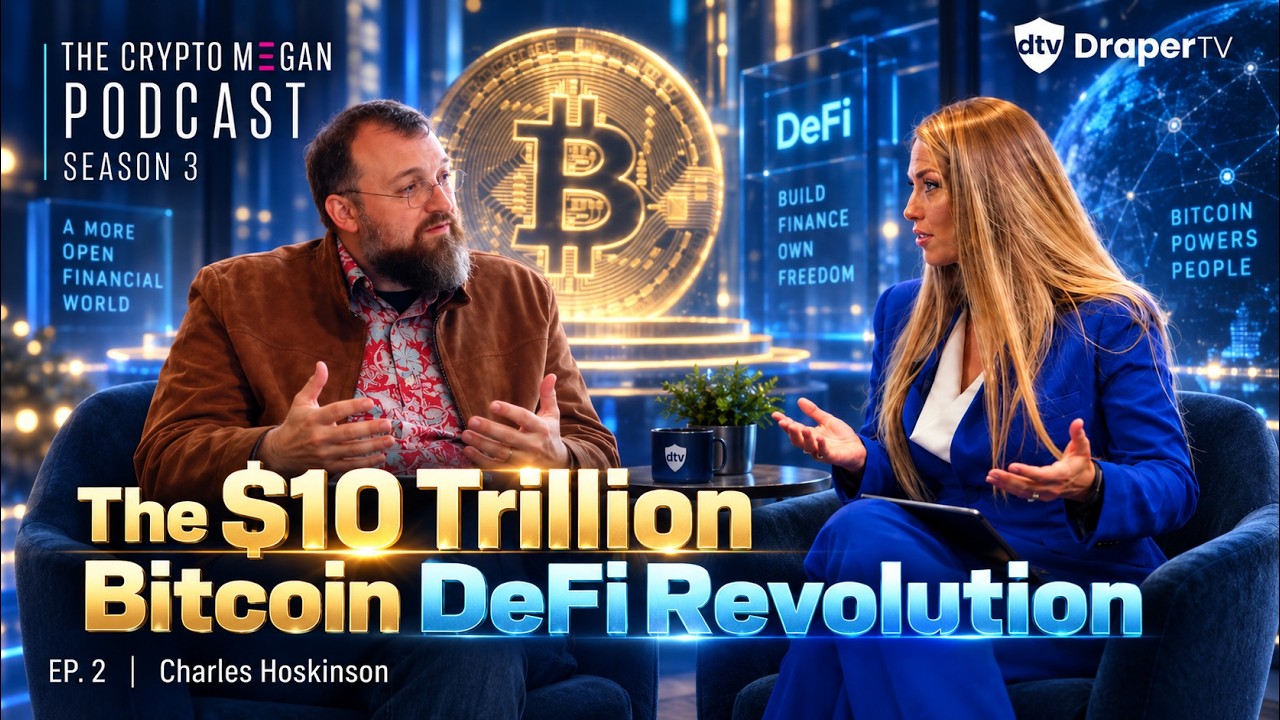
Charles Hoskinson estimates Bitcoin DeFi could reach $10 trillion, four times Solana and Ethereum combined. The Taproot upgrade and BitVMs now let Bitcoin support programmable finance. He proposes three rules: only Bitcoin used, fees in Bitcoin, yields in Bitcoin.
Chapters
It's a multi-trillion-dollar opportunity. Actually, it's 4 times larger than the market cap of Solana and Ethereum combined. So it just gives people a sense of how gargantuan it will be. And Bitcoin at this juncture, especially with the bull market coming, has almost unlimited liquidity. Not the beginning, but it's been the midpoint of a very long conversation about how does Bitcoin achieve programmability. And it's been like the holy grail for a lot of us in the cryptocurrency space who kind of grew up with Bitcoin. Because back in the day, we all tried our hand at somehow making it better. So they're like a lot of the Ethereum people. We started with projects like Colorcoins and Mastercoin. I was on the BitShares side. But the basic idea was, could you create overlay protocols or companion protocols where you would have some degree of programmability so you can issue assets, you can have smart contracts, but nobody quite had the courage on the Bitcoin side for a very long time to try to actually pull some ability into Bitcoin for programmability until the Taproot revolution went live right around 2021. And then it took a little while for people to figure out a development model for it. And then we started seeing this concept of BitVMs, you know, Bitcoin virtual machines. And the first generation was kind of a toy, but now we're in BitVM 2, BitVMX, and now we're starting to get to a point where Bitcoin has a brain so it actually can talk to other systems. You can actually program enough to have interoperability.
Which is huge.
Massive.
Massive. And you say a lot of people didn't have the courage. Why was that? Because it's such a monumental undertaking or because the Bitcoin system is so unique and the people within it. Talk to us a little bit about that.
Well, one part philosophical. Once you have achieved the original goals of the project, then what you don't want to do is start going off in mission creep directions. So if your goal is to create digital gold and a decentralized store of value, the minute you add programmability, you exponentially increase the complexity and difficulty of the system. And then suddenly everything's up for grabs, like changing the consensus algorithm or the block time or the governance structure. And there was no clear way without a founder around or some centralized organizing authority to be able to manage that, 'cause it's so complicated and there's so much movement with it. Second, there were security and technological reasons. So when you look at the security side of these things, the last time they actually tried to change Bitcoin's script to make it more expressive, it led to an inflation bug that for a period of time created billions of fake Bitcoin. So it was a very bad time, I believe it was around 2010.
Right.
So they tried it once before and it scared the hell out of everybody. And a corollary to that is the big block debate in 2015, where there was a conversation of, should we start changing the protocol to accommodate more use and utility, or should we keep most of these things to live outside of the ecosystem, the layer 2 space or the sidechain space? And the small blockers won, so it stayed in the sidechain side of the space. And the third thing is, it's a bit philosophical, cultural, I'd say.
Right.
The Bixcoin maximalism has always been very resistant to DeFi in general, and it took them a little while to start getting comfortable with it. And I think a lot of that was just they didn't see a way to do that with values and safety. I often like to say there are 3 rules in Bitcoin. You can never violate them if you want to be successful in the Bitcoin space. So rule number one is there is only Bitcoin. So in other words, you have to use the security of the Bitcoin network and you can't really talk about other systems. You just talk about Bitcoin. Rule number 2, you pay transaction fees in Bitcoin. You can't have another token. And rule number 3, you get your yield back or your return So unless and until you're able to present that experience, you're kind of dead in the water philosophically, culturally, and technologically. And it's only been recently where Bitcoin DeFi has evolved to that point where we now can actually entertain those 3 rules.
Yeah. And it feels just so incredible that Bitcoin has sort of gone from just this store of value, like you said, the digital gold, to now we have this whole ecosystem opening up through such a monumental thing as bringing DeFi to Bitcoin that we never would have thought possible. before. So you guys did a presentation on that earlier. You walked us through how that's going to be possible, Cardano's involvement in all of this. And I would love to hear from you how that went, what you're doing, and just how big of an opportunity this is.
So it's, it's the ecosystem that really needs this. And what we do is we look at it like a stack. And so the first layer of the stack is the infrastructure. So that's how does Bitcoin go about talking to other systems and And what trade-off profile are you prepared to accept for that to happen? So the settlement time, how long does it take to go in and out of the system? Is it minutes? Is it hours? Is it days? The security, so are you solely relying on the security of the Bitcoin network and proof of work, or is it some form of hybrid model where you're using other networks or some exotic thing like exotic crypto, like multi-party computation or trusted hardware? And the cost, and so every one of these transactions, are they $1? Are they $10? Are they $100 of value? 'Cause it's not really practical if every time you wanna do this, it's $5,000 a transaction. So what's happened is that we have seen a dramatic improvement in all 3 of those categories. We've seen a reduction in the latency, we've seen an improvement in the security model, and we've seen actually a mass reduction in the transaction fees. And we're getting to that point where the trade-off profile is reaching a point where consumers are gonna come in. Second layer of the stack is the user interface, and so the wallets have to be ridiculously simple. And you always have to remember those 3 rules: there's only Bitcoin, you pay fees, Bitcoin and you get yield in Bitcoin. So what we did is we tried to pull an Apple with the iPod with the wheel. We said, you know what, we're going to do the toggle. So a little toggle switch.
Nice.
You have your Bitcoin and you have a switch and you push the switch and it says DeFi mode. And there you go, you're in Bitcoin DeFi mode and no mention of another network, no mention of other things. And we found a way so that all your transactions, you can pay your fees in Bitcoin and all your returns you can get back in Bitcoin. And then the third part is, well, what can you do with it? Where does the yield come from? Can you lend it? Can you stake it? Can you buy things with it? Can you trade it on DEXs? So you need a DeFi ecosystem for this that's multi-chain.
Right.
And all 3 of these will grow in parallel. So the event that we had was really an event about bringing an ecosystem of partners together, and they live in all different parts of the stack. So some of the people that came up from Argentina, like Fairgate, for example, and others like BitcoinOS and the Sundial team. These people were really worried about the infrastructure side and how do we make that better, faster, cheaper. Then the wallet side, we had the Lace Wallet demo, the toggle switch, and kind of show that as an archetype that can then be ported to other larger wallets like Bitcoin.com or Blockchain.com, which have 110 million users.
Wow.
And then when you look at the ecosystem side, a lot of Cardano dApps were present, but then we also talked about the development You know, what we like is that all those magical languages that we came up with and development experience we came up for Cardano, which is a UTXO system, which is the closest you can get to Bitcoin, can we use those tools on Bitcoin itself? So is there a path where a Cardano programming language can be used to write Bitcoin script? Is there a path where Cardano off-chain hosts like Maestro or Blockfrost can also be used to build a dApp that's on Bitcoin? And so we showcased that as well, and we kind of demoed a lot of the different things. So it's the middle part of the conversation. It's not concluded, but certainly a lot of great progress has been made, and some of the things have already been running on Bitcoin mainnet. So we had demonstrated transaction between Bitcoin mainnet and Cardano mainnet where an Ordinal was able to move back and forth, which is a huge leap forward. It really proves not only the concept, but it proves it at scale.
That is huge. And I'm listening to a couple of things here. The toggle, that to me reminds me of sort of the Steve Jobsian moment of making things easy, like the click of the button and you're in. And that's what it kind of like impacted me when you said that, because that's how we're going to make it easy to the masses and how we're going to make it seamless and accessible. And, and the way that you described Cardano being the closest to Bitcoin, I think a lot of people don't actually know that. And so what is it about it that's so similar to Bitcoin?
Well, what we did is we just took a lot of the really, really good ideas that came from the Bitcoin space and we just extended and improved them. And so, for example, the UTXO model we created It extended UTXO. So we added full programmability to it, but it has the same accounting model that Bitcoin has under the hood. So if you're a Bitcoin developer, you'll instantly get how Cardano manages it. Just has all the things you always wish that Bitcoin had.
Right.
And then when you look at consensus, we modeled our consensus after proof of work, but we found a proof of stake variant with it. And so the first step is that we wrote a paper back in 2015.
More from Tim


He Sold His Car to Build This Startup, Then Pitched It for $1M 😳 #Startups #AI

This Startup Moves Your Crypto BEFORE Hackers Can Steal It 😳 #Crypto #Cybersecurity




15 Months Without Refrigeration?! This Startup Thinks It Can Go Global 🥥 #FoodTech #Startups



